

Eight techniques do most of the work in one-to-one relationship therapy: emotion regulation, structured "I" statement scripts, cognitive reframing, behavioural experiments, boundary setting, self-soothing, reflective attachment work, and journalling homework. Each targets a different failure point in a relationship, and you do not need your partner in the room for any of them.
Use emotion regulation when you shut down or flood with anger mid-conversation. Reach for structured communication scripts when arguments repeat the same script every time. Cognitive reframing helps when you catastrophise your partner's intentions. Behavioural experiments test whether a feared outcome (asking for space, raising a complaint) actually happens. Boundary setting works when resentment has built from saying yes too often. Self-soothing calms the nervous system before you speak, not after. Reflective attachment work explains why certain triggers feel disproportionate. Journalling homework turns single insights into lasting habits.
- Emotion regulation: use before a difficult conversation, not during the aftermath.
- "I" statement scripts: use when the same argument keeps recurring.
- Cognitive reframing: use when you assume the worst about a partner's motives.
- Behavioural experiments: use to test a feared outcome in a low-stakes way.
- Boundary setting: use when resentment has quietly accumulated.
- Self-soothing: use before a difficult conversation, not during the aftermath.
- Journalling homework: use to track patterns between sessions.
Key Takeaways
Individual-focused techniques change relationship dynamics by altering your own responses, and consistent practice between sessions determines how quickly that change shows up — just like choosing popular couple pizza choices for the perfect date night can strengthen your connection through shared rituals.
| Point | Details |
|---|---|
| Start with regulation | Practise breathing resets daily, not just during conflict, so the skill holds under pressure. |
| Use scripts before instinct | Write "I" statements and boundary lines in advance rather than improvising them mid-argument. |
| Track patterns digitally | Use journalling and mood tracking between sessions to spot triggers you'd otherwise forget. |
| Escalate for safety issues | Contact emergency services or a crisis line immediately if abuse or acute risk is present. |
| Book accredited support | MySafeTherapy connects you with BACP, UKCP, or NCPS therapists across video, chat, and avatar formats. |
Further reading and platform resources
- Types of relationship therapy: your 2026 guide — a primer on therapy approaches and how they map to different relationship issues.
- Relationship therapy explained: proven methods for couples — a deeper look at the evidence behind commonly used methods.
- How Individual Therapy for Relationship Issues Works — external overview of CBT and attachment-based individual methods.
- Individual vs Couples Therapy: Attachment-Based Counselling — external guidance on sequencing individual and joint work.
This article is general information, not a substitute for advice from a qualified doctor. Consult a qualified healthcare professional about your own circumstances before acting on anything here.
Table of Contents
- Why do individual-focused couples therapy techniques actually work?
- Step-by-step exercises you can try this week
- Which online therapy formats suit each technique?
- How do you choose the right therapist for individual relationship work?
- When are individual techniques not enough?
- Getting started with therapist-supported individual work
Why do individual-focused couples therapy techniques actually work?
You change the relationship by changing your half of the pattern, not your partner's. That is the core mechanism behind every technique on this list, and it holds up even when only one person is in the room.
Relationships run on feedback loops: you withdraw, they pursue; they criticise, you defend. Individual therapy interrupts that loop from your end, and research on solo relationship work shows this ripple effect is real. Change one side of a loop consistently and the whole pattern tends to shift, because your partner is reacting to a new stimulus.
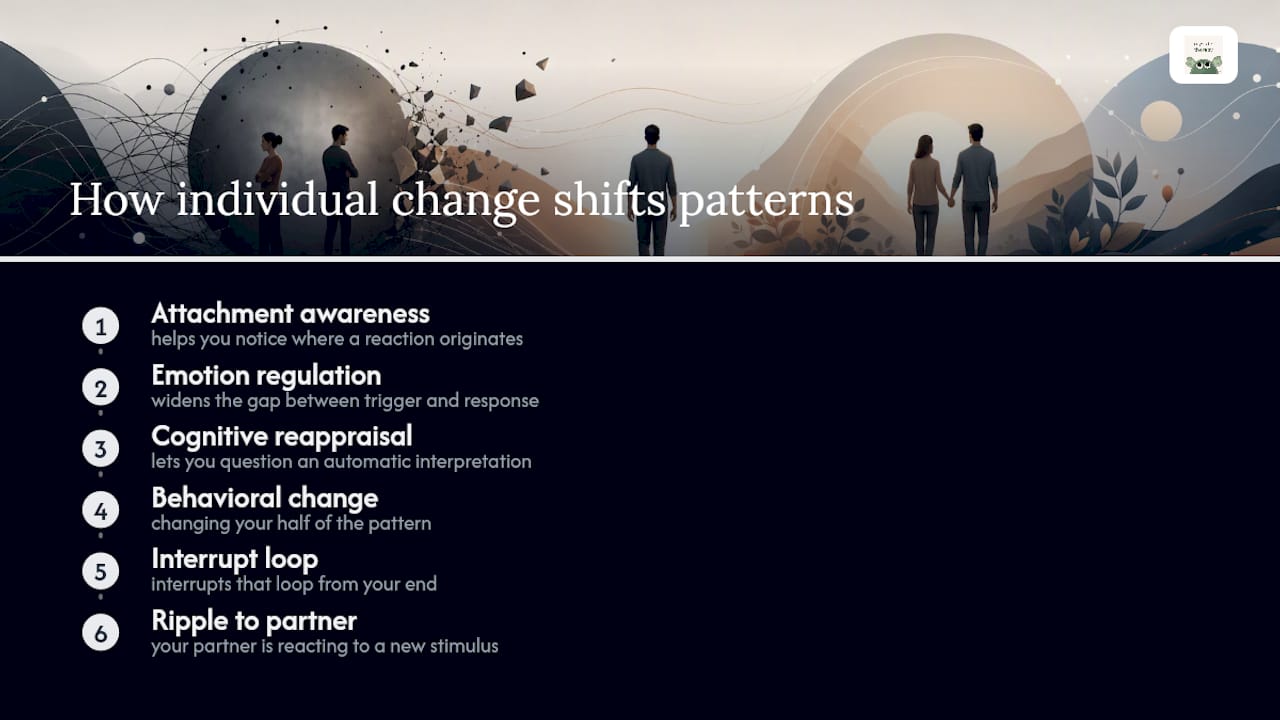
Three processes drive this. Attachment awareness helps you notice where a reaction originates, often earlier than the current relationship. Emotion regulation widens the gap between trigger and response, so you act rather than react. Cognitive reappraisal lets you question an automatic interpretation ("they don't care") before it hardens into certainty. Evidence-based individual approaches, including CBT and attachment-based methods, are built specifically around measuring this kind of behavioural shift over time. A therapist accredited by BACP, UKCP, or NCPS will typically frame your goals this way from session one: not "fix them", but "change your response".

Step-by-step exercises you can try this week
These exercises map directly onto the techniques above. Work through them in order, or pick the one that matches today's problem.
- Breathing reset for emotion regulation. Goal: lower physiological arousal before a hard conversation. Inhale for four counts, hold for four, exhale for six, repeat six times. Script for yourself: "I'm activated, not in danger. I can wait sixty seconds before I respond." Homework: practise this twice daily, not just in conflict, so it becomes automatic under pressure.
- The structured "I" statement. Goal: state a need without triggering defensiveness. Format: "When [specific behaviour], I feel [emotion], and what I need is [specific request]." Example: "When plans change without notice, I feel dismissed, and what I need is a text beforehand." Homework: write three versions before you say any of them aloud.
- Cognitive reframing worksheet. Goal: separate fact from interpretation. Write the situation, your automatic thought, the evidence for and against it, and one alternative explanation. Homework: complete this every time you notice a spiral of assumptions about your partner's intent.
- Behavioural experiment template. Goal: test a feared outcome directly. Predict what will happen, take a small action (raise a topic you usually avoid), then record what actually occurred versus your prediction. Homework: run one experiment weekly, starting with low-stakes requests.
- Boundary script. Goal: state a limit clearly, without over-explaining. Format: "I'm not able to [X]. I can [alternative]." Homework: rehearse the line out loud until it feels less rehearsed.
- Reflective journalling prompts. Goal: connect present-day triggers to attachment history, a process psychodynamic approaches treat as central to lasting change. Prompt: "What does this reaction remind me of from earlier in my life?" Homework: write for ten minutes after any conversation that felt disproportionately charged.
Pro Tip: Pace behavioural experiments deliberately. Confidence built on small wins carries you into the harder ones.
Which online therapy formats suit each technique?
Different formats suit different work. Video sessions work best for anything experiential, roleplaying an "I" statement script or rehearsing a boundary line with real-time feedback on tone and pacing. Chat-based therapy fits brief homework check-ins between sessions, quick accountability without booking a full slot. Avatar sessions reduce exposure when you're processing shame or embarrassment you're not ready to say aloud to a visible therapist.
Digital tools extend this beyond the session itself:
- Use AI journalling to log triggers and reactions daily, then bring patterns to your next session rather than relying on memory.
- Use mood tracking to spot correlations between your emotional baseline and relationship friction, which turns vague "I've been off lately" into concrete data.
- Schedule consistent weekly slots rather than ad hoc bookings, since regularity does more for skill-building than session length.
Check any platform's data handling before logging sensitive material, and keep detailed journalling on a device only you access.
How do you choose the right therapist for individual relationship work?
Three things matter most: recognised credentials, direct experience with individual relationship-focused work, and a working style that fits how you process things. A general practice therapist without relationship-specific experience will not necessarily know how to adapt couples-oriented techniques for solo use.
Ask these questions before booking, and again in your first session:
- Are you accredited with BACP, UKCP, or NCPS, and what is your specific experience with relationship-focused individual clients?
- What approach do you use for attachment or pattern work, and how do you typically assign homework between sessions?
- How do you handle confidentiality if my partner is mentioned or later wants to attend a joint session?
- What does a realistic timeline look like for the issue I'm bringing?
Watch for these red flags:
- A therapist who promises quick fixes or a fixed number of sessions to "resolve" a relationship.
- Vague or absent answers about safeguarding procedures when you mention conflict or distress.
- No clear explanation of how fees, cancellation policy, or session frequency work before you commit.
Compare formats and costs across a few therapists before deciding. Weekly sessions suit active pattern-breaking work; fortnightly suits maintenance once initial changes have stuck.
When are individual techniques not enough?
Three situations always require escalation beyond self-help or one-to-one talk therapy: any violence or abuse in the relationship, acute risk to yourself or another person, and a substance or mental health crisis that individual coaching-style work cannot safely contain. Skills like reframing or boundary scripts are not designed for those situations, and applying them there can be dangerous.
- If you're at immediate risk, contact emergency services or a crisis line without delay.
- If abuse is present, prioritise safety planning over communication techniques, and say so plainly to your therapist.
- If your partner needs to be involved, your therapist can guide how and when, rather than you managing that alone.
Online sessions carry standard confidentiality protections, but ask your therapist directly how notes are stored and who can access them.
Pro Tip: Keep a private, non-shared note of anything safety-related as it happens. It's easier to act clearly later with dates and specifics than to reconstruct events from memory under stress.
Why individual work counts as real relational change
Working alone on a relationship problem can feel like doing half the job. It isn't. Your responses are the only variable you fully control, and shifting them changes what your partner is responding to. That's not a consolation prize, it's a legitimate starting point, and sometimes the only one available when circumstances don't allow joint sessions. If your situation changes later, individual work and couples work aren't in competition; they build on each other.
Getting started with therapist-supported individual work
MySafeTherapy pairs you with UK-accredited therapists (registered with BACP, UKCP, or NCPS) for relationship-focused individual sessions, and lets you choose the format that actually suits how you process difficult material, video, chat, or avatar-based sessions if anonymity helps you speak more honestly.
Sessions run alongside AI journalling and mood tracking built into the platform, so the exercises above don't stay theoretical between appointments. Scheduling is flexible, including evenings and weekends, and pricing is stated upfront before you book anything. If shame or trust issues are part of what's driving the relationship strain, that's worth naming to your therapist early; it changes which techniques get prioritised first. When you're ready to start, you can book a session with an accredited therapist and begin working through this at your own pace.