

TL;DR:
- UK users in 2026 should consider Pixelfed, Glass, or Monnett for privacy-focused, ad-free social platforms. These alternatives offer chronological feeds and minimal data collection, contrasting with mainstream apps that rely on algorithms and advertising revenue.
Which Instagram alternatives should UK users consider in 2026?
The strongest Instagram alternatives for UK users in 2026 are Pixelfed, Glass, VSCO, Flickr, and BeReal—each offering meaningfully different privacy models, feed structures, and ad experiences. The right choice depends on whether you prioritise data control, creative community, or simply a feed that shows posts in the order they were made.
| Platform | Privacy model | Ad model | Feed algorithm | Content focus | Open-source | UK availability |
|---|---|---|---|---|---|---|
| Pixelfed | Full user control | None | Chronological | Photography | Yes (AGPL) | Yes |
| Glass | Privacy-first | None | Curated/chronological | Photography | No | Yes |
| VSCO | Moderate | Minimal | Curated | Creative photography | No | Yes |
| BeReal | Moderate | None | Chronological | Authentic moments | No | Yes |
| Flickr | Moderate | Limited | Chronological/groups | Photography | No | Yes |
| 500px | Moderate | Minimal | Curated | Professional photography | No | Yes |
| Behance | Moderate | Adobe ecosystem | Curated | Creative portfolios | No | Yes |
| Commercial | Ad-supported | Algorithmic | Visual discovery | No | Yes | |
| Snapchat | Limited | Pervasive | Algorithmic | Ephemeral/social | No | Yes |
| Threads | Limited (Meta) | Growing | Algorithmic | Text and image | No | Yes |
| TikTok | Limited | Pervasive | Algorithmic | Short-form video | No | Yes |
| Limited | Ad-supported | Algorithmic | Microblogging/media | No | Yes | |
| Tumblr | Moderate | Limited | Chronological/algorithmic | Multimedia blogging | No | Yes |
| Imgur | Minimal | Ad-supported | Community-voted | Memes/viral images | No | Yes |
| Substack | Moderate | None (subscription) | Chronological | Newsletter/multimedia | No | Yes |
| Monnett | Privacy-first | None | Chronological | Community/social | No | Yes |
| Rodeo | Moderate | None | Project-based | Creative collaboration | No | Yes |
| Grainery | Privacy-focused | None | Filtered/controlled | Photo and video | No | Yes |
Key strengths at a glance:
- Pixelfed: open-source federation via ActivityPub, zero ads, full data portability
- Glass: ad-free photography community with a clean, distraction-free interface
- BeReal: daily prompts that discourage polished, curated content
- VSCO: creative tools with a low-pressure, largely ad-free environment
- Flickr: established photo management with active community groups
- Monnett: European privacy compliance with human-centred design
- Grainery: audience filtering for controlled, private sharing
How do the leading photo sharing alternatives compare in depth?
The platforms in this list split into three broad categories: privacy-first and open-source, creative communities with light commercialisation, and mainstream networks that carry most of Instagram's original problems.
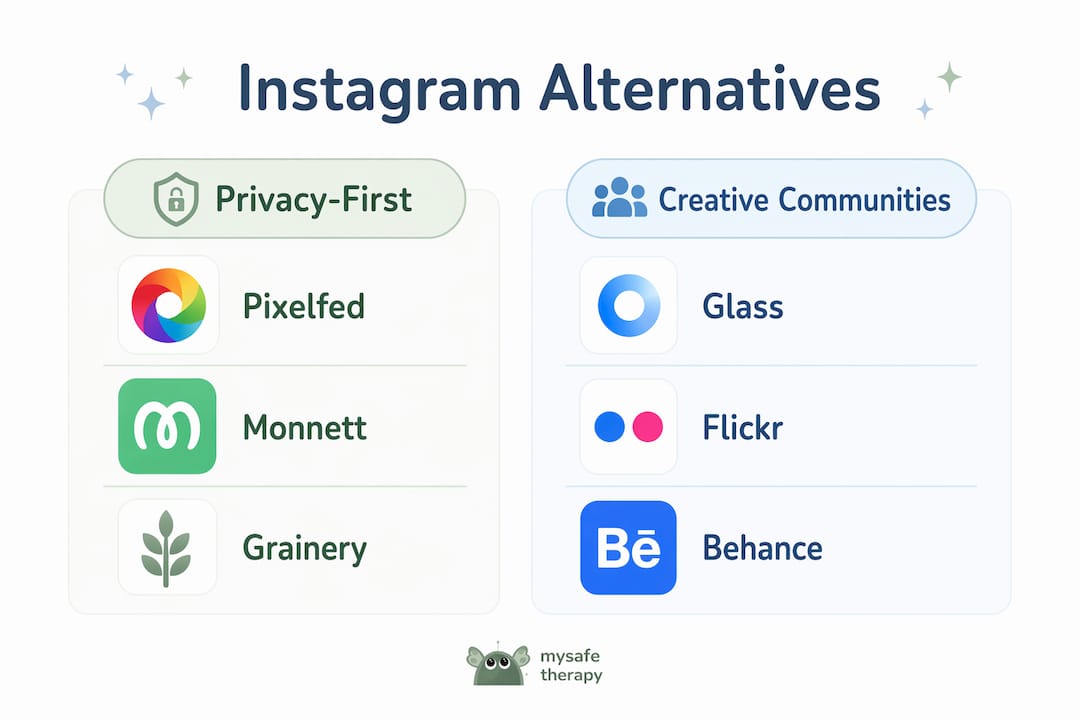
Privacy-first and open-source
Pixelfed is the most technically rigorous alternative. It runs on the ActivityPub protocol, which means your account can interact with Mastodon users and other Fediverse platforms, extending your reach well beyond a single server. There are no ads, no algorithmic sorting, and no data sold to third parties. The tradeoff is real: switching to Pixelfed means moving from a product to a protocol, and your audience will be smaller and more intentional by design. Self-hosting requires PHP, a database, and Redis, though managed instances are available for those who do not want to run their own server.

Monnett takes a different approach. Built with European privacy compliance at its core, it prioritises moderated, human-centred interaction over viral reach. It suits users who want a quieter, more considered social environment rather than the scale of Meta's platforms.
Grainery offers audience filtering, letting you control precisely who sees each post. For users who want the sharing experience without broadcasting to an unknown public, that level of control is genuinely useful.
Creative communities with light commercialisation
Glass is the cleanest option for photographers who want an ad-free home for their work. The interface is minimal, the community is photography-focused, and the platform does not sell user data to advertisers. VSCO sits alongside it as a creative tool first and a social network second, with editing features that rival dedicated photo apps and a community that skews towards visual artists. Neither platform will give you Instagram's reach, but both offer a noticeably calmer experience.

Flickr remains the most established photography platform on this list, with decades of community groups, photo management tools, and a loyal user base. Its free tier includes storage limits, but its Pro plan is straightforwardly priced. 500px targets professional and semi-professional photographers specifically, with a quality-focused feed and licensing options for commercial work.
Behance sits in a different category entirely. It is a portfolio platform rather than a social feed, built for designers, illustrators, and creative professionals who need to present work to potential clients or employers. Substack similarly serves creators who want direct relationships with their audience through newsletters and multimedia posts, with subscription-based monetisation rather than advertising.
Mainstream alternatives with familiar trade-offs
Threads, owned by Meta, shares Instagram's data infrastructure. It offers a text-and-image feed with a growing user base, but users who leave Instagram for privacy reasons will find little comfort in Threads. Snapchat and TikTok both rely on pervasive advertising and algorithmic feeds designed to maximise time spent on the platform. Twitter (now operating as X) blends microblogging with image and video sharing, but remains ad-supported with an opaque feed algorithm.
Pinterest occupies a useful middle ground. Its algorithmic discovery is commercial, but the platform lacks Stories and Reels, making it a lower-pressure environment for visual inspiration. Tumblr supports multimedia blogging with niche communities and a partly chronological feed. Imgur is best understood as an image hosting platform for memes and viral content rather than a personal sharing tool. Rodeo combines photo sharing with project management features, making it more relevant for creative teams than individual users.
Pro Tip: If you are new to federated platforms, start with a managed Pixelfed instance rather than self-hosting. Sites like pixelfed.social let you create an account in minutes without any server configuration.
Why are users leaving Instagram?
The reasons are consistent and well-documented. Instagram's feed is no longer chronological. It prioritises content Meta's algorithm predicts will generate engagement, which in practice means sponsored posts, Reels from accounts you do not follow, and content optimised for clicks rather than quality.
- Advertising volume: Instagram's revenue model depends on advertising. Users encounter sponsored posts throughout their feed, Stories, and Explore tab, with little control over frequency or relevance.
- Data collection: Instagram collects extensive behavioural data, including browsing activity outside the app, to build advertising profiles. This sits uneasily with GDPR principles around data minimisation and user consent.
- Algorithmic opacity: The feed algorithm is not transparent. Users cannot see why specific content is prioritised, and chronological feeds are no longer the default.
- Feature overload: Instagram has added Stories, Reels, Shopping, and Live video in rapid succession, shifting the platform away from its original photography focus.
- Content homogenisation: Algorithmic amplification rewards a narrow range of content formats, pushing creators towards Reels and away from static photography.
The UK's regulatory environment adds further pressure. The Online Safety Act places new obligations on platforms to protect users, particularly those under 18, and the UK government is actively consulting on under-16 social media restrictions modelled on Australia's approach. For users already uncomfortable with Instagram's data practices, these developments make the case for alternatives more concrete.
How to choose the right Instagram alternative for your needs
The decision comes down to four factors: what you share, who you share it with, how much privacy you require, and whether you need a large audience.
- Privacy requirements: If data minimisation is your priority, Pixelfed, Glass, and Monnett are the only options that genuinely deliver it. Mainstream platforms including Threads, Snapchat, and TikTok collect and monetise user data by design.
- Feed preference: Chronological feeds are available on Pixelfed, BeReal, Flickr, and Grainery. Algorithmic feeds dominate on Pinterest, TikTok, Threads, and Twitter.
- Content type: Photographers are best served by Glass, Flickr, or 500px. Creative professionals should consider Behance. Users who want authentic, unedited sharing will find BeReal's daily prompt format compelling.
- Community size: There is a direct tradeoff between reach and autonomy. Pixelfed's community is intentionally smaller. TikTok and Snapchat offer vast audiences but at the cost of privacy and algorithmic control.
- App availability: All platforms listed are available in the UK. Pixelfed's mobile experience relies on progressive web apps and third-party clients rather than a native app, which is worth knowing before you commit.
Pro Tip: Test two or three platforms simultaneously for a month before committing. Smaller federated platforms like Pixelfed reward patience; their value becomes clearer once you have built a small, engaged following rather than chasing reach from day one.
How does UK law regulate social media platforms?
The Online Safety Act 2023 is the primary legislation governing social media platforms operating in the UK. It places a duty of care on platforms to protect users from illegal content and, for the largest services, from legal but harmful content. Ofcom is the designated regulator and has powers to fine non-compliant platforms.
The UK government is currently consulting on restricting under-16 access to social media, following Australia's approach. Platforms named in the consultation include Snapchat, TikTok, YouTube, Instagram, Facebook, and X. Age verification is central to the proposed restrictions, but as the Electronic Frontier Foundation has noted, there is no privacy-preserving method of verifying every user's age at scale. For privacy-first platforms like Pixelfed and Monnett, mandatory age checks would conflict directly with their data minimisation principles.
GDPR, retained in UK law as UK GDPR, continues to apply to all platforms processing UK users' data. It requires lawful bases for data processing, data minimisation, and the right to erasure. Instagram's advertising model relies on behavioural profiling, which has faced regulatory scrutiny across Europe. Platforms with no advertising model, such as Glass and Pixelfed, have structurally simpler GDPR compliance obligations.
Which platforms integrate well with other apps and services?
Integration capability varies considerably across this list, and it matters most for creators who manage content across multiple channels.
Pixelfed's ActivityPub federation means it connects natively with Mastodon, Misskey, and other Fediverse platforms. A post on Pixelfed can be followed, liked, and commented on by Mastodon users without any additional setup. Behance integrates directly with Adobe Creative Cloud, making it the natural choice for designers already working in Photoshop or Illustrator. Substack connects with email clients and supports RSS, giving creators distribution options beyond the platform itself.
Pinterest offers an API that third-party scheduling tools such as Buffer and Later support, making it straightforward to manage alongside other social channels. TikTok and Snapchat both have developer APIs, though their primary integrations are with advertising and analytics platforms rather than creative tools. Flickr supports third-party apps through its API and connects with photo management software including Lightroom via plugins.
Threads, as part of Meta's ecosystem, shares infrastructure with Instagram and Facebook, which simplifies cross-posting but reinforces the same data environment. Twitter's API access has become more restricted since 2023, limiting third-party integrations that were previously common.
Social media, mental health, and why your platform choice matters
Platform design has measurable consequences for wellbeing. Algorithmic feeds on Instagram and TikTok are built to maximise engagement, which in practice means surfacing content that provokes strong emotional responses. For users already managing anxiety, depression, or low self-esteem, that loop can be actively harmful.
A UK government report found that 66% of young people aged 16–21 see age checks as enhancing safety, but express significant concern about the privacy implications of biometric data collection. That tension, wanting protection without surrendering personal data, is precisely what privacy-first platforms are designed to address.
Digital rights experts warn that broad age verification requirements may increase data breach risk and push younger users towards less regulated platforms. The concern is not hypothetical: when mainstream platforms become harder to access, users do not stop seeking community online.
Best practices for safer social media use:
- Choose platforms with chronological feeds to reduce compulsive checking behaviour
- Prefer ad-free environments to limit exposure to content designed to trigger purchasing impulses
- Use platforms that allow you to export your data, so you are not locked into a service
- Set time limits at the device level rather than relying on in-app tools
- Seek mental health tools specifically designed for your needs if social media use is affecting your wellbeing
For users experiencing social anxiety or finding that online interactions are worsening their mental health, switching platforms is a practical first step. It is not always sufficient on its own.
Mysafetherapy offers confidential support alongside your digital choices
Choosing a privacy-respecting platform is one part of a healthier relationship with social media. For users whose online experiences have contributed to anxiety, burnout, or low mood, Mysafetherapy offers a different kind of support: confidential, UK-based therapy with accredited therapists registered with BACP, UKCP, and NCPS.
Sessions are available via video, chat, or avatar-based counselling, with evening and weekend appointments to fit around your schedule. Pricing is transparent, there are no long-term commitments, and switching therapists is straightforward if your first match is not right. If you are ready to speak with someone, you can start therapy at a time that suits you.
Key takeaways
Pixelfed, Glass, and Monnett are the strongest privacy-first Instagram alternatives for UK users in 2026, offering ad-free, chronological feeds with no behavioural data collection.
| Point | Details |
|---|---|
| Privacy-first options | Pixelfed, Glass, and Monnett collect no advertising data and offer full or near-full data control. |
| Chronological feeds | Pixelfed, BeReal, Flickr, and Grainery show posts in order, removing algorithmic manipulation. |
| UK regulatory context | The Online Safety Act and proposed under-16 restrictions will affect all major platforms, with privacy-first services facing the greatest compliance tension. |
| Age verification risk | 66% of UK young people aged 16–21 support age checks for safety but raise concerns about biometric data privacy. |
| Mysafetherapy | For users whose social media use affects their mental health, Mysafetherapy connects them with UK-accredited therapists via confidential online sessions. |