

TL;DR:
- Most UK adults should start with Mysafetherapy, which offers UK-accredited therapists, multiple formats, and transparent privacy. Alternatives include multinational platforms with faster onboarding but variable accreditation and lower-cost messaging services tailored to reflective communication styles. Verifying therapist registration and understanding privacy policies are essential steps before choosing an online therapy platform.
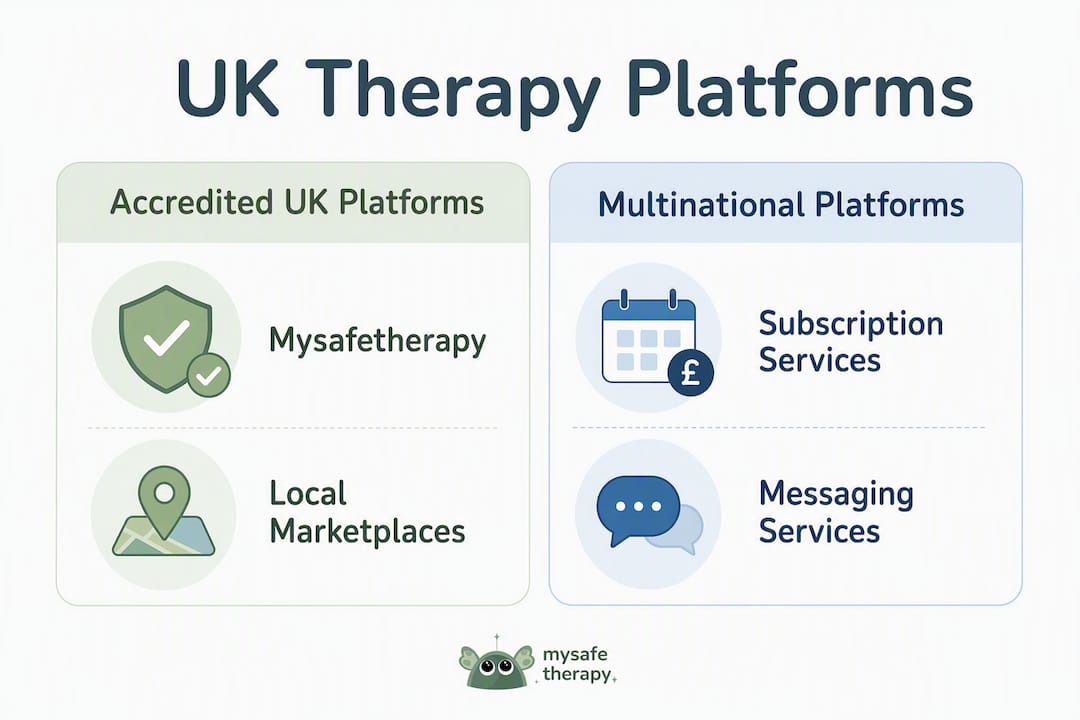
For most UK adults, Mysafetherapy is the recommended starting point. It connects clients with therapists registered with BACP, UKCP, or NCPS, offers video, chat, phone, and avatar sessions, and publishes clear privacy notices aligned with UK GDPR. If Mysafetherapy does not fit your circumstances, two alternatives cover the main trade-offs:
- Mysafetherapy — UK-accredited therapists, multiple formats, transparent privacy and pricing, AI-assisted self-help tools
- Subscription multinational platforms (such as BetterHelp or Talkspace) — faster onboarding, larger therapist pools, but therapists may not hold UK-recognised accreditation
- Text-first messaging services (such as Online-Therapy.com) — lower-cost, asynchronous support suited to reflective communication styles
Private therapy in the UK typically costs between £40–£90 per 50-minute session for an independent therapist; platform subscriptions often bundle messaging and live sessions into a weekly or monthly fee. Before committing to any platform, verify the therapist's registration on the BACP or UKCP public register. Both are accredited by the Professional Standards Authority, which means clients have a formal complaints route if something goes wrong.
Table of Contents
- How do these online therapy tools compare at a glance?
- What does each platform category actually offer?
- How do you choose the right online therapy platform?
- How we compared these platforms
- Why accreditation, privacy, and human matching matter in the UK
- Which platform should you choose?
- How responsive is customer support across these platforms?
- What do user reviews say about these platforms?
- Key takeaways
- Why Mysafetherapy favours a UK-first approach
- Mysafetherapy: a practical next step for UK adults
- Useful sources and further reading
How do these online therapy tools compare at a glance?
| Platform / Category | Price model & typical cost | Therapy formats | Therapist accreditation & switch | Best for | Availability | Privacy & data | Matching method | NHS integration |
|---|---|---|---|---|---|---|---|---|
| Mysafetherapy | Subscription; from £49/month | Video, chat, phone, avatar | BACP/UKCP/NCPS; easy switch | UK adults needing accredited, multi-format therapy | Evenings & weekends | UK GDPR-aligned; clear privacy notice; AI use disclosed | Clinician-informed | No direct NHS link |
| Subscription multinational platforms (BetterHelp, Talkspace, Thriveworks, Grow Therapy, MD Live) | Weekly/monthly subscription | Video, chat, messaging | Varies; US-licensed therapists common; switch available | Fast access, large therapist pool | Often 24/7 | Varies; some US data storage; FTC action on BetterHelp data practices noted | Algorithm-driven | None |
| Text-first messaging services (Online-Therapy.com, Brightside Health) | Subscription; typically lower cost | Async messaging; optional video | Varies; check individual registration | Asynchronous, reflective support; lower budget | Flexible, async | Varies; check data storage location | Algorithm | None |
| Employer/EAP programmes | Free to employee (employer-funded) | Phone, video, brief counselling | Varies; often short-term only | Short-term, employer-funded support | Business hours, some 24/7 helplines | Employer data-sharing policies apply | Referral-based | Sometimes linked to NHS pathways |
| Local UK marketplaces (TherapyRoute, It's Complicated, Mindler, Sesame Care) | Per-session; £40–£90 typical | Video, in-person, phone | UK-registered therapists; varies by directory | Clients wanting local or in-person option | Depends on therapist | Varies by platform | Self-select or directory | No |

Price column: Mysafetherapy's subscription model from £49/month compares favourably with per-session independent rates of £40–£90. Employer EAPs are free at point of use but typically limited to six to eight sessions.
Accreditation column: UK-recognised registers (BACP, UKCP, NCPS) are the clearest trust signal for UK clients. Multinational platforms often list US state-licensed therapists, which does not carry the same complaints route under UK law.
Privacy column: The BACP Ethical Framework 2025 requires practitioners to assess any digital or AI tool for security and to provide a clear privacy notice. Platforms that do not publish this information should be treated with caution.
What does each platform category actually offer?
Mysafetherapy
Mysafetherapy is a UK-based marketplace that matches clients with therapists holding BACP, UKCP, or NCPS registration. Sessions run via video, live chat, phone, or avatar format, the last of which allows anonymous participation for clients who prefer not to appear on camera. Pricing starts from £49/month, and therapist switching is straightforward without restarting the onboarding process. The platform supplements live sessions with AI-assisted journaling, mood tracking, and guided self-help booklets, all governed by a published UK GDPR-aligned privacy notice that discloses how AI tools interact with client data. Evenings and weekend slots are available.
Pros: UK-accredited therapists; multiple session formats including anonymous avatar; clear privacy and AI disclosure; AI self-help tools between sessions; easy therapist switching.
Cons: Smaller therapist pool than large multinational platforms; no direct NHS referral pathway.
Who this suits: UK adults who want a verified, accredited therapist, care about data privacy, and value format flexibility, including those who prefer anonymity.
Subscription multinational platforms
This category includes BetterHelp, Talkspace, Grow Therapy, Thriveworks, and MD Live. These services onboard quickly, often within 24–48 hours, and maintain large therapist rosters. The trade-off is accreditation: therapists are typically licensed in US states, and UK clients have no formal complaints route through a UK professional body if a problem arises. The FTC took action against BetterHelp in 2023 for sharing sensitive mental health data with third-party advertisers, which illustrates the data-handling risk that can accompany large, commercially driven platforms.

Pros: Fast matching; large therapist pools; evening and weekend availability; often include messaging between sessions.
Cons: Therapists may not hold UK-recognised accreditation; data may be stored outside the UK; matching is typically algorithm-driven rather than clinically informed.
Who this suits: People who need an appointment quickly and are less concerned about UK-specific accreditation or data residency.
Text-first messaging services
Online-Therapy.com and Brightside Health sit in this category. Asynchronous messaging allows clients to write reflections at any time and receive a therapist response within a set window, typically 24 hours. This suits people who find real-time conversation difficult or who want a lower-cost ongoing support structure. Live video sessions are usually available as an add-on. Accreditation standards vary, so checking individual therapist registration before subscribing remains important.
Pros: Flexible, async access; lower price points; useful for reflective communication styles.
Cons: No real-time crisis support; therapist accreditation varies; response windows can feel slow for acute distress.
Who this suits: Clients managing mild-to-moderate anxiety or low mood who prefer written reflection over live conversation.
Employer/EAP programmes
Employee Assistance Programmes are employer-funded and typically free to the employee. They cover short-term counselling, usually six to eight sessions, plus signposting to further resources. The limitation is brevity: EAPs are not designed for complex or long-term presentations. Data-sharing arrangements between the EAP provider and the employer should be checked before use.
Pros: Free at point of use; fast access; often include 24/7 telephone helplines.
Cons: Session limits; employer data-sharing policies may apply; not suited to complex or long-term needs.
Local UK marketplaces
TherapyRoute, It's Complicated, Mindler, and Sesame Care operate as directories or marketplaces connecting clients with UK-registered therapists, some of whom also offer face-to-face sessions. These platforms suit clients who want the option of in-person care or who prefer to self-select a therapist by reading detailed profiles. Per-session pricing at £40–£90 is standard.
Pros: UK regulatory focus; potential for in-person follow-up; detailed therapist profiles for self-selection.
Cons: No subscription bundling; platform-level privacy and matching standards vary; no AI self-help tools.
Pro Tip: Book a 15-minute introductory consultation before committing to any platform. UKCP guidance recommends using this time to assess warmth, clarity of approach, and how the therapist handles progress tracking, not to explore deep history.
How do you choose the right online therapy platform?
The decision comes down to eight criteria. Work through them in order, because the first two, accreditation and privacy, affect safety and should not be traded away for convenience.
- Therapist accreditation — confirm registration with BACP, UKCP, or NCPS. These are PSA-accredited registers that carry a formal complaints route.
- Privacy and data handling — read the privacy notice before signing up. Check where data is stored, whether AI tools process session content, and what the confidentiality limits are.
- Therapy format — decide whether video, chat, phone, or asynchronous messaging fits your schedule and communication style. A comparison of video and chat formats can help clarify the practical differences.
- Pricing model — subscription billing suits regular ongoing therapy; per-session billing suits infrequent or trial use. Check cancellation and refund terms before entering payment details.
- Ability to switch therapist — a platform that makes switching difficult is a red flag. Relational fit matters, and the first match is not always the right one.
- Clinical oversight — check whether the platform has a clinical lead or governance structure, not just a customer service team.
- Crisis and safeguarding arrangements — confirm what happens if you disclose risk of harm. A platform should have a clear protocol, not just a generic helpline number.
- Matching method — AI-driven matching increases speed but can reduce clinical fit; clinician-informed matching is preferable for complex presentations.
Questions to ask in an introductory call:
- Which professional body are you registered with, and can I verify that online?
- How long is each session, and how often do you recommend we meet?
- What are the cancellation and refund terms?
- How do you manage clinical risk if I disclose something serious?
- Does the platform use AI tools, and if so, how is my data stored?
Red flags to watch for:
- No published privacy notice or vague references to "secure storage"
- No way to verify therapist registration independently
- Auto-renewal billing with no clear cancellation route
- No method to change therapist without restarting the process
- Absent or generic crisis guidance
Pro Tip: Use the introductory consultation to test relational fit, not to cover your full history. Assess whether the therapist explains their approach clearly and can describe how they track progress. That conversation tells you more than any platform rating.
How we compared these platforms
The comparison above was built on eight criteria weighted to reflect UK clinical and regulatory priorities.
- Therapist accreditation — highest weight; BACP, UKCP, and NCPS registration with a PSA-accredited complaints route.
Limitations: Platform policies and pricing change. This comparison reflects publicly available information as of 2026 and will be reviewed periodically. Individual therapist quality varies within any platform, so verifying registration directly with the relevant professional body remains the reader's responsibility.
What "best for" labels mean: Each label reflects the narrowest, most accurate use case for that platform category, not a general endorsement. A platform labelled "best for fast access" may not be the safest or most clinically appropriate choice for complex needs.
Why accreditation, privacy, and human matching matter in the UK
The titles "psychotherapist" and "counsellor" are not protected by statute in the UK. Anyone can use them. Registration with BACP, UKCP, or NCPS is therefore the primary practical safeguard for clients. The BACP Register sets and monitors standards covering training, supervision, and continuing professional development. The UKCP register is accredited by the Professional Standards Authority, which adds a further layer of governance and public protection. The NCPS Accredited Register operates on similar principles, with published renewal reporting on governance and registrant categories.
The BACP Ethical Framework 2025 sets explicit requirements on AI use: practitioners must assess the security of any digital tool before use and provide a clear, accessible privacy notice describing data handling and any foreseeable limits to confidentiality. The framework also requires that remote meeting spaces are private and free from intrusion, and that clients are informed about data handling under UK GDPR and the Data Protection Act. A platform that cannot demonstrate compliance with these requirements falls short of the standard a UK-registered therapist is expected to meet.
Matching method affects clinical outcome. Purely algorithm-driven matching prioritises therapist availability over clinical appropriateness. For presentations involving trauma, complex grief, or cultural specificity, the human element in matching, considering background, modality fit, and clinical history, can meaningfully affect whether therapy is effective. Platforms should be transparent about whether their matching is clinician-informed or availability-based.
Pro Tip: To verify a therapist's registration quickly, search their full name on the BACP public register or the UKCP website. Registration should be current, not lapsed. A therapist who cannot be found on any PSA-accredited register should not be engaged through any platform.
- BACP registration: covers counsellors and psychotherapists; complaints route available to clients.
- UKCP registration: covers psychotherapists and psychotherapeutic counsellors; PSA-accredited.
- NCPS registration: covers counsellors; PSA-accredited; published governance reporting.
Which platform should you choose?
For most UK adults seeking ongoing, accredited therapy with clear privacy practice, Mysafetherapy is the strongest fit. It combines UK-registered therapists, format flexibility, transparent data handling, and AI-assisted self-help tools within a single subscription. The therapist pool is smaller than multinational platforms, but every therapist holds UK-recognised accreditation and is subject to a formal complaints process.
Match your priority to a category:
- Need UK-accredited care with clear privacy practice → Mysafetherapy
- Need the fastest possible appointment and accreditation is secondary → subscription multinational platforms (BetterHelp, Talkspace, Grow Therapy, MD Live, Thriveworks)
- Prefer asynchronous, written support at lower cost → text-first messaging services (Online-Therapy.com, Brightside Health)
- Employer-funded, short-term support → your employer's EAP programme
- Want in-person option or detailed self-selection → local UK marketplaces (TherapyRoute, It's Complicated, Mindler, Sesame Care)
- Budget is the primary barrier → NHS Talking Therapies offer free, structured, evidence-based support, though waiting times and session limits vary by area
The practical next step is to book a 15-minute introductory consultation. Use it to verify registration, test relational fit, and confirm cancellation terms before subscribing.
How responsive is customer support across these platforms?
Support quality varies significantly between platform categories. Mysafetherapy provides direct contact for account and clinical queries, with escalation to a clinical lead for safeguarding concerns. Subscription multinational platforms typically offer 24/7 chat support, but responses to clinical concerns are often handled by non-clinical staff, with escalation routes that are not always clearly documented. Text-first services tend to rely on in-app messaging for support, which can be slow for urgent matters.
Employer EAP programmes usually include a 24/7 telephone helpline staffed by trained advisers, which is their strongest support feature. Local UK marketplaces vary: some offer platform-level support, others function as directories with no direct client support beyond the individual therapist.
When evaluating support, ask specifically what happens if you experience a clinical crisis outside session hours. A platform that directs all out-of-hours concerns to a generic helpline number without a documented escalation protocol is not adequately set up for clinical risk.
What do user reviews say about these platforms?
User reviews across platforms consistently highlight three themes: therapist quality, ease of switching, and pricing transparency. Mysafetherapy receives positive feedback for its accreditation focus and format variety, particularly from clients who value the avatar session option for anonymity. Subscription multinational platforms attract high volumes of reviews, with BetterHelp and Talkspace among the most reviewed globally, but recurring complaints centre on therapist matching quality and difficulty cancelling subscriptions.
Text-first services receive mixed reviews: clients who suit the asynchronous format report satisfaction, while those expecting real-time support find the model frustrating. EAP programmes are generally rated positively for accessibility and cost, but session limits draw consistent criticism from clients with complex needs. Local UK marketplaces receive positive reviews for therapist profile detail and the ability to self-select, though platform-level support is noted as inconsistent.
The Mind guidance on finding therapy cautions that some lower-cost online counselling sites may not use professional therapists. Cross-referencing user reviews with independent accreditation verification remains the most reliable approach.
Key takeaways
Mysafetherapy is the strongest fit for UK adults who prioritise accredited therapists, clear privacy practice, and format flexibility within a single subscription.
| Point | Details |
|---|---|
| Verify accreditation first | Check therapist registration on BACP, UKCP, or NCPS before subscribing to any platform. |
| Privacy notice is non-negotiable | A platform without a clear UK GDPR-aligned privacy notice and AI disclosure does not meet BACP 2025 standards. |
| Test fit with a 15-minute intro | Use the introductory consultation to assess warmth, approach clarity, and progress tracking, not to cover full history. |
| Match platform to your priority | UK-accredited care: Mysafetherapy; fastest access: subscription multinationals; async support: text-first services. |
| Mysafetherapy for UK-first therapy | Mysafetherapy connects UK adults with BACP/UKCP/NCPS-registered therapists across video, chat, phone, and avatar formats from £49/month. |
Why Mysafetherapy favours a UK-first approach
UK accreditation and UK GDPR compliance are editorial priorities for Mysafetherapy, not incidental features. The titles "counsellor" and "psychotherapist" carry no statutory protection in the UK, which means a platform's choice to require PSA-accredited registration is a substantive safety decision, not a marketing claim. When a therapist holds BACP, UKCP, or NCPS registration, a client has a documented complaints route, a guarantee of minimum training standards, and the assurance of ongoing supervision and CPD requirements.
This comparison is designed to help UK adults identify safe, accredited options. The accreditation and privacy columns in the table above are weighted heavily because they most directly affect client safety and continuity of care. A therapist who relocates, changes platforms, or whose registration lapses mid-therapy creates a disruption that is easier to manage when the original engagement was through a UK-regulated framework.
Mysafetherapy is a UK-based provider offering accredited therapists and multiple session formats. Readers should still verify individual therapist registration and confirm that the therapist's approach suits their specific needs before subscribing.
Mysafetherapy: a practical next step for UK adults
Mysafetherapy offers a direct alternative to the multinational subscription platforms and directory-style marketplaces covered in this comparison. Every therapist on the platform holds BACP, UKCP, or NCPS registration. Sessions are available via video, live chat, phone, or avatar format for clients who prefer anonymity. Pricing starts from £49/month, with a clear cancellation policy published before you commit. AI-assisted journaling and mood tracking supplement live sessions, and the platform's approach to AI use is documented transparently.
The practical next step is to view the individual therapy page and book a 15-minute introductory consultation with a therapist whose registration you can verify on the BACP or UKCP public register. Check the cancellation terms before subscribing, and confirm the therapist's approach matches your presenting concern.
This article provides general information about online therapy platforms and is not a substitute for professional clinical advice. Verify current platform policies and therapist registration directly before making any decision.
Useful sources and further reading
- BACP Ethical Framework for the Counselling Professions 2025 — the governing ethical framework for UK counsellors and psychotherapists, covering AI assessment, privacy notices, and remote practice requirements.
- BACP Register of Counsellors and Psychotherapists — public register for verifying therapist registration and complaints eligibility.
- UKCP: Our Register — PSA-accredited register of psychotherapists and psychotherapeutic counsellors; includes guidance on how to choose a therapist.
- UKCP: How to choose a psychotherapist — practical guidance on introductory consultations and what to assess before committing.
- Mind: How to find therapy or counselling — guidance on low-cost options, online counselling cautions, and how to assess provider quality.
- Why therapy confidentiality matters: privacy, trust, and what to ask — practical prompts for assessing confidentiality practice before starting therapy.
- Mysafetherapy: AI and therapy — explanation of how Mysafetherapy uses AI tools and the safeguards in place.
- Mysafetherapy: confidential online therapy in the UK — detail on how the platform manages client privacy and data handling.