
TL;DR:
- Research indicates that the quality of therapeutic support and the strength of the client-therapist relationship predict outcomes more than the therapy format itself. Digital formats like chat and video are effective when supported by skilled, engaged therapists, with support level being a key factor in success and retention. The choice of format should prioritize personal preference, accessibility, and engagement, as the relationship and consistency ultimately drive improvement.
If you are weighing up video versus chat therapy for anxiety or depression, the choice feels more consequential than it probably is. Getting video vs. chat therapy explained properly matters, because most comparisons focus on technology rather than the factor that actually predicts outcomes. NHS Talking Therapies now offers several digital formats, and private platforms have expanded those options further. What research consistently shows may surprise you: the format itself is rarely the deciding variable. The quality of therapeutic support and the strength of the relationship between you and your therapist matter far more.
Table of Contents
- Key takeaways
- Digital therapy on the NHS: what is available
- What the research says about effectiveness
- Chat vs. video: practical differences that matter
- How to choose the right format for you
- AI and digital innovation in therapy delivery
- My perspective on choosing between formats
- Start therapy with Mysafetherapy today
- FAQ
Key takeaways
| Point | Details |
|---|---|
| Format is not the main predictor | Therapeutic alliance and support level consistently predict outcomes more than video or chat delivery. |
| Structured support outperforms low-support formats | Internet-based therapy with clinician guidance produces significantly better results and lower dropout rates. |
| Chat therapy is a spectrum | Crisis text lines and structured chat therapy with a qualified therapist are fundamentally different things. |
| Video therapy preserves non-verbal cues | Facial expressions and body language give therapists additional clinical information not available in text. |
| Both formats suit different people | Personal preference, privacy needs, and technical access all shape which format will work best for you. |
Digital therapy on the NHS: what is available
NHS Talking Therapies is the primary route for adults in England seeking structured mental health support for anxiety and depression without a GP referral. You can self-refer online and access trained professionals using methods such as cognitive behavioural therapy (CBT), counselling, or guided self-help, depending on your presentation.
The available delivery methods have expanded considerably. Sessions may take place via telephone, video call, or written messaging platforms. Guided self-help is often delivered through an online workbook with periodic check-ins. The core treatment, however, remains structured therapeutic work on thoughts and behaviour. The delivery medium is secondary to that structure.
Key facts about NHS digital therapy access:
- Self-referral is available without a GP in most areas of England
- CBT, counselling, and guided self-help are all accessible digitally
- Session formats include video, telephone, and asynchronous written support
- Private platforms such as Mysafetherapy extend access to evenings and weekends with BACP, UKCP, and NCPS registered therapists
For adults exploring the types of mental health support available online, the NHS is a strong starting point. Private platforms complement it where waiting times or scheduling create barriers.
What the research says about effectiveness
This is where comparing video and chat therapy becomes genuinely interesting. A 2026 network meta-analysis published in the British Journal of Psychiatry examined support levels across internet-based interventions for depression. The finding was clear: therapeutic support ranked highest in effectiveness, with effect sizes between g=0.38 and g=0.71, while technical-only support produced the weakest results.
Put differently: a chat-based therapy session with a skilled, engaged therapist will likely outperform a video session where the therapist is disengaged and contact is minimal. The medium is not what drives improvement. The relationship is.
| Format | Effectiveness evidence | Dropout risk |
|---|---|---|
| Therapist-guided internet CBT | High (g=0.38–0.71) | Lower with human contact |
| Technical/automated support only | Low (g=0.15) | Highest (RR=1.6) |
| AI conversational therapy | Moderate to high | Reduced with perceived alliance |
| Unstructured chat/support lines | Variable | Not well-studied |
The dropout data is particularly telling. Technical-only digital therapy carries the highest dropout risk at a relative risk of 1.6 compared to human-supported formats. People disengage when they feel unsupported, regardless of how polished the platform looks.
A 2026 randomised controlled trial in JAMA Network Open added a further nuance. An AI conversational agent reduced anxiety symptoms more than a face-to-face group therapy condition. The mechanism identified was perceived therapeutic alliance: participants who felt a connection with the AI agent showed greater engagement and better outcomes. This does not mean AI beats human therapy. It means the relational quality of any interaction, even a digital one, is what produces change.
Pro Tip: When evaluating any therapy platform, ask specifically about therapist contact frequency. Platforms that offer weekly check-ins or asynchronous messaging between sessions consistently produce better outcomes than those where you interact only with automated content.
Chat vs. video: practical differences that matter
Beyond the clinical evidence, there are real practical differences between these two formats that affect your day-to-day experience of therapy.
What chat therapy actually means
This distinction is worth making clearly. Many people searching for "chat therapy" are actually encountering crisis text services, which are not therapy. NHS ChatHealth, for example, provides confidential advice and guidance via text but cannot diagnose, prescribe, or deliver clinical interventions. It is a support service, and a useful one. It is not structured psychotherapy.
Structured chat therapy, by contrast, involves a qualified therapist using a secure messaging platform to deliver CBT or counselling. Sessions may be synchronous (live chat at a scheduled time) or asynchronous (therapist responds within a set window). The chat therapy spectrum is wide, and the distinction between support messaging and actual therapy has significant implications for what outcomes you should expect.
What video therapy offers differently
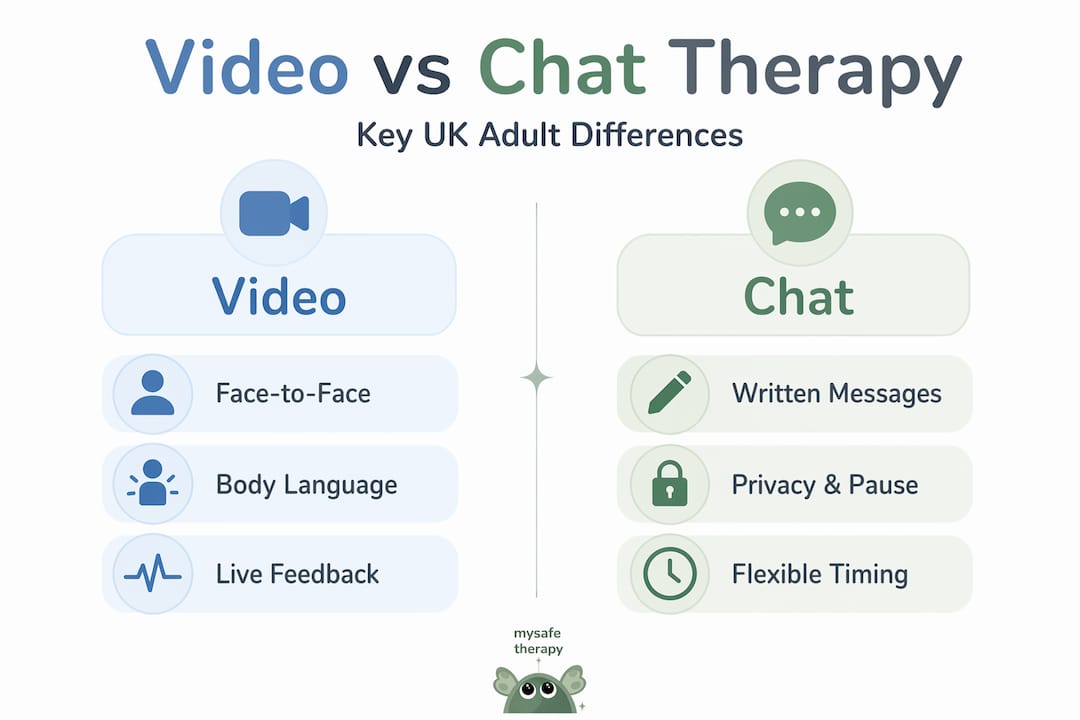
Video therapy provides the closest approximation to in-person sessions that digital formats allow. The therapist can observe facial expressions, posture, and other non-verbal signals that inform clinical judgement. For conditions like depression, where flat affect or withdrawal may be clinically significant, this matters. Building rapport also tends to happen more quickly over video than text.
The practical advantages of both formats are distinct:
Chat therapy advantages:
- High accessibility for those with social anxiety or vocal processing difficulties
- Asynchronous options allow reflection before responding
- Greater perceived anonymity and privacy
- No need for a private space with visual and audio control
- Written record of sessions available for review
Video therapy advantages:
- Non-verbal cues visible to the therapist
- More natural conversational flow
- Stronger rapport-building potential in fewer sessions
- Closer to in-person therapy for those transitioning from face-to-face
Pro Tip: If you live with social anxiety, chat-based formats may reduce the initial barrier to starting therapy. However, aim to progress toward video or in-person sessions over time if your therapist recommends it. Starting where you are comfortable is valid. Staying only in the most comfortable format indefinitely may limit therapeutic depth.
How to choose the right format for you
There is no universally correct answer to the question "which therapy format is more effective?" The right format is the one you will actually attend consistently. Dropout is the biggest predictor of poor outcomes in digital therapy, so the format that keeps you engaged is the one that works.
Ask yourself these questions before making a decision:
- Do I have a private, quiet space for a video call? If not, chat or asynchronous messaging removes that barrier entirely.
- How comfortable am I with spoken conversation about difficult topics? Those who find verbal expression challenging may find written formats easier initially.
- How important is it that my therapist notices non-verbal signals? For trauma, eating disorders, or presentations with significant somatic components, video is often preferable.
- Do I need flexible scheduling? Asynchronous chat options allow therapy to fit around work and family commitments in ways synchronous video cannot.
- What does my therapist recommend? A qualified clinician's recommendation based on your presenting issues carries more weight than format preference alone.
- Am I willing to try more than one format? Many platforms, including Mysafetherapy, allow you to switch formats or therapists without starting from scratch.
If you are unsure how to take the first step, the guide on how to start online therapy walks through the practical process from self-referral to first session.
AI and digital innovation in therapy delivery
The question of video versus chat is now a three-way conversation, with AI-assisted formats entering clinical practice. A 2026 trial published in JMIR Mental Health found that both AI therapy chatbots and ChatGPT produced significant reductions in PHQ-9 depression scores compared to a control group. Anxiety symptom improvement was less consistent, which is worth noting if anxiety management is your primary goal.
The role AI currently plays is best understood as supplementary rather than replacement. AI tools at Mysafetherapy, such as AI journaling and mood tracking, function alongside live video and chat sessions with qualified therapists. They extend support between sessions rather than substitute the therapeutic relationship.
Key considerations about AI in mental health therapy:
- AI shows measurable benefit for depression but less consistent results for anxiety
- Therapeutic alliance with an AI agent still predicts outcomes, suggesting relational quality matters even in automated contexts
- AI tools are not regulated as clinical therapy in the UK and should not replace BACP or UKCP registered practitioners for complex presentations
- Hybrid models combining AI support with human therapist contact represent the current best-practice direction
For a fuller picture of how these technologies are evolving, the article on AI in online therapy covers recent UK-relevant research in detail.
My perspective on choosing between formats
From my experience working in digital mental health, the single most common mistake people make when choosing between video and chat therapy is treating it as a permanent decision. They agonise over the format before they have tried either, then stick with their initial choice long after it has stopped serving them.
What I have found matters far more is therapist quality and contact consistency. I have seen people make substantial progress managing anxiety through asynchronous chat with a skilled therapist. I have also seen people stall in video therapy because the relationship never quite clicked. The format was not the variable. The match was.
The research confirms what practitioners observe: human contact throughout therapy improves both treatment effects and retention, regardless of whether that contact happens by video or text. The misconception to challenge is the idea that video is inherently "more real" or more effective. Text-based therapy with strong therapeutic alliance consistently outperforms video sessions where contact is minimal and engagement is low.
My advice: pick the format that removes the most barriers to starting. Then stay open to adjusting as your needs evolve.
— MySafeTherapy
Start therapy with Mysafetherapy today
Mysafetherapy connects UK adults with BACP, UKCP, and NCPS registered therapists for both video and chat therapy sessions. Sessions are available evenings and weekends, and you can switch therapists or formats without penalty.
Whether you are managing anxiety, depression, or a combination of both, Mysafetherapy offers personalised, evidence-based therapy in the format that works for your life. Pricing is transparent, access is immediate, and your first step takes minutes. Start therapy today and get matched with a qualified therapist who suits your needs, schedule, and preferences. If you would prefer to browse practitioners first, you can book a session directly with a registered UK therapist.
FAQ
Is video therapy better than chat therapy for anxiety?
Not categorically. Research from 2026 shows that therapeutic support level and engagement predict outcomes more reliably than delivery format. Both video and chat therapy can be effective for anxiety when delivered by a qualified therapist with consistent contact.
What is the difference between chat therapy and a crisis text line?
A crisis text line such as NHS ChatHealth provides advice and support but does not deliver clinical therapy. Structured chat therapy involves a qualified therapist delivering CBT or counselling via secure messaging, which is a fundamentally different level of intervention.
Can I switch between video and chat therapy during treatment?
Yes, most reputable platforms allow format switching. Mysafetherapy specifically enables therapist and format changes without requiring you to restart your treatment from the beginning.
How effective is AI chatbot therapy for depression?
A 2026 randomised trial found that AI chatbots reduced PHQ-9 scores significantly compared to a control group. Results for anxiety were less consistent. AI tools currently work best as a supplement to human therapist contact rather than a standalone treatment.
Does the NHS offer both video and chat therapy?
NHS Talking Therapies offers digital delivery options including video and telephone sessions, with some services offering written or messaging-based support. Access and specific format availability vary by area. Private platforms offer more consistent format flexibility.