

AI journaling for mental health works best as a self-help support, not a treatment. It can help you spot emotional patterns, structure reflection, and convert vague feelings into concrete next steps. Small trials show measurable improvements in mood and stress when the design is right. It cannot diagnose you, replace a therapist, or manage a crisis. If you are dealing with severe symptoms or feel unsafe, professional help comes first, always.
TL;DR:
- AI journaling is most effective when it references personal memories and provides brief, specific follow-up questions rather than offering generic advice.
- It shows measurable mood and stress improvements over short periods when prompts are relevant and help with emotional reframing, but effects vary greatly depending on individual context.
- The privacy risks escalate with tools that store long-term memory and use contextual sensing, demanding careful review of data handling policies before use.
- Regular routines of short daily check-ins and weekly reflections, using structured methods like mood-tagging or the 3/2/1 approach, maximize benefits and habit formation.
- AI journaling supports ongoing therapy by tracking patterns and aiding reflection but is not a substitute for professional treatment, especially during severe or crisis situations.
Table of Contents
- What is AI journaling and how does it actually work?
- What the research shows about outcomes and limits
- How AI journaling helps in practice: the mechanisms that matter
- Building a safe, effective AI journaling routine
- Privacy, safety and the red flags worth knowing
- Where MySafeTherapy stands on AI journaling and therapy
- Fitting AI journaling alongside other mental health tools
- Separating the hype from the real value
- Combine AI journaling with a therapist who knows your history
- Sources
- FAQ
What is AI journaling and how does it actually work?
AI journaling means writing (or speaking) into an app that reads what you enter, remembers relevant details over time, and responds with questions, summaries, or suggestions rather than a blank page waiting for tomorrow's entry. The mechanics behind that experience matter more than most reviews suggest, because they determine whether the tool actually helps you reflect or just archives your words.
Persistent memory is the feature that separates a genuine AI journal from a digital diary with a chatbot bolted on. Most serious tools use vector-based retrieval, sometimes called RAG (retrieval-augmented generation), to store your entries as searchable embeddings rather than stuffing every past entry into the AI's working memory. Engineering teams building these systems favour this approach because it keeps costs down and, done properly, supports more privacy-conscious storage than dumping raw text into a single context window. The practical upside for you is what researchers at MIT Media Lab call the "callback moment": the app references something you wrote three weeks ago, at exactly the point it becomes relevant again.
Prompting style varies more than most people expect:
- Guided journeys walk you through a structured theme (gratitude, a difficult relationship, a recurring worry) over several sessions.
- Coach-style follow-ups ask one or two probing questions after you write, rather than offering advice immediately.
- Summaries condense a week or month of entries into themes you can review at a glance.
- Action suggestions turn a reflection into a small, testable next step, such as a conversation to have or a boundary to set.
The best tools favour short, specific follow-up questions over long paragraphs of generic advice. That design choice comes directly from human-computer interaction research showing that brief, context-aware prompts preserve your sense of ownership over the reflection, where a wall of AI-generated advice tends to shut it down.
Multimodal input has become standard rather than a premium feature. Voice transcription suits anyone who thinks better out loud or journals during a commute. Photo import lets you log a scene, a whiteboard, or a handwritten page and have the app extract text or context from it. Some platforms also offer contextual sensing, quietly pulling in sleep data, step counts, or location to enrich entries without you typing it all out.
That last category deserves a pause before you switch it on. Contextual sensing can genuinely sharpen the picture; a journal that notices you slept four hours before a spike in irritability is doing something a plain diary cannot. But it also means the app holds a much richer dataset about your daily life, which raises the privacy stakes considerably (more on that later). Weigh the benefit against how much of your life you actually want a company's servers to see.
What the research shows about outcomes and limits
The strongest evidence for AI journaling comes from a two-week randomised trial run by MIT Media Lab, which found that AI suggestions referencing a participant's own past memories, when personal and genuinely novel, produced measurable drops in PHQ-8 depression scores alongside increases in daily positive affect. The key variable was not that participants used AI at all. It was that the suggestions felt personally relevant rather than generic.
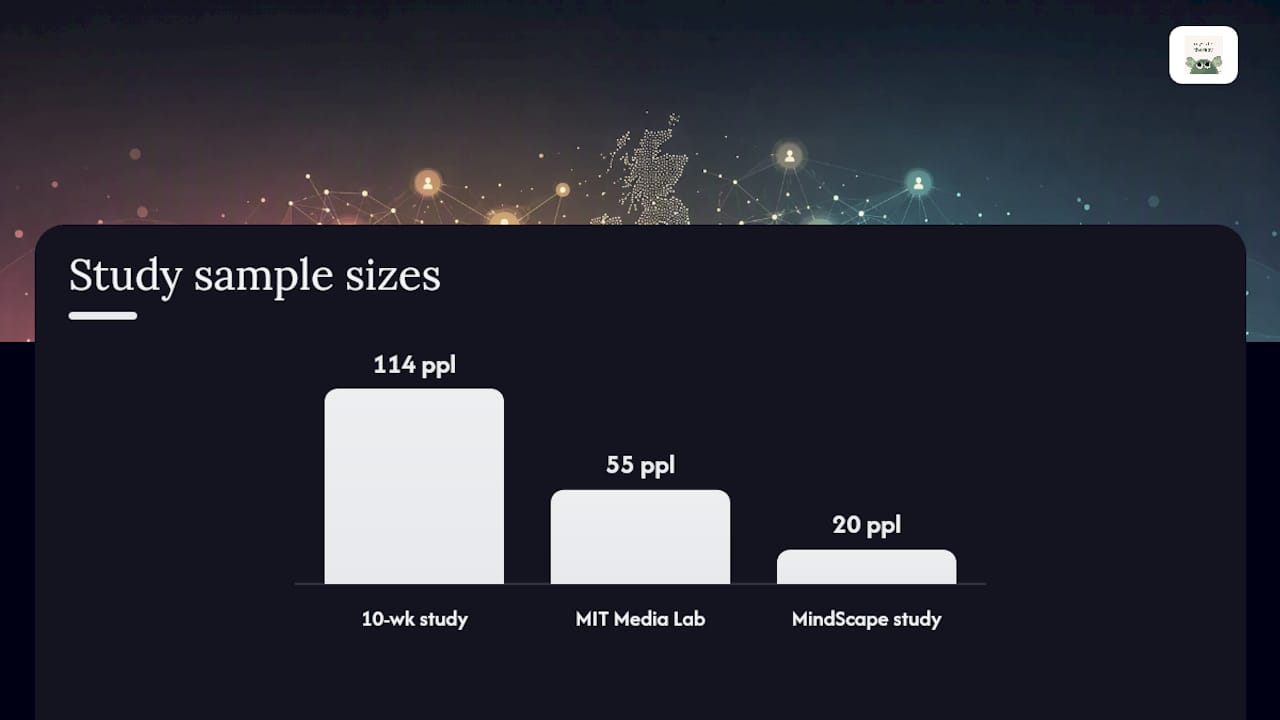
What the trials found: A 55-person, two-week study linked memory-referencing AI prompts to lower PHQ-8 scores. A separate 114-person, 10-week study linked AI-assisted reflective writing to lower perceived stress, with cognitive reappraisal doing the mediating work. An 8-week study of students reported increases in positive affect and reductions in negative affect alongside falling PHQ-4 scores.
A longer study published in the Journal of Psychology in Africa followed 114 students for 10 weeks and found participation in an AI-assisted reflective writing programme associated with lower perceived stress and higher psychological wellbeing. The mechanism the researchers identified was cognitive reappraisal, the process of reframing a stressful event into something more manageable or meaningful. That matters because it tells you the AI isn't magically soothing anyone; it is nudging a specific, well-understood emotion-regulation skill that talking therapies also train.
The MindScape study, an 8-week exploratory project with 20 college students, combined passive behavioural sensing with LLM-generated prompts and reported a 7% increase in positive affect, an 11% reduction in negative affect, a 6% drop in loneliness, and a week-over-week decline in PHQ-4 scores. This is the clearest evidence so far that contextual data (sleep, activity, location) can sharpen an AI journal's relevance rather than just adding noise.
A fourth strand of research looked at the human side of the interaction rather than the mood scores. A four-week deployment study using LLM-based journaling found that AI interpretive feedback helped participants connect fragmented experiences into a coherent narrative and supported meaning-making, while the researchers explicitly flagged the need to preserve user agency rather than let the AI dictate interpretation.
Three limits run through all of this work:
- Every trial is small. Sample sizes of 20, 55, and 114 people are enough to detect a real signal, not enough to call the effect settled science.
- Most designs are preliminary, quasi-experimental, or exploratory rather than large confirmatory trials.
- Effects are context-specific. A memory-referencing prompt worked because it was personal; a generic AI pep talk almost certainly would not replicate the result.
None of these studies used AI journaling as a stand-alone treatment for clinical depression or anxiety. They tested it as a self-reflection support alongside normal life, which is exactly the role it should play for you.
How AI journaling helps in practice: the mechanisms that matter
The research above points to four concrete mechanisms, and understanding them helps you use the tool with intention rather than just typing at it each night.
- Pattern detection and memory callbacks. An AI journal that remembers what stressed you last month can flag a repeat before you notice it consciously. This continuity is the single biggest advantage over a plain notebook, where patterns only surface if you reread months of entries yourself.
- Facilitated cognitive reappraisal. When a follow-up question nudges you to consider a situation from another angle, that's reappraisal in action, the same mechanism linked to reduced stress in the JPA study.
- Action-oriented suggestions. Reflection that stops at "I felt anxious today" achieves less than reflection that ends with "next time, I will text a friend before the meeting." Good AI journals nudge towards the second sentence.
- Low-burden check-ins. A 90-second voice note logged during a lunch break builds a habit far more reliably than a 20-minute writing session you keep postponing.
- Preserved agency. You edit, delete, or ignore AI suggestions as you see fit. The tool proposes; you decide.
That last point is worth dwelling on, because it's where AI journaling for mental health can go wrong. Research on human-AI collaborative journaling stresses that the AI works best as a mirror reflecting patterns back at you, not as a stand-in therapist offering interpretations you're expected to accept. If a tool's tone shifts from question to directive ("you should confront your manager about this"), that's a design choice worth being wary of, not a sign the app has understood you better.
Pro Tip: Treat every AI-generated insight as a hypothesis, not a verdict. If an app tells you that you seem anxious every Sunday evening, test it against your own memory before accepting it as fact. The best use of the tool is as a prompt for your own judgement, not a replacement for it.
Digital emotional safety also plays a bigger role than people expect. A private, non-judgemental space measurably increases engagement for people who feel stigma around admitting to mental health struggles, according to human-computer interaction research on private AI journaling environments. For someone who has never opened up to a person about how they're doing, typing it to an AI first can be the on-ramp that gets them talking to a therapist eventually, rather than a detour that keeps them from one.
Building a safe, effective AI journaling routine
You don't need an elaborate system to get value from this. A workable routine has two rhythms, not one.
- Daily check-ins (2 to 3 minutes). A quick voice note or a few typed lines logging your mood, one event that stood out, and one thing you're carrying into tomorrow.
- Weekly deeper sessions (10 to 20 minutes). Use this slot to review the AI's summary of the week, follow a guided prompt on a specific theme, and set an intention for the week ahead.
NHS-aligned guidance on journaling frequency backs this pacing directly: short sessions of 5 to 15 minutes, two to three times weekly, are enough to support anxiety management without becoming another chore on your list.
A few structured formats give the routine shape rather than leaving you staring at a cursor:
- The 3/2/1 method: three things you're grateful for, two things that challenged you, one thing you're looking forward to.
- Mood-tagging: a one-word or one-number mood log attached to each entry, which the AI can chart over weeks to reveal trends you'd otherwise miss.
- Goal-tracking: a running log of a specific behaviour change (sleep, exercise, a habit you're building), reviewed weekly against your entries.
- Photo prompts: a picture of your day, annotated with a sentence or two, useful on days when writing feels like too much.
When the AI drafts a summary or a suggested reframe, read it as a first draft of your own thinking, not a finished thought. Edit it, delete the parts that don't ring true, and keep the parts that do. Several apps let you export entries as PDFs or share selected sections directly, which is worth using deliberately: share the weekly summary with a therapist, not necessarily the raw daily log, unless you want your therapist reading every unfiltered thought.
Before you commit to a tool, run through a short data checklist:
- Is data encrypted in transit and at rest?
- Can you export your entries in a usable format?
- Can you permanently delete your data, not just archive it?
- Is there a clear option to share summaries with a clinician, with your explicit consent each time?
And know when to stop journaling and reach out instead. If you notice persistent low mood lasting more than two weeks, thoughts of self-harm, or a sense that reflection is making things worse rather than clearer, that's the point to contact a GP, a crisis line, or a therapist directly, not to journal your way through it alone.
Privacy, safety and the red flags worth knowing
Persistent memory is what makes AI journaling useful, and it's also exactly what makes privacy the first thing to check before you write anything sensitive. A tool that remembers your entries across months is, by definition, storing a detailed record of your mental state somewhere on a server you don't control. That's a materially different risk profile from a paper diary in a drawer.
Watch for these red flags in a privacy policy before you sign up:
- Vague or absent language about whether your entries are used to train the underlying AI model.
- No clear statement on third-party data sharing, including with advertisers or analytics partners.
- No visible option to export or permanently delete your data.
- No mention of encryption standards for stored entries.
- Contextual sensing (location, sleep, activity) turned on by default rather than as an opt-in choice.
On the other side, features worth actively seeking out include pre-journaling risk screens that surface crisis resources if your entry suggests you're in danger, clear emergency signposting (crisis line numbers, not just a wellness disclaimer), and clinician dashboards that only share data with explicit, per-instance consent rather than blanket access.
Pro Tip: If you're testing a new AI journaling app with sensitive material, start with a pseudonym and avoid naming other people directly for the first few weeks. You can always add detail once you trust how the app handles your data; you can't un-share what you've already typed.
Practical privacy habits go a long way regardless of which app you choose: keep identifying details (full names, addresses, workplace specifics) light where you can, favour tools that offer local storage or on-device processing options, and read the deletion policy before the privacy policy, since it tells you fastest whether the company treats your data as genuinely yours.
Where MySafeTherapy stands on AI journaling and therapy
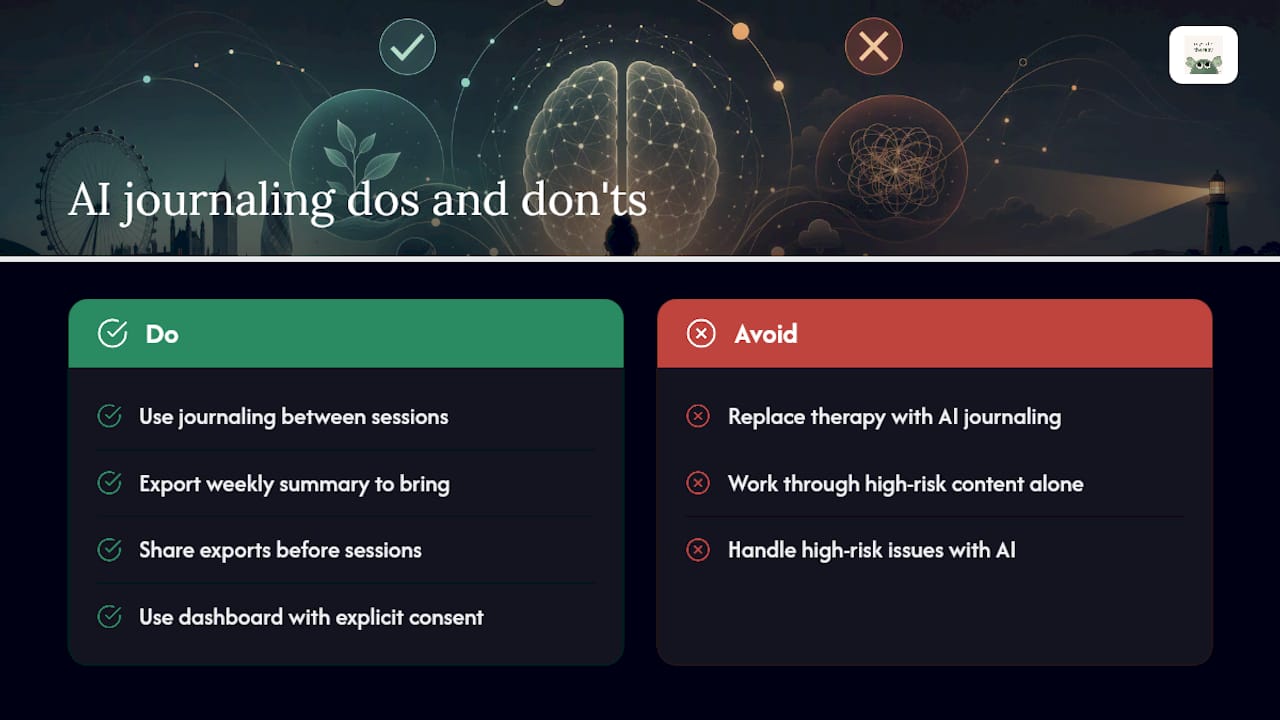
Mysafetherapy treats AI journaling as exactly what the evidence supports: a supplement between therapy sessions, not a replacement for one. Used well, a journal becomes the record you bring into a session rather than the thing that happens instead of it.
The clearest practical use is mood tracking between appointments. A client who logs a brief entry most days arrives at their next session with weeks of concrete detail rather than a foggy sense of "things have been hard," which gives a therapist far more to work with. Mysafetherapy connects clients with UK-accredited therapists registered with BACP, UKCP, and NCPS, offering sessions by video, chat, or avatar depending on what feels most comfortable, and journal exports fit naturally into that preparation whichever format you choose.
The practical recommendation is straightforward: export a weekly summary rather than the raw daily log, and bring it to session as a starting point for discussion rather than a substitute for the conversation. Where a clinician dashboard is available, use it with explicit consent each time, and let your therapist take the lead on anything flagged as high-risk content rather than working through it with an AI alone.
Mysafetherapy is transparent about the boundary here. The platform's AI self-help tools, journaling and mood tracking included, exist to support ongoing mental health management between sessions. They sit alongside therapist-matched care, not in place of it, for anyone whose needs go beyond what self-reflection alone can address.
Fitting AI journaling alongside other mental health tools
AI journaling works best as one piece of a wider toolkit rather than the whole approach. It pairs naturally with mood-tracking apps, since a mood log gives the AI's pattern detection something concrete to work from rather than just narrative text. Sleep and activity trackers add another layer: a journal that can note "your low mood entries cluster after short sleep nights" is doing something a standalone diary cannot.
The more significant integration is with therapy itself, and the research on clinician dashboards that surface summarised patient-generated data suggests this can meaningfully improve session preparation and communication between patient and therapist, provided consent and safety checks are properly in place. That's a considerably better use of the technology than treating the journal as a closed loop that never reaches a professional.
Cognitive behavioural therapy worksheets and structured self-help programmes also slot in well alongside AI journaling, since many of the reflection techniques (reframing, thought records, behavioural experiments) map directly onto what a guided AI prompt is already asking you to do. If you're already working through a CBT-based programme, look for an AI journal that lets you tag entries by theme, so the overlap between the two becomes visible rather than living in two disconnected apps. A practical resource on journaling techniques is worth a read if you want the non-AI version of these methods to compare against.
Separating the hype from the real value
The conventional pitch for AI journaling oversells the "AI" part and undersells the "journaling" part. What the strongest studies actually show is that structured, memory-aware reflection helps, and AI happens to be a reasonably good engine for delivering that structure consistently, night after night, when your own motivation runs out.
Where this goes wrong is when an app's suggestions start to feel like instructions rather than prompts. The moment a journal tells you what to think instead of asking what you think, you've lost the thing that made reflection useful in the first place, which is your own judgement doing the work.
Try these tools cautiously: read the privacy policy before your first entry, use a pseudonym while you build trust in a new app, and treat every AI insight as a starting point for your own thinking. Combine it with a therapist wherever your situation calls for one. The habit-building is real. The insight is genuinely valuable. Neither replaces professional care when you need it.
— MySafeTherapy
Combine AI journaling with a therapist who knows your history
Most standalone journaling apps stop at the entry; they can't connect what you've written to a treatment plan or flag when a pattern needs a professional eye. Mysafetherapy closes that gap by pairing AI self-help tools, including journaling and mood tracking, with therapist-matched care from practitioners registered with BACP, UKCP, or NCPS.
New clients have options for session formats and scheduling, with flexibility to adjust their therapy arrangements. If you're already journaling with AI and want a professional to help interpret the patterns it surfaces, or you're starting from scratch and want both tools in one place, book a session with an accredited therapist and bring your journal along to the first appointment.
This article is general information, not a substitute for advice from a qualified doctor. Consult a qualified healthcare professional about your own circumstances before acting on anything here.
Sources
- Resonance: Drawing from Memories to Imagine Positive Futures through AI-Augmented Journaling — MIT Media Lab
- AI-assisted reflective writing and psychological well-being: the mediating role of emotion regulation (JPA, 2026)
- MindScape Study: Integrating LLM and Behavioral Sensing for Personalized AI-Driven Journaling Experiences (PMC)
FAQ
What is the 3/2/1 method of journaling?
The 3/2/1 method asks you to write three things you're grateful for, two things that challenged you, and one thing you're looking forward to. It gives a routine shape without requiring lengthy writing, which suits both AI-guided and traditional journals.
What type of journaling is best for mental health?
Structured, regular journaling that combines short daily check-ins with a deeper weekly review tends to work best, particularly when it prompts cognitive reappraisal rather than pure venting. Evidence from the JPA study points specifically to reframing-based reflection as the mechanism behind reduced stress.
Which AI tool is best for mental health?
There is no single best AI journaling tool for every reader; the right choice depends on your priorities around privacy, memory features, and whether you want clinician integration. Look for persistent memory, transparent data handling, and, if you're already in therapy, a way to export summaries for your sessions, as offered through Mysafetherapy's AI self-help tools.
What is the best AI journaling app?
The best app for you is the one whose privacy policy you'd be comfortable reading aloud to your therapist, with genuine persistent memory rather than a gimmick, and prompting that asks questions instead of issuing advice. Trial a couple of options with light, non-identifying entries before committing your full history to one.
Can AI journaling replace therapy?
No. AI journaling can support self-reflection and habit-building between sessions, but it cannot diagnose conditions, manage a crisis, or replace the clinical judgement of an accredited therapist. If symptoms are severe or persistent, professional support should come first.