

This article gives you ready-to-use mental health journal prompts grouped by need, plus a short evidence-backed guide on using them. NHS-referenced research suggests 15 minutes of journalling, two to three times a week, can lower stress and build resilience. Skip straight to the prompt lists below, or read the brief how-to first.
TL;DR:
- Consistent journaling for 15 minutes two to three times weekly can significantly reduce stress and anxiety while enhancing resilience.
- Short, regular sessions are more effective and easier to maintain than infrequent, longer writing periods.
- Using prompts tailored to your current mood or situation helps target specific issues like anxiety, low mood, or trauma more safely.
- Digital tools and voice notes offer comparable benefits to paper journaling, especially for those with difficulty handwriting or privacy concerns.
- Combining journaling with structured techniques like thought records and mood tracking can deepen insight and reveal patterns over time.
Table of Contents
- Why journalling helps: the evidence behind mental health journal prompts
- How to use prompts: timing, formats and a simple starter routine
- Prompt lists for daily check-ins, anxiety, low mood, gratitude, self-compassion and action
- Turning prompts into insight: thought records, feedback loops and mood tracking
- How journalling fits with therapy and Mysafetherapy tools
- Keeping your journal private and safe
- Personalising prompts for your own needs and diagnosis
- Setting an intention before you write
- What actually keeps people journalling
- A gentle alternative: how Mysafetherapy can support your journalling practice
- Sources
Why journalling helps: the evidence behind mental health journal prompts
Journalling works because it forces disorganised thoughts onto a page where you can actually look at them. That act of offloading, moving worry from your head into words, reduces the mental load of carrying a problem around unexamined. Once a thought is written down, patterns become visible: the same worry resurfacing every Sunday night, or a mood dip that always follows a particular meeting.

Short, regular sessions appear to matter more than long, occasional ones. NHS-referenced guidance indicates that around 15 minutes of writing, two to three times weekly, produces measurable reductions in stress and anxiety while increasing resilience.
People who journal consistently often notice:
- Calmer, more settled sleep after writing out the day's worries
- Clearer thinking when facing a decision or conflict
- A growing habit of spotting small positives they'd otherwise miss
- Fewer thoughts circling unresolved at bedtime
How to use prompts: timing, formats and a simple starter routine
Brief sessions several times a week form a sensible starting point in an effective workflow for emotional healing. Longer sessions sound more thorough, but they're also easier to abandon after a short time. Brevity protects the habit.
You don't need a leather notebook. Voice notes and phone recordings offer comparable therapeutic benefits to pen and paper, which matters if handwriting feels effortful, if you have dyslexia, or if you simply think more clearly out loud. A basic notes app works just as well as a dedicated journalling tool for most people.
A simple starter routine:
- Pick a fixed slot, such as after your evening meal or before bed, and set a 15 minute timer.
- Choose one prompt from a relevant group below rather than trying to answer several.
- Write without editing. Grammar and structure don't matter here.
- Read the entry back and add one sentence about what you noticed.
Blank-page paralysis is common, and it's exactly why structured prompts exist as a bridge into reflection when free writing feels too open-ended. If a prompt brings up a thought you can't seem to shake or reframe, that's the moment to move from open reflection to a structured technique like a thought record, covered further down.
Pro Tip: If you sit staring at the page, write the date and one sentence about your physical state (tired, tense, restless). That single sentence is often enough to unlock the rest.
Prompt lists for daily check-ins, anxiety, low mood, gratitude, self-compassion and action
Pick whichever group matches how you feel right now rather than working through them in order. There's no correct sequence.
Daily check-in prompts
- What's the first feeling I noticed today, and where did I feel it in my body?
- What took up most of my mental energy today?
- What's one thing I'd like to let go of before I sleep?
- On a scale of one to ten, how settled do I feel, and why that number?
- What surprised me today, good or bad?
- What do I need more of right now?
Anxiety-management prompts
- What exactly am I worried will happen, in one sentence?
- What's the evidence that this fear will come true?
- What would I tell a friend who described this same worry to me?
- What's within my control here, and what isn't?
- What has helped me get through anxious moments before?
- If the worst outcome happened, what would my next step actually be?
Depression and low-mood prompts
- What's one small thing that felt slightly easier today than yesterday?
- What have I been avoiding, and what's the smallest possible step towards it?
- Who or what has offered even a moment of comfort recently?
- What would "good enough" look like for today, rather than "perfect"?
- What's a thought I've had repeatedly this week, and is it fact or feeling?
- What's one basic need (food, rest, movement) I could meet today?
Gratitude and noticing positives prompts
- What's something ordinary I'd miss if it disappeared?
- Who did something small for me recently that I haven't acknowledged?
- What's a sense (sound, smell, taste) that gave me a moment of pleasure today?
- What's something about my body I'm grateful for right now?
- What went better than expected this week?
- What's a comfort I take for granted?
Self-compassion prompts
- What would I say to a close friend in my exact situation?
- Where am I holding myself to a standard I wouldn't apply to anyone else?
- What's one way I've coped that I haven't given myself credit for?
- What does my inner critic say, and whose voice does it actually sound like?
- What's a kind action I could offer myself today?
- What have I got right, even partially, this week?
Action-focused prompts
- What's one small behaviour I could change this week, and what's the first step?
- What got in the way of a goal last time, and what would I do differently?
- What's a habit I want to build, and what could I attach it to?
- Who could support me with this change, and have I asked them?
- What would tell me I'd made progress, even a small amount?
- What's one thing I'll do differently tomorrow because of what I've written today?
If writing surfaces thoughts of self-harm or suicidal intent, stop journalling and contact your GP, call NHS 111, or reach the Samaritans on 116 123. Journal prompts support reflection; they are not a substitute for urgent mental health support.
Turning prompts into insight: thought records, feedback loops and mood tracking
Free writing is often enough. When a specific negative thought keeps resurfacing unchallenged, though, a more structured technique helps. The NHS Every Mind Matters programme recommends a seven-question thought record that walks you through the situation, the automatic thought, the emotion, the evidence for and against it, and a more balanced alternative.
| Technique | What it does | Best used when |
|---|---|---|
| Free-form prompt writing | Offloads and clarifies thoughts | General reflection, daily check-ins |
| Thought record | Challenges and reframes a specific negative thought | A worry keeps recurring unchanged |
| Feedback loop | Consolidates insight after writing | End of any journalling session |
| Mood tracking | Reveals patterns over time | You suspect a mood, sleep or trigger pattern |
A short feedback loop after any entry sharpens what you've learned: write "When I read this, I notice…" and "When I read this, I feel…" This two-line habit turns a description of your day into something closer to insight. Pairing prompts with quick mood tracking also reveals patterns a single entry can't, such as a dip that always follows poor sleep or a particular type of day at work.
How journalling fits with therapy and Mysafetherapy tools
Journalling complements therapy rather than replacing it. Many therapists use client journal entries as material to explore in session, identifying recurring themes the client might not have named aloud.
Mysafetherapy supports this alongside professional care through:
- AI-guided journaling tools that prompt reflection between sessions
- Mood tracking to surface patterns for you and your therapist
- Flexible session formats, including video, chat, and evenings and weekends
- Access to UK-accredited therapists registered with bodies such as BACP, UKCP and NCPS
Keeping your journal private and safe
A journal only works as a tool for honesty if you trust it won't be read by anyone else. That sense of a trustworthy, private setting is what allows genuinely difficult material to surface rather than staying half-written and guarded.
If you're writing on paper, a locked drawer or a notebook kept somewhere genuinely private matters more than it sounds. Shared households make this harder, so some people deliberately keep their journal at work, in a bag, or somewhere a partner or housemate wouldn't casually look.
Digital journalling raises different questions. A notes app synced to the cloud is convenient but worth checking for app lock or biometric protection, particularly if your phone is shared or often left unattended. Voice recordings carry the same consideration: label files something neutral rather than something that broadcasts their contents if a screen is glanced at.
It's worth deciding in advance what you'll do with old entries. Some people keep everything as a record of progress; others prefer to periodically shred or delete entries once they've served their purpose, particularly ones written during a crisis. Neither approach is more correct than the other.
If you're in a living situation where privacy genuinely isn't achievable, that's a legitimate reason to favour a password-protected app over a physical notebook, or to journal during hours when you're alone. The format matters far less than the sense of safety it gives you to write honestly.
Personalising prompts for your own needs and diagnosis
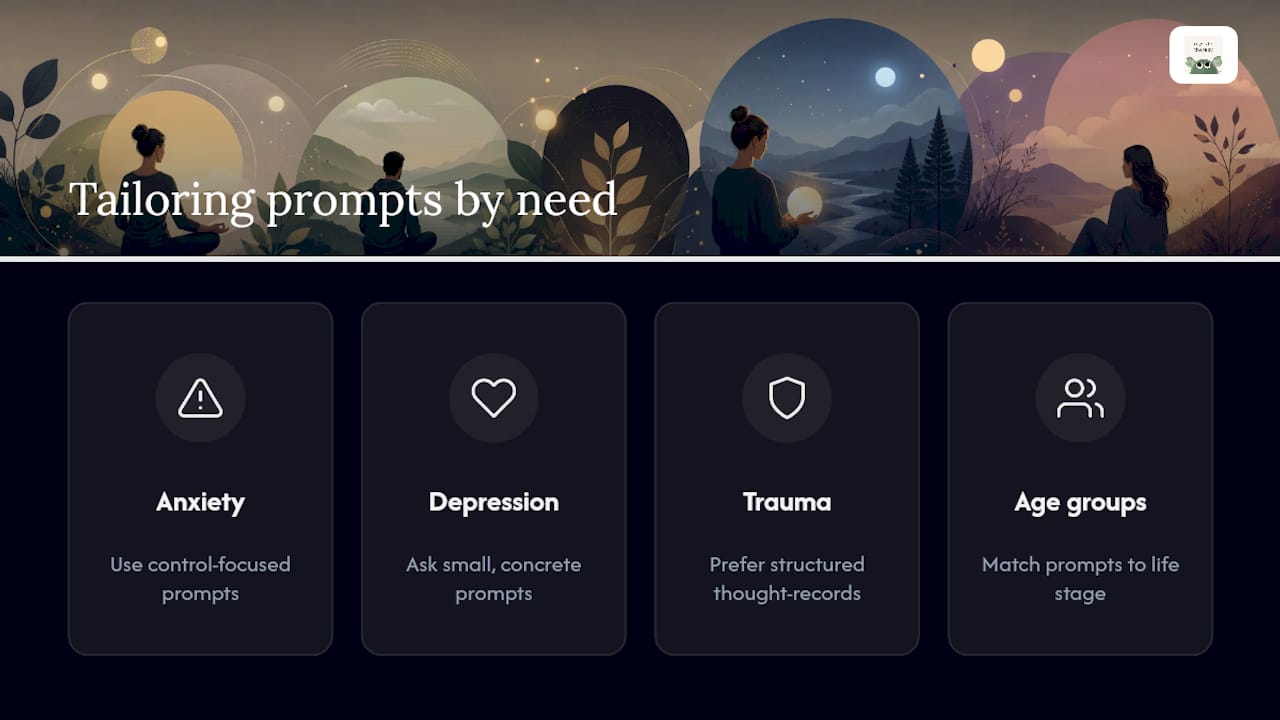
Generic prompts are a starting point, not a fixed script. If you live with a specific diagnosis, anxiety, depression, PTSD, or an eating disorder among them, some standard prompts may need adjusting or avoiding entirely.
For anxiety, prompts that ask you to imagine worst-case outcomes in detail can occasionally amplify rumination rather than settle it. If a prompt leaves you more anxious after writing than before, that's useful information: swap it for one focused on what's within your control today instead.
For depression, prompts demanding big-picture reflection ("What do I want from life?") can feel punishing on a low day. Smaller, more concrete prompts, "What's one thing that felt slightly easier today?", tend to be more workable when energy and motivation are limited.
If you experience intrusive or trauma-related thoughts, structured formats like the thought record often feel safer than open-ended prompts, because they contain the reflection within specific, answerable questions rather than leaving space for the mind to wander into distressing detail.
Age and life stage matter too. NHS resources aimed at younger people show journalling adapts well across age groups, provided the prompts match the reader's actual concerns rather than generic adult templates. A student's anxiety prompts might centre on exams and social pressure; a new parent's might focus on sleep deprivation and identity change.
There's no obligation to use every group in this article. Three or four prompts that genuinely resonate are worth more than a full set answered mechanically.
Setting an intention before you write
A prompt works better when you know, roughly, what you want from the session before you start. Sitting down with no aim beyond "I should journal" often produces vague, surface-level entries.
Before you begin, ask yourself one question: am I trying to process something specific, or simply check in with how I'm feeling generally? A processing session suits the anxiety or low-mood prompts above. A general check-in suits the daily prompts.
It's also worth setting a boundary in advance: how long you'll write for, and what you'll do if a prompt brings up something heavier than expected. Deciding this beforehand, rather than mid-entry, makes it easier to pause and step away if you need to, rather than pushing through discomfort out of a sense of obligation.
Small, realistic goals sustain the habit better than ambitious ones. "I'll write three times this week" is more achievable than "I'll journal every single day," and hitting a modest target consistently builds far more momentum than an ambitious one abandoned after four days.
What actually keeps people journalling
Try one prompt for a week before judging whether journalling works for you. Most people give up too early, expecting clarity after a single entry rather than treating it as a slow accumulation of small insights.
The habit-linking trick that seems to work best: attach journalling to something you already do without thinking, brushing your teeth, the kettle boiling, sitting down after the school run. New habits stick far better bolted onto old ones than floating free in an already busy day.
If a prompt brings up something urgent, contact your GP or NHS 111 straight away.
— MySafeTherapy
A gentle alternative: how Mysafetherapy can support your journalling practice
Journalling alone gets you a long way, but some thoughts need a second perspective to actually shift. Mysafetherapy's AI journaling tool sits between the prompts in this article and a full therapy session, offering guided reflection and mood tracking that flags patterns you might miss writing alone.
If a particular prompt keeps surfacing something you can't resolve on paper, that's often the sign it's worth talking through with someone qualified. Mysafetherapy connects you with UK-accredited therapists registered with BACP, UKCP and NCPS, with sessions available over video, chat or phone, including evenings and weekends, so you're not choosing between fitting therapy in and getting on with your week. You can bring your journal entries into session as a starting point rather than beginning from scratch each time.
If you'd rather start with self-directed tools, try the AI journaling feature first. If you're ready for guided support, you can book an online therapy session directly and take it from there.
Sources
- Journaling | Waiting Room
- Self-help CBT techniques: thought records (NHS Every Mind Matters)
- The write stuff :: Mersey Care NHS Foundation Trust
- Journaling for better mental health (Oxford Health NHS Foundation Trust)