

TL;DR:
- Mental health tracking is scientifically validated and accessible for all UK adults.
- Regular tracking improves insight, communication, and self-management of mental health conditions.
- Using validated tools and professional support ensures safe, effective, and meaningful progress.
Mental health tracking is often dismissed as something reserved for clinical settings or people managing serious diagnoses. In reality, monitoring symptoms and progress using validated tools like PHQ-9 and digital platforms such as True Colours is genuinely useful for any UK adult who wants to understand their mental health and make meaningful improvements. This article explains the science behind tracking, the direct benefits you can expect, the practical methods available, and the important risks to consider. Whether you are already in therapy or simply curious about your wellbeing, this guide gives you the information you need to start safely.
Table of Contents
- The science behind mental health tracking
- Key benefits of tracking your mental health
- Practical methods for tracking mental health
- Balancing the benefits and risks of mental health tracking
- Evidence-based guidance: choosing safe and effective tracking tools
- Our perspective: tracking mental health is powerful, but only when centred on real life
- Accessible support: take your first steps with MySafeTherapy
- Frequently asked questions
Key Takeaways
| Point | Details |
|---|---|
| Tracking deepens insight | Monitoring your symptoms and moods regularly helps you better understand your well-being patterns. |
| Enhances therapy effectiveness | Sharing tracked data with your therapist supports more focused and effective treatment sessions. |
| Balance tracking for best effect | Tracking is most useful when balanced and guided by clinician support, avoiding obsession. |
| Choose safe, evidence-based tools | Always select tracking methods with proven reliability that respect privacy and consent. |
The science behind mental health tracking
Mental health tracking is not guesswork. It is grounded in a well-established field of measurement science, and the tools available to UK adults today are more accessible than ever before.
The most widely used measurement instruments are called PROMs, which stands for Patient-Reported Outcome Measures. These are standardised questionnaires that individuals complete themselves, recording how they feel over a period of time. The PHQ-9 (Patient Health Questionnaire-9) is one of the most familiar. It contains nine questions related to depression symptoms and generates a score that helps identify severity, ranging from minimal to severe. Clinicians use this score to gauge how a person is responding to treatment, but individuals can also use it independently to monitor their own patterns.
"PHQ-9 monitoring is valued for understanding depression severity, temporal changes, informing treatment plans, facilitating dialogue, and person-centred care in primary care."
Beyond paper-based questionnaires, digital tracking platforms have transformed how this data is collected and used. True Colours, developed by Oxford Health NHS Foundation Trust, allows users to submit regular mood and symptom reports via text or smartphone. The system generates visual graphs over time, making trends immediately visible to both the user and their clinician. Well-Track is another platform used in the UK, particularly for people managing serious mental illness, and it incorporates goal-setting and physical wellbeing monitoring.
| Tool | Format | Evidence base | NHS integration | User privacy |
|---|---|---|---|---|
| PHQ-9 | Questionnaire | High (validated) | Yes | High |
| True Colours | App/text | Strong (decade of use) | Yes | High |
| Well-Track | App | Moderate | Partial | Moderate |
| Wearables (HRV) | Device | Emerging | Limited | Variable |
These tools support a broader understanding of mental health management tips by giving individuals concrete data to work with, rather than relying solely on memory or general impressions when speaking with a clinician or therapist.
Key benefits of tracking your mental health
Now that you know the science behind mental health tracking, let's look at the direct benefits you can expect from adopting a regular practice.
Research consistently shows that tracking delivers several practical advantages. According to findings published in Nature Digital Medicine, benefits include improved insight into symptoms, better communication with therapists, personalised goal-setting, early relapse detection, and enhanced self-management strategies such as lifestyle adjustments.
Here is a breakdown of the core benefits:
- Improved self-awareness. Tracking reveals patterns you might not notice in daily life, such as your mood consistently dipping on Sunday evenings or your anxiety rising during particular weeks. This kind of awareness is the starting point for change.
- Stronger communication in therapy. Arriving at a session with concrete data, rather than trying to recall how you felt over the past fortnight, makes conversations more productive. Your therapist can see patterns and tailor sessions accordingly.
- Realistic goal-setting. When you can see where you started, you can set meaningful targets and observe progress. This builds motivation and a clearer sense of direction.
- Early relapse detection. For people managing depression, bipolar disorder, or anxiety, gradual worsening of symptoms can be difficult to perceive from the inside. Tracking provides an external reference point that can flag deterioration early.
- Better self-management. Identifying which lifestyle factors (sleep, exercise, social contact) correlate with better mood helps you make informed choices about self-help tools for anxiety and depression and daily habits.
Statistic: True Colours has been used by over 36,000 UK patients with good compliance, and Well-Track showed improvements in physical fitness, mood, and self-confidence among people managing serious mental illness.
These figures matter. They indicate that sustained, real-world use of tracking tools by a large population produces measurable outcomes, not just theoretical benefits.
The benefits also extend to how you use therapy self-help resources between sessions. Tracking keeps your mental health active in your mind without requiring a formal appointment, which builds consistency and momentum.
Pro Tip: Record not just your symptoms but also context, including stress levels, sleep quality, and daily routines. This richer data gives far more useful insights than scores alone, and makes discussions with your therapist significantly more informative.
Practical methods for tracking mental health
You understand the benefits. Now here is exactly how you can start tracking your mental health using practical, real-world tools that are accessible from the UK today.
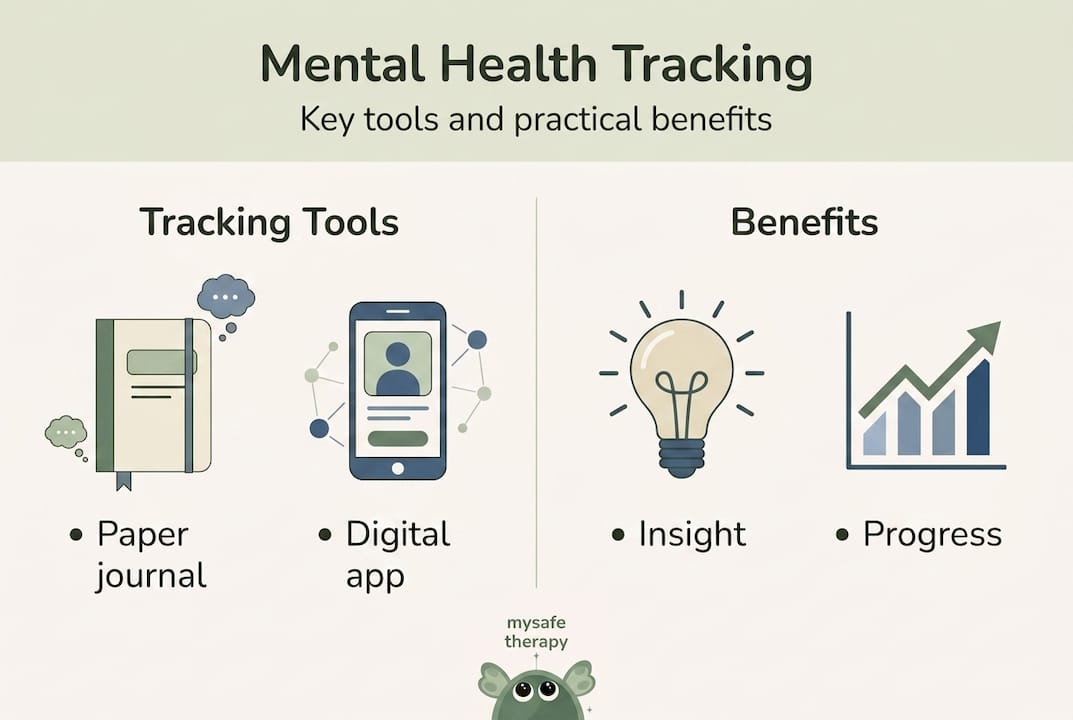
There are three main categories of tracking method: digital apps, paper-based tools, and wearable devices. Each has distinct strengths, and combining them often produces the best results. As research published in New Scientist highlights, wearables using HRV (heart rate variability) provide a physiological measure of stress that complements self-report questionnaires. HRV is the variation in time between each heartbeat. A higher HRV generally indicates better stress resilience, and tracking it over time can reveal when your nervous system is under sustained pressure, even when you feel outwardly functional.
Step-by-step guide to getting started safely:
- Choose one primary tool. Avoid overwhelming yourself at the start. Begin with a single method, such as a daily mood app or a weekly PHQ-9 score, and commit to it for four weeks.
- Set a regular time. Consistency matters more than frequency. Tracking at the same time each day, for example before bed, produces more comparable data than sporadic recordings.
- Record context alongside scores. Note relevant factors: hours of sleep, significant events, physical activity, and social interactions. This contextual layer transforms numbers into meaningful narratives.
- Share your data with a professional. Tracking is most effective when reviewed with a therapist or GP who can help interpret trends and adjust support accordingly. Consider types of mental health support online that facilitate data sharing within sessions.
- Review and adjust monthly. What works for one person may not suit another. After a month, assess whether your chosen method is practical and meaningful, and adjust your approach accordingly.
- Gradually introduce complementary tools. Once one method is established, add a secondary layer, such as a wearable for physiological data or a journalling prompt for qualitative reflection.
For those considering starting online therapy, integrating tracking from the outset means your therapist has rich data to inform early sessions, reducing the time spent reconstructing your mental health history.
Paper-based methods remain valuable, particularly for those who prefer not to use smartphone apps or are concerned about digital privacy. A simple mood chart with daily ratings from one to ten, alongside brief written notes, costs nothing and creates a tangible record that can be brought to any appointment. Bullet journalling is another popular approach, allowing flexible, personal records of emotional states, energy levels, and significant events.

Balancing the benefits and risks of mental health tracking
While tracking offers many strengths, it is vital to consider its possible risks and how to approach it wisely.
Not all tracking experiences are positive. The same data that empowers one person may distress another. It is important to be aware of the following concerns:
- Tracking fatigue. Completing daily check-ins can become burdensome, particularly during periods of low motivation. If tracking starts to feel like a chore, it is a sign to simplify or pause.
- Data obsession. Focusing excessively on scores can shift attention away from lived experience and towards numbers. Some individuals find this increases rather than reduces anxiety.
- Privacy concerns. Mental health data is sensitive. Not all apps have robust privacy protections, and some share data with third parties. Reading privacy policies carefully is essential before committing to any digital tool.
- Inappropriate use in clinical settings. NHS England guidance notes that digital tracking is not suitable for all contexts, particularly inpatient settings, where surveillance without strong evidence can be harmful.
Research also highlights a clear tension: while tracking benefits insight and personalisation, excessive tracking risks obsession or heightened anxiety, and balance with clinician oversight is described as the key to sustainable practice.
The relationship between physical health and mental wellbeing is also relevant here. External factors, including food and mental health effects, can influence mood scores significantly, making it important not to interpret tracking data in isolation.
Safe tracking is also informed by good online therapy safety guidance, which emphasises the importance of choosing accredited professionals and evidence-based tools.
Pro Tip: Review your tracking habits monthly. If completing check-ins regularly feels stressful or you find yourself fixating on your scores, raise this with your therapist. Tracking should create clarity, not generate additional pressure.
Evidence-based guidance: choosing safe and effective tracking tools
To wrap up, here is how you can confidently choose safe and effective tracking solutions, guided by official recommendations that apply directly to UK adults.
Selecting a mental health tracking tool requires more than reading positive app store reviews. There are clear standards to apply:
- Look for NHS or MHRA recognition. The Medicines and Healthcare products Regulatory Agency (MHRA) has issued specific guidance on mental health apps. Following MHRA guidance means checking whether a tool has a demonstrated evidence base, clear safety information, and transparent data practices.
- Prioritise validated PROMs. Questionnaires like the PHQ-9 and GAD-7 (Generalised Anxiety Disorder-7) are clinically validated, meaning they have been rigorously tested for accuracy and reliability. Using these in combination with digital platforms provides a strong evidence foundation.
- Check for consent and data ownership. You must understand who holds your data, how it is stored, and whether it can be deleted on request. This is a legal right under UK GDPR and an important practical safeguard.
- Seek clinician-supported tools. Validated PROMs and clinician-supported tools like True Colours promote accessible progress monitoring, align with NHS routine outcome measures, and actively support wellbeing improvement. This dual function, serving both individual users and their care teams, is a mark of quality.
- Do not interpret results in isolation. Scores require context. A rising PHQ-9 score may reflect a difficult week rather than a deteriorating condition. Reviewing data with a qualified professional ensures that interpretation is accurate and proportionate.
Returning to core mental health management tips is always useful at this stage. Tracking is one component of a broader approach to managing and improving mental health, not a standalone solution.
Our perspective: tracking mental health is powerful, but only when centred on real life
We have covered the facts and official guidance. Here is a direct, experience-led view on what best practice in mental health tracking actually looks like when applied to real lives.
The most common mistake people make when starting to track their mental health is treating their score as the goal. A seven on a mood scale is not success. Leaving the house, reconnecting with a friend, managing a difficult conversation without shutting down: these are the markers of progress that truly matter. Data should inform that kind of progress, not replace it.
In our view, the best results come when tracking informs rather than controls your approach to wellbeing. There is a meaningful difference between using a PHQ-9 score to start a conversation with your therapist and using it to judge whether you are allowed to feel okay today. The former is genuinely useful. The latter can become a form of self-surveillance that increases distress rather than reducing it.
People benefit most when digital tools are used alongside therapy and a compassionate professional. A graph showing a consistent decline in mood over six weeks is far more actionable when discussed with someone who knows your circumstances, your history, and the particular pressures you are navigating. Tracking tools are not diagnostic. They are observational, and observation without interpretation has limited value.
True mental health progress is not a perfect upward chart. It is a life that feels more manageable, more your own, and more connected to what you value. The question worth asking regularly is not "What is my score today?" but rather "Is my tracking helping me feel more empowered, or more anxious?" If the honest answer is the latter, that is important information in itself.
Working with personalised therapy support alongside tracking tools creates the conditions where genuine, lasting change becomes possible. One without the other is less effective. Together, they give you both the data and the human understanding to act on it meaningfully.
Accessible support: take your first steps with MySafeTherapy
If this article has shown you anything, it is that mental health tracking is most effective when it sits alongside professional support, not in place of it. Understanding your patterns is the first step. Knowing what to do with that understanding is where therapy makes the difference.
MySafeTherapy connects you with UK-accredited therapists registered with BACP, UKCP, and NCPS, who can help you interpret your tracking data and use it to guide genuinely personalised support. Whether you prefer video sessions, chat-based therapy, or avatar sessions that offer extra privacy, the platform is built around your comfort and schedule, including evenings and weekends. AI journalling and mood tracking tools are built into the platform, so your self-monitoring and your therapy work in alignment. You can start therapy online today and take your first properly supported step towards understanding your mental health with the guidance of a qualified professional.
Frequently asked questions
Is tracking mental health only for people with diagnosed conditions?
No. Tracking benefits anyone seeking insight or improvement, not just those with formal diagnoses. It is a practical tool for general self-awareness and wellbeing management.
Can tracking make mental health worse?
For some individuals, over-tracking may raise anxiety or increase focus on symptoms unhelpfully. NHS guidance acknowledges this risk, which is why clinician input and regular review of your tracking habits are recommended.
What is the most reliable method to track mental health?
Validated PROMs and clinician-supported digital tools like True Colours are recommended, as they have a demonstrated evidence base and align with NHS routine outcome measures.
Do I need permission to use mental health apps?
You do not need external permission, but you should carefully review privacy policies, consent terms, and safety information. MHRA guidance advises checking an app's evidence base and safety credentials before use.