

TL;DR:
- Standard UK mental health programs often have high dropout rates due to rigid formats.
- Personalised therapy adapts methods, timing, and content to individual needs for better engagement.
- Digital innovations and flexible approaches offer scalable, effective, and tailored mental health support.
Standard mental health programmes in the UK leave a significant number of people behind. High dropout rates in NHS therapy programmes raise serious questions about whether a one-size-fits-all model can genuinely serve the range of people seeking support for anxiety, depression, and relationship difficulties. The reality is that many adults disengage not because therapy does not work, but because the format, timing, or approach does not fit their lives. This guide explains what personalised therapy is, how it is delivered, where the challenges lie, and how you can find a flexible, confidential option that actually suits you.
Table of Contents
- Understanding personalised therapy: What it is and why it matters
- How personalised therapy works: Methods and digital innovations
- Challenges and nuances of personalisation: From dropouts to scalability
- Applying personalised therapy: Finding the right fit online
- A fresh perspective on personalised therapy: Evidence-based or overhyped?
- Explore flexible, personalised therapy options today
- Frequently asked questions
Key Takeaways
| Point | Details |
|---|---|
| Personalisation drives engagement | Tailored therapy approaches help UK adults stick with treatment and address unique needs. |
| Modular and digital methods | Flexible treatments and AI-powered platforms make personalisation scalable and confidential. |
| Challenge of scalability | Too much individualisation can reduce service capacity, so evidence-based models are preferable. |
| Practical steps for UK adults | Ask about personalisation methods, digital tools, and therapist matching when choosing a provider. |
Understanding personalised therapy: What it is and why it matters
Personalised therapy is a structured approach to mental health care that adapts its methods, format, and content to the individual rather than applying a fixed protocol to everyone. It differs from standard therapy in a fundamental way: rather than assigning every person the same six or twelve sessions of cognitive behavioural therapy (CBT), it takes into account your specific concerns, preferences, schedule, and how you respond as treatment progresses.
Standard therapy often struggles with engagement. Many people find that sessions are too infrequent, too rigid in format, or simply not matched to the severity or type of problem they are experiencing. Personalised approaches enhance engagement and acceptability compared to one-size-fits-all methods, which is a meaningful distinction when you are dealing with something as variable as anxiety or depression.
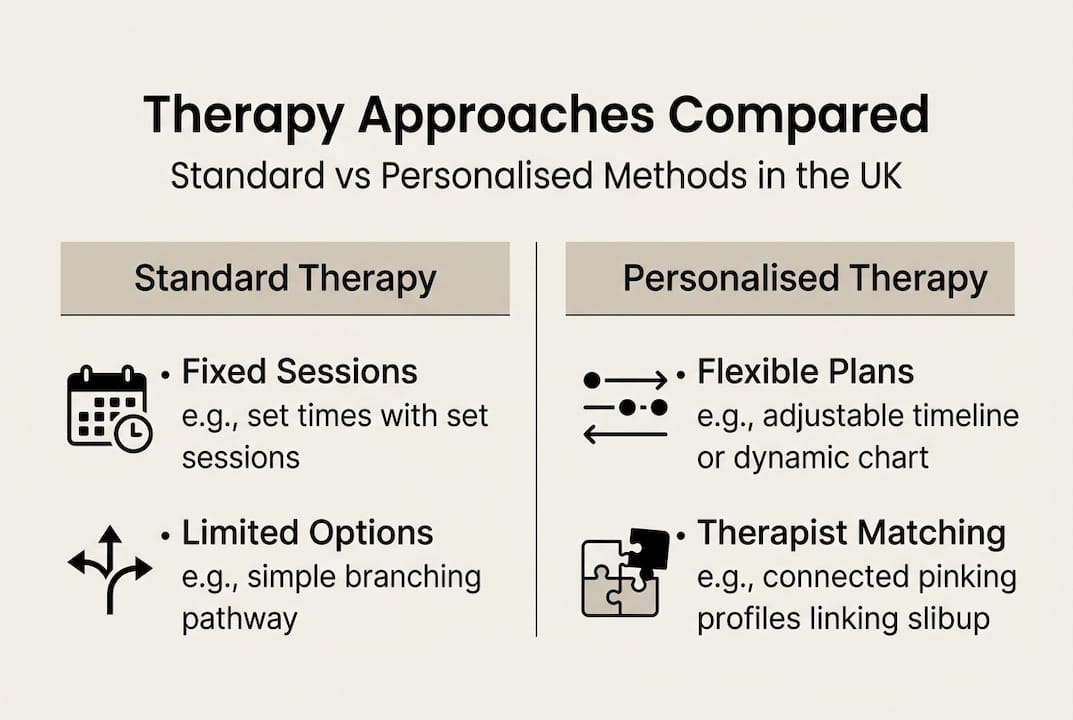
For anxiety, personalisation might mean choosing between exposure-based techniques and mindfulness-led methods depending on your history and comfort. For depression, it could involve adjusting session frequency based on how you are responding week to week. For relationship challenges, it might mean selecting a therapist with specific experience in attachment or communication difficulties.
Key features that distinguish personalised therapy include:
- Therapist matching based on your presenting concerns and personal preferences
- Flexible session formats, including video, chat, or avatar-based options
- Adjustable treatment intensity, so sessions can increase or decrease as needed
- Ongoing feedback loops that allow the therapist to adapt their approach
- Choice of modality, such as CBT, psychodynamic therapy, or integrative methods
Exploring self-guided therapy options alongside live sessions can also add a layer of personalisation that standard programmes rarely offer. Understanding effective therapy techniques helps you make informed choices before committing to a particular approach.
"Personalisation in therapy is not about making every session unique for its own sake. It is about systematically adjusting care to improve the likelihood of meaningful engagement and recovery."
Pro Tip: Before starting any therapy, write down three things that have made previous support feel unhelpful. These specifics will help you identify what a personalised approach needs to address for you personally.
Access to flexible therapy sessions and quality therapist matching are two of the most practical indicators that a platform takes personalisation seriously.
How personalised therapy works: Methods and digital innovations
Understanding what personalised therapy is leads naturally to the question of how it is actually delivered. The methods range from structured modular treatments to sophisticated digital platforms that adapt in real time.
Methodologies include modular treatments, guided self-help, adaptive digital platforms, prediction models, and collaborative care. Each of these serves a different function within a personalised framework.
Here is how the main delivery approaches compare:
| Approach | Flexibility | Scalability | Clinician involvement |
|---|---|---|---|
| Modular therapy | High | Moderate | Active |
| Fully bespoke therapy | Very high | Low | Intensive |
| Digital adaptive platforms | Moderate | High | Variable |
Modular therapy breaks treatment into discrete components. A therapist selects the modules most relevant to your needs, such as sleep hygiene, worry management, or interpersonal skills, and sequences them accordingly. This is more flexible than a fixed protocol but still structured enough to be delivered at scale.

Digital platforms, including those using artificial intelligence and machine learning, adapt content based on your responses, mood tracking data, and session feedback. Some platforms use prediction models such as PETRUSHKA, which analyses clinical data to forecast which treatment is most likely to result in remission for a given individual.
The practical steps for starting with a digital personalised platform typically follow this sequence:
- Complete an initial assessment covering your symptoms, history, and preferences
- Receive a recommended therapist match or treatment pathway
- Begin sessions in your chosen format, such as video or chat
- Provide ongoing feedback that informs session adjustments
- Review progress at agreed intervals with your therapist
Understanding the range of online therapy types available helps you identify which format suits your lifestyle. The role of AI in online therapy is expanding rapidly, and knowing how these tools work gives you a clearer picture of what to expect from a modern personalised platform.
Collaboration between clinician and client remains central to all of these methods. Technology supports the process, but the therapeutic relationship is still the mechanism through which change occurs.
Challenges and nuances of personalisation: From dropouts to scalability
Personalisation in therapy is a sound principle, but its real-world application involves significant challenges. Understanding these helps you make more realistic assessments of what any given platform or service can deliver.
High dropout rates of 45% and one-session exit rates of 29% in standard programmes signal that personalisation needs to address both engagement and scalability simultaneously. These figures are not just administrative problems. They represent people who needed support and did not receive it in a form that worked for them.
The following factors complicate the delivery of truly personalised therapy at scale:
- NHS capacity constraints limit the degree to which clinicians can tailor treatment for every individual
- Younger adults, particularly those aged 18 to 30, show higher dropout rates and require more intensive tailoring
- Prediction models, while promising, have limited external validation and may not generalise across diverse populations
- Digital access barriers mean that not all adults can benefit equally from platform-based personalisation
- Therapist training variability affects how consistently personalised approaches are applied in practice
Scalability is perhaps the most persistent tension. A fully bespoke approach that works well for one person requires considerable clinician time and cannot easily be replicated across a large caseload. Modular and digital approaches offer a practical middle ground, but they require careful implementation to avoid becoming as rigid as the standard protocols they aim to replace.
| Challenge | Impact on personalisation | Practical response |
|---|---|---|
| High dropout rates | Reduces outcome data | Improve early engagement |
| Prediction model limits | Reduces treatment accuracy | Use as one input, not sole guide |
| NHS capacity | Restricts tailoring | Supplement with private/online options |
Reviewing mental health management tips alongside your therapy plan can help you stay engaged between sessions and reduce the risk of early dropout.
Pro Tip: When assessing a therapy provider, ask directly: "How do you adjust my treatment if I am not responding?" A clear, specific answer indicates genuine personalisation. A vague response suggests a more standardised model.
Applying personalised therapy: Finding the right fit online
Knowing the barriers to personalisation helps you approach the search for online therapy with clearer criteria. The goal is to find a provider that combines evidence-based methods with genuine flexibility and confidentiality.
Digital platforms with personalisation improve adherence and outcomes, particularly when they offer evidence-based modular options rather than generic content. This is a practical benchmark you can apply when evaluating any online service.
One notable data point: digital prediction tools have reached 71% accuracy for remission in clinical settings, which represents a meaningful improvement over unguided treatment selection. This is not a guarantee, but it illustrates the potential of well-designed personalised platforms.
When assessing an online therapy platform, look for the following:
- Therapists registered with BACP, UKCP, or NCPS
- Clear information on how therapist matching works
- Options for video, chat, or alternative session formats
- Transparent pricing and flexible session frequency
- A stated process for adjusting treatment based on your progress
- Confidentiality policies that are clearly explained
The practical steps for starting online personalised therapy are straightforward:
- Identify your primary concern, such as anxiety, depression, or relationship difficulties
- Research platforms that specialise in that area and offer modular or adaptive options
- Complete an initial assessment and review the recommended match before committing
- Confirm session format, frequency, and cost in advance
- Agree with your therapist on how progress will be measured and reviewed
Reading a clear guide on starting online therapy removes much of the uncertainty from this process. If you are currently using a platform that does not feel right, exploring online therapy alternatives may surface options better suited to your needs.
The right fit is not always the first option you try. Personalisation includes the freedom to change providers without starting from scratch.
A fresh perspective on personalised therapy: Evidence-based or overhyped?
There is a tendency in mental health discourse to treat personalisation as an unqualified good. The evidence is more nuanced. Modular and digital approaches are more realistic for the current capacity of UK services than fully bespoke therapy, and they deliver measurable improvements in engagement and remission rates. Fully bespoke models, while appealing in principle, face serious implementation challenges around scalability and consistency.
What most people miss is that personalisation is often incremental rather than absolute. A platform that adjusts session frequency based on your feedback is personalising your care, even if it is not redesigning your entire treatment plan each week. That incremental adjustment is where real value lies.
The hype around AI-driven personalisation is real, but so is the progress. The key is to distinguish between platforms using technology as a genuine clinical tool and those using it as a marketing term. Reviewing flexible online therapy options with this lens in mind leads to more informed decisions.
Personalisation works best when it is treated as a process, not a feature.
Explore flexible, personalised therapy options today
If this guide has clarified what personalised therapy involves and why it matters, the next step is straightforward: find a provider that puts these principles into practice.
MySafeTherapy connects UK adults with accredited therapists registered with BACP, UKCP, and NCPS, offering video, chat, and avatar-based sessions at times that suit your schedule, including evenings and weekends. The platform uses therapist matching, AI journaling, and mood tracking to support a genuinely adaptive approach to your care. Pricing is transparent, sessions are flexible, and switching therapists is straightforward if your needs change. You can start personalised therapy today or explore the full range of confidential online therapy options available to you.
Frequently asked questions
Is personalised therapy more effective than standard therapy?
Personalised approaches enhance engagement and acceptability compared to standard methods, though real-world implementation varies and one-session dropout rates remain a challenge across services.
What digital tools are used in personalised online therapy?
Digital platforms use AI, machine learning, guided self-help modules, and adaptive therapy content to tailor treatment selection and adjust session content based on your responses.
How can I ensure my therapy is truly personalised?
Ask providers how they match therapists, adjust treatment over time, and use patient preferences as part of their clinical process. Specific, structured answers indicate genuine personalisation.
Does personalised therapy guarantee better results for anxiety and depression?
Personalised therapy improves adherence and remission rates, with prediction tools reaching 71% accuracy for remission in some settings, though outcomes still depend on individual circumstances and platform quality.
Recommended
- Types of online therapy for flexible mental health care
- Why flexible therapy sessions improve mental health support
- Essential mental health management tips for UK adults
- What is self-guided therapy? Mental health for UK adults
- Parks Therapy Centre | Established in 1986 | Physiotherapy, Acupuncture & more