
TL;DR:
- Self-guided therapy based on CBT offers an effective, accessible alternative for mild to moderate mental health symptoms.
- It involves self-paced modules using workbooks or apps, emphasizing techniques like behavioral activation and cognitive restructuring.
- Success depends on consistent engagement, individual fit, and recognizing when to seek more structured professional support.
Many people assume that managing anxiety, depression, or stress always requires a therapist in the room. That assumption holds a lot of people back from getting any support at all. Self-guided therapy, based on CBT principles, offers a practical, evidence-based alternative that you can work through independently, at your own pace, without waiting lists or referrals. It is not a workaround or a lesser option. For mild to moderate symptoms, it can be genuinely effective. This article explains what self-guided therapy is, how it works, which UK tools are worth your time, and how to decide whether it is the right fit for you.
Table of Contents
- Understanding self-guided therapy: Key principles and definition
- How self-guided therapy works: Tools, modules and techniques
- Effectiveness and limits: Evidence and real-world impact
- How to choose, apply, and stay motivated: Practical tips for UK adults
- Why the individual fit matters: Beyond the one-size-fits-all approach
- Start your self-guided therapy journey with MySafeTherapy
- Frequently asked questions
Key Takeaways
| Point | Details |
|---|---|
| Clear definition | Self-guided therapy lets you manage mental health independently using trusted techniques and UK apps. |
| Proven methods | CBT-based interventions are delivered through structured modules, workbooks, and reliable digital tools. |
| Real-world effectiveness | Empirical evidence shows small-to-moderate benefits for anxiety and depression, best for mild-moderate cases. |
| Individual fit paramount | Adherence and personal context matter more than app selection for successful outcomes. |
| Practical UK resources | Adults in the UK can access safe, confidential self-guided therapy via NHS and approved apps anytime. |
Understanding self-guided therapy: Key principles and definition
Self-guided therapy, sometimes called unguided therapy, is a structured approach to mental health support that you work through without direct therapist involvement. It draws heavily on cognitive behavioural therapy (CBT), which is one of the most researched and clinically validated psychological treatments available. CBT works on the principle that thoughts, feelings, and behaviours are interconnected. By changing unhelpful thought patterns, you can shift how you feel and act.
The self-help therapy overview that underpins most programmes typically includes three core CBT techniques:
- Behavioural activation: Scheduling meaningful activities to counteract low mood and withdrawal
- Cognitive restructuring: Identifying and challenging distorted or unhelpful thoughts
- Relaxation techniques: Controlled breathing, progressive muscle relaxation, and grounding exercises
These techniques are delivered through workbooks, apps, or online modules rather than face-to-face sessions. You set the pace, complete exercises between sessions, and track your own progress. There is no therapist scheduling your appointments or reviewing your homework in real time.
This is what distinguishes self-guided therapy from guided or face-to-face therapy. In guided formats, a therapist or coach provides feedback, accountability, and clinical oversight. In self-guided formats, CBT-based techniques are applied independently, which places more responsibility on the individual but also removes barriers like cost, availability, and stigma.
"The most significant shift in mental health care over the past decade has not been a new drug or a new diagnosis. It has been the recognition that structured self-help, when properly designed, can produce real clinical outcomes."
In the UK context, self-guided therapy has become increasingly relevant. NHS waiting times for talking therapies can stretch to months. Private therapy carries a significant cost. Self-guided options, many of which are free or low-cost, fill a genuine gap. The growth of AI in online therapy has further expanded what is possible without direct human involvement, making self-guided programmes more responsive and personalised than ever before.
How self-guided therapy works: Tools, modules and techniques
A typical self-guided therapy programme follows a structured sequence. You do not simply download an app and hope for the best. The process is deliberate and progressive.
- Assessment: You complete an initial questionnaire to identify your primary concerns, whether anxiety, low mood, sleep difficulties, or stress.
- Psychoeducation: The programme explains the psychological mechanisms behind your symptoms, helping you understand why you feel the way you do.
- Skill-building modules: You work through CBT-based exercises at your own pace, covering techniques such as thought records, worry postponement, and behavioural experiments.
- Practice and homework: Between modules, you apply what you have learned in real-life situations and record your observations.
- Progress monitoring: Mood tracking and self-assessment tools help you measure change over time and adjust your approach accordingly.
CBT modules teach skills including mindfulness, self-monitoring, and problem-solving through apps and online tools. Meanwhile, digital mental health tools deliver psychoeducation, relaxation exercises, and exposure techniques specifically for anxiety.
The following table summarises the most widely used self-guided therapy tools available to UK adults:
| Tool | Format | Primary focus | Cost |
|---|---|---|---|
| SilverCloud | Online platform | Anxiety, depression | Free via NHS referral |
| WorryTree | Mobile app | Worry and anxiety | Free |
| My Possible Self | Mobile app | Stress, anxiety, low mood | Free basic version |
| Reading Well books | Bibliotherapy | Anxiety, depression, OCD | Free via libraries |
For therapy types for anxiety, the choice of tool matters less than consistent engagement. Each platform structures its content differently, but all rely on the same underlying CBT framework.
Pro Tip: Set a fixed time each day for your self-guided therapy module, even if it is only 15 minutes. Consistency matters far more than session length. Treat it like a scheduled appointment you cannot cancel.
If you are unsure where to begin, the therapy for anxiety and depression guide provides a clear starting point for matching your symptoms to the right approach.
Effectiveness and limits: Evidence and real-world impact
The evidence base for self-guided therapy is substantial, though it is not without nuance. Understanding both the strengths and the boundaries of this approach is essential before committing to it.
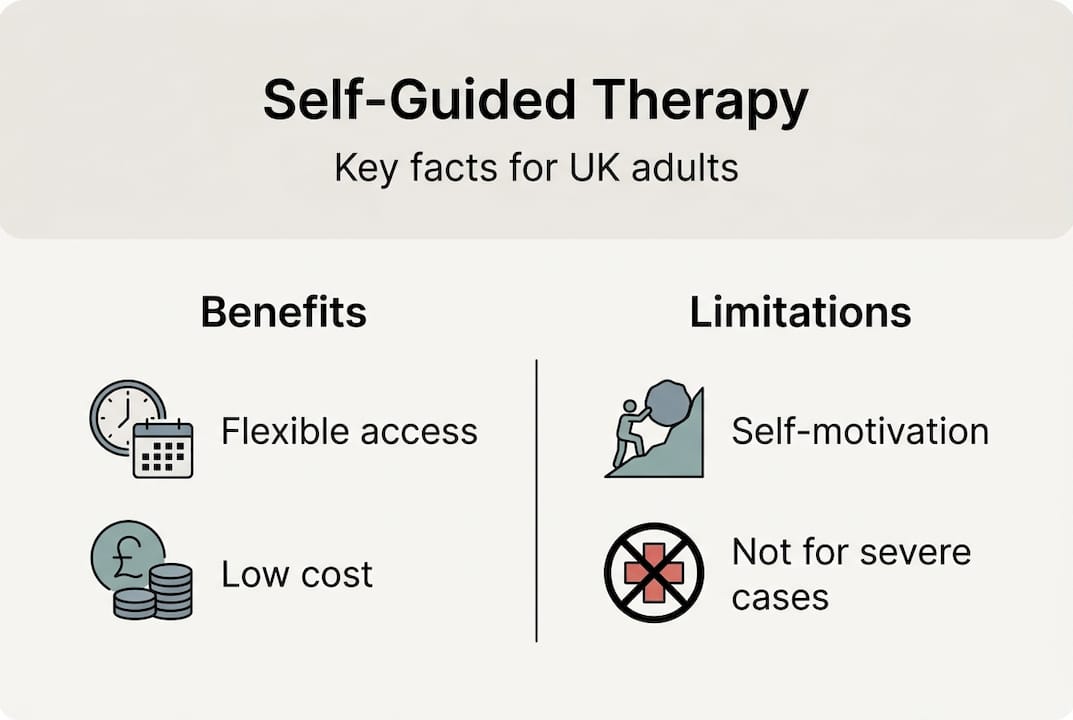
Unguided digital CBT reduces depression with a standardised mean difference of 0.63 and produces medium effect sizes for anxiety compared with no treatment. SilverCloud, one of the most widely studied platforms in the UK, reports 65 to 80 per cent improvement rates among users who complete the programme. These are clinically meaningful figures.
However, the picture is more complex when you look at who benefits most.
- Mild to moderate symptoms: Self-guided therapy is most effective here. People with manageable levels of anxiety or low mood tend to respond well.
- Severe symptoms: The evidence is less supportive. Those experiencing severe depression, panic disorder, or trauma-related conditions typically require more intensive support.
- Adherence: This is the decisive variable. Drop-out rates in unguided programmes are higher than in guided formats. Without accountability, motivation can wane.
| Factor | Self-guided therapy | Guided therapy |
|---|---|---|
| Cost | Low to free | Moderate to high |
| Flexibility | High | Moderate |
| Adherence | Lower | Higher |
| Effectiveness (mild) | Comparable | Comparable |
| Effectiveness (severe) | Limited | Stronger |
| Waiting time | Minimal | Can be lengthy |
Guided therapy offers better adherence in NHS settings, though unguided approaches can match guided outcomes for some individuals. A Cochrane review confirms self-help is effective for anxiety disorders, while recent outcome data reinforces that completion rates are the strongest predictor of success.
Pro Tip: If you find yourself repeatedly skipping modules or losing track of your progress, that is not a personal failing. It is a signal that you may benefit from a more structured format with some human support built in.
For broader context on managing mental health day to day, the mental health management tips resource covers practical strategies that complement any self-guided programme.
How to choose, apply, and stay motivated: Practical tips for UK adults
Choosing the right self-guided therapy tool is not simply a matter of downloading the most popular app. The fit between the tool and your specific situation determines how useful it will be.
When evaluating options, consider the following:
- Symptom match: Does the programme address your primary concern, whether that is anxiety, low mood, sleep, or stress?
- Evidence base: Is the tool grounded in CBT or another validated approach? Avoid programmes that lack clinical backing.
- Accessibility: Is it available on your preferred device? Can you access it at the times you are most likely to engage?
- Cost: Many NHS-endorsed options are free. The NHS self-help guide lists available UK resources including SilverCloud, WorryTree, Reading Well books, and My Possible Self.
- Privacy: Confirm the platform's data handling practices before entering personal health information.
Adherence is critical for effectiveness, and meta-analyses highlight that individual fit is a key factor in outcomes. In practical terms, this means the best programme is the one you will actually complete.
To stay motivated, structure matters. Set a weekly goal, such as completing two modules or practising one technique daily. Use the mood tracking features built into most apps. Review your progress at the end of each week and adjust your approach if something is not working.
Pro Tip: Pair your self-guided programme with a simple journalling habit. Writing three sentences about your mood and any patterns you notice each evening takes less than five minutes and significantly improves self-awareness over time.
If you are exploring alternatives to specific platforms, the moodhealth alternatives guide offers a useful comparison. For those new to online support, the accessible online therapy guide and the guide to safe online support provide clear, practical starting points. If cost is a concern, the affordable therapy guide outlines cost-effective options across the UK.
Know when to escalate. If your symptoms worsen, if you experience thoughts of self-harm, or if daily functioning becomes significantly impaired, self-guided therapy is not sufficient. Contact your GP, NHS Talking Therapies, or emergency services without delay.
Why the individual fit matters: Beyond the one-size-fits-all approach
Most discussions of self-guided therapy focus on the tools themselves: which app is best, which platform has the strongest evidence, which technique works fastest. That framing misses the point.
The decisive factor is not the quality of the programme. It is whether you will engage with it consistently, in your specific circumstances, with your specific symptoms and motivations. Meta-analyses confirm broad benefits, but they also reveal significant heterogeneity. The same programme produces very different outcomes across individuals.
This is not a reason to avoid self-guided therapy. It is a reason to choose carefully and honestly. If you know you struggle with self-directed tasks, a fully unguided format may not serve you well. If you value privacy and flexibility above all else, it may be exactly right.
The mental health tips perspective we hold at MySafeTherapy is straightforward: the best therapy is the one that fits your life, not the one with the highest average effect size in a clinical trial. Start with honest self-assessment, choose accordingly, and remain open to adjusting your approach as your needs change.
Start your self-guided therapy journey with MySafeTherapy
If this article has clarified what self-guided therapy involves and whether it might suit you, the next step is straightforward. MySafeTherapy provides a confidential, accessible environment where you can start therapy at your own pace, with the option to connect with a UK-accredited therapist if and when you need more structured support.
You are not committed to a single format. MySafeTherapy offers flexible options including self-help tools, AI journalling, mood tracking, and one-to-one sessions with therapists registered with BACP, UKCP, or NCPS. Whether you begin with self-guided resources or move directly to live support, discover MySafeTherapy and find an approach that genuinely fits your situation, your schedule, and your preferences.
Frequently asked questions
Is self-guided therapy suitable for severe anxiety and depression?
Self-guided therapy works best for mild to moderate symptoms. For severe cases, guided or face-to-face therapies are generally more appropriate and effective.
Which apps or platforms are recommended for self-guided therapy in the UK?
Popular options include SilverCloud, WorryTree, My Possible Self, and Reading Well books, all of which are NHS-endorsed resources and widely accessible across the UK.
How effective is self-guided therapy compared with guided therapy?
Unguided therapy can match guided therapy for some outcomes, but guided therapy improves adherence and symptom reduction, particularly within NHS stepped-care settings.
What should I do if my symptoms worsen during self-guided therapy?
If symptoms escalate, self-guided therapy is not sufficient. Seek support from your GP, NHS Talking Therapies, or emergency services. Self-help is not suitable for crisis situations or severe trauma.
Recommended
- Essential mental health management tips for UK adults
- What is self-help therapy? A guide to mental health support
- Your step-by-step guide to accessible online therapy
- Online therapy safety for UK adults: 2026 guide
- Featured Mindfulness Course | Mindful Self Compassion in Support of Psychedelic-Assisted Therapy