
Managing anxiety or depression while keeping your daily life intact is a genuine challenge for millions of UK adults. Stigma, long waiting lists, and the sheer number of available options can make finding the right support feel more stressful than the problem itself. Yet the evidence is clear: structured self-help, combined with the right therapy format, produces measurable improvements. This guide covers practical techniques, a direct comparison of NHS, private, and app-based therapy, and a step-by-step framework for choosing the approach that fits your life, your schedule, and your need for privacy.
Table of Contents
- Understanding your needs: criteria for effective mental health management
- Top self-help techniques and NHS recommendations
- How digital CBT and online therapy work for UK adults
- Comparing NHS, private, and app-based therapy options
- Choosing the right approach: best-fit recommendations for different situations
- Our perspective: why flexibility and guided support make the difference
- Find tailored, confidential support with MySafeTherapy
- Frequently asked questions
Key Takeaways
| Point | Details |
|---|---|
| Personalise your approach | Choose mental health strategies aligned with your real-life needs, from privacy to flexible timing. |
| Self-help and therapy options | NHS-backed self-help and digital CBT are proven to support mild to moderate anxiety and depression. |
| Digital access is effective | Guided online therapy matches face-to-face results and is often quicker and more private. |
| Choose the right fit | Compare NHS, private, and app-based options to find the best support for your symptoms and situation. |
Understanding your needs: criteria for effective mental health management
Before choosing any strategy, it helps to be clear about what you actually need. For most UK adults managing anxiety or depression, four factors tend to matter most: privacy, convenience, evidence-backed methods, and adaptability to a busy or unpredictable schedule.
Privacy is not a minor concern. Many people avoid seeking help precisely because they fear being judged at work or within their social circle. Understanding therapy safety for UK adults is therefore a practical starting point, not just reassurance. Equally, knowing that a therapist is properly registered matters. Working with accredited therapists in the UK registered with bodies such as BACP, UKCP, or NCPS provides a baseline of safety and professional accountability.
The NHS guidelines outline a clear set of self-help criteria that form the foundation of any management plan. These include:
- Staying physically active on a regular basis
- Maintaining consistent daily routines
- Eating a balanced, nutritious diet
- Keeping social connections, even when motivation is low
- Gradually facing situations that cause anxiety rather than avoiding them
- Limiting alcohol and other substances that affect mood
Digital support tools, such as therapy apps and online self-help programmes, add a layer of flexibility that traditional in-person services cannot always match. Evening and weekend availability, no travel required, and the ability to pause and resume at your own pace all reduce the practical barriers to getting started.
Pro Tip: Map out your week and identify two or three specific moments when your mood or anxiety tends to dip. Targeting those windows with a planned activity or a brief check-in session is far more effective than a vague intention to "do something" about your mental health.
Top self-help techniques and NHS recommendations
With your criteria in mind, here are the most effective techniques you can start using without a referral or a waiting list.
- Move your body daily. Even a 20-minute walk has a measurable effect on mood. Physical activity increases serotonin and reduces cortisol, the primary stress hormone.
- Anchor your day with routines. Waking, eating, and sleeping at consistent times stabilises your circadian rhythm, which directly influences emotional regulation.
- Eat to support your brain. Diets rich in vegetables, whole grains, and oily fish are associated with lower rates of depression in UK population studies.
- Stay socially connected. Isolation amplifies both anxiety and low mood. Even brief, low-pressure contact with a trusted person can interrupt a downward spiral.
- Practise gradual exposure. Avoiding feared situations provides short-term relief but strengthens anxiety over time. Small, deliberate steps into discomfort reduce it systematically.
- Reduce alcohol intake. Alcohol is a depressant. It may feel like relief in the moment, but it consistently worsens anxiety and low mood the following day.
"Keeping to a routine can help you feel more in control and can improve your mood." This principle, drawn from NHS self-help details, underpins most evidence-based management programmes used across the UK.
Self-management works best for mild to moderate symptoms or as a complement to ongoing therapy. If symptoms are persistent or significantly affecting your ability to function, self-help alone is unlikely to be sufficient. Exploring accessible therapy options alongside these techniques tends to produce better outcomes.
Pro Tip: Use a mood tracking app or a simple journal to log your daily state for two weeks. Patterns often emerge that are not obvious in the moment, and this data is genuinely useful if you later start working with a therapist.
How digital CBT and online therapy work for UK adults
CBT, or Cognitive Behavioural Therapy, is the most widely researched talking therapy for anxiety and depression. In plain terms, it works by helping you identify negative thought patterns and replace them with more accurate, balanced ones. It also uses behavioural techniques, such as activity scheduling and gradual exposure, to break the cycles that maintain low mood and anxiety.
Digital CBT applies these same principles through online platforms, apps, or video-based sessions. Its popularity has grown significantly because it removes the need to travel, offers greater scheduling flexibility, and feels less exposing for people who find face-to-face contact uncomfortable.
| Feature | Digital CBT | In-person CBT |
|---|---|---|
| Effectiveness | Comparable for anxiety/depression | Well established |
| Flexibility | High: evenings, weekends | Limited by clinic hours |
| Cost | £0 (NHS) to £80/session | £50 to £150/session |
| Privacy | High: no waiting room | Moderate |
| Best suited for | Mild to moderate symptoms | Mild to severe symptoms |
Formats available include:
- Guided digital CBT: A therapist reviews your progress and provides feedback at regular intervals
- Unguided self-help programmes: You work through structured modules independently
- Video therapy sessions: Real-time one-to-one sessions conducted online
- App-based programmes: Structured exercises delivered via smartphone
CBT is the primary recommended therapy for anxiety and depression in UK adults and is available via self-referral to NHS Talking Therapies for those aged 18 and over. Clinical data shows digital CBT produces large effect sizes (d=1.08) for anxiety reduction compared to waitlist controls, with guided formats consistently outperforming unguided ones. For a broader overview of what is available, the types of therapy for anxiety page provides a useful reference.
Comparing NHS, private, and app-based therapy options
With a clearer sense of what each therapy format offers, it is worth putting them side by side for practical comparison.
| Factor | NHS Talking Therapies | Private online therapy | App-based programmes |
|---|---|---|---|
| Speed of access | Weeks to months | Days | Immediate |
| Cost | Free | £45 to £120/session | Free to £15/month |
| Confidentiality | High | High | Moderate to high |
| Professional guidance | Yes | Yes | Limited |
| Crisis suitability | Refer to crisis team | Not suitable | Not suitable |
The NHS offers video calls, phone sessions, guided self-help programmes such as SilverCloud, and supported online CBT, all without requiring a GP referral in most areas. This makes it one of the most accessible routes available.
Private online options such as Mindler and platforms connecting you with BetterHelp UK therapists offer flexible video and messaging formats, typically ranging from £45 to £120 per session, with some NHS-linked arrangements in certain regions.
Pros and cons at a glance:
- NHS: Free, professionally supervised, but subject to waiting times that vary considerably by region
- Private online: Fast, confidential, flexible scheduling, but carries an out-of-pocket cost
- App-based: Immediate, low cost, useful for mild symptoms, but lacks real-time professional support
For those concerned about cost, reviewing affordable therapy in the UK options can help identify the most practical route. More detail on treatment pathways is available via NHS depression treatments.
Choosing the right approach: best-fit recommendations for different situations
Now that you have seen the real trade-offs, here are specific recommendations based on your current situation.
- Mild symptoms: Begin with the NHS self-help techniques outlined above. Structured routines, physical activity, and a mood journal are sufficient starting points for many people.
- Moderate symptoms: Guided online CBT, either through NHS Talking Therapies or a reputable private platform, is the appropriate next step. CBT involves identifying negative thoughts, challenging them systematically, and scheduling positive activities to rebuild momentum.
- Severe or persistent symptoms: Combine CBT with medical support. For severe depression, clinical guidance recommends combining therapy with antidepressants and specialist mental health team involvement where needed.
- Urgent or crisis situations: Online therapy is not appropriate for crisis. Call 111 or contact Samaritans on 116 123 immediately. These services are available around the clock.
- Preference for speed and confidentiality: Private online therapy or a reputable app-based programme offers the fastest, most discreet route. A step-by-step therapy guide can help you navigate the process.
Pro Tip: Bookmark two or three support options now, before you need them urgently. Having a shortlist ready means you act quickly when symptoms worsen, rather than spending energy on research at the worst possible moment.
Our perspective: why flexibility and guided support make the difference
Conventional advice tends to present mental health management as a fixed checklist. Exercise more. Sleep better. See a therapist. What this framing misses is that anxiety and depression are not stable conditions. They shift with work pressures, relationship changes, seasonal patterns, and a dozen other variables. A strategy that works in October may be inadequate by January.
This is why flexibility is not a convenience feature. It is a clinical necessity. Guided digital therapy, where a qualified professional reviews your progress and adjusts the approach accordingly, consistently shows lower dropout rates and better outcomes than unguided self-help. The data supports this, and so does the practical experience of those managing these conditions over months and years.
The people who manage best are not those who find the perfect solution once. They are those who maintain access to a range of tools and use them responsively. Blending daily self-help habits with timely digital check-ins, and knowing when to escalate, produces the most durable results. Accessible therapy advice is most valuable when it helps you build that kind of adaptive system, not just a one-time plan.
Find tailored, confidential support with MySafeTherapy
The strategies in this guide are most effective when supported by professional guidance. MySafeTherapy connects you with UK-accredited therapists registered with BACP, UKCP, and NCPS, all available via secure video, chat, or avatar-based sessions to suit your preferences and schedule.
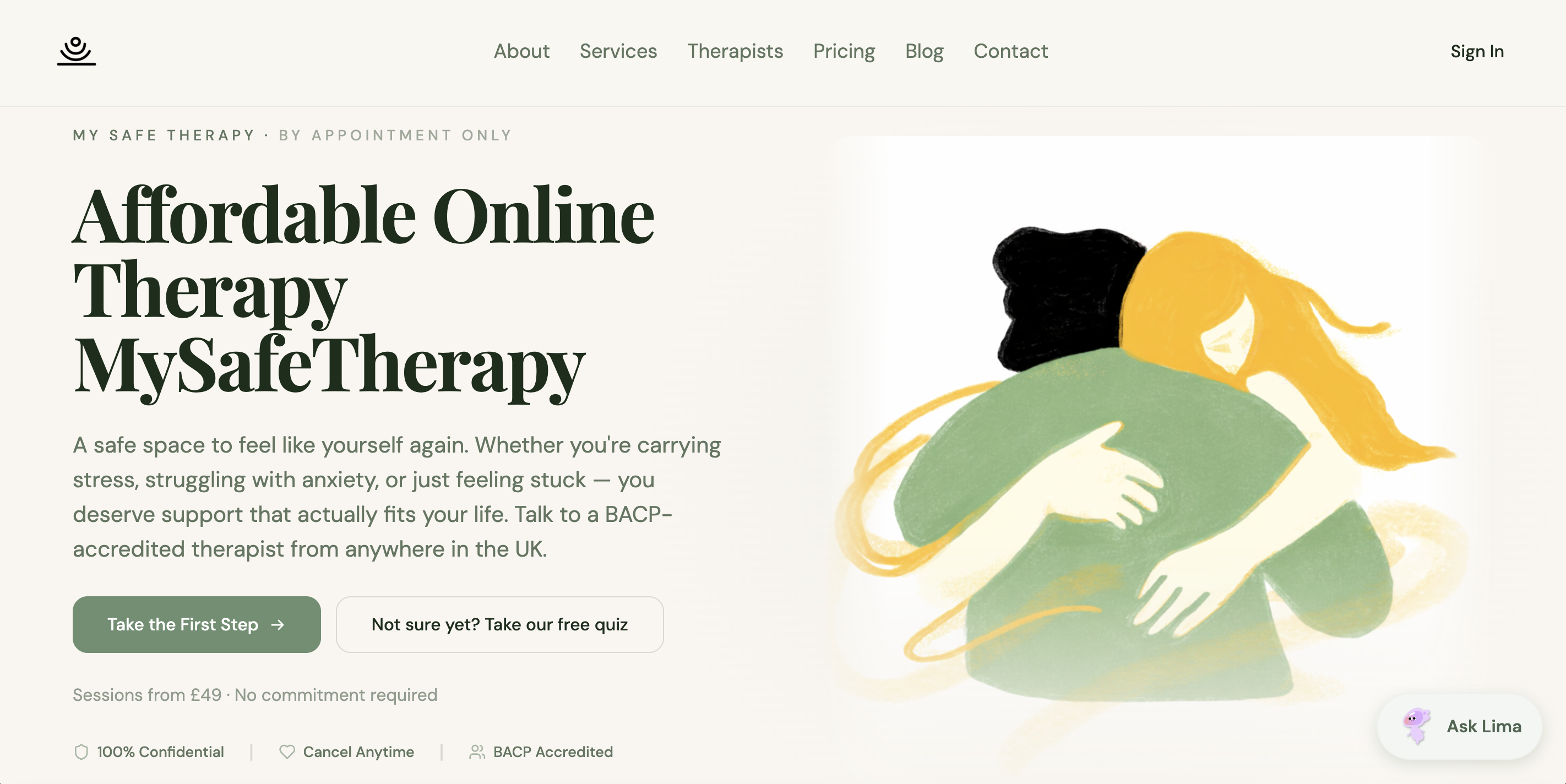
Privacy is built into every part of the platform. Sessions are available in the evenings and at weekends, and you can switch therapists easily if your needs change. AI journaling and mood tracking tools support your progress between sessions. To find the right fit, start therapy online or take the free therapy quiz to identify the most suitable approach for your situation.
Frequently asked questions
How do I access NHS online therapy without a GP referral?
Many NHS Talking Therapies programmes accept self-referral online for adults aged 18 and over, with no need to see your GP first. You can search for your local service and submit a referral directly through the NHS website.
Are digital CBT and app-based therapies actually effective?
Research shows digital CBT produces effect sizes comparable to in-person therapy for anxiety and depression, particularly when a professional provides guidance. Unguided programmes are useful for mild symptoms but show higher dropout rates.
How confidential are online therapy sessions in the UK?
Both NHS and reputable private providers use encrypted, secure platforms to protect your sessions. Reputable private platforms such as MySafeTherapy are also bound by GDPR and professional ethical codes that require strict confidentiality.
How quickly can I start therapy online if I need help now?
For urgent mental health needs, contact 111 or Samaritans immediately. For non-urgent support, private online therapy can typically begin within a few days, while NHS Talking Therapies waiting times vary by local area.