

In the UK, almost anyone can legally call themselves a 'therapist' or 'counsellor'. There is no law preventing this. That single fact changes how you should approach finding mental health support, particularly online where it is harder to verify who you are speaking with. Therapist titles are not statutorily protected in the UK, meaning accreditation through a recognised body is the primary quality assurance available to you. This guide explains what accreditation means, how it differs from registration, and how to confirm your online therapist meets the standards you deserve.
Table of Contents
- Why does accreditation matter for UK therapists?
- What is an accredited therapist (and how is it different from being registered)??)
- How accreditation works: Standards, registers, and pathways
- How to verify if an online therapist is accredited in the UK
- Considerations for choosing an accredited therapist for anxiety or depression
- Get support from an accredited therapist online
- Frequently asked questions
Key Takeaways
| Point | Details |
|---|---|
| Accredited therapists meet high standards | Accredited UK therapists follow strict training, ethics, and ongoing assessment for quality assurance. |
| Registration and accreditation differ | Registration is a basic requirement, while accreditation signals extra competence and experience. |
| Verify before starting therapy | Always use official PSA-accredited registers to check your online therapist's credentials. |
| Fit and expertise matter | Choose therapists with experience in your concern, especially for anxiety or depression. |
Why does accreditation matter for UK therapists?
The absence of legal protection around therapy titles creates a genuine risk. Without it, a person with minimal training could offer sessions for anxiety or depression, and there would be no automatic mechanism to stop them. Accreditation fills that gap. It is a voluntary but rigorous process through which a therapist demonstrates they meet defined standards of training, ethics, and professional conduct.
Accreditation is granted by PSA-accredited registers such as the British Association for Counselling and Psychotherapy (BACP), the UK Council for Psychotherapy (UKCP), and the National Counselling and Psychotherapy Society (NCPS). These organisations verify that a therapist has completed sufficient training, adheres to a code of ethics, and is subject to a formal complaints process.
When you work with a non-accredited therapist, you may have no formal route for complaint if something goes wrong. There is no guarantee of minimum training hours, no ethical framework they are bound to, and no oversight body monitoring their practice. For sensitive issues like anxiety or depression, that is a significant risk.
Online therapy raises the stakes further. You cannot read a certificate on a wall or ask reception staff to confirm credentials. Online therapy safety depends heavily on your ability to verify who you are working with before the session begins.
Key risks of working with a non-accredited therapist include:
- No verified minimum training or supervised practice hours
- No ethical code governing their conduct
- No formal complaints or disciplinary process
- No professional indemnity insurance requirement
- No obligation to engage in continuing professional development
"Accreditation provides voluntary quality assurance via PSA-accredited registers, offering a level of protection that statutory regulation does not currently extend to most therapy titles in the UK."
Pro Tip: Before booking any session, ask the therapist for their registration number and the name of their accrediting body. Then verify it directly on that organisation's public register. This single step significantly reduces your risk.
For a detailed breakdown of what therapist registration safety involves, and why it matters for your wellbeing, it is worth reviewing the standards each body applies. Accredited therapists consistently offer safer evidence-based support because their methods are assessed against recognised clinical frameworks.
What is an accredited therapist (and how is it different from being registered)?
These two terms are often used interchangeably, but they mean different things. Understanding the distinction helps you make a more informed choice.

Registration means a therapist has joined a professional body's register, typically after completing a recognised qualification. It is the first formal step. Accreditation goes further. It requires the therapist to demonstrate a higher level of clinical experience, usually a minimum number of supervised practice hours, and to pass an assessment by the organisation.
UKCP registration for psychotherapists involves training consistent with UKCP Standards of Education and Training, with a focus on in-depth psychotherapy. Accreditation builds on this foundation with additional assessed criteria. Early-career therapists may be registered but not yet accredited, as accreditation typically requires post-qualification experience that takes time to accumulate.
| Feature | Registered therapist | Accredited therapist |
|---|---|---|
| Completed recognised qualification | Yes | Yes |
| Listed on a professional register | Yes | Yes |
| Assessed clinical experience | Not always | Yes |
| Subject to ethics and complaints process | Yes | Yes |
| Higher standard verified by organisation | No | Yes |
| Preferred by employers and insurers | Sometimes | Consistently |
The pathway a therapist follows to reach accreditation typically involves these steps:
- Complete an accredited training programme in counselling or psychotherapy
- Register with a relevant professional body upon qualification
- Accumulate a required number of supervised client hours post-qualification
- Submit an application for accreditation, including case studies and evidence of practice
- Undergo assessment by the professional body
- Maintain accreditation through continuing professional development and periodic renewal
For more detail on therapist registration details and what each stage involves, it is useful to review the specific criteria set by the body relevant to your therapist's specialism. If you are exploring online therapy access for the first time, understanding these stages helps you ask the right questions.
How accreditation works: Standards, registers, and pathways
Several professional bodies oversee accreditation for therapists in the UK. Each covers different specialisms and applies its own standards, though all PSA-accredited registers meet a common baseline set by the Professional Standards Authority (PSA).
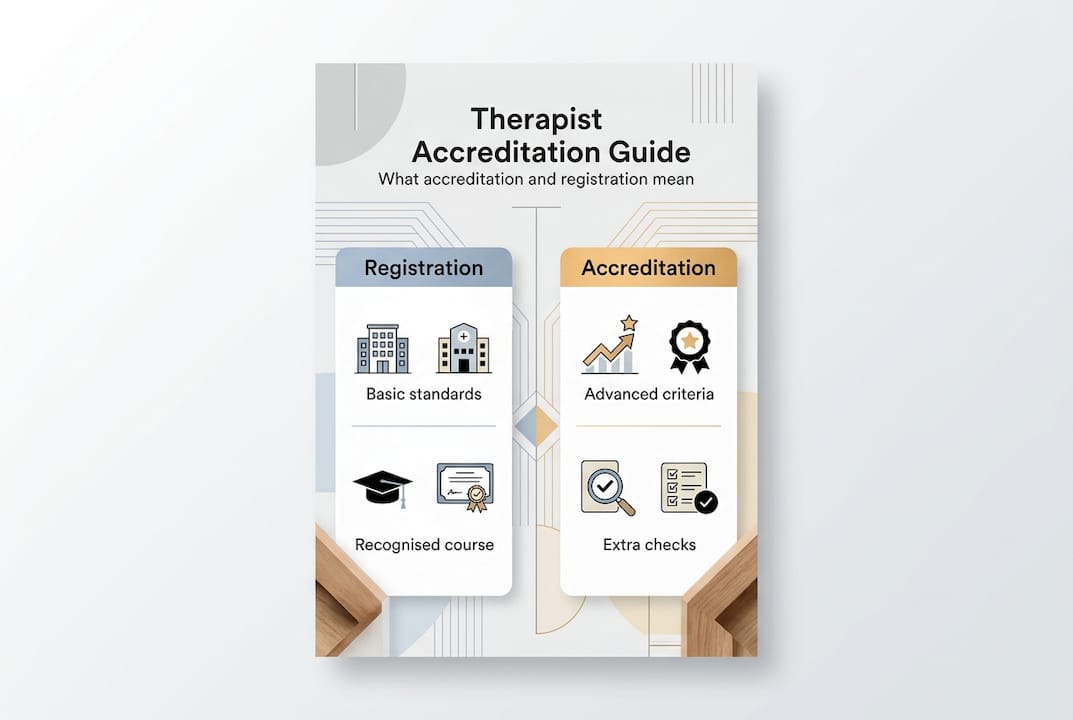
The PSA is an independent body accountable to Parliament. It accredits registers of health and care practitioners, including therapy registers. When a register holds PSA accreditation, it means the register itself has been assessed and meets defined standards of governance, transparency, and public protection.
| Register | Specialism | How to verify |
|---|---|---|
| BACP | Counselling and psychotherapy | bacp.co.uk/therapist-finder |
| UKCP | Psychotherapy and psychotherapeutic counselling | psychotherapy.org.uk/find-a-therapist |
| BABCP | Cognitive behavioural therapy (CBT) | babcp.com/find-a-therapist |
| HCPC | Clinical and counselling psychologists | hcpc-uk.org/check-the-register |
| NCPS | Counselling and psychotherapy | ncps.com/find-a-therapist |
UKCP registration pathways include equivalence assessments for experienced practitioners who trained internationally or through non-standard routes. This means overseas-qualified therapists can still achieve recognised accreditation in the UK, provided their training and experience meet the required standards.
Key points to understand about these registers:
- PSA accreditation of a register is separate from a therapist's individual accreditation
- Not all professional bodies hold PSA accreditation; those that do offer stronger public assurance
- HCPC registration applies specifically to psychologists and is statutory, unlike most therapy registers
- Membership of a professional body does not automatically mean accreditation has been achieved
For accredited therapists safety, the register a therapist belongs to matters. If you are seeking support for anxiety specifically, a therapist accredited with BABCP in CBT may be particularly relevant. You can explore therapy for anxiety approaches to understand which modalities are most evidence-based for your situation.
How to verify if an online therapist is accredited in the UK
Verification is straightforward when you know where to look. The online format enhances access and confidentiality for UK adults, but it also means you must take verification steps yourself rather than relying on a physical clinic environment.
Follow these steps before booking your first session:
- Ask the therapist directly for their registration number and the name of their professional body
- Visit the official website of that professional body (see the table above for direct links)
- Use the therapist finder or register search tool to locate their entry by name or registration number
- Confirm their membership status is current and active, not lapsed or suspended
- Check whether any disciplinary notes or restrictions are listed against their record
- Confirm the platform or service you are using has a clear privacy policy and uses secure, encrypted communication
Pro Tip: Any therapist who is reluctant to provide their registration number or professional body details should be treated with caution. Accredited therapists are listed on public registers precisely so that clients can verify their credentials without difficulty.
Beyond credentials, assess the platform itself. A reputable online therapy service will provide a signed agreement or terms of service, explain how your data is stored and protected, and outline the limits of confidentiality clearly. For practical guidance on verifying accreditation and what to look for in a secure platform, reviewing online therapy safety tips before you begin is a sensible step.
Considerations for choosing an accredited therapist for anxiety or depression
Accreditation confirms a therapist meets professional standards. It does not automatically mean they are the right fit for your specific needs. For anxiety or depression, the therapist's specialism and approach matter considerably.
For anxiety and depression, choosing a modality-experienced accredited therapist is recommended. Cognitive Behavioural Therapy (CBT), for example, has a strong evidence base for both conditions and is overseen by BABCP-accredited practitioners. Person-centred therapy, psychodynamic approaches, and EMDR are also used effectively, depending on the individual.
A useful statistic: since 2020, the majority of UK therapists have offered online sessions as a standard part of their practice, reflecting a significant and sustained shift in how therapy is delivered. This means you have genuine choice in finding an accredited therapist who works online, at times that suit you.
When selecting a therapist, consider the following:
- Does their stated specialism include anxiety, depression, or your primary concern?
- Are they accredited with a PSA-recognised body relevant to their approach?
- Do they offer flexible scheduling, including evenings or weekends?
- Is their platform or service transparent about confidentiality and data protection?
- Do they provide a brief initial consultation before committing to ongoing sessions?
For a fuller picture of therapy types for anxiety and how different approaches compare, reviewing the evidence for each modality helps you make a more informed decision. It is also worth preparing for therapy sessions in advance, and understanding what a complete therapy session guide looks like so you know what to expect from the process.
Get support from an accredited therapist online
Finding a qualified, accredited therapist for online support does not need to be complicated. MySafeTherapy connects you with UK-accredited therapists who are registered with recognised professional bodies including BACP, UKCP, and NCPS.
All therapists listed on MySafeTherapy are fully accredited, experienced in supporting anxiety and depression, and operate under clear confidentiality standards. Sessions are available via video, chat, or avatar-based formats, with flexible scheduling including evenings and weekends. Pricing is transparent, and switching therapists is straightforward if your needs change. You can start therapy online directly, or if you are unsure where to begin, take the free therapy quiz to identify what kind of support may suit you best.
Frequently asked questions
Are all UK therapists required to be accredited?
No, accreditation is not legally required in the UK, but it is strongly preferred by employers and insurers as evidence of professional competence and ethical practice.
How can I check if a therapist is accredited?
Visit a PSA-accredited register such as BACP or UKCP and search for the therapist by name or registration number to confirm their current membership status.
Do accredited therapists offer online support confidentially?
Yes, most accredited therapists provide online sessions with confidentiality protocols that align with the ethical standards set by their professional body.
What is the difference between a registered and an accredited therapist?
Registered therapists meet minimum entry standards; accredited therapists have demonstrated additional clinical experience and have been formally assessed by a recognised professional organisation.