
When searching for mental health support, most people assume therapists are regulated professionals bound by strict legal standards. The reality is more complex. In the UK, therapist titles are not legally protected, meaning anyone can call themselves a counsellor or psychotherapist without formal oversight. Understanding how professional registration works empowers you to make informed choices about your mental health care, ensuring you access safe, ethical, and effective therapy that meets recognised standards of practice.
Table of Contents
- Key Takeaways
- What therapist professional registration means in the UK
- How voluntary professional registration works and key bodies involved
- The SCoPEd framework and its role in informed therapy choices
- Why therapist professional registration matters for your safety and quality care
- Find safe, accredited therapists with MySafeTherapy
- Frequently asked questions
Key Takeaways
| Point | Details |
|---|---|
| Titles are unprotected | In the UK anyone may call themselves a therapist, counsellor or psychotherapist regardless of training. |
| Registration is voluntary | Professional registration is not mandatory, so clients must verify credentials rather than relying on titles. |
| PSA accreditation matters | Accredited registers verified by the Professional Standards Authority confirm training ethics supervision and ongoing development standards. |
| Check PSA registration | Always verify your therapist appears on a PSA accredited register before beginning therapy. |
What therapist professional registration means in the UK
The UK therapy landscape operates differently from many healthcare professions. In the UK, 'therapist', 'counsellor', and 'psychotherapist' are not protected titles, unlike clinical psychologist or psychiatrist, which require specific qualifications and HCPC registration. This creates a situation where anyone may use therapist titles without official oversight, regardless of training, experience, or ethical commitment.
This unregulated status carries significant implications:
- Quality and safety standards vary widely between practitioners
- No legal requirement exists for minimum training or qualifications
- Clients face challenges distinguishing qualified therapists from untrained individuals
- Professional accountability relies entirely on voluntary registration systems
- Harmful practice may continue unchecked without formal oversight mechanisms
Voluntary professional registration emerged to address these gaps, providing benchmarks for training, ethics, and practice standards. However, because registration remains optional, clients must actively verify credentials rather than relying on titles alone. This responsibility places the burden on you to research and confirm your therapist's qualifications, making informed choices essential for safe therapy experiences. Platforms offering therapist matching for online therapy can simplify this process by pre-screening practitioners against recognised standards.
How voluntary professional registration works and key bodies involved
Several major professional bodies maintain registers of qualified therapists in the UK. The largest include BACP with over 60,000 members, alongside UKCP, NCPS, BPC, and HGI. These organisations operate voluntary registration through bodies like BACP, UKCP, NCPS, BPC, and HGI, maintaining standards in training, ethics, supervision, insurance, and CPD. The Professional Standards Authority (PSA) accredits these registers, providing independent verification that they meet rigorous quality benchmarks.
Registration requirements typically include:
- Minimum Level 4 Diploma in counselling or psychotherapy (240 credits)
- Adherence to detailed ethical frameworks and codes of conduct
- Regular clinical supervision at prescribed ratios, usually monthly or fortnightly
- Professional indemnity insurance covering client harm and negligence
- Continuing professional development of 30+ hours annually
- Annual renewal demonstrating ongoing compliance with standards
These requirements ensure registered therapists maintain competence throughout their careers. Registration signals commitment to professional standards and public protection, distinguishing qualified practitioners from those operating without accountability. The renewal process prevents complacency, requiring therapists to demonstrate continuous learning and ethical practice year after year.
Pro Tip: Always confirm if your therapist appears on a PSA-accredited register before beginning therapy. This simple check verifies they meet independently assessed standards for training, ethics, and ongoing professional development, significantly reducing risks associated with unregulated practice.
Exploring types of therapy memberships helps you understand how different approaches align with professional registration requirements and your specific mental health needs.
The SCoPEd framework and its role in informed therapy choices
Navigating therapist qualifications becomes easier with the SCoPEd framework, developed collaboratively by UK professional bodies. SCoPEd framework (2022, amended 2025) categorises counsellors, therapists, and advanced psychotherapists across five core themes to support informed client decisions. This classification system maps three distinct practitioner categories based on training depth, complexity of client issues addressed, and clinical competence.
The framework assesses competence across five themes: professionalism and professional identity, assessment and formulation, creating and maintaining the therapeutic relationship, therapeutic process and interventions, and self-awareness and reflection. Each category requires progressively advanced capabilities:
| Category | Training level | Typical client issues | Supervision requirements |
|---|---|---|---|
| Counsellor | Level 4 Diploma (240 credits) | Common mental health concerns, life transitions | Monthly minimum |
| Therapist | Level 5-6 qualification (480+ credits) | Complex presentations, trauma, personality difficulties | Fortnightly minimum |
| Advanced psychotherapist | Level 7 postgraduate training | Severe mental health conditions, complex trauma | Weekly minimum |
This structure helps you match therapy complexity to your needs. Someone experiencing workplace stress might work effectively with a counsellor, whilst complex trauma typically requires a therapist or advanced psychotherapist with specialist training. Understanding these distinctions prevents mismatches that could compromise therapy effectiveness or safety.
Pro Tip: Use SCoPEd categories to guide therapist selection according to your presenting issues complexity. If you are unsure which category suits your needs, many platforms offer assessments to help determine appropriate support levels.
The framework's 2025 update refined competency descriptors and strengthened alignment across professional bodies, making it easier to compare qualifications regardless of which organisation accredits a therapist. Resources on how to prepare for therapy for anxiety and depression complement SCoPEd understanding by helping you articulate your needs clearly.
Why therapist professional registration matters for your safety and quality care
Registration creates accountability structures absent in unregulated practice. Registration provides accountability and ethical oversight; clients can complain and therapists can be sanctioned or removed, protecting the public. When problems arise with registered therapists, formal complaints mechanisms investigate concerns and impose sanctions ranging from additional supervision requirements to removal from registers. The NHS recommends using PSA-accredited registers when seeking private therapy, recognising their role in public protection.
Empirical data demonstrates registration's protective function. UKCP and BACP have removed therapists from their registers for misconduct, with 26 practitioners struck off collectively since these bodies began maintaining registers. Complaints to professional bodies increased 24% since 2020, reflecting growing public awareness and willingness to report concerns. Whilst these numbers appear small relative to total membership, they represent meaningful protection unavailable with unregistered practitioners.
"The NHS advises people seeking private therapy to check their therapist is registered with a professional body accredited by the Professional Standards Authority, ensuring minimum standards for training, ethics, and accountability."
Key ways registration safeguards clients include:
- Mandatory ethical codes governing boundaries, confidentiality, and professional conduct
- Regular supervision ensuring therapists receive guidance on complex cases
- Complaints procedures providing recourse when therapy causes harm
- Insurance requirements protecting clients financially if negligence occurs
- CPD obligations keeping therapists current with evidence-based practices
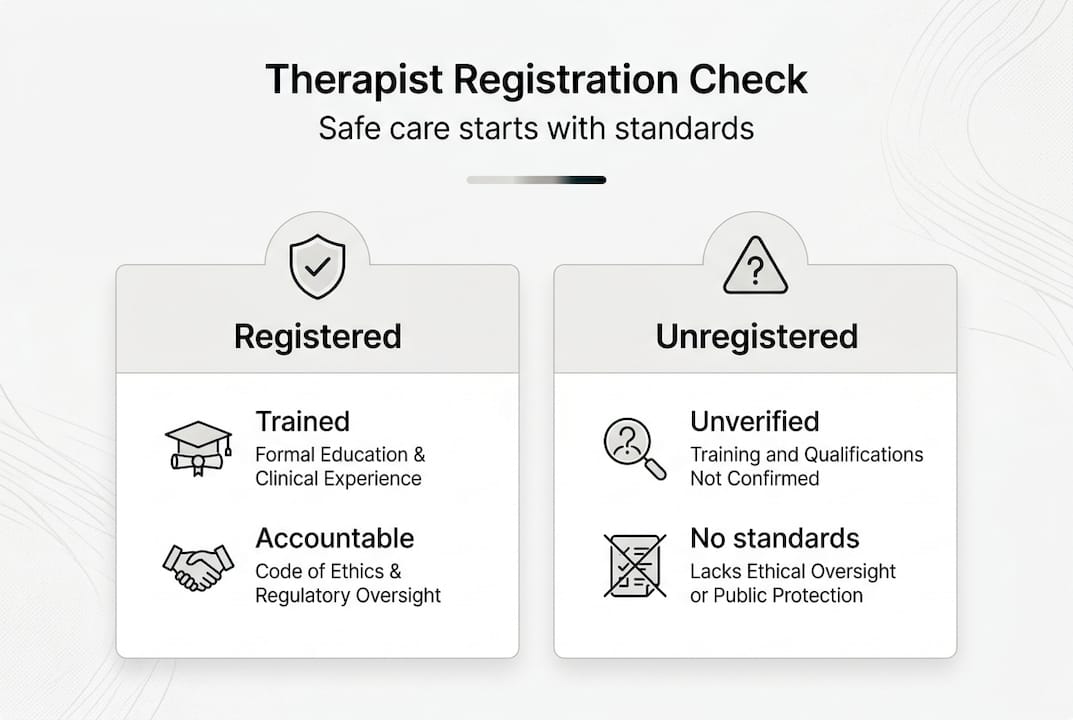
| Aspect | Registered therapist | Unregistered therapist |
|---|---|---|
| Training verification | Minimum Level 4 Diploma required | No minimum standards |
| Ethical oversight | Bound by professional codes | No formal obligations |
| Complaints mechanism | Formal investigation process | No accountability structure |
| Insurance | Professional indemnity mandatory | Optional or absent |
| Ongoing development | 30+ CPD hours annually | No requirements |
These protections become critical when therapy addresses vulnerable states or traumatic experiences. Knowing your therapist operates within a professional framework provides reassurance and practical recourse if concerns arise. Tools like the therapy need assessment quiz help you evaluate whether professional support suits your situation before committing to therapy.

Find safe, accredited therapists with MySafeTherapy
Navigating therapist registration and verification can feel overwhelming when you are already struggling with mental health challenges. MySafeTherapy simplifies this process by connecting you exclusively with PSA-registered therapists who meet verified training, ethics, and supervision standards. Our free therapy need quiz helps you assess whether therapy suits your current needs and matches you with appropriately qualified practitioners.
The platform removes guesswork from finding safe, effective mental health support. Every therapist profile displays their professional registration details, qualifications, and specialisms, enabling informed choices without extensive research. Our blog provides expert guidance on therapist matching for online therapy, helping you understand what to look for and how to prepare for your first session. Visit MySafeTherapy to start your journey towards safe, professional mental health care with confidence.
Frequently asked questions
What does it mean if a therapist is registered?
Registration indicates a therapist has met minimum training standards, typically a Level 4 Diploma or higher, and commits to ongoing ethical practice, supervision, and professional development. It means they belong to a professional body that can investigate complaints and impose sanctions if standards are breached. Registration provides accountability absent in unregulated practice, giving you recourse if therapy causes harm or falls below acceptable standards.
Is therapist registration mandatory in the UK?
No, therapist titles are not protected and registration remains voluntary with no current legal mandate. As of 2026, anyone can legally use titles like therapist, counsellor, or psychotherapist without qualifications or registration. This differs from professions like clinical psychology, where HCPC registration is legally required. The voluntary nature of registration places responsibility on clients to verify credentials before beginning therapy.
How can I check if a therapist is properly registered?
Clients can verify therapists via public PSA-accredited registers such as BACP and UKCP websites. Visit the professional body's website and use their member search function, entering the therapist's name to confirm active registration. Ask therapists directly about their qualifications, which professional body they belong to, supervision arrangements, and CPD activities. Legitimate practitioners welcome these questions and provide transparent answers.
What are the risks of choosing an unregistered therapist?
Unregistered therapists may lack proper training, operate without ethical guidelines, and face no accountability for harmful practice. You have limited recourse if therapy causes psychological harm, boundary violations occur, or confidentiality is breached. Without supervision requirements, unregistered practitioners may mishandle complex presentations, potentially worsening your mental health. Choosing registered therapists significantly improves safety, quality, and your ability to address concerns through formal complaints mechanisms.
Why does registration matter if it is not legally required?
Voluntary registration creates professional standards and accountability structures that legal regulation would provide in other healthcare fields. It distinguishes qualified, ethical practitioners from those operating without training or oversight. Registration enables complaints processes, ensures ongoing competence through CPD, and provides insurance protection if negligence occurs. These safeguards protect vulnerable clients seeking mental health support, making registration practically essential despite its voluntary legal status.