

TL;DR:
- Online therapy formats vary in privacy, scheduling, symptom severity, and interaction preferences.
- Individual therapy offers personalized support ideal for complex issues but at a higher cost.
- Blended care combines self-guided modules with live sessions, improving outcomes across different severities.
Choosing the right online therapy can feel overwhelming, particularly when you are managing anxiety, depression, or relationship difficulties alongside a busy schedule. The format you select matters as much as the therapist you work with. Some people thrive in one-to-one video sessions; others prefer the anonymity of text-based support or the structured pace of self-guided modules. Understanding the main therapy types available to UK adults, and the criteria that distinguish them, helps you make a confident, informed decision rather than defaulting to whatever happens to be most convenient.
Table of Contents
- How to choose the right online therapy format
- Individual online therapy: Personalised one-to-one support
- Group online therapy: Community and shared learning
- Guided self-help and self-guided therapy: Flexible, step-by-step support
- Comparison of online therapy types for UK adults
- Our perspective: What most guides miss about online therapy choices
- Find trusted online therapy tailored to your needs
- Frequently asked questions
Key Takeaways
| Point | Details |
|---|---|
| Choose based on needs | Selecting the right online therapy type depends on your symptoms, preferences, and desired level of interaction. |
| Personalised support most effective | Individual online therapy offers high efficacy and privacy, especially for complex issues. |
| Flexibility for mild concerns | Guided self-help and blended care provide convenient, accessible options for mild to moderate challenges. |
| Evidence supports multiple formats | Research shows online group, individual, and blended therapies are effective for anxiety and depression. |
How to choose the right online therapy format
Before reviewing individual therapy types, it is worth establishing what you actually need from a format. Four factors tend to matter most: privacy, scheduling, symptom severity, and how you prefer to interact with support.
Privacy and confidentiality vary between formats. Individual video or chat sessions with a registered therapist offer the highest level of privacy. Group sessions involve shared disclosure, which suits some people but not others. Knowing your comfort level with visibility shapes which format will feel safe enough to engage with honestly.
Scheduling flexibility is another key consideration. Asynchronous formats, such as messaging-based therapy or self-guided modules, allow you to engage at any hour. Live sessions, whether video or phone, require a fixed appointment. If your working hours are irregular or you need evening and weekend access, asynchronous or blended options may be more practical.
Symptom severity is perhaps the most clinically important factor. Online CBT is the most evidence-based treatment for anxiety and depression, recommended by NICE, with standardised mean differences (SMDs) of 0.87 to 1.02 versus a waiting list. However, the format through which CBT is delivered affects suitability. Mild to moderate symptoms may respond well to guided self-help, while more complex presentations typically require direct therapist involvement.
Interaction preference covers whether you find it easier to open up via text, voice, or face-to-face video. Some people feel more comfortable typing their thoughts; others need the immediacy of spoken conversation.
Key questions to ask yourself before starting online therapy:
- Do I need a fixed appointment or flexible access?
- How comfortable am I sharing with others present?
- Are my symptoms mild, moderate, or severe?
- Do I prefer text, audio, or video interaction?
- What is my budget for sessions?
Pro Tip: When reviewing platforms, check that therapists are registered with BACP, HCPC, UKCP, or NCPS. Registration confirms adherence to professional standards and ethical guidelines. Good therapist matching processes also ask about your preferences upfront, which improves outcomes from the start. If you are unsure where to begin, an accessible therapy guide can walk you through the registration and assessment process step by step.
Individual online therapy: Personalised one-to-one support
Individual online therapy connects you directly with a qualified therapist via video, phone, or chat. Sessions are tailored entirely to your situation, which makes this format the most flexible in terms of clinical approach. Your therapist can draw on cognitive behavioural therapy (CBT), person-centred counselling, psychodynamic methods, or integrative techniques depending on what suits you.
Individual online CBT is highly effective for anxiety, depression, and generalised anxiety disorder (GAD), with SMDs reaching up to 0.96 versus a waiting list. These are clinically meaningful results, comparable to in-person delivery.
"Individual CBT online is the gold standard for anxiety and depression, offering the depth of personalisation that structured programmes cannot replicate."
For a fuller picture of how sessions work in practice, the therapy for anxiety guide covers what to expect session by session.
Advantages of individual online therapy:
- Highest level of privacy and confidentiality
- Fully tailored interventions based on your history and goals
- Flexible scheduling, including evenings and weekends
- Strong evidence base across anxiety, depression, and trauma
- Easy to switch therapist if the relationship is not working
Limitations to consider:
- Typically the most expensive format per session
- Availability depends on individual therapist schedules
- Progress relies heavily on the quality of the therapeutic relationship
Individual therapy is particularly well suited to anyone dealing with complex presentations, trauma, or symptoms that have not responded to self-directed approaches. It is also the recommended format when safety is a concern, as a therapist can monitor risk and escalate care if needed.
Group online therapy: Community and shared learning
Group online therapy connects several participants and one or two therapists via a video platform. Sessions are typically structured around a shared theme, such as managing social anxiety, building communication skills, or processing grief. The format creates a sense of community that individual therapy cannot replicate.

Shared experience is one of the most underestimated therapeutic factors. Hearing that others face similar challenges reduces isolation and normalises distress. For relationship difficulties and moderate anxiety in particular, the group context provides both skills practice and social reinforcement.
CBT formats show equivalent efficacy, but group therapy is preferred over guided self-help for retention, meaning participants are more likely to complete a course of group sessions than a self-directed programme.
Advantages of group online therapy:
- More affordable than individual sessions
- Peer support and shared coping strategies
- Structured resources and consistent session format
- Reduces feelings of isolation
- Useful for building interpersonal skills in a safe setting
Limitations to consider:
- Less privacy than individual sessions
- Sharing personal material in front of others can feel inhibiting
- Not suitable for acute crisis or complex trauma
- Group dynamics can occasionally affect session quality
Pro Tip: When joining a group programme, look for clear ground rules around confidentiality, regular check-ins between participants and the therapist, and a structured curriculum. These features significantly improve both safety and outcomes. Reviewing therapy techniques used in group settings can also help you know what to expect.
Guided self-help and self-guided therapy: Flexible, step-by-step support
Not everyone needs direct interaction. For mild anxiety or depression, a structured self-directed approach can be genuinely effective and far more accessible in terms of time and cost.
Guided self-help involves working through structured modules, often based on CBT, with periodic input from a coach or therapist. Self-guided therapy is fully independent, using apps or online portals without any live support. Both formats offer maximum scheduling flexibility and are accessible at any hour.
A typical self-guided process follows these steps:
- Register on the platform and complete an initial assessment
- Work through structured modules at your own pace
- Track mood and progress using built-in tools
- A coach reviews your progress and sends feedback (guided self-help only)
However, guided self-help carries higher dropout rates and is not suitable for severe or complex cases, or for those without reliable internet access. The absence of live support reduces accountability, which is the most common reason people disengage.
"Reliable recovery rates are better in blended care than stepped care, at 54% versus 45%, suggesting that combining formats produces stronger outcomes than relying on self-help alone."
Advantages:
- Maximum flexibility, available any time
- Lower cost than live therapy
- Useful for mild symptoms or as a supplement to live sessions
Limitations:
- Higher dropout compared to live formats
- Not appropriate for severe or complex presentations
- Limited accountability without therapist contact
For more detail on how these formats work in practice, the self-help therapy guide and self-guided therapy overview both provide useful context. You can also explore how AI and online therapy tools are increasingly supporting self-directed approaches.
Comparison of online therapy types for UK adults
To help with your final decision, here is a direct comparison of the four main formats available to UK adults.
| Format | Best for | Evidence | Retention | Cost |
|---|---|---|---|---|
| Individual | Moderate to severe, complex | Strong (SMD up to 0.96) | High | Higher |
| Group | Moderate, relationship issues | Equivalent to individual | Good | Moderate |
| Guided self-help | Mild symptoms | Moderate | Lower | Low |
| Blended care | Mild to moderate, varied | Strong (54% recovery) | High | Moderate |
Blended care combines low and high intensity support, saving an average of four sessions compared to stepped care while achieving a 54% recovery rate versus 45% in stepped care alone. CBT formats show equivalent efficacy across individual and group delivery, but both outperform guided self-help for retention.
Benefits of blended care specifically:
- Combines self-paced modules with live therapist sessions
- Adapts intensity as your needs change
- Reduces total session time without reducing outcomes
- Suitable for a wide range of symptom severities
- Increasingly available on UK platforms
For guidance on evaluating platforms before you commit, the therapy safety guide covers what to look for in terms of data security, therapist credentials, and platform transparency.
Our perspective: What most guides miss about online therapy choices
Most comparisons of online therapy formats focus on efficacy statistics and cost. Those factors matter, but they miss something more fundamental: the format you can actually stick with is the one that will help you.
Research consistently shows that therapeutic alliance, the quality of connection between client and therapist, is one of the strongest predictors of outcome. A highly effective modality delivered by a therapist you do not connect with will underperform a moderately effective one where you feel genuinely heard. This is why format selection should never be driven by convenience alone.
There is also a real risk in defaulting to self-help formats for complex issues simply because they are cheaper or easier to access. Lower engagement rates in self-guided therapy are not a personal failing; they reflect a structural mismatch between format and need.
"The most effective therapy is the one you can stick with and feel heard in."
Pro Tip: Request a trial session or initial assessment before committing to any format. Most reputable platforms offer this. It gives you direct evidence of fit rather than relying on assumptions. Explore further insights on how to evaluate your options before you start.
Find trusted online therapy tailored to your needs
Understanding your options is the first step. Taking action is the next one.
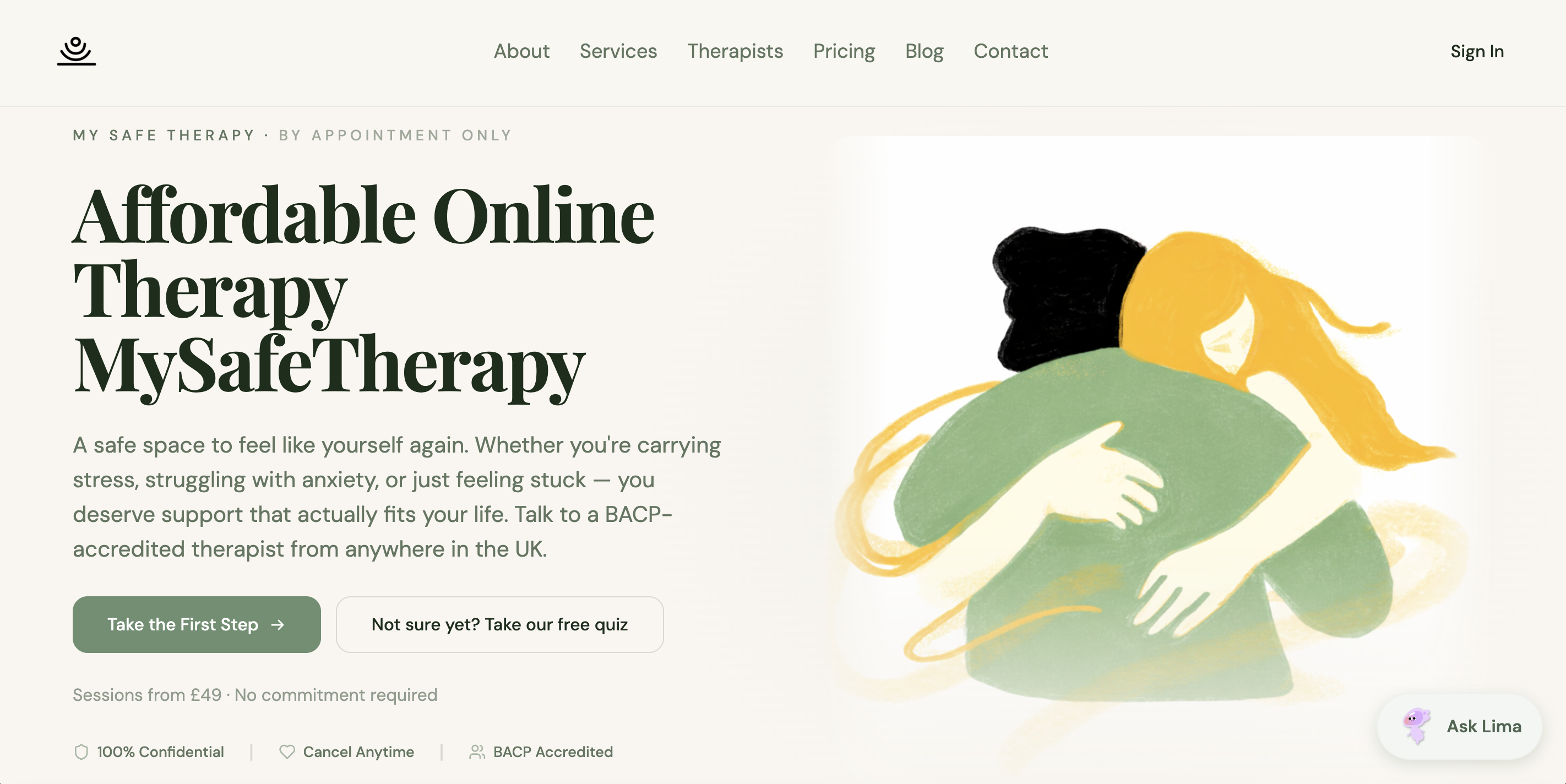
MySafeTherapy connects you with UK-accredited therapists registered with BACP, UKCP, and NCPS, across individual, group, and blended formats. Sessions are available via video, chat, or avatar-based interaction, with evening and weekend availability to fit around your schedule. Confidentiality is built into every aspect of the platform, from encrypted communications to clear data policies. Whether you are ready to start therapy today or want to explore your options first, the MySafeTherapy platform provides transparent pricing, easy therapist switching, and AI-supported tools to support your mental health between sessions.
Frequently asked questions
Is online therapy as effective as in-person sessions?
For most anxiety and depression cases, online CBT is as effective as in-person therapy, with standardised mean differences of 0.87 to 1.02 versus a waiting list, according to recent clinical research.
Which online therapy type suits severe anxiety or depression?
Individual online therapy with a registered therapist is recommended for severe cases, as guided self-help is less acceptable for complex presentations and carries higher dropout rates.
How do confidentiality and privacy work with online therapy?
Therapists operating in the UK follow strict data protection regulations, and reputable platforms use encrypted communications and secure servers to protect your personal information during all sessions.
Can I switch between different online therapy formats?
Most platforms allow you to move between formats as your needs evolve. Blended care achieves 54% recovery versus 45% in stepped care, demonstrating that combining formats can improve outcomes.
What is the difference between guided self-help and self-guided therapy?
Guided self-help includes periodic input from a therapist or coach alongside structured modules, while self-guided therapy is fully independent and relies entirely on your own progress through the programme.