

TL;DR:
- Structured journaling techniques, including expressive writing, gratitude journaling, and worry time, significantly improve mental health by reducing anxiety and depression symptoms. Building a consistent habit involves simple tools, anchoring to daily routines, and using prompts to ease entry while avoiding common mistakes like unstructured venting or perfectionism. Combining journaling with professional therapy enhances overall outcomes, especially for complex cases, and fosters lasting self-awareness and emotional regulation.
Mental health journaling is the deliberate practice of writing your thoughts and feelings to reduce anxiety, manage depression, and build emotional clarity. Research published in 2026 confirms that structured expressive writing, gratitude journaling, and CBT-based worry journaling each produce measurable improvements in wellbeing. This guide explains how to journal for mental health using techniques grounded in science, with practical steps for starting a consistent habit and avoiding the common mistakes that reduce its effectiveness.
What does the science say about journaling for mental health?
Structured expressive writing produces real, measurable mental health benefits. Expressive writing conducted over 15–20 minutes across 3–4 consecutive days reduces anxiety and depression symptoms and improves immune markers. Consistency matters more than duration. Even 5–10 minutes of focused writing delivers more benefit than longer, infrequent sessions.
Gratitude journaling works through a different mechanism. Specific gratitude statements written over 14 days can reduce depressive symptoms at a level comparable to antidepressants in mild to moderate cases. Describing why you are grateful produces stronger results than listing generic items. The benefits also persist after the practice ends, which makes it one of the most efficient techniques available.
The CBT technique known as "worry time" involves setting aside 15 minutes to write down worries in a scheduled window. This reduces unscheduled intrusive thoughts throughout the day. You can read more about how CBT informs this approach in cognitive behavioural therapy practice.
Different journaling types engage distinct brain processes. Narrative construction, cognitive offloading, affect labelling, and metacognition each target anxiety and depression through separate pathways. Writing externalises thoughts from the reactive limbic system into the prefrontal cortex, creating cognitive space and reducing emotional charge.
| Journaling Type | Primary Purpose | Key Benefit |
|---|---|---|
| Expressive writing | Processing difficult emotions | Reduces anxiety and depression symptoms |
| Gratitude journaling | Mood improvement | Decreases depressive symptoms over 14 days |
| Worry journaling | Anxiety containment | Reduces intrusive rumination throughout the day |
| Reflective journaling | Self-awareness | Builds pattern recognition and healthier coping |
| Third-person journaling | Emotional regulation | Creates perspective and reduces emotional reactivity |
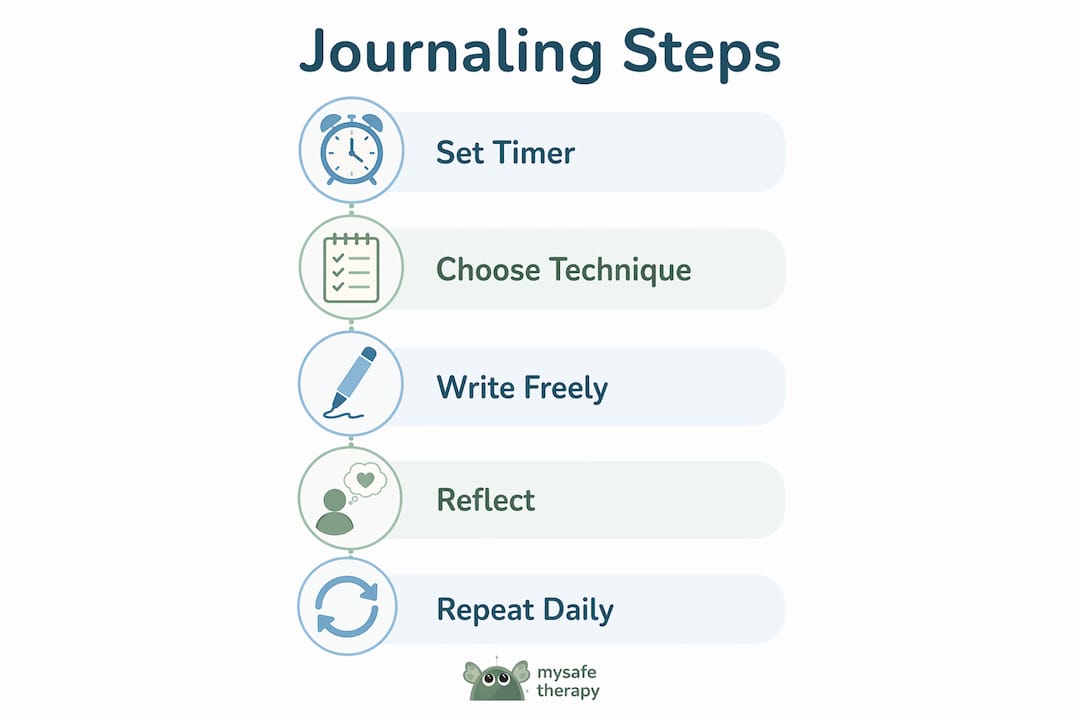
Pro Tip: Set a timer for 15 minutes before you begin. A fixed endpoint removes the pressure of deciding when to stop, which is one of the main reasons people avoid starting.
Which journaling techniques suit different mental health needs?
Choosing the right technique depends on what you are trying to address. Expressive writing suits people processing difficult emotions or past trauma. You write continuously without censoring, which clears working memory and reduces the emotional charge attached to difficult memories. A useful prompt: "Write about the experience that is taking up the most mental space right now. Do not edit. Do not stop."

Gratitude journaling is the strongest technique for lifting low mood and reducing mild to moderate depression. The key is specificity. Instead of writing "I am grateful for my family," write "I am grateful that my sister called me this morning because it reminded me I am not alone." That specificity is what produces the therapeutic effect.
Analytical or third-person journaling helps with emotional regulation and perspective. You write about yourself as if describing a friend: "She is feeling overwhelmed because she has taken on too many responsibilities." This small shift in perspective reduces emotional reactivity and helps you see patterns you would otherwise miss.
Worry journaling is the most structured technique for anxiety. You schedule a fixed 15-minute window each day, write every worry you can think of, and then close the journal. When worries arise outside that window, you note them briefly and return to them at the scheduled time. This trains the brain to contain anxiety rather than let it run continuously.
Here is a summary of suitability by need:
- Expressive writing: Best for trauma processing, grief, or emotional overwhelm
- Gratitude journaling: Best for low mood, mild depression, or negativity bias
- Analytical journaling: Best for recurring emotional patterns or relationship difficulties
- Worry journaling: Best for generalised anxiety, intrusive thoughts, or sleep disruption
- Creative journaling: Best for stress relief, self-expression, and building a positive relationship with writing
Pro Tip: If you are unsure which technique to start with, try gratitude journaling for two weeks. It has the lowest barrier to entry and the strongest evidence base for beginners.
How do you start journaling and build a consistent habit?
Starting is the hardest part. Most people overthink the format and never begin. The most effective approach is to reduce friction to near zero.
Follow these steps to build a sustainable journaling habit:
- Choose a low-friction tool. Basic pen and paper or a notes app outperform ornate leather journals for consistency. Beginners who use simple tools write more often. The tool is not the point. The writing is.
- Set a realistic time commitment. Start with 5–10 minutes. You do not need long sessions to see benefits. A short, focused entry beats a lengthy one you never write.
- Anchor journaling to an existing habit. Habit-anchoring means linking journaling to something you already do reliably, such as morning coffee, a lunch break, or the moment before bed. This removes the need for willpower. The existing habit triggers the new one.
- Use a prompt to start. Blank pages create resistance. Keep three or four go-to prompts written on a sticky note inside your journal. Examples: "What is on my mind right now?", "What am I avoiding thinking about?", "What went well today and why?"
- Set a physical reminder. Place your journal on your pillow, next to the kettle, or beside your toothbrush. Visual cues are more reliable than digital reminders for habit formation.
- Decide on a format in advance. Knowing whether you are doing a gratitude entry, a worry dump, or free writing before you sit down removes decision fatigue and makes it easier to begin.
Journaling as a mindfulness tool works best when it becomes a form of mental hygiene rather than a task. The goal is not literary quality. The goal is self-understanding. You can also track your progress over time by learning why tracking mental health matters and how to do it effectively alongside journaling.
Pro Tip: Miss a day? Write one sentence about why. This keeps the habit alive without the guilt spiral that causes most people to abandon journaling entirely.
What are the most common journaling mistakes to avoid?
Journaling done poorly can temporarily worsen mood. Knowing the pitfalls protects you from them.
- Unstructured venting without reflection. Writing purely to vent without any analytical framing can deepen distress rather than relieve it. Venting has a place, but it needs to be followed by a reflective question such as "What does this tell me about what I need right now?"
- Journaling during an anxiety spiral. Writing during acute anxiety can increase rumination rather than reduce it. If you are in a high-anxiety state, use a grounding technique first. Box breathing or a brief body scan brings you back to baseline before you write analytically.
- Perfectionism about the writing itself. Worrying about grammar, style, or whether your entries are "good enough" defeats the purpose. Journaling is not judged. It is a private tool for self-reflection through writing, not a performance.
- Inconsistency followed by abandonment. Missing several days and then giving up is the most common pattern. Realistic expectations prevent this. You do not need to journal every day for it to work. Three or four times a week produces consistent benefits.
- Never reviewing past entries. Reading back through previous entries is one of the most powerful parts of the practice. It reveals patterns, shows growth, and highlights recurring triggers you might not notice in the moment.
"Distinguishing between mid-spiral venting and reflective processing mode is the single most important skill in mental health journaling. One releases pressure. The other builds insight."
When a technique stops working or feels stale, switch. Move from expressive writing to gratitude journaling, or try a creative journaling approach for stress relief. Flexibility is not inconsistency. It is good practice. You can find further guidance on self-help tools for anxiety that complement journaling effectively.
Key takeaways
Consistent, structured journaling is the most accessible evidence-based tool for reducing anxiety and depression symptoms without clinical intervention.
| Point | Details |
|---|---|
| Choose the right technique | Match your journaling method to your need: expressive for trauma, gratitude for low mood, worry journaling for anxiety. |
| Consistency beats duration | Even 5–10 minutes of focused writing several times a week produces measurable mental health benefits. |
| Anchor to existing habits | Link journaling to a daily routine such as morning coffee to remove reliance on motivation or willpower. |
| Avoid journaling mid-spiral | Use grounding techniques first during acute anxiety, then write analytically once you reach a calmer baseline. |
| Review past entries regularly | Reading back through your journal reveals patterns, growth, and recurring triggers that are invisible in the moment. |
Mysafetherapy's view on journaling as a mental health tool
Journaling is one of the most consistently underestimated tools in mental health support. At Mysafetherapy, we see it used effectively by people managing anxiety, depression, and burnout, but we also see it misused in ways that create frustration rather than relief.
The most common misconception is that journaling should feel cathartic immediately. For many people, the first few sessions feel awkward or even uncomfortable. That discomfort is not a sign the practice is failing. It is a sign that something real is being surfaced. The value often shows up two or three weeks in, when you read back and notice a pattern you had not consciously registered.
We would also push back on the idea that journaling is a replacement for therapy. It is not. For mild to moderate anxiety and low mood, structured journaling techniques produce genuine benefits. For more complex presentations, including trauma, persistent depression, or relationship difficulties, journaling works best as a complement to professional support rather than a substitute for it. The two approaches reinforce each other in ways that neither achieves alone.
The most realistic expectation is this: journaling will not resolve the underlying causes of your distress. It will give you a clearer view of them. That clarity is worth a great deal. It is often the first step toward making a change. If you want to build on that clarity with structured mental health goals, the process becomes considerably more effective.
— Mysafetherapy
Ready to go further than journaling alone?
Journaling builds self-awareness. Professional therapy builds on it. For adults managing anxiety, depression, or burnout, combining a structured journaling practice with regular sessions from a BACP or UKCP-registered therapist produces outcomes that neither approach achieves independently.
Mysafetherapy connects you with UK-accredited therapists for video, chat, and avatar-based sessions, available evenings and weekends. Sessions start from £49, with no long waiting lists and no referral required. If you are ready to take the next step, you can start therapy today or explore online chat counselling if you prefer text-based support. Your journaling practice has already given you a head start.
FAQ
How long should a mental health journal entry be?
Five to ten minutes of focused writing is sufficient for consistent benefit. Research confirms that shorter, regular sessions outperform longer, infrequent ones.
What are good journaling prompts for anxiety?
Effective prompts include: "What am I worried about right now?", "What is the worst realistic outcome and how would I cope?", and "What do I need most today?" These prompts direct attention rather than amplify worry.
Is journaling effective for depression?
Gratitude journaling over 14 days has been shown to reduce depressive symptoms at a level comparable to antidepressants in mild to moderate cases. Expressive writing also reduces depression symptoms when practised consistently over several days.
Should i journal by hand or on a device?
Either works. The most important factor is accessibility. Choose whichever tool you will actually use consistently, as low-friction access is the strongest predictor of habit formation.
Can journaling make anxiety worse?
Journaling during an acute anxiety spiral can increase rumination. Use a grounding technique first to reach a calmer baseline, then write. Structured techniques such as worry journaling are safer than unstructured venting during high-anxiety periods.