
TL;DR:
- By 2026, mental health support has shifted from episodic treatment to continuous, personalized care integrating digital tools and community strategies. AI augments clinical judgment through mood tracking and documentation, while holistic pillars like lifestyle and social support form core components of care. Significant government investments expand access and infrastructure, emphasizing proactive, accessible, and dignified mental health services.
Mental health support is not simply expanding. It is being rebuilt. The old model, where someone reached crisis point and then waited weeks for a single appointment, is giving way to something far more continuous, personalised, and technologically integrated. Defining mental health support in 2026 means grappling with a system that now spans wearable devices, AI-assisted therapy tools, community hubs, and evidence-based lifestyle interventions, all working alongside accredited clinicians. This article maps out what that shift actually looks like, and what it means for anyone seeking support today.
Table of Contents
- Key takeaways
- Defining mental health support in 2026: from episodes to continuity
- AI and digital tools in mental health care
- Holistic mental wellness: lifestyle and community as pillars
- Policy, funding, and access in 2026
- My perspective on what truly defines effective support
- Access therapy that reflects how support works in 2026
- FAQ
Key takeaways
| Point | Details |
|---|---|
| Continuous care is replacing episodic therapy | Mental health support now prioritises ongoing, proactive monitoring over infrequent clinic appointments. |
| AI augments but does not replace clinicians | Digital tools handle documentation and mood tracking, but human judgement remains central to safe care. |
| Holistic wellness is now evidence-based | Sleep hygiene, exercise, and social connection are formal pillars of clinical mental health strategy, not optional extras. |
| Government investment is reshaping access | The UK has committed £473 million to mental health infrastructure, expanding the workforce and community provision. |
| Technology must be balanced with dignity | Effective support in 2026 combines technological convenience with genuine human connection and clinician-led care. |
Defining mental health support in 2026: from episodes to continuity
For most of the twentieth century, mental health support was defined by its episodic nature. You attended sessions when symptoms became unmanageable, then discharged yourself until the next crisis. That model is now widely regarded as clinically insufficient. Mental health support in 2026 is shifting from reactive treatment to proactive continuous care, integrating neuroscience findings with digital monitoring tools that did not exist a decade ago.
The drivers of this shift are practical as much as philosophical. Modern life does not pause between appointments. Stress, relational difficulties, and mood fluctuation happen constantly, and the evidence now supports matching care to that reality. Continuous care is more effective than episodic appointments because it tracks the dynamic nature of mental health challenges as they actually occur.
Wearable technology plays a significant role here. Devices that monitor heart rate variability, sleep quality, and stress indicators feed data into digital health platforms, allowing clinicians and individuals to spot deterioration early. Telehealth and digital tools enable proactive, personalised monitoring and prompt intervention. The practical result is that someone with generalised anxiety does not have to wait until a panic attack lands them in A&E before receiving support.
Key features of continuous care systems in 2026 include:
- Real-time mood and stress tracking via wearable devices and mobile applications
- Asynchronous therapy formats such as messaging and voice notes between scheduled sessions
- Automated alerts to clinicians when tracking data suggests a significant change
- Flexible session frequency adjusted to current need rather than fixed weekly slots
Pro Tip: If you are exploring continuous care options, look for platforms that allow you to communicate with your therapist between sessions, not just during them. Asynchronous contact is one of the most underused features of modern online therapy.
Ethical questions are legitimate here. Constant monitoring raises data privacy concerns, and not every person is comfortable with the idea of their physiological data being shared with a clinician. Consent frameworks and transparent data policies are becoming as important as clinical governance in evaluating any mental health platform.
AI and digital tools in mental health care
Artificial intelligence is now embedded across the mental health support system, though its role is frequently misunderstood. The concern that AI will replace therapists misrepresents what is actually happening. AI improves accessibility and personalisation in mental health but raises genuine ethical and privacy concerns, and hybrid models combining AI with human clinicians are the dominant approach.
The practical applications fall into three broad categories:
- Chatbots and conversational tools: These provide low-intensity support between sessions, psychoeducation, and triage. They are useful for mild symptoms but not equipped to handle acute crisis presentations.
- Mood and symptom tracking: AI analyses patterns in self-reported data and identifies correlations between sleep, activity, and mood that individuals might not recognise themselves.
- Documentation automation: AI documentation tools free clinician time for direct patient care by handling session notes and administrative workflows, though they require oversight to maintain treatment quality.
"The danger is not that AI becomes too powerful. The danger is that people in genuine distress interact with a chatbot and receive no meaningful follow-up from a human clinician." This concern, widely shared among practitioners, reflects the core limitation of AI in mental health. It can identify patterns and provide information. It cannot provide the therapeutic relationship that underpins recovery.
AI tools augment but do not replace human clinical judgement. Overreliance on chatbot crisis support risks inadequate care. For those curious about how digital tools interact with accredited therapy, AI in online therapy is explained in detail for UK adults navigating these questions.
The hybrid model is where the field is settling. AI handles the volume and the logistics. Clinicians handle the complexity and the connection.
Holistic mental wellness: lifestyle and community as pillars
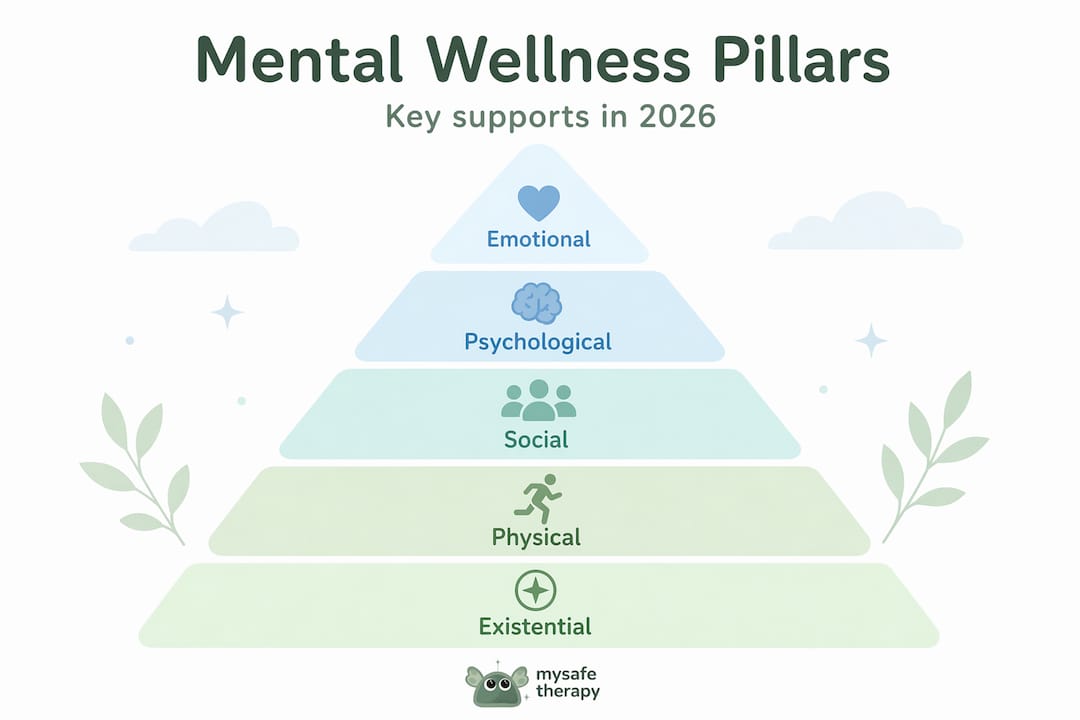
One of the most significant conceptual changes in defining mental wellness 2026 is the formal recognition that mental health cannot be addressed by clinical intervention alone. Mental wellness depends on integrated pillars: emotional, psychological, social, physical, and existential dimensions, each supported by its own evidence base.

This framing has practical implications. A person seeking support for depression is now more likely to receive a plan that incorporates therapy, sleep hygiene guidance, structured physical activity, and social reconnection rather than medication alone.
| Wellness pillar | Evidence-based approach | Example intervention |
|---|---|---|
| Emotional | Cognitive behavioural therapy, journalling | Weekly CBT sessions with a registered therapist |
| Psychological | Mindfulness, ACT, self-compassion training | Daily mindfulness practice via app |
| Social | Group therapy, peer support, community groups | Local mental health peer support circles |
| Physical | Aerobic exercise, sleep hygiene | 150 minutes of weekly moderate exercise |
| Existential | Values clarification, meaning-based therapy | Narrative therapy exploring purpose and identity |
The physical pillar now has particularly strong clinical backing. 150 minutes of moderate aerobic exercise weekly improves mental health outcomes, and 60 minutes of screen-free time before bed reduces sleep onset latency by 47 minutes. Sleep is not a lifestyle choice in this context. It is a clinical variable.
Community programmes are expanding rapidly. Workplace mental health has moved beyond awareness campaigns to psychological safety infrastructure and proactive manager-led support. Schools are embedding mental health education into curricula. Understanding why mental health matters across these social dimensions helps explain why community provision is not supplementary to clinical care; it is structurally part of it.
Pro Tip: When assessing any mental health support plan, check whether it addresses all five pillars. A plan that focuses solely on one dimension, such as medication without social support, is likely to produce slower and less durable recovery.
For those looking to act on these principles directly, evidence-based strategies for UK adults provide a practical starting point that aligns with the holistic framework described here. For a broader understanding of what holistic wellness means in practice across these domains, the evidence is clear that integrated approaches yield measurably better outcomes.
Policy, funding, and access in 2026
The structural changes defining mental health resources 2026 are not happening by accident. Significant government investment is reshaping what services exist and who can reach them.
In the UK, the £473 million mental health investment has funded a transformation of mental health infrastructure, including the early recruitment of 8,500 additional mental health workers. This is not a marginal policy adjustment. It is the largest workforce expansion in the NHS mental health sector in recent memory, and it is enabling the shift from crisis-only services to community-based, preventive care.
| Policy development | Details |
|---|---|
| UK £473m investment | Funds 8,500 new workers; expands community mental health centres and 24/7 hubs |
| US HHS 2026 action plan | Targets psychiatric overprescribing; promotes psychotherapy, nutrition, and physical activity as alternatives |
| Workplace mental health regulation | Growing pressure on employers to provide psychological safety infrastructure, not just EAP programmes |
| Community hubs expansion | 24/7 mental health access points replacing reliance on A&E for non-crisis urgent presentations |
The US HHS 2026 action plan, launched in May 2026, formally targets psychiatric overprescribing by emphasising non-medication evidence-based approaches including psychotherapy, nutrition, and physical activity. The policy direction in both the UK and US points to the same conclusion: mental health is becoming central to healthcare, education, work culture, and public policy in ways that simply did not exist five years ago.
Funding stability remains a real challenge. Workforce stress and uneven geographic access mean that community provision is not yet consistent across the UK. People in rural areas, or those without digital access, remain underserved despite the investment. These gaps are known, and addressing them is part of the ongoing policy agenda, but they are gaps that individuals navigating the system today need to account for.
My perspective on what truly defines effective support
I've worked with people at very different points in their mental health experience, and the most consistent pattern I've observed is this: the people who make the most durable progress are not those who found the most technologically sophisticated platform. They are the ones who found consistent human support and built lifestyle habits that reinforced their clinical work.
What concerns me about some of the enthusiasm around AI and digital tools is the assumption that accessibility alone is sufficient. Reaching someone faster is meaningless if what reaches them is inadequate. I've seen people in genuine distress receive chatbot responses when what they needed was a qualified human being. The technology has a legitimate place, but it requires clinical governance to be safe.
My view on the future of mental health support is that the most effective systems will be those that use technology to remove friction, not to replace depth. The 2026 model works when an AI tool helps a clinician do their job better, and when continuous monitoring means a therapist knows you need to talk before you have to reach out in crisis. That is the version of this future worth working towards.
The other thing I'd say plainly: destigmatising professional support still matters. Self-care and community resources are genuinely valuable, but they are not a substitute for working with a registered therapist when that is what the situation requires. The step-by-step guide to mental health support in the UK is a good place to start if you are unsure what level of support is right for your situation.
— MySafeTherapy
Access therapy that reflects how support works in 2026
The mental health strategies 2026 demands, including continuous care, personalised support, and flexible access, are exactly what Mysafetherapy is built to provide. The platform connects you with UK-accredited therapists registered with BACP, UKCP, and NCPS, available via video, chat, and avatar-based sessions across evenings and weekends.
Mysafetherapy supplements live therapy with AI journalling, mood tracking, and self-help resources, reflecting the hybrid digital-therapeutic model that evidence now supports. Pricing is transparent, therapist switching is straightforward, and confidentiality is central to the platform's design. Whether you are dealing with anxiety, burnout, relationship difficulties, or trauma, you can start therapy today and be matched with a therapist who fits your needs. If you prefer to choose directly, you can book with Samantha Cotterill or book with Robert Paynter for personalised, accredited online therapy.
FAQ
What does mental health support mean in 2026?
Mental health support in 2026 refers to an integrated system combining continuous care, AI-assisted tools, evidence-based lifestyle interventions, and accredited clinical therapy. It moves beyond single-episode treatment to proactive, ongoing care.
How is AI used in mental health support?
AI handles mood tracking, documentation, and low-intensity chatbot support, freeing clinicians to focus on direct care. It augments rather than replaces human therapists, and should always be paired with professional clinical oversight.
What are the five pillars of mental wellness?
The five pillars are emotional, psychological, social, physical, and existential wellness. Each has its own evidence base and is addressed through a combination of therapy, lifestyle habits, and community support.
How much has the UK invested in mental health services?
The UK government has committed £473 million to transform mental health infrastructure, including the early recruitment of 8,500 additional mental health workers to expand community and preventive care.
Is online therapy as effective as face-to-face therapy?
Research consistently shows that accredited online therapy produces outcomes comparable to in-person sessions for conditions including anxiety, depression, and trauma, particularly when delivered by registered clinicians using evidence-based methods.