

TL;DR:
- Setting specific, measurable, and realistic mental health goals using the SMART framework facilitates sustainable change and builds confidence. Focusing on small, manageable habits over 90 days with regular tracking and professional support enhances progress and reduces overwhelm. Flexibility, self-compassion, and targeted attention to one area at a time are key to maintaining motivation and long-term well-being.
Mental health goals are defined as specific, manageable objectives that support emotional well-being and daily functioning. Knowing how to set mental health goals effectively is the difference between vague intentions and sustainable change. The SMART framework (Specific, Measurable, Achievable, Relevant, Time-bound) is the leading evidence-based method for this, recommended in 2026 clinical guidance. Applied correctly, it converts wishes like "feel less anxious" into concrete habits that build over time. Tools such as mood-tracking apps, journalling, and professional therapy from platforms like Mysafetherapy provide the structure and accountability that make those habits last.
How to set mental health goals using the SMART framework

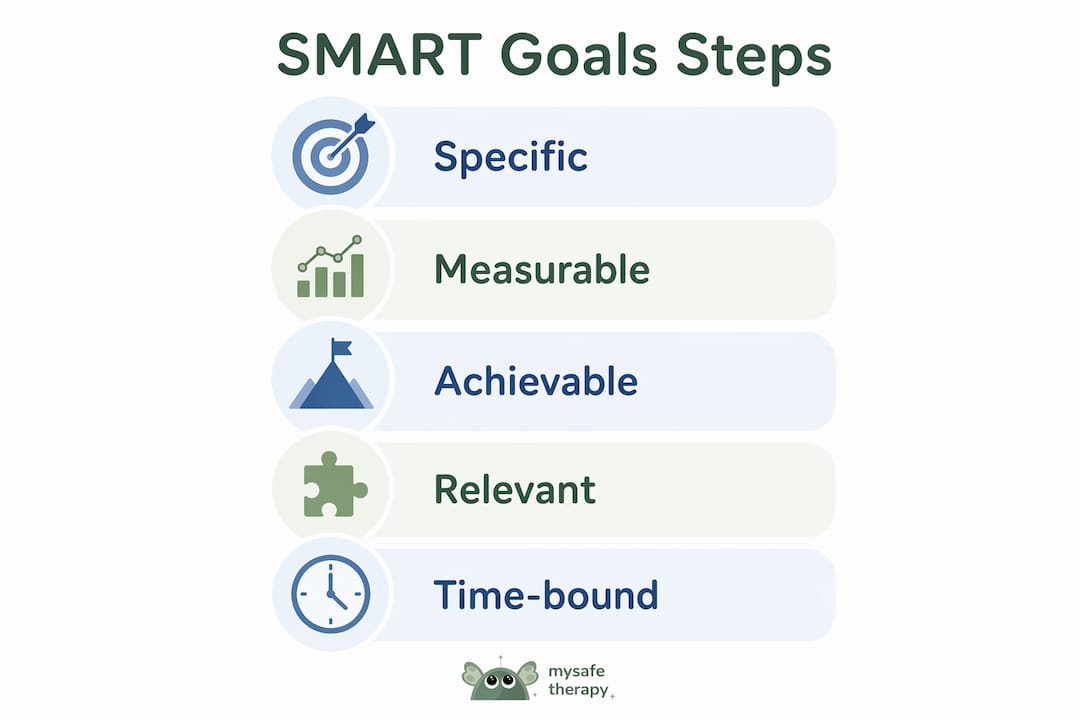
The SMART framework is the most reliable method for turning a mental health intention into a workable plan. Each component addresses a specific reason why goals fail, and together they create a structure that is both motivating and realistic.
Specific goals name the exact behaviour you will practise. "I will do a 5-minute grounding exercise before bed" is specific. "I will manage my stress better" is not. Specificity removes ambiguity and makes it clear what success looks like on any given day.
Measurable goals attach a number to the behaviour. Practising a grounding exercise 5 days per week gives you a clear weekly target. Logging your mood four times a week is another measurable mental health goal example. Without a number, you cannot assess whether you are progressing or drifting.
Achievable goals sit within your current capacity. If you are managing burnout, committing to a 60-minute daily meditation is likely to collapse within a fortnight. A 10-minute session is far more sustainable. The goal must stretch you slightly without overwhelming you.
Relevant goals connect to what genuinely matters to you right now. If poor sleep is your primary concern, a goal around sleep hygiene is relevant. A goal around social confidence, while worthwhile, may not be the right priority at this moment.
Time-bound goals carry a deadline or review point. A four-week target creates urgency and a natural checkpoint for honest assessment.
The table below illustrates the difference between vague intentions and SMART-formulated mental health goals.
| Vague goal | SMART alternative |
|---|---|
| Feel happier | Journal for 10 minutes each morning, 5 days a week, for 4 weeks |
| Worry less | Practise a 5-minute breathing exercise before bed, 4 nights a week |
| Be less stressed | Take a 15-minute walk at lunchtime, 3 days a week, for 6 weeks |
| Improve my relationships | Spend 20 minutes of phone-free time with a family member, twice a week |
- Write your SMART goal down and place it somewhere visible
- Break it into weekly micro-targets so progress feels tangible
- Review the goal at the end of each week, not just the end of the month
- Adjust the goal if life circumstances change, without treating that as failure
Pro Tip: Link your SMART goal to a specific trigger. "After I make my morning coffee, I will write three sentences in my journal" is more likely to stick than a goal with no environmental cue.
Why starting small leads to better mental health outcomes
Research supports 90-day milestone horizons over annual goals because they maintain urgency while giving habits time to form. A year-long goal loses momentum by February. A 90-day goal keeps the finish line close enough to feel real.
The concept of the "what-the-hell effect" explains why overambition backfires. When you set a goal beyond your current capacity and miss it once, the psychological response is often to abandon the goal entirely rather than simply resume. Starting at 50% of perceived capacity removes this trap. If you think you can meditate for 20 minutes daily, start with 10. The consistency you build at 10 minutes is worth far more than the sporadic effort you produce chasing 20.
Practical starting points for personal wellness goals include a 10-minute mindfulness walk each morning, journalling three times a week, or practising one breathing technique before a stressful event. These are not trivial. They are the foundation on which more demanding habits are built.
The benefits of starting small are concrete:
- Lower risk of early abandonment when motivation dips
- Easier to maintain during high-stress periods
- Creates a track record of success that builds self-efficacy
- Allows you to identify what works before scaling up
- Reduces the anxiety that often accompanies large behavioural changes
Pro Tip: Use habit stacking to anchor new mental health habits to existing routines. Attaching a new habit to something you already do reliably, such as a morning coffee or a commute, increases adherence more than willpower alone.
Prioritising one area of mental wellness at a time is equally important. Sleep, physical activity, social connection, and emotional regulation are all valid targets. Attempting all four simultaneously is the most common reason people abandon their goals within weeks. Choose one, build it into a consistent habit over 90 days, then add the next.
How to track mental health progress without self-judgement
Tracking frequency of behaviours is more effective than tracking feelings. Measuring how many times you practised a skill this week is objective and within your control. Measuring whether you "feel better" is not. Feelings fluctuate for reasons unrelated to your efforts, and using them as the primary metric leads to inaccurate assessments of progress.
Practical tools for monitoring mental wellbeing include:
- Mood-tracking apps such as Daylio or Bearable, which log daily emotional states alongside behaviours
- A paper journal with a simple weekly habit tracker grid
- A notes app with a brief end-of-day reflection prompt
- A shared accountability log with a trusted friend or therapist
Flexible goal adjustment is a sign of good self-management, not weakness. If a goal is consistently missed, the correct response is to examine why and modify the goal, not to push harder with the same approach. A therapist or counsellor can provide an objective perspective on whether a goal is calibrated correctly.
Support systems significantly improve goal adherence. Peer groups, therapy sessions, and even structured online communities provide accountability and encouragement at the moments when motivation is lowest. Working with a therapist gives you personalised tools and a regular review point that self-monitoring alone cannot replicate.
Creating mental health milestones at the 30-day and 60-day marks within a 90-day cycle gives you two natural checkpoints. At each milestone, ask: Is this goal still relevant? Has my capacity changed? What is working and what is not? This structured review prevents goals from becoming stale or disconnected from your actual life.
Common mistakes when setting mental health objectives
Vague goals are the most frequent error. "Feel happier" or "be less anxious" lack direction and provide no clear action to take on a Tuesday morning. Without a specific behaviour attached, these intentions fade within days. Rephrasing vague goals using SMART criteria immediately improves both clarity and motivation.
Trying to address every area of mental health simultaneously is the second most common mistake. Sleep, anxiety, relationships, self-esteem, and work stress are all legitimate concerns, but treating them as a single project creates cognitive overload. Focusing on one domain at a time produces better outcomes than spreading effort thinly across five.
Rigid goal expectations create a third problem. When a goal is treated as a pass-or-fail test rather than a flexible guide, any deviation triggers disproportionate self-criticism. This is particularly relevant for people managing anxiety or perfectionism, where the goal itself can become a source of stress. Progress is not linear, and small incremental steps lead to sustainable change more reliably than dramatic overhauls.
A practical check before setting any mental health goal is to consider whether physical factors might be contributing to the issue. A primary care health check can rule out physical causes such as sleep apnoea or thyroid imbalance before attributing everything to psychological factors.
Pro Tip: If your goals consistently feel overwhelming or unclear, that is a signal to seek professional support rather than push through alone. A qualified therapist can help you identify the right goals for your current situation and build a realistic plan around them.
Key takeaways
Effective mental health goal-setting requires specific, measurable targets, a gradual starting point, and consistent tracking of behaviours rather than feelings.
| Point | Details |
|---|---|
| Use the SMART framework | Convert vague intentions into specific, time-bound behaviours with clear weekly targets. |
| Start at 50% capacity | Beginning with manageable goals prevents early abandonment and builds lasting consistency. |
| Use 90-day milestones | Short horizons maintain urgency and allow regular reassessment of relevance and progress. |
| Track frequency, not feelings | Count how often you practise a skill each week for objective, controllable progress data. |
| Focus on one area at a time | Prioritising a single domain of mental wellness reduces overwhelm and improves success rates. |
What we have learned from working with mental health goals
The most persistent misconception we see at Mysafetherapy is that a missed day means a failed goal. It does not. A setback is data. It tells you something about the goal's design, your current capacity, or an obstacle you had not anticipated. The productive response is curiosity, not self-criticism.
We have also observed that the people who make the most consistent progress are rarely the ones who set the most ambitious goals. They are the ones who set modest, specific targets and protect them fiercely. A 10-minute journalling habit maintained for three months produces more measurable change than a 60-minute practice abandoned after two weeks.
Self-compassion is not a soft concept. It is a practical tool. Research from clinical settings consistently shows that people who treat setbacks with patience and realistic expectations return to their goals faster than those who respond with self-judgement. Celebrating a small win, such as completing your breathing exercise four out of five days, reinforces the behaviour and builds the identity of someone who follows through.
The goal is not perfection. The goal is a slightly better pattern of behaviour, repeated often enough to become unremarkable. That is how mental wellness actually improves.
— MySafeTherapy
Ready to set goals with professional support?
Setting personal wellness goals is more effective when you have a qualified professional helping you calibrate them to your actual life. Mysafetherapy connects you with UK-accredited therapists registered with BACP, UKCP, and NCPS, all of whom are experienced in collaborative goal-setting for anxiety, depression, burnout, and more.
Sessions are available via video, chat, or avatar format, including evenings and weekends, so professional support fits around your schedule rather than the other way around. Mysafetherapy also provides AI journalling and mood tracking tools to complement your therapy between sessions. If you are ready to move from intention to a structured plan, start therapy today with a therapist matched to your needs and goals.
FAQ
What is the SMART framework for mental health goals?
The SMART framework stands for Specific, Measurable, Achievable, Relevant, and Time-bound. It converts vague intentions such as "feel less anxious" into concrete behaviours like "practise a 5-minute breathing exercise before bed, four nights a week, for four weeks."
How many mental health goals should I set at once?
Set one goal at a time, focused on a single area such as sleep, anxiety, or social connection. Attempting multiple goals simultaneously is a leading cause of burnout and early abandonment.
How do I track mental health progress effectively?
Track the frequency of behaviours rather than feelings. Count how many times per week you practised a skill, and use tools such as Daylio, Bearable, or a paper habit tracker to maintain an objective record.
What should I do if I keep missing my mental health goals?
Treat missed goals as information rather than failure. Review whether the goal is too demanding, poorly timed, or missing an environmental cue. If goals consistently feel unmanageable, working with a qualified therapist provides personalised guidance and accountability.
How long should a mental health goal last?
A 90-day milestone horizon is more effective than annual goals because it maintains urgency while allowing time for habit formation. Review progress at 30 and 60 days to adjust the goal as needed.