

The most practical first step is a five-minute breathing exercise from NHS Every Mind Matters combined with completing the free Mind Plan quiz, which generates a personalised self-help programme. For anyone wanting structured digital support, guided self-help through NHS Talking Therapies or a private platform such as Mysafetherapy offers a clear, accredited route. The PHQ-9 and GAD-7 screening questionnaires can help you gauge symptom severity before deciding whether self-management is appropriate or whether professional care is needed.
Key options at a glance:
- NHS Every Mind Matters Mind Plan — free, five-question quiz generating a personalised self-help programme; many people who complete the email programme report improved wellbeing
- PHQ-9 / GAD-7 — validated screening tools used across UK primary care; a PHQ-9 score at the higher end of the scale typically indicates the need for professional treatment
- NHS Talking Therapies — self-referral available in most areas of England for anxiety and depression, no GP needed
- Mysafetherapy — UK-based private platform connecting adults with BACP, UKCP, and HCPC-accredited therapists, with AI journaling and mood-tracking tools included
Urgent help: If you are in immediate danger, call 999. For urgent mental health support, call NHS 111 (option 2). The Samaritans are available 24 hours a day on 116 123. Do not wait for a scheduled appointment if you are experiencing suicidal thoughts or a mental health crisis.
Table of Contents
- 1. Short, practical self-help techniques you can use today
- 2. UK digital tools and apps: how to check safety and privacy
- 3. Screening tools used in UK primary care: PHQ-9, GAD-7, and what scores mean
- 4. How guided self-help and online therapy work in the UK
- 5. When to seek urgent help: red flags and UK contacts
- 6. How to choose the right tool or provider for your situation
- Key takeaways
- Why UK-specific guidance matters for your mental wellbeing
- Mysafetherapy: accredited UK therapy without the wait
- Authoritative UK sources and further reading
1. Short, practical self-help techniques you can use today
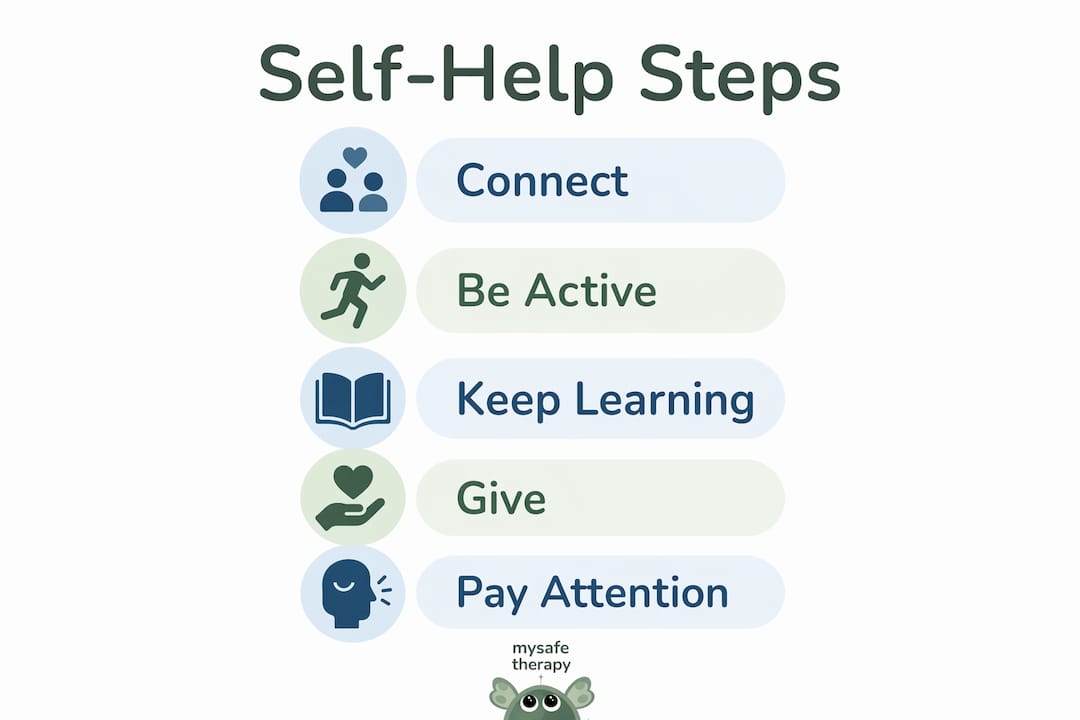
The NHS five steps to mental wellbeing — connect, be active, keep learning, give, and pay attention — provide the evidence base for most short self-help routines. Each technique below maps to one or more of those steps and takes between five and twenty minutes.
Paced breathing (5 minutes). Breathe in for four counts, hold for two, and breathe out for six. This activates the parasympathetic nervous system and reduces acute anxiety within a single session. Repeat at the same time each day to build a reliable stress-management habit.
Grounding (5–10 minutes). The 5-4-3-2-1 technique asks you to name five things you can see, four you can touch, three you can hear, two you can smell, and one you can taste. It interrupts rumination and is particularly useful during panic or dissociation.
Progressive muscle relaxation (15–20 minutes). Working from feet to face, tense each muscle group for five seconds then release. Clinical evidence supports its use for both anxiety and insomnia, and audio guides are freely available through NHS self-help pages.
Brief behavioural activation (10 minutes). Choose one small, pleasurable or purposeful activity — a short walk, a phone call to a friend, or five minutes of a hobby — and schedule it at a fixed time. Behavioural activation is a core component of CBT-based depression treatment and works even in brief doses.
Micro-exercise (10 minutes). A brisk ten-minute walk raises mood-related neurotransmitters and satisfies the NHS "be active" step. The effect on low mood is measurable after a single session, not just over weeks.
Pro Tip: Build a two-minute anchor at the start and end of each day: thirty seconds of paced breathing, a one-line mood note in a journal or app, and a single scheduled activity. Tracking this over seven days gives you concrete data on whether a technique is working before you invest more time in it.
2. UK digital tools and apps: how to check safety and privacy
The digital mental health space in the UK is large and uneven in quality. Knowing which signals to look for protects you from tools that overstate their clinical value or handle your data poorly.
What types of tools exist. Broadly, digital mental health support tools fall into four categories: symptom trackers and mood diaries, guided CBT courses, general wellbeing and mindfulness apps, and platforms combining journaling or mood tracking with live therapist access. Each category carries different regulatory implications.
The MHRA distinction matters. In January 2026, the MHRA published updated guidance urging people to check whether a digital mental health product is regulated as a medical device before using it. An app that claims to diagnose, treat, or manage a condition must carry a UKCA or CE mark and appear on the MHRA public register. A general wellbeing app does not require that registration, but it also cannot make clinical claims. NHS listing and MHRA medical-device status are separate checks: an app can appear on an NHS resource page as a wellbeing tool without being a regulated medical device.
Safety checklist before downloading any mental health app:
- Does it claim to diagnose or treat a condition? If yes, check the MHRA public register for UKCA/CE certification.
- Is it listed by NHS Every Mind Matters or the NHS Apps Library?
- Does it publish peer-reviewed evidence or clinical trial results?
- Does it have a clear, plain-English privacy policy stating where data is stored, who can access it, and whether it is shared with third parties?
- Is clinician involvement disclosed, including whether therapists or psychologists contributed to the content?
If a regulated app causes harm or distress, you can report it to the MHRA via the Yellow Card scheme. This reporting helps monitor device safety post-market.
For a broader understanding of digital mental health terminology and what UK data-protection rules mean for app users, the Mysafetherapy blog provides a plain-language explainer covering GDPR obligations and what to expect from a compliant platform.
Pro Tip: Start with tools listed on NHS Every Mind Matters or the NHS Apps Library. Pair a wellbeing app with a simple daily self-help routine rather than relying on the app alone — the combination produces more consistent engagement than either approach in isolation.
3. Screening tools used in UK primary care: PHQ-9, GAD-7, and what scores mean
The PHQ-9 and GAD-7 are the standard short questionnaires used across UK primary care, NHS Talking Therapies, and private therapy services to measure depression and anxiety severity. Both are self-completed and take under three minutes each.
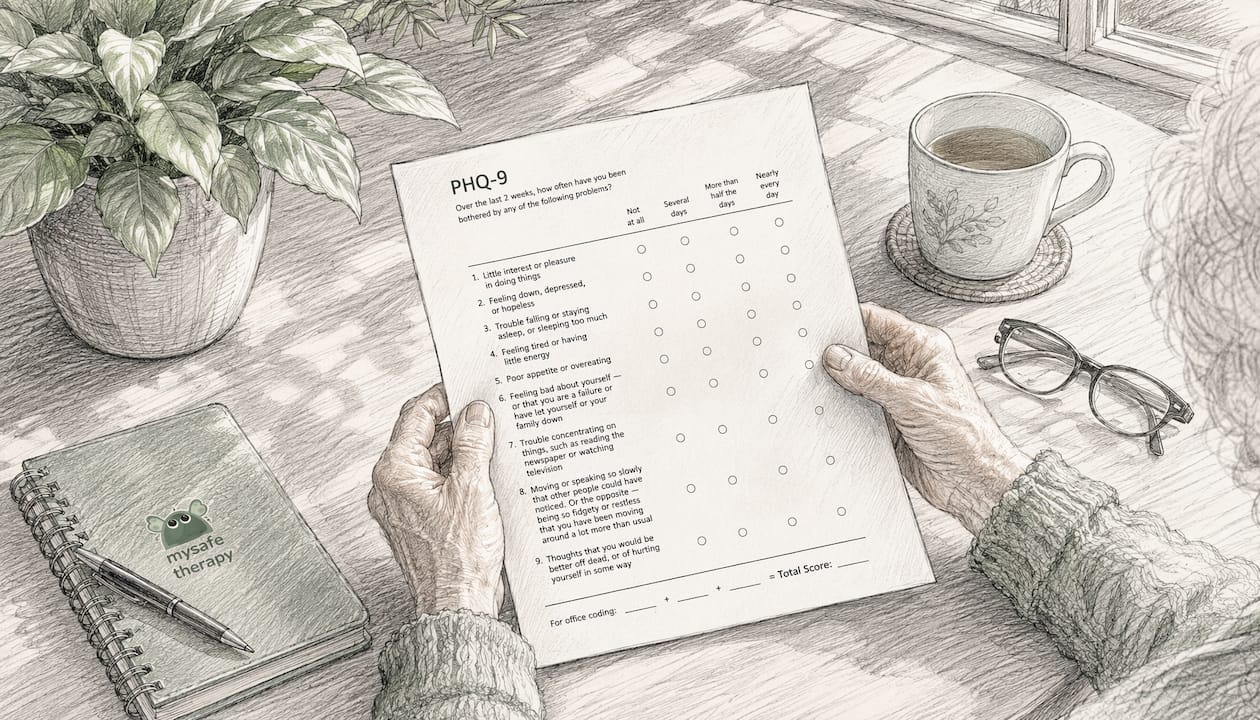
The PHQ-2 and GAD-2 are two-item versions used as initial screens. A positive result on either typically prompts completion of the full nine- or seven-item version. In UK primary care, a GP or therapist will usually administer these at first contact and then at regular intervals to track change.
A UK primary care validation study found the PHQ-9 achieves sensitivity of 91.7% and specificity of 78.3% against a diagnostic gold standard, making it a reliable brief instrument for identifying depression in general practice.
PHQ-9 and GAD-7 score bands
| Tool | Score range | What it commonly indicates |
|---|---|---|
| PHQ-9 | 0–5 | Minimal or no depression |
| PHQ-9 | 5–9 | Mild depression; self-help and monitoring appropriate |
| PHQ-9 | 10–15 | Moderate depression; guided self-help or GP review recommended |
| PHQ-9 | 15–26 | Moderately severe to severe; professional treatment typically warranted |
| GAD-7 | 0–5 | Minimal anxiety |
| GAD-7 | 5–9 | Mild anxiety; self-help strategies appropriate |
| GAD-7 | 10–15 | Moderate anxiety; consider referral |
| GAD-7 | 15–20 | Severe anxiety; professional assessment recommended |
How to use these tools practically:
- Complete the PHQ-9 and GAD-7 honestly, based on the past two weeks, not your worst-ever period.
- Share results with your GP or therapist rather than acting on scores alone. A score above the threshold is a prompt for a conversation, not a diagnosis.
- A PHQ-9 score of 15 or above, or a GAD-7 score of 15 or above, should prompt referral to NHS Talking Therapies or a GP without delay.
- Repeat the questionnaires every two to four weeks during self-help or therapy to track whether your symptoms are improving, stable, or worsening.
The CORE-10, a UK-developed outcome measure, is often used alongside or instead of the PHQ-9 for sessional monitoring in therapy, as it covers functioning and risk as well as symptom severity.
4. How guided self-help and online therapy work in the UK
Guided self-help and online therapy are distinct interventions, though both are available digitally and both have an NHS evidence base.
Guided self-help uses structured CBT-based materials — typically a workbook or online course — supported by a practitioner who facilitates progress and reviews outcomes. NICE guidance (NG222) recommends it as an effective first-line option for mild to moderate depression and anxiety. It typically runs over 6–8 sessions and can be delivered by phone, video, or online course. It requires self-motivation: there is homework between sessions, and outcomes depend partly on consistent engagement.
Online therapy involves regular one-to-one sessions with an accredited therapist, delivered via video, phone, or chat. It is more intensive than guided self-help and suits people with moderate to severe symptoms, those who have not responded to self-help, or those who prefer a private, flexible arrangement.
Access routes in the UK:
- NHS Talking Therapies — self-referral is available in most areas of England for anxiety and depression; no GP referral needed. Find your local service at NHS Talking Therapies. Waiting times vary by area.
- Mind and Rethink Mental Illness — both charities provide free information, peer support, and signposting to local services. Mind's website includes self-help resources and a directory of local Mind services.
- Private online therapy — platforms such as Mysafetherapy connect adults with BACP, UKCP, and HCPC-accredited therapists, with sessions available evenings and weekends. Private therapy involves a cost but typically has shorter waiting times and greater flexibility over session format and therapist choice.
When comparing NHS versus private therapy options, the key trade-offs are cost, waiting time, and the degree of control over which therapist you see and when.
What to check when choosing a provider:
- Therapist accreditation: BACP, UKCP, or HCPC registration confirms professional standards and ethical oversight.
- Session formats available: video, phone, chat, or avatar-based sessions suit different preferences and circumstances.
- Outcome monitoring: reputable services use validated measures such as PHQ-9, GAD-7, or CORE-10 to track progress.
- Supervision: accredited therapists receive regular clinical supervision, which is a quality and safety requirement.
Combining guided self-help with brief daily techniques from Section 1 is a practical approach for mild to moderate symptoms. If PHQ-9 or GAD-7 scores are not improving after four to six weeks of consistent self-help, stepping up to structured therapy is the appropriate next move. For more on self-help therapy formats and who benefits most, the Mysafetherapy blog covers the evidence in accessible detail.
5. When to seek urgent help: red flags and UK contacts
Some situations require immediate professional intervention rather than self-help tools. Recognising the red flags clearly is the priority.
Seek urgent help if you or someone you know is experiencing:
- Suicidal thoughts, plans, or intent to act
- Thoughts of harming others
- Severe self-neglect (not eating, drinking, or maintaining basic safety)
- A sudden, major change in behaviour or functioning — including confusion, extreme agitation, or inability to communicate
- A mental health crisis that is escalating rapidly despite attempts at self-management
UK emergency and crisis contacts:
- 999 — call immediately if there is risk to life
- NHS 111 (option 2) — urgent mental health support, available 24 hours a day; a trained mental health professional will assess and advise
- Samaritans — 116 123, free, 24 hours a day, seven days a week; also available at jo@samaritans.org
- Crisis teams — most NHS trusts have a local crisis resolution and home treatment team; search "mental health crisis team" plus your area on the NHS website
- A&E — attend your nearest emergency department if you are in immediate danger and cannot reach help by phone
When calling NHS 111 or a crisis line, state clearly that you are calling about a mental health crisis. Have to hand: your name, GP surgery, any current medication, and a brief description of what has changed. This helps the triage worker direct you to the right level of care quickly.
6. How to choose the right tool or provider for your situation
Matching a tool or service to your current needs requires honest assessment across a few practical dimensions.
Decision checklist:
- Symptom severity — PHQ-9 and GAD-7 scores provide an objective starting point. Mild scores suit self-help; moderate to severe scores warrant guided self-help or therapy.
- Time and commitment — self-help techniques require five to twenty minutes daily; guided self-help requires six to eight structured sessions; weekly therapy requires a regular, sustained commitment.
- Budget — NHS Talking Therapies is free at point of use; private therapy involves a monthly or per-session cost. Check whether your employer offers an Employee Assistance Programme (EAP) that includes counselling sessions.
- Data privacy — for any digital tool, confirm GDPR compliance, data storage location (UK or EEA preferred), and whether data is sold or shared with third parties.
- Clinician involvement — apps that include therapist-reviewed content or live therapist access carry more clinical weight than purely algorithmic tools.
For telehealth accessibility and practical tips on making remote sessions work for a busy schedule, Chameleon Healthcare's blog covers the operational side of digital therapy well.
Comparing support categories
| Category | Typical effectiveness | Cost | Commitment | Best suited to |
|---|---|---|---|---|
| Self-help techniques | Moderate for mild symptoms | Free | 5–20 min/day | Mild stress, low mood, prevention |
| Guided self-help | Good for mild–moderate symptoms | Free (NHS) or low cost | 6–8 sessions | Mild–moderate depression/anxiety |
| Online therapy | Strong for moderate–severe symptoms | £40–£100 per session | Weekly, ongoing | Moderate–severe or complex presentations |
Red flags when evaluating a product or provider:
- Claims to diagnose or cure a condition without MHRA registration
- No named accrediting body for therapists
- Vague or absent privacy policy
- No outcome monitoring or progress tracking
- Pressure to commit to long-term contracts before an initial assessment
Key takeaways
The most reliable approach to mental wellbeing combines short daily self-help techniques with validated screening tools and, where needed, accredited professional support through NHS or private routes.
| Point | Details |
|---|---|
| Start with brief self-help | Five to twenty minutes of paced breathing, grounding, or behavioural activation can reduce symptoms measurably within days. |
| Use validated screening tools | PHQ-9 and GAD-7 scores guide whether self-management is appropriate or professional care is needed; a score of 15 or above on either warrants professional review. |
| Check MHRA and NHS signals for apps | Apps claiming to diagnose or treat must carry a UKCA/CE mark; NHS listing and MHRA registration are separate checks. |
| Access guided self-help via NHS Talking Therapies | Self-referral is available in most areas of England; NICE recommends guided self-help as a first-line option for mild to moderate depression and anxiety. |
| Mysafetherapy for private accredited support | Mysafetherapy connects UK adults with BACP, UKCP, and HCPC-accredited therapists and includes AI journaling and mood-tracking tools alongside live sessions. |
Why UK-specific guidance matters for your mental wellbeing
The volume of mental health content online is not the problem. The problem is that most of it is not written for the UK regulatory and clinical context. An app endorsed by a US health authority carries no weight here. A therapist listed on a foreign directory may not meet BACP or UKCP standards. A screening threshold cited from an American study may differ from the cut-offs used in UK primary care validation research.
UK-specific guidance matters because the safety checks are different. MHRA registration, NICE recommendations, and NHS Talking Therapies self-referral pathways are the relevant frameworks. When you use a tool that has been assessed against those standards, you have a defensible basis for trusting it. When you use one that has not, you are relying on marketing copy.
Combining immediate self-help with a structured plan to monitor progress using PHQ-9 or GAD-7 is not overcautious. It is the stepped-care model that NHS and NICE guidance is built on. If scores improve, you have evidence that self-management is working. If they do not, you have the same evidence that it is time to step up. Mysafetherapy fits naturally into that model as a private access point to accredited therapists and digital tools, available without a waiting list and with the flexibility to switch therapist if the first match is not right.
Mysafetherapy: accredited UK therapy without the wait
Waiting times for NHS Talking Therapies vary significantly by area, and not every presentation is suited to guided self-help alone. Mysafetherapy offers a direct route to accredited UK therapists registered with BACP, UKCP, or HCPC, with sessions available via video, phone, chat, or avatar format to suit different preferences and levels of comfort with disclosure.
Alongside live therapy, the platform includes AI-guided journaling, mood tracking, and self-help booklets that complement weekly sessions and support progress between appointments. Pricing is transparent, there are no long-term contracts, and switching therapist is straightforward if your needs change. For professionals managing work-related stress or burnout, a dedicated service for professionals is also available.
If you have completed a PHQ-9 or GAD-7 and your scores suggest moderate or above, or if self-help techniques have not produced improvement after a few weeks, starting therapy with Mysafetherapy is a practical next step you can take today.
Authoritative UK sources and further reading
- NHS Every Mind Matters Mind Plan — free personalised self-help programme based on a five-question quiz
- NHS five steps to mental wellbeing — evidence-based daily actions to build and maintain mental health
- NHS Talking Therapies self-referral — find your local service and refer yourself without a GP
- MHRA guidance on digital mental health technologies — how to check whether an app is a regulated medical device
- NICE NG222: Depression in adults — clinical guidance on guided self-help and psychological treatments
- PHQ-9 guidance (ELFT/NHS) — scoring instructions and clinical thresholds
- CORE-10 information (Core System Trust) — UK outcome measure for sessional monitoring
- Mind — mental health charity providing information, peer support, and local services
- Rethink Mental Illness — charity supporting people affected by severe mental illness
- Mysafetherapy: start therapy — begin with an accredited UK therapist online
Before using any digital mental health tool, check the MHRA register if the app makes clinical claims, and read the privacy policy to confirm how your data is stored and used. This article provides general information and does not constitute professional medical or psychological advice. For your own situation, consult a qualified clinician or your GP.