

Sensory grounding using the 5-4-3-2-1 method, paced breathing with a long exhale, and simple physical anchors like feet-on-floor or cold water are the fastest, evidence-informed options for calming trauma responses in the moment. These techniques stabilise the nervous system; they don't replace trauma-focused therapy, which addresses the underlying cause. Practising them while calm makes them far more reliable when you're not.
TL;DR:
- Grounding techniques like the 5-4-3-2-1 method and paced breathing are most effective when practiced regularly in calm states before a crisis occurs.
- Different trauma severities and types require tailored approaches, with dissociative cases benefiting from stronger physical stimuli like cold water or movement.
- Techniques should be sorted by intensity and rehearsed daily to ensure quick, automatic use during actual flashbacks or panic attacks.
- Grounding serves as a stabilisation tool, not a treatment, and ongoing therapy such as trauma-focused CBT or EMDR is essential for addressing the root causes of trauma.
- Consistent practice, personalized technique selection, and professional support improve grounding effectiveness and overall trauma recovery.
Table of Contents
- What grounding techniques for trauma actually do
- The 5-4-3-2-1 sensory grounding technique, step by step
- Breathing techniques that calm a trauma response
- Physical grounding: fast, tactile ways to interrupt a trauma response
- Cognitive grounding: orienting yourself back to the present
- How to build a grounding toolkit that actually works under pressure
- When grounding isn't enough on its own
- Why this guide is trustworthy
- Tailoring grounding for different trauma types and severity
- Common mistakes that undermine grounding practice
- Making grounding part of your daily routine
- Using grounding during a flashback or panic attack
- Why mindfulness matters alongside grounding
- What the evidence says about grounding techniques for trauma
- Clinical perspective: practice before processing
- Getting trauma-informed support alongside your grounding practice
- Sources
- FAQ
What grounding techniques for trauma actually do
Grounding techniques for trauma work by pulling attention away from an internal flashback or panic state and back into the present physical environment. When something triggers a trauma response, the brain can behave as though the danger is happening now, rather than in the past. That's the mechanism behind flashbacks, dissociation, and the frozen or flooded feeling many trauma survivors describe.
Clinicians often use the "window of tolerance" model to explain this: a zone where you can think clearly and respond flexibly, bordered by hyperarousal (panic, racing thoughts, anger) on one side and hypoarousal (numbness, shutdown, dissociation) on the other. Grounding works by nudging you back toward that window using sensory or cognitive input strong enough to interrupt the trauma response and re-engage the parts of the brain responsible for reasoning and judgement.
Polyvagal theory offers a useful frame here too: it describes the nervous system moving between states of threat and safety, with grounding helping to re-engage the calmer, socially connected state rather than staying stuck in fight, flight, or shutdown responses.
Crucially, this is stabilisation work, not treatment. UK clinical guidance from NICE's NG116 guideline recommends trauma-focused CBT or EMDR as the actual treatments for post-traumatic stress disorder. Grounding sits alongside this as preparatory skills training:
- It reduces distress in the moment so you can function day to day.
- It builds a sense of safety before deeper trauma processing begins.
- It gives therapists a stable baseline to work from, lowering the risk of re-traumatisation during trauma-focused sessions.
The 5-4-3-2-1 sensory grounding technique, step by step
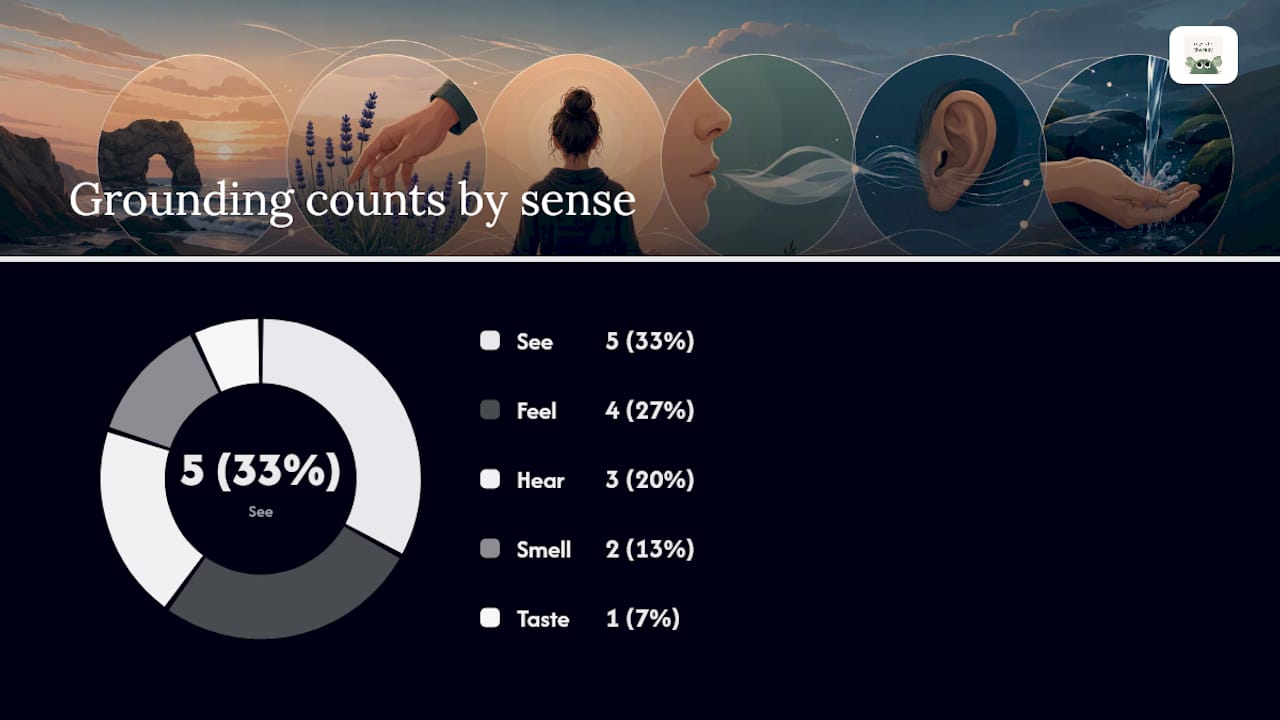
The 5-4-3-2-1 method is the most widely recommended sensory grounding exercise for trauma-related flashbacks and anxiety, and it's specifically listed by NHS Inform as a grounding exercise. It works by forcing your attention through each of your senses in turn, which is harder to do half-heartedly than it sounds.
Here's the full script:
- Name 5 things you can see. Be specific: not "a wall" but "the chipped paint on the skirting board" or "the blue mug on the second shelf."
- Name 4 things you can feel. The texture of your sleeve, the pressure of your feet on the floor, the temperature of the air on your skin, the weight of your own hands in your lap.
- Name 3 things you can hear. Traffic outside, your own breathing, a clock ticking. Distant or faint sounds count.
- Name 2 things you can smell. If nothing's obvious, name two smells you associate with safety, or move to a scented object you keep for this purpose.
- Name 1 thing you can taste. A sip of water, a mint, or simply the current taste in your mouth.
If a sense isn't available, whether you're on a bus, in a meeting, or somewhere you can't speak aloud, swap it. Replace smell or taste with texture (count two more things you can feel) or run the whole exercise silently, describing each item to yourself in full sentences rather than single words. The detail matters more than the category: "vague labelling" (just thinking "chair, chair, chair") doesn't engage attention the way specific, sensory-rich description does.
Pro Tip: Rehearse 5-4-3-2-1 when you're calm, not just when you're triggered. Trauma specialists consistently note that grounding needs to be practised in advance so it becomes automatic. Trying a brand-new technique for the first time mid-flashback rarely works.
Breathing techniques that calm a trauma response
Breath work slows a racing nervous system down, but only if you get the ratio right. The mechanism is straightforward: a longer exhale than inhale signals safety to the parasympathetic nervous system and supports vagal tone, which is the physiological basis behind 4-7-8 breathing and similar paced-breathing methods.
Three patterns worth learning include 4-7-8 breathing, which involves inhaling for 4 counts, holding for 7, and exhaling slowly for 8, repeated several cycles.
- Box breathing: inhale, hold, exhale, hold, each for 4 counts. Useful when a held breath feels steadier than a stretched exhale.
- Coherent breathing: roughly 5 to 6 breaths per minute, inhaling and exhaling for similar counts. Gentler than 4-7-8, good for sustained daily practice rather than acute crisis moments.
A genuine caveat here: deep or controlled breathing isn't universally calming. For some trauma survivors, particularly those whose trauma involved suffocation, restraint, or breathing difficulty, focusing on the breath can trigger panic rather than ease it. If that happens to you, don't force it. Switch immediately to sensory-first grounding instead, cold water, a textured object, feet-on-floor, and treat that as your primary tool rather than a backup.
Physical grounding: fast, tactile ways to interrupt a trauma response
Physical grounding uses strong bodily sensation to pull you out of dissociation or hyperarousal quickly, often faster than a cognitive technique can manage.
Cold stimulus is one of the most reliable options. Holding an ice cube, running cold water over your wrists, or splashing your face triggers what's sometimes called the dive reflex, a sharp physiological jolt that reliably interrupts dissociation and hyperarousal. It's abrupt, but that's precisely why it works when gentler methods aren't cutting through.
Feet-on-floor grounding is subtler and works almost anywhere:
- Press both feet flat into the floor and notice the contact point.
- Say silently, "My feet are on the floor. The floor is solid. I am here, now, safe."
- Push down gently through your heels for a few seconds, then release.
A grounding object carried in a pocket or bag, a smooth stone, a piece of fabric, a small charm, gives you something tactile to reach for discreetly in public. One detail worth getting right: choose an object you acquired after the trauma occurred, not something that predates it, to avoid accidental associations. Movement helps too, whether that's a brisk walk, stamping your feet, or, in private, shaking out your hands and shoulders to physically discharge tension.
Cognitive grounding: orienting yourself back to the present
Cognitive grounding uses mental tasks and factual statements to shift processing back toward the prefrontal cortex, the part of the brain responsible for reasoning, rather than leaving you stuck in a reactive, past-oriented state.
Useful tasks include:
- Counting backwards from 100 in sevens (93, 86, 79...).
- Naming every category you can think of: types of fruit, dog breeds, capital cities.
- Recalling the lyrics to a familiar song, out loud or in your head.
- Reciting your address, phone number, or the date, slowly and deliberately.
An orienting script works well when a flashback starts to take hold: state your name, today's date, where you physically are right now, and a simple safety statement such as "The danger happened then. I am safe here, now." This lines up with the orienting response used in Somatic Experiencing, where looking around the room, noticing safety cues, and resting your gaze helps complete the nervous system's natural safety check.
Updating takes this further: actively list two or three concrete differences between the traumatic memory and your current reality (different room, different year, different people present). This reduces the sense that the past event is recurring.
Pro Tip: Keep your orienting statement short and memorised word-for-word. Under stress, you won't have the working memory to improvise a long script, but a rehearsed sentence comes out almost automatically.
How to build a grounding toolkit that actually works under pressure
Not every technique suits every state. Mild dissociation (feeling foggy, distant, slightly unreal) often responds well to cognitive grounding or gentle sensory input. Full flooding (racing heart, panic, overwhelming fear) usually needs something stronger and faster: cold stimulus or physical movement tends to cut through better than a quiet counting exercise.
- Sort your techniques by intensity. Keep a mental (or written) list split into "mild" and "severe" categories, so you're not fumbling for the right tool mid-crisis.
- Practise daily in low-stakes moments. A minute of feet-on-floor grounding while waiting for the kettle, or one round of 4-7-8 breathing before a meeting, builds the automatic response you'll need later.
- Rehearse situationally. If certain places or situations reliably trigger you, walk through your chosen technique in your head beforehand.
- Track what works. Note the technique, the situation, and how effective it was, even briefly in a phone note. Patterns emerge quickly: you might find cold water outperforms breathing every time, or that counting works better at work than at home.
- Adjust every few weeks. Techniques that felt effective initially sometimes lose impact through habituation. Swap in a fresh sensory variant if that happens.
When grounding isn't enough on its own
Grounding techniques for trauma are stabilisation tools, not a cure. If you're relying on them daily just to function, or they only take the edge off before symptoms return, that's a signal you need more than self-help.
Watch for these red flags:
- Flashbacks that recur frequently despite consistent grounding practice.
- Any thoughts of suicide or self-harm.
- Severe or prolonged dissociation, including lost time or feeling detached from your body for extended periods.
- Avoidance that's shrinking your daily life (skipping work, withdrawing from relationships).
NICE guideline NG116 recommends trauma-focused CBT or EMDR as the evidence-based treatments for PTSD, both of which typically begin with a stabilisation phase before addressing the trauma memory directly.
Before a first trauma therapy contact, it helps to note down what triggers you, what grounding techniques you've already tried, and what specifically you want from therapy, whether that's flashback reduction, better sleep, or simply feeling safer day to day.
Why this guide is trustworthy
This guide draws on established UK clinical sources: NHS Inform's grounding exercises, NICE guideline NG116 on PTSD treatment, and published trauma stabilisation frameworks, rather than generic wellness advice.
Mysafetherapy connects readers with UK-accredited therapists registered with bodies including the BACP, UKCP, and NCPS, offering trauma-informed sessions via video, chat, or avatar-based formats, alongside AI journaling and mood tracking tools that support grounding practice between sessions. The clinical framing throughout reflects established stabilisation-first practice, not a single practitioner's personal method.
Tailoring grounding for different trauma types and severity
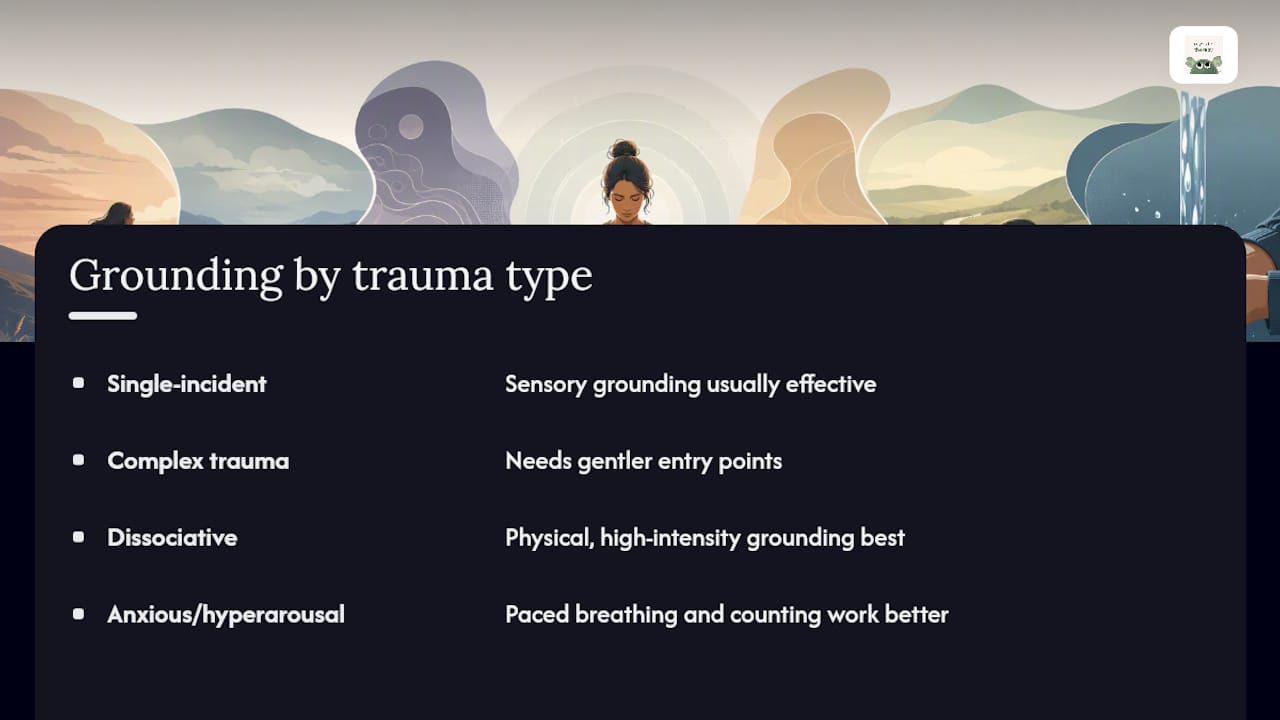
A single car accident and years of childhood abuse don't respond to grounding in the same way, and treating them identically often leads to frustration.
Single-incident trauma (an accident, an assault, a medical emergency) tends to respond well to standard sensory grounding, since the nervous system usually has a stable baseline to return to once the acute response passes. Complex or developmental trauma, built up over years, especially in childhood, often needs gentler entry points. Sensory grounding alone can feel insufficient, or even overwhelming, if dissociation is a long-standing coping pattern rather than an occasional response.
For dissociative presentations, physical, high-intensity grounding (cold water, firm pressure, movement) generally outperforms quiet cognitive tasks, which can be too easy to drift through without really engaging. For predominantly anxious or hyperaroused presentations, paced breathing and counting often work better, since the goal is slowing down rather than snapping into alertness.
Severity matters too. If dissociation is severe enough that grounding attempts don't register at all, that's not a sign grounding has failed as a category. It usually means the techniques need to be more intense, more frequent, or practised alongside professional support rather than instead of it. This is exactly the kind of nuance a trauma-informed therapist can help calibrate individually.
Common mistakes that undermine grounding practice
The single biggest mistake is only trying grounding for the first time during a crisis. Techniques that feel simple on paper often fall apart under real stress if they haven't been rehearsed, which is why practice while calm matters so much.
Vague execution is another common trap. Naming "five things" in your head without real detail (chair, wall, floor, window, door) doesn't demand enough attention to interrupt a trauma response. Specificity, the exact shade of the wall, the particular scuff on the floor, is what makes the exercise work.
Giving up after one attempt is also common. Grounding rarely resolves distress instantly; it's normal to need several minutes and more than one technique stacked together, sensory grounding followed by an orienting statement, for example.
Some people also pick techniques that don't suit their trauma type, as covered above, then conclude grounding "doesn't work for them" when really the wrong tool was chosen for the state they were in. Others treat grounding as a complete solution and stop pursuing therapy altogether, even as symptoms persist or worsen.
Finally, breath-focused techniques can misfire for people whose trauma involved suffocation or restraint. If a breathing exercise increases panic rather than reducing it, that's a signal to switch tools entirely, not to push through.
Making grounding part of your daily routine
Grounding works best as an established habit, not an emergency-only measure. Anchoring a short practice to something you already do daily, brushing your teeth, making coffee, the commute home, builds the automatic response that crisis moments require.
A workable structure looks like this: a brief sensory or breathing exercise each morning, a body check-in at a set point during the day (feet-on-floor for thirty seconds), and a wind-down practice before bed, perhaps coherent breathing or a short orienting statement. None of these need to take more than a minute or two.
Situational rehearsal matters as well. If certain environments, crowded transport, particular conversations, reliably trigger you, mentally walk through your grounding response beforehand rather than waiting to improvise under pressure.
Consistency does more than intensity here. Five minutes of grounding practice daily for a month builds far more resilience than one long session attempted only when things feel unbearable.
Using grounding during a flashback or panic attack
When a flashback or panic attack hits, the order of operations matters more than which specific technique you reach for.
Start with the most physically immediate option: press your feet into the floor, or reach for cold water if it's available. This interrupts the physiological spike faster than a cognitive exercise can.
Once the acute intensity eases slightly, move to an orienting statement: your name, the date, where you are, and a brief safety statement. This helps distinguish the present moment from the memory that's intruding.
If breathing feels manageable at this point, add a paced breath, exhale longer than you inhale, but skip this step entirely if breath-focus tends to escalate your panic rather than calm it.
Finally, once you're stable enough to think clearly, use 5-4-3-2-1 or a similar detailed sensory scan to fully re-anchor yourself in the present before resuming whatever you were doing.
Why mindfulness matters alongside grounding
Mindfulness and grounding overlap, but they're not identical. Mindfulness is the broader skill of noticing present-moment experience without judgement; grounding is a specific, often more directive, application of that skill aimed at interrupting distress.
Where mindfulness practice supports grounding is in building the underlying capacity to notice sensation and thought without becoming swept up in it. Someone with regular mindfulness practice often finds grounding techniques easier to apply, because they're already accustomed to observing their internal state rather than being consumed by it.
That said, standard mindfulness meditation (sitting quietly, observing the breath) can occasionally increase distress for trauma survivors, particularly those prone to dissociation, since prolonged internal focus without an anchoring task can allow intrusive material to surface unchecked. Grounding techniques are generally more structured and outward-facing for this reason: naming objects, engaging senses, orienting to the room. For many trauma survivors, that structure makes grounding a safer entry point into present-moment awareness than open-ended mindfulness meditation.
What the evidence says about grounding techniques for trauma
Grounding techniques for trauma aren't a fringe wellness trend; they sit within recognised UK clinical guidance. NHS Inform lists sensory grounding exercises specifically for managing flashbacks and anxiety, and NHS survivor support materials provide detailed scripts covering sensory grounding, cold stimulation, grounding objects, and imagery updating as stabilisation tools.
The strongest evidence sits behind grounding's role as preparatory work rather than as standalone treatment. NICE guideline NG116 identifies trauma-focused CBT and EMDR as the treatments with a genuine evidence base for resolving PTSD, with stabilisation skills, including grounding, recommended as groundwork that reduces the risk of re-traumatisation once trauma processing begins.
The physiological rationale behind breathing-based grounding is well established too: slower, longer exhalation supports parasympathetic activation, the basis of 4-7-8 and similar paced-breathing methods. Where the evidence gets more nuanced is in universality. Breathwork doesn't suit everyone, and some clinical accounts note it can increase panic in people with respiratory trauma or high baseline arousal, which is why a varied toolkit outperforms relying on a single method.
Clinical perspective: practice before processing
The instinct to jump straight to "fixing" trauma is understandable, but stabilisation isn't a delay tactic. It's the foundation everything else is built on. A grounding technique you've never used before a flashback will let you down at the exact moment you need it, while one rehearsed for weeks becomes almost reflexive. Patience with practice matters more than finding the "perfect" technique. If grounding alone stops moving the needle, that's not failure; it's the cue to bring in trauma-focused therapeutic support built for the deeper work grounding was never meant to do.
— MySafeTherapy
Getting trauma-informed support alongside your grounding practice
Grounding techniques give you something to do in the moment. What they can't do is address why the trigger exists in the first place, and that's where trauma-informed therapy fits in.

The platform connects users with UK-accredited therapists registered with professional bodies, offering sessions by video, chat, or avatar-based format, including options available in evenings and weekends. Between sessions, AI-guided journaling and mood tracking help you notice patterns in what triggers you and which grounding techniques are actually working, so your therapist has real data to build on rather than guesswork.
Individual therapy sessions start from Essential plans at £50 to £75 per session, with Standard, Premium, and Elite tiers available depending on how much support you need. If chat-based support feels less exposing to start with, chat therapy is available from £50 per session. Book a session, or browse therapy formats and services to find the right fit before committing.
Sources
- Post-traumatic stress disorder NG116 | NICE
- Dr Weil 4-7-8 Breathing Exercise (clinical resource)
- Coping with trauma (NHS resource)
This article is general information, not a substitute for advice from a qualified doctor. Consult a qualified healthcare professional about your own circumstances before acting on anything here.
FAQ
What are grounding techniques for trauma?
Grounding techniques for trauma are sensory, physical, or cognitive exercises that bring your attention back to the present moment when a flashback, panic, or dissociative episode pulls you into a past traumatic experience. The most established example is the 5-4-3-2-1 sensory method, recommended by NHS Inform for exactly this purpose.
What is the 3-3-3 rule for grounding?
The 3-3-3 rule is a simplified sensory grounding exercise: name three things you can see, three things you can hear, and move three parts of your body. It works on the same principle as 5-4-3-2-1, using sensory attention to interrupt distress, and suits situations where the fuller five-sense version feels like too much.
What are some grounding techniques that help with distressing thoughts?
Beyond sensory scanning, useful options include paced breathing with a long exhale, feet-on-floor pressure, cold water on the wrists or face, counting backwards by sevens, and naming concrete differences between a traumatic memory and your current surroundings. Mixing a physical technique with a cognitive one tends to work better than relying on either alone.
Can I process trauma using grounding alone?
Grounding stabilises distress but doesn't process the underlying trauma memory itself. NICE guideline NG116 identifies trauma-focused CBT and EMDR as the treatments that address trauma directly, with grounding serving as preparatory groundwork rather than a substitute.
How much does trauma therapy cost through Mysafetherapy?
Individual therapy sessions range from £50 to £75 for the Essential plan, rising through Standard, Premium, and Elite tiers depending on therapist experience and session type. Full current pricing is available on the Mysafetherapy pricing page.