

TL;DR:
- Effective anxiety treatment depends on symptom severity, starting with self-help tools for mild cases. Persistent or severe anxiety requires practitioner-led CBT or exposure therapy for durable relief. Using behavioral markers alongside mood ratings enhances tracking progress and guides stepping up care appropriately.
The most effective anxiety therapy tools are those matched to symptom intensity. For mild to moderate anxiety, low-intensity self-help techniques such as paced breathing, CBT thought records, and structured worry time deliver measurable relief. For persistent, severe, or complex presentations, practitioner-delivered CBT and graded exposure produce more durable outcomes. This is the principle behind the NICE stepped-care model, which recommends offering the least intrusive, most effective intervention first and escalating only when needed.
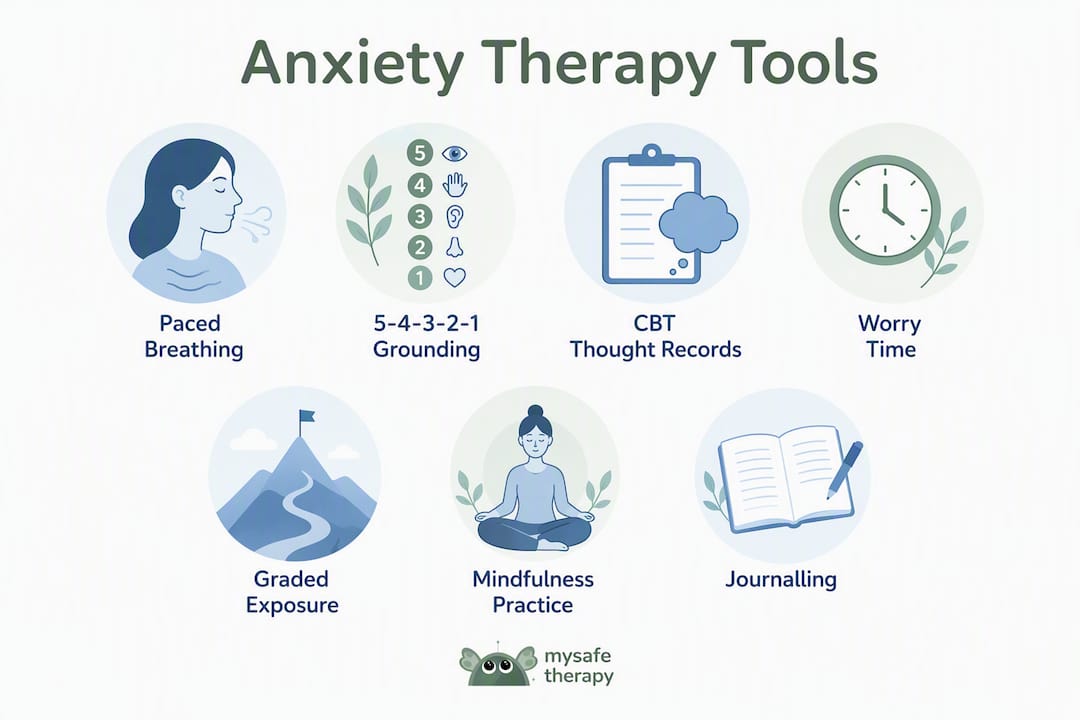
The tools covered here fall into six categories: breathing and grounding exercises, CBT techniques, exposure-based methods, mindfulness and acceptance practices, digital CBT programmes, and journalling with behavioural activation. Each section includes step-by-step instructions and UK access routes.
If you are in crisis right now: call 999 or go to your nearest A&E if you feel at immediate risk of harm. For urgent mental health support, call NHS 111 and select the mental health option. The Samaritans are available 24 hours a day on 116 123.
Trust signals: all recommendations align with NHS guidance on generalised anxiety disorder, NICE clinical guideline CG113, and NICE quality standard QS53. Mysafetherapy connects UK adults with BACP-, UKCP-, and NCPS-registered therapists for those who need accredited practitioner support.
Table of Contents
- Why do these therapy tools actually help with anxiety?
- How do you choose the right tool for your situation?
- What are the best anxiety therapy tools, and how do you use them?
- How do you practise these tools so they actually work?
- What should you do during a panic attack?
- When and where should you get more help in the UK?
- How does therapist-supported digital care work, and where does Mysafetherapy fit?
- Key takeaways
- A note on what actually works in practice
- Start accredited online therapy with Mysafetherapy
- Trusted UK sources and further reading
Why do these therapy tools actually help with anxiety?
Anxiety persists through a small set of maintaining processes: unhelpful thought patterns, avoidance behaviour, physiological arousal, and low mood. The best anxiety therapy tools each target one or more of these mechanisms directly.
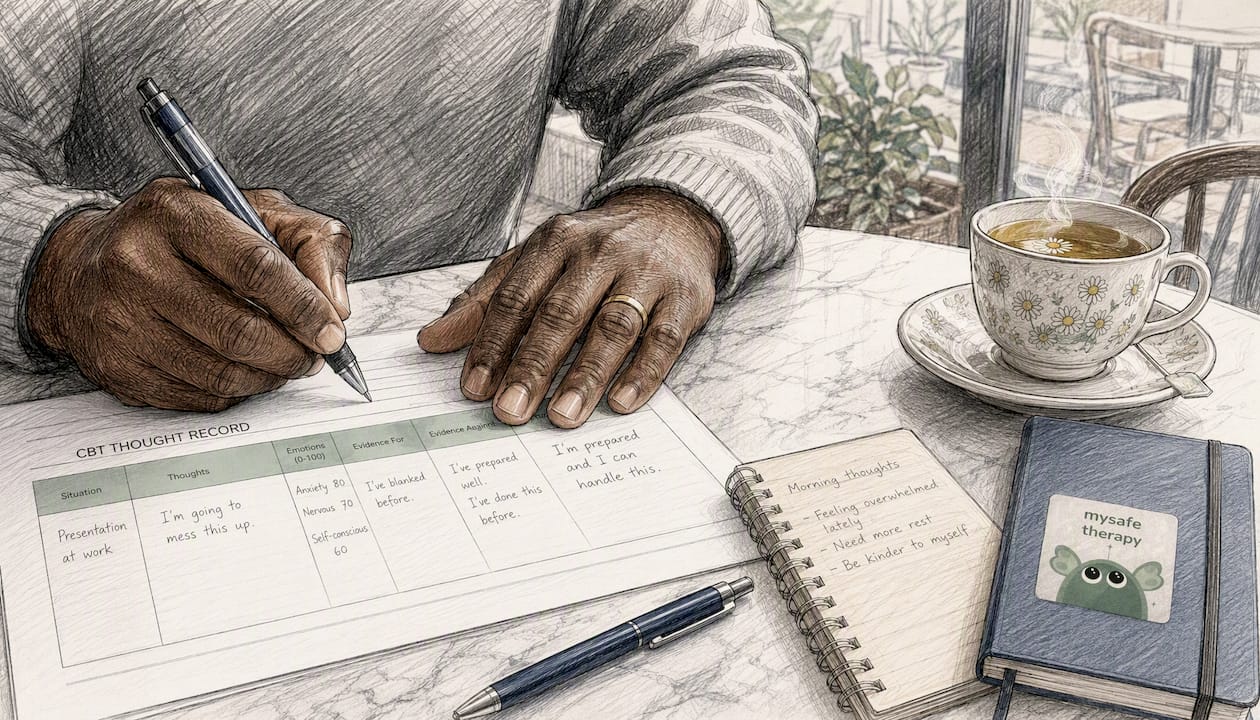
Cognitive restructuring (the core of CBT) interrupts the cycle of catastrophic thinking by teaching people to identify distorted thoughts and test them against evidence. A person who catastrophises about a presentation at work, for example, can use a thought record to weigh the realistic probability of the feared outcome against their automatic assumption.
Exposure addresses avoidance, which is the single most powerful driver of persistent anxiety. Research consistently shows that avoidance maintains anxiety by preventing corrective learning. Graded exposure systematically reduces avoidance and produces durable reductions in fear.
Behavioural activation targets the low mood and withdrawal that frequently accompany anxiety. Scheduling meaningful activity breaks the inactivity-low mood cycle and provides natural evidence against anxious predictions.
Mindfulness and acceptance-based tools change the relationship with anxious thoughts rather than trying to eliminate them. Techniques drawn from Acceptance and Commitment Therapy (ACT) and Mindfulness-Based Cognitive Therapy (MBCT) teach psychological flexibility, reducing the secondary distress that comes from fighting anxiety itself.
Physiological regulation techniques, including paced breathing and progressive muscle relaxation (PMR), directly reduce autonomic arousal and interrupt the physical feedback loop that sustains panic.
NICE quality standard QS53 requires that people with anxiety disorders are offered evidence-based psychological interventions as a first-line option. The NHS recommends trying talking therapies before medication in most cases, and NHS Every Mind Matters provides free, stepwise CBT exercises that teach these skills directly.
The tool categories below map onto these mechanisms:
- CBT techniques: — targets unhelpful thinking and builds behavioural evidence
How do you choose the right tool for your situation?
The right starting point depends on symptom severity, functional impact, and whether comorbid conditions are present. These three triage questions give a practical filter.
Question 1: How much does anxiety interfere with daily life? Rate interference on a 0–10 scale. Scores of 0–3 suggest mild anxiety where self-directed tools are appropriate. Scores of 4–6 indicate moderate anxiety where guided low-intensity support (such as NHS Talking Therapies or a structured digital programme) is worth considering. Scores of 7 or above, or any score accompanied by suicidal thoughts, warrant GP contact or direct self-referral to NHS Talking Therapies.
Question 2: Are there comorbid conditions? Depression, substance misuse, or a trauma history each complicate self-directed work. Complex presentations benefit from therapist-delivered care rather than unguided self-help.
Question 3: Have you tried self-help before without improvement? Persistent symptoms despite consistent self-help practice are a clear signal to step up to practitioner-supported care.
| Symptom level | Recommended starting point | When to escalate |
|---|---|---|
| Mild (0–3 interference) | NHS self-help guides, breathing exercises, CBT worksheets | No improvement after several weeks |
| Moderate (4–6 interference) | NHS Talking Therapies self-referral, guided digital CBT (e.g. SilverCloud via NHS) | Persistent symptoms, comorbidity, or safety concerns |
| Severe (7–10 interference) | GP referral, therapist-delivered CBT/exposure | Immediate: suicidal ideation or severe functional impairment |
| Complex (trauma, substance misuse) | Specialist therapist-delivered care | At assessment |
Pro Tip: Treat any new tool as a two-to-six-week behavioural experiment. Set a specific, measurable success criterion before you start, for example "I will rate my worry interference below 5 on at least four out of seven days by week four." This framing, recommended by NHS Inform's anxiety self-help guide, increases adherence and makes it easier to detect whether a tool is working.
For a broader overview of types of therapy for anxiety and how to match them to your needs, Mysafetherapy's blog provides a practical UK-focused guide.
What are the best anxiety therapy tools, and how do you use them?
The tools below are ordered from immediate symptom relief through to structured longer-term techniques. Each includes a brief protocol and common pitfalls.
1. Paced breathing and physiological regulation
What it is: Controlled, slow breathing that activates the parasympathetic nervous system and reduces acute arousal.
Who it helps: Anyone experiencing physical anxiety symptoms, panic, or pre-event anxiety.
How to practise:
- Inhale slowly through the nose for 4 counts.
- Hold for 4 counts.
- Exhale through the mouth for 6 counts.
- Repeat for 5–10 cycles.
Progressive muscle relaxation (PMR) extends this by systematically tensing and releasing muscle groups from feet to face over 15–20 minutes. The NHS self-help guide and NHS Every Mind Matters both include free guided relaxation exercises.
Common pitfall: Using breathing techniques as avoidance. Paced breathing is most effective as a preparation for engaging with feared situations, not as a permanent escape from them.
2. The 5-4-3-2-1 grounding method
What it is: A sensory grounding technique that anchors attention to the present moment and interrupts dissociation or panic escalation.
How to practise:
- Name 5 things you can see.
- Name 4 things you can physically feel.
- Name 3 things you can hear.
- Name 2 things you can smell.
- Name 1 thing you can taste.
This takes under two minutes and requires no equipment. It is particularly useful during the early stages of a panic attack, before physiological arousal peaks.

3. CBT thought records
What it is: A structured written exercise that identifies automatic negative thoughts, examines the evidence for and against them, and generates a more balanced perspective.
Who it helps: People whose anxiety is driven primarily by worry, catastrophising, or overestimation of threat.
Brief template:
| Column | Prompt |
|---|---|
| Situation | What happened? Where were you? |
| Automatic thought | What went through your mind? |
| Emotion (0–10) | What did you feel, and how intense? |
| Evidence for | Facts that support the thought |
| Evidence against | Facts that challenge the thought |
| Balanced thought | A more realistic alternative |
| Emotion after (0–10) | How intense is the feeling now? |
TherapistAid provides free, printable thought record worksheets and guided activities that follow this format. The NHS Every Mind Matters platform includes a digital version of the "spotting unhelpful thoughts" exercise.
4. Worry time
What it is: A scheduled, time-limited period (typically 15–20 minutes per day) dedicated to worry, with deliberate postponement of worry outside that window.
How to practise:
- Choose a fixed daily time, at least two hours before bed.
- When a worry arises outside that time, note it briefly and defer it.
- During worry time, address each item: is it solvable now? If yes, plan a concrete action. If not, practise acceptance and move on.
This technique, featured in NHS Every Mind Matters, reduces the pervasive quality of generalised anxiety by containing it to a defined period.
5. Graded exposure
What it is: A systematic, stepwise approach to confronting feared situations or objects, starting with the least anxiety-provoking and progressing gradually. Exposure is the active ingredient for reducing avoidance and producing durable anxiety reduction; relaxation alone does not achieve the same long-term outcome.
Who it helps: Anyone whose anxiety involves avoidance, including social anxiety, health anxiety, agoraphobia, and specific phobias.
Example hierarchy for social anxiety:
- Make eye contact with a shop assistant (anxiety rating: 3/10)
- Ask a stranger for directions (5/10)
- Speak up once in a small group meeting (6/10)
- Introduce yourself to someone new at an event (7/10)
- Give a short presentation to colleagues (9/10)
Stay at each step until anxiety reduces by at least half before moving up. For social anxiety specifically, Mysafetherapy offers therapist-guided exposure work via video, chat, or avatar sessions.
6. Mindfulness and body scan
What it is: Sustained, non-judgemental attention to present-moment experience, including physical sensations, thoughts, and emotions.
How to practise (10-minute body scan):
- Lie or sit comfortably and close your eyes.
- Direct attention to the breath for two minutes.
- Slowly scan from the top of the head to the feet, noticing sensations without trying to change them.
- When the mind wanders, gently return attention to the body.
Daily practice of 10–20 minutes builds the psychological flexibility that reduces secondary anxiety about anxiety itself. The NHS recommends mindfulness as part of a broader mental health toolkit.
7. Journalling and activity scheduling
An anxiety diary tracks triggers, physical symptoms, thoughts, and behaviours over time. Reviewing entries weekly reveals patterns that are invisible in the moment, for example a consistent spike in anxiety on Sunday evenings linked to anticipatory worry about Monday.
Activity scheduling, drawn from behavioural activation, counters the withdrawal that accompanies low mood. The process is straightforward: list activities that previously brought a sense of achievement or pleasure, rate predicted enjoyment before doing them, then rate actual enjoyment afterwards. The gap between prediction and reality is itself a CBT behavioural experiment.
For practical self-help tools for anxiety and depression, including diary templates and scheduling guides, Mysafetherapy's resource hub provides UK-focused materials.
8. Digital CBT programmes: SilverCloud, Wysa, and NHS self-help
Structured digital programmes deliver CBT content in a format that can be accessed at any time. Three options are well-established in UK pathways:
- NHS self-help guides — (including the NHS Inform anxiety self-help guide): free, text-based CBT modules covering worry, unhelpful thoughts, and graded exposure. No registration required.
- Wysa: — a UK-available digital CBT and self-help app that uses conversational AI to guide users through CBT exercises, mood tracking, and coping strategies. Available directly via app stores and through some NHS trusts.
NICE's early value assessment HTG676 reviewed digitally enabled therapies and noted that they can deliver evidence-based CBT content and may benefit patients compared with a waitlist, particularly when used alongside practitioner support. Unguided use alone produces weaker outcomes.
How do you practise these tools so they actually work?
Consistent, structured practice is what separates tools that produce measurable change from those that are tried once and abandoned. NHS Inform's guidance is direct on this point: many people stop self-help CBT too early, before the techniques have had time to produce corrective learning.
A practical weekly schedule:
- Daily (10–15 minutes): paced breathing or mindfulness practice, ideally at the same time each day to build habit.
- Three times per week: complete one thought record or worry-time session.
- Twice per week: one in-situ exposure step, staying in the situation until anxiety reduces by at least 50%.
- Weekly (15 minutes): review your anxiety diary, rate interference on a 0–10 scale, and compare with your baseline.
- Every two weeks: assess whether you are meeting your pre-specified success criteria. If not, consider stepping up.
Measuring progress accurately: mood ratings alone are an unreliable indicator of progress. Behavioural markers, such as time spent in previously avoided situations, number of exposure steps completed, and frequency of worry-time use, provide more reliable evidence of change. This is consistent with NICE guideline CG113's approach to outcome measurement.
Reducing dropout: pair practice with an existing daily habit (for example, paced breathing immediately after brushing teeth). Use app reminders or brief therapist check-ins to maintain accountability. For practical coping skills and habit-building templates, Mysafetherapy's blog provides structured guidance.
Pro Tip: When motivation is low, start with behavioural activation rather than cognitive techniques. Scheduling one small, achievable activity produces a mood shift that makes engaging with thought records and exposure work considerably easier. Behaviour first, cognition second.
What should you do during a panic attack?
Panic attacks peak within 10 minutes and resolve within 20–30 minutes without intervention. The physiological sensations, though intensely uncomfortable, are not dangerous. Knowing this is itself a clinical tool: secondary fear of the panic response amplifies and prolongs the attack.
Step-by-step panic plan:
- Step 1 — Ground yourself: use the 5-4-3-2-1 method. Name five things you can see, four you can feel, three you can hear, two you can smell, one you can taste.
- Step 2 — Pace your breathing: inhale for 4 counts, hold for 4, exhale for 6. Avoid hyperventilating or breathing into a bag.
- Step 3 — Relax your muscles: drop your shoulders, unclench your jaw, and release tension in your hands.
- Step 4 — Use acceptance language: say to yourself, "This is a panic attack. It is uncomfortable but not dangerous. It will pass." Resist the urge to flee the situation if it is safe to remain.
- Step 5 — After the attack: note the trigger, the duration, and what helped. This information is valuable for your therapist or GP.
When to seek urgent help: call 999 or go to A&E if you experience chest pain that does not resolve, loss of consciousness, or if you have thoughts of harming yourself. For urgent mental health support that does not require A&E, call NHS 111 (mental health option) or contact your local crisis team. If panic attacks are accompanied by suicidal thoughts or severe dissociation, contact your GP the same day or attend an urgent mental health service. A safety plan agreed with a clinician is the most reliable protection in these circumstances.
When and where should you get more help in the UK?
Self-help tools are appropriate for mild to moderate anxiety with no significant comorbidity. Several indicators suggest it is time to step up to practitioner-supported care.
Escalation triggers:
- Symptoms persist despite four to six weeks of consistent self-help practice
- Anxiety is causing significant functional impairment at work, in relationships, or in daily activities
- Suicidal ideation, self-harm, or severe dissociation is present
- Comorbid depression, substance misuse, or a trauma history complicates the picture
- Panic attacks are frequent and not responding to self-management strategies
How to access NHS support:
- Self-referral to NHS Talking Therapies (IAPT): most adults in England can self-refer directly without a GP appointment. Scotland, Wales, and Northern Ireland have equivalent services accessed via GP or self-referral depending on the local health board.
- GP referral: appropriate for complex presentations, medication queries, or when self-referral is not available locally.
- Urgent mental health services: NHS 111 (mental health option), local crisis teams, or A&E for immediate risk.
Choosing a private therapist: accreditation checklist:
- Registered with BACP, UKCP, or NCPS
- Trained in CBT and/or exposure-based methods relevant to your anxiety type
- Able to provide evidence of supervised practice and continuing professional development
- Clear about fees, cancellation policy, and confidentiality arrangements
| UK digital resource | Access route | What it provides |
|---|---|---|
| NHS self-help guides (NHS Inform) | Free, no registration | Text-based CBT modules, worry and exposure exercises |
| NHS Every Mind Matters | Free, no registration | Stepwise CBT exercises, mood plan, relaxation tools |
| SilverCloud | GP or IAPT referral | Structured digital CBT with practitioner check-ins |
| Wysa | Direct download (App Store/Google Play) | Conversational CBT, mood tracking, crisis signposting |
| NHS Talking Therapies (IAPT) | Self-referral or GP | Therapist-delivered CBT, guided self-help, group therapy |
How does therapist-supported digital care work, and where does Mysafetherapy fit?
The distinction between unguided self-help and therapist-supported digital care is clinically significant. NICE's assessment of digitally enabled therapies found that structured digital CBT programmes can be effective within a stepped-care model, but the evidence is strongest when practitioner support is built in. Unguided programmes show higher dropout rates and less consistent outcomes.
Mysafetherapy operates at the intersection of digital accessibility and accredited human care. The platform connects UK adults with therapists registered with BACP, UKCP, or NCPS, and offers sessions via video, live chat, or avatar format. For people who find face-to-face or video contact difficult, the avatar option provides a lower-barrier entry point to therapist-delivered CBT and exposure work.
Integrated self-help tools, including AI-guided journalling, mood tracking, guided journeys, and progress reports, support the between-session practice that determines whether therapy produces lasting change. These tools function as measurement instruments as much as therapeutic aids: mood and behaviour data tracked between sessions gives both the client and therapist objective evidence of progress, which aligns directly with NICE's recommendation to use behavioural markers alongside mood ratings.
For anxiety presentations with a trauma component, Mysafetherapy also offers access to therapists trained in trauma-informed approaches. Readers whose anxiety is rooted in past trauma can explore PTSD-specific support on the platform.
Pro Tip: When starting therapist-supported digital care, bring your anxiety diary and your baseline interference rating to the first session. A therapist who can see your behavioural data from day one can set a more precise treatment plan and identify which tool category to prioritise.
For a broader view of how AI features safely support human therapy, Mysafetherapy's AI and therapy overview explains the evidence base and practical safeguards.
Key takeaways
The most effective anxiety therapy tools are those matched to symptom severity within a stepped-care model: start with low-intensity self-help for mild symptoms and escalate to practitioner-delivered CBT or exposure for persistent or complex presentations.
| Point | Details |
|---|---|
| Match tool to severity | Use the NICE stepped-care model: self-help for mild, guided digital or IAPT for moderate, therapist-delivered CBT for severe. |
| Exposure is the active ingredient | Graded exposure reduces avoidance and produces durable change; breathing and grounding alone are insufficient for long-term improvement. |
| Measure behaviour, not just mood | Track time in avoided situations and exposure steps completed; these markers are more reliable than mood ratings alone. |
| Treat tools as experiments | Set a measurable success criterion before starting any technique and review at two to four weeks to decide whether to continue or step up. |
| Mysafetherapy for accredited support | Mysafetherapy connects UK adults with BACP/UKCP/NCPS-registered therapists via video, chat, or avatar, with integrated mood tracking and AI journalling. |
A note on what actually works in practice
The gap between what anxiety tools promise and what they deliver in practice usually comes down to one thing: avoidance. Not avoidance of the feared situation, though that matters too, but avoidance of the discomfort that comes with doing the exercises properly.
Thought records feel pointless when anxiety is high. Exposure feels counterintuitive. Mindfulness feels impossible when the mind is racing. These reactions are not signs that the tools are wrong for you. They are signs that the tools are working on exactly the right target.
The most common mistake is treating breathing exercises and grounding techniques as the whole toolkit rather than as preparation for the harder work. Physiological regulation is a useful first step. It is not a treatment. The research on exposure is unambiguous: confronting avoided situations, with support and at a manageable pace, is what produces lasting change. Everything else is scaffolding.
There is also a tendency to measure progress by how anxious you feel on a given day, which is unreliable. Anxiety fluctuates with sleep, stress, and physical health. A better measure is what you did despite the anxiety: did you complete the exposure step? Did you attend the meeting? Did you use worry time instead of ruminating for an hour? Behaviour is the signal. Mood is the noise.
For anyone who has tried self-help tools and found them insufficient, the answer is not a different app. It is a different level of care. Practitioner-supported therapy, delivered by an accredited clinician who can adjust the approach in real time, produces outcomes that unguided self-help cannot replicate for moderate to severe presentations.
Start accredited online therapy with Mysafetherapy
Structured self-help tools produce real results for mild anxiety. For moderate to severe symptoms, or when self-directed practice has stalled, the evidence points clearly to therapist-supported care.
Mysafetherapy gives UK adults direct access to BACP-, UKCP-, and NCPS-registered therapists without a waiting list. Sessions are available via video, live chat, or avatar therapy, including evenings and weekends. Pricing is transparent, there are no long-term commitments, and switching therapists is straightforward if the first match is not right.
Integrated tools, including AI journalling, mood tracking, and progress reports, sit alongside live sessions so that between-session practice is structured and measurable. This is the combination that NICE's assessment of digitally enabled therapies identifies as producing the strongest outcomes: human clinical oversight with digital support between appointments.
For social anxiety specifically, Mysafetherapy's social anxiety support page outlines how therapist-guided exposure work is delivered on the platform. To start therapy, select a therapist, choose a session format, and book a first appointment at a time that suits you.
This article provides general information about anxiety management tools and is not a substitute for professional clinical advice. For personalised guidance, consult a qualified mental health professional or your GP.
Trusted UK sources and further reading
The resources below are primary or authoritative sources for the tools and approaches covered in this article.
- NHS — Generalised anxiety disorder (GAD): NHS clinical overview of GAD, including treatment options, self-help advice, and how to access NHS Talking Therapies. The starting point for any UK reader seeking authoritative guidance.
- NHS Every Mind Matters — self-help CBT techniques: free, stepwise CBT exercises including worry time, thought-spotting, and relaxation. No registration required.
- NHS Inform — anxiety self-help guide: Scotland's NHS self-help guide with structured CBT modules, graded exposure guidance, and advice on maintaining practice.
- NICE guideline CG113 — Generalised anxiety disorder and panic disorder: the clinical guideline underpinning stepped-care recommendations for anxiety in the UK. Relevant for clinicians and informed patients.
- NICE quality standard QS53 — Psychological interventions for anxiety: sets the standard that evidence-based psychological interventions must be offered as a first-line option.
- NICE HTG676 — Digitally enabled therapies: NICE's early value assessment of digital CBT platforms, including SilverCloud and Wysa, within NHS pathways.
- Simply Psychology — CBT for anxiety: accessible clinical summary of CBT mechanisms, with particular clarity on the role of exposure in anxiety treatment.
- Mysafetherapy — self-help resources for anxiety: UK-focused self-help resources and worksheets, with guidance on selecting accredited therapy services.
| Resource | Type | Access |
|---|---|---|
| NHS Every Mind Matters | Free digital CBT exercises | Direct, no registration |
| NHS Inform anxiety guide | Structured self-help modules | Direct, no registration |
| TherapistAid worksheets | Printable CBT tools | Free download |
| SilverCloud | Digital CBT programme | GP or IAPT referral |
| Wysa | CBT app with AI support | App Store / Google Play |
| NHS Talking Therapies (IAPT) | Therapist-delivered CBT | Self-referral or GP |
| Mysafetherapy | Accredited online therapy | Direct booking |