

TL;DR:
- A self-help guide for anxiety offers evidence-based techniques like CBT and mindfulness to manage symptoms effectively with consistent practice. It emphasizes matching tools to specific symptoms, practicing body-based exercises, and integrating cognitive strategies over time. Professional support is recommended if symptoms persist beyond six months or severely impair daily life.
A self-help guide for anxiety is a structured set of clinically validated techniques that help you regulate symptoms, reduce distress, and build long-term resilience without requiring immediate professional intervention. Anxiety affects over 300 million people globally, crossing diagnostic categories and manifesting in physical, cognitive, and behavioural forms. Approaches grounded in Cognitive Behavioural Therapy (CBT), Acceptance and Commitment Therapy (ACT), and mindfulness have the strongest evidence base for mild to moderate anxiety. Tools like diaphragmatic breathing, cognitive reframing, and the 5-4-3-2-1 grounding technique give you immediate and lasting relief when applied correctly. This guide explains how to identify your anxiety type, apply the right techniques, and build a routine that holds.
What type of anxiety do you have and which tools suit it?
Correct tool selection depends on how your anxiety manifests. Using a cognitive technique during a physical panic response, for example, rarely works. Matching the method to the symptom is the first step in any effective anxiety management approach.
Anxiety symptoms fall into three broad categories:
- Physical symptoms: Racing heart, chest tightness, shallow breathing, muscle tension, or nausea. These respond best to body-based regulation tools.
- Cognitive symptoms: Worry loops, catastrophic thinking, rumination, or intrusive thoughts. These respond to CBT thought records, worry postponement, and ACT defusion techniques.
- Behavioural symptoms: Avoidance of situations, procrastination, social withdrawal, or compulsive checking. These require gradual exposure and behavioural activation strategies.
The table below maps common symptoms to the most effective tools:
| Symptom Type | Primary Tool | Secondary Tool |
|---|---|---|
| Physical (racing heart, tension) | Diaphragmatic breathing | 5-4-3-2-1 grounding |
| Cognitive (worry, rumination) | CBT thought records | Worry postponement |
| Behavioural (avoidance) | Exposure hierarchy | Behavioural activation |
| Mixed presentation | Body regulation first | Cognitive reframing after |
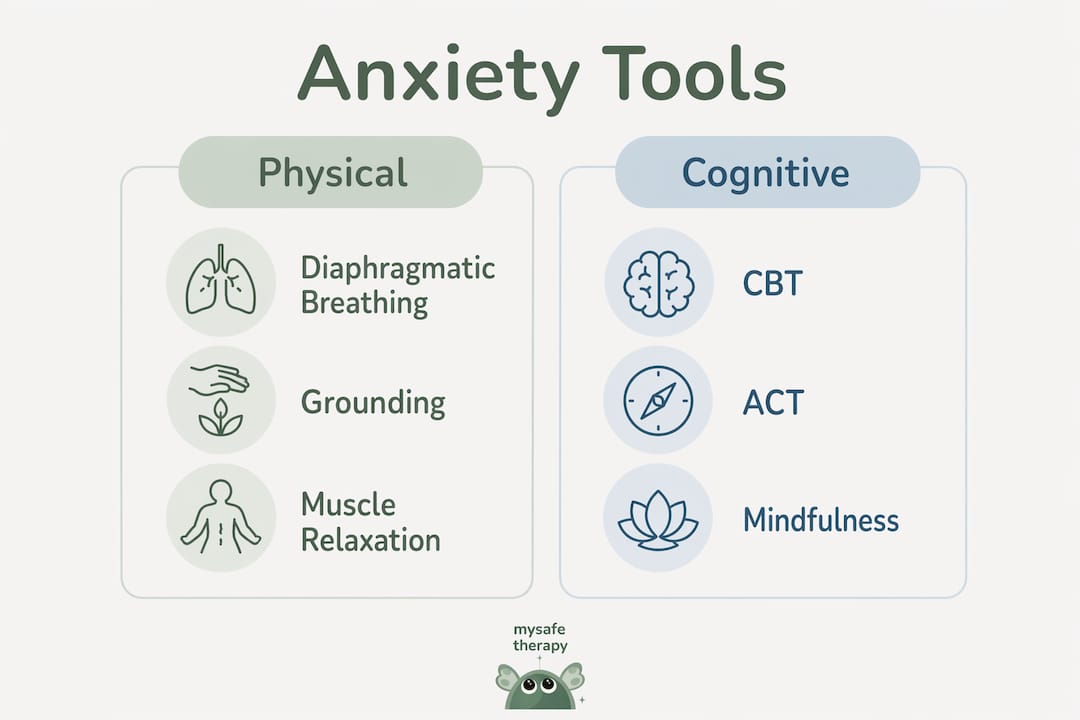
At least 13 evidence-based coping skills, including diaphragmatic breathing, grounding, cognitive reframing, and journaling, significantly lower symptom intensity when applied consistently. The key word is "consistently." A single session of breathing exercises will not retrain a nervous system that has been in a heightened state for months.
Pro Tip: Keep a brief symptom log for one week before choosing your primary tool. Note whether your anxiety feels more physical, mental, or avoidance-driven. This single step prevents the common mistake of applying the wrong technique and concluding that self-help does not work.
How to use body-based anxiety relief exercises
Bottom-up strategies like grounding and breathing calm the physical nervous system directly, without requiring you to think your way out of anxiety first. This matters because during high-intensity symptoms, the reasoning part of your brain is less accessible. Body-based tools work with your physiology, not against it.

Diaphragmatic breathing: the correct method
Most people breathe incorrectly when anxious, taking short, sharp inhales that worsen symptoms. Slowing the exhale to equal or longer than the inhale directly slows heart rate and activates the parasympathetic nervous system. The exhale is the physiological trigger for relaxation, not the inhale.
Follow these steps:
- Sit or lie in a comfortable position with one hand on your chest and one on your abdomen.
- Inhale slowly through your nose for a count of four, allowing your abdomen to rise rather than your chest.
- Hold for a count of two.
- Exhale slowly through your mouth for a count of six or seven, longer than your inhale.
- Repeat for five to ten cycles, focusing entirely on the exhale length.
The 5-4-3-2-1 grounding technique
The 5-4-3-2-1 grounding method effectively interrupts overwhelming thought spirals when performed out loud. It works by redirecting attention from internal worry to external sensory experience.
- Name 5 things you can see around you.
- Name 4 things you can physically touch, and briefly touch them.
- Name 3 things you can hear right now.
- Name 2 things you can smell.
- Name 1 thing you can taste.
Saying each item aloud increases the technique's effectiveness. Doing it silently in your head allows anxious thoughts to compete for attention.
Gentle movement and muscle relaxation
Progressive Muscle Relaxation (PMR) involves tensing and releasing muscle groups from your feet upward. Yoga stretches targeting the shoulders, neck, and hip flexors also release stored physical tension. Even a ten-minute walk activates the body's natural stress response system in a controlled way.
Pro Tip: Practise diaphragmatic breathing for five minutes every morning before checking your phone. This sets your nervous system baseline for the day rather than starting in a reactive state.
How do CBT and ACT help you manage anxious thoughts?
Structured self-help CBT programmes with practical exercises are effective for mild to moderate anxiety. They work by identifying and challenging the distorted thinking patterns that maintain anxiety, rather than simply suppressing symptoms.
CBT offers several specific tools worth knowing:
- Thought records: Write down the anxious thought, identify the cognitive distortion (catastrophising, mind-reading, all-or-nothing thinking), and generate a more balanced alternative.
- Worry postponement: Schedule a specific 15-minute "worry window" each day. When anxious thoughts arise outside this window, note them and defer them. This reduces the sense that worry is uncontrollable.
- Exposure hierarchies: List feared situations from least to most anxiety-provoking. Gradually face each one, starting at the bottom. Avoidance maintains anxiety; exposure reduces it over time.
ACT takes a different approach. Rather than challenging thoughts, it teaches you to observe them without being controlled by them. ACT phrases like "I'm noticing I'm having the feeling of anxiety" create psychological distance between you and the thought. This is called defusion. The thought loses its urgency when you treat it as an event to observe rather than a fact to act on.
Mindfulness for anxiety relief operates on a similar principle. Practices from Mindfulness-Based Cognitive Therapy (MBCT), such as the body scan and mindful breathing, train attention to stay in the present rather than projecting into feared futures. You can find a detailed comparison of these approaches in this guide to therapy types for anxiety.
Self-help CBT protocols target common underlying mechanisms rather than single diagnoses. This means the same tools work across generalised anxiety, social anxiety, health anxiety, and panic, which makes them practical for most adults without needing a formal diagnosis first.
Pro Tip: After completing a thought record, follow it immediately with two minutes of diaphragmatic breathing. Combining cognitive reframing with physical regulation produces faster relief than either technique alone.
How do you build a self-help routine that actually lasts?
Consistent, proactive use of breathing and mindfulness throughout the day prevents nervous system overwhelm. Waiting until anxiety peaks before using these tools is the most common reason self-help fails. By that point, the physiological response is already entrenched and harder to interrupt.
A sustainable routine follows a clear structure:
- Morning anchor (5–10 minutes): Diaphragmatic breathing or a brief body scan before the day begins.
- Midday check-in (5 minutes): Posture reset, three slow exhale breaths, and a brief note in a journal or mood tracker.
- Evening wind-down (10–15 minutes): PMR, a thought record if needed, or a mindfulness practice from an app like Headspace or Calm.
- Weekly review (15 minutes): Look back at your symptom log. Note which techniques reduced intensity and which did not. Adjust accordingly.
Structured CBT self-help programmes typically require 45 minutes of daily practice over 8 weeks to produce measurable changes in cognitive patterns. That figure is not arbitrary. It reflects the time needed to build new neural pathways through repetition.
The goal is not to eliminate all stress. The aim is expanding your capacity for resilience rather than removing every source of discomfort. Recognising emotions as temporary, checking your posture, and engaging your reasoning brain through structured exercises all contribute to this.
You can also explore self-help tools for anxiety and depression to supplement your routine with additional evidence-based resources.
When to seek professional support
Self-help is not the right primary intervention for every situation. Consider speaking to a professional if:
- Anxiety is significantly disrupting your work, relationships, or daily functioning.
- Symptoms have persisted for more than six months without improvement.
- You are experiencing panic attacks, agoraphobia, or intrusive thoughts that feel unmanageable.
- Self-help techniques are not producing any reduction in symptoms after six to eight weeks of consistent practice.
"Many users fail with self-help because they treat it as a one-time fix instead of committing to structured, consistent practice protocols." This observation reflects a pattern seen repeatedly in clinical settings. Self-help works, but only when it is treated as a discipline rather than an occasional remedy.
In the UK, your GP is the first point of contact for a formal referral. NHS Talking Therapies (formerly IAPT) provides free CBT-based support in England. Charities such as Mind and Anxiety UK offer helplines, peer support, and self-help resources. Online therapy platforms provide faster access when NHS waiting times are a barrier.
Key takeaways
Effective anxiety self-help requires consistent daily practice combining body-based regulation and cognitive techniques, not occasional use of a single tool.
| Point | Details |
|---|---|
| Match tools to symptoms | Use body-based techniques for physical symptoms and cognitive tools for worry and rumination. |
| Exhale controls relaxation | Extending the exhale beyond the inhale activates the parasympathetic nervous system and lowers heart rate. |
| Consistency drives results | CBT self-help programmes require approximately 45 minutes of daily practice over 8 weeks to retrain thought patterns. |
| Combine approaches | Pairing diaphragmatic breathing with cognitive reframing produces faster relief than either technique alone. |
| Know when to escalate | Seek professional support if symptoms persist beyond six months or significantly impair daily functioning. |
What Mysafetherapy has learned about self-help for anxiety
The most persistent misconception we encounter is that self-help for anxiety means forcing yourself to think positively. It does not. Positive thinking applied to genuine anxiety often backfires because it asks you to argue against a feeling that your nervous system believes is real. The more effective approach, and the one supported by ACT research, is to observe the feeling without immediately trying to change it.
We have also seen that people abandon self-help too quickly. Six days of breathing exercises followed by a difficult week does not mean the method failed. It means the nervous system has not yet had enough repetitions to form a new default response. Patience here is not passive. It is a deliberate commitment to the process.
The other pattern worth naming is the tendency to use only one type of tool. Someone who only practises mindfulness but never addresses avoidance behaviour will plateau. Someone who only does thought records but never regulates their body during a panic response will find CBT frustrating. The integration of body-based and cognitive interventions is not a suggestion. It is the mechanism by which self-help produces lasting change.
Finally, self-compassion is not a soft addition to the process. It is structurally necessary. Treating setbacks as evidence of failure increases anxiety. Treating them as data points in a learning process reduces it.
— Mysafetherapy
Ready to go further with professional support?
Self-help techniques are a strong foundation. For many people, combining them with professional therapy produces faster and more durable results.
Mysafetherapy connects you with UK-accredited therapists registered with BACP, UKCP, and NCPS, available via video, chat therapy, or avatar therapy for those who prefer anonymity. Sessions are available evenings and weekends, with transparent pricing from £49. Whether you are just starting out or have been managing anxiety for years, professional support can help you apply these techniques more precisely and work through patterns that self-help alone may not reach. Start therapy with Mysafetherapy and take the next step at your own pace.
FAQ
What is a self-help guide for anxiety?
A self-help guide for anxiety is a structured set of evidence-based techniques, including CBT, ACT, and mindfulness, that you apply independently to reduce symptoms and build resilience. It is most effective for mild to moderate anxiety when practised consistently.
How long does self-help for anxiety take to work?
Structured CBT self-help programmes typically require 45 minutes of daily practice over 8 weeks to produce measurable changes in anxiety patterns. Results vary depending on symptom severity and consistency of practice.
What is the difference between CBT and ACT for anxiety?
CBT identifies and challenges distorted thoughts to reduce their impact, while ACT teaches you to observe thoughts without acting on them. Both are effective, and combining them with body-based tools produces the best outcomes.
Does deep breathing actually reduce anxiety?
Yes, but only when the exhale is controlled. Slowing the exhale to equal or longer than the inhale activates the parasympathetic nervous system and directly lowers heart rate. Simply taking a deep breath without controlling the exhale has limited effect.
When should i stop self-help and see a professional?
Seek professional support if anxiety significantly disrupts daily functioning, persists beyond six months, or does not improve after six to eight weeks of consistent self-help practice. UK options include NHS Talking Therapies, Mind, Anxiety UK, and online platforms such as Mysafetherapy.