
TL;DR:
- Choosing evidence-based mental health therapies relies on rigorous clinical research approved by UK guidelines. CBT, EMDR, and trauma-focused CBT have the strongest evidence, with structured protocols and measurable outcomes. Access may be limited by systemic barriers, but online options and informed patient advocacy can help connect individuals with effective support.
Choosing the right mental health support should not feel like a guessing game. Yet for many adults in the UK facing anxiety, depression, or trauma, the sheer volume of therapy options, combined with vague reassurances that something "might help," makes the search genuinely difficult. The good news is that decades of clinical research, reinforced by robust UK guidelines, have produced a clear body of evidence identifying which therapies consistently produce results. This article explains what evidence-based therapy actually means, outlines the approaches with the strongest track record, and provides a practical framework for matching methods to your specific circumstances.
Table of Contents
- What does 'evidence-based therapy' mean?
- Top evidence-based therapies for anxiety, depression and trauma
- Comparing top therapies: what works best for your needs?
- Making therapy work for you: patient choice and real-world barriers
- What most lists miss: closing the gap between guidance and reality
- Find confidential, evidence-based therapy support online
- Frequently asked questions
Key Takeaways
| Point | Details |
|---|---|
| Evidence-based therapies explained | These approaches use treatments proven to work through research and UK guidelines. |
| CBT is widely effective | CBT offers strong results for anxiety and depression, and can be delivered online or in person. |
| Trauma needs specialist care | PTSD often responds best to EMDR or trauma-focused CBT, both recommended by NICE. |
| Access varies | Real-world access and patient freedom of choice can lag behind the guidance—know your options. |
| Confidential support is available | Online therapy can deliver evidence-based methods and keep your mental health journey private. |
What does 'evidence-based therapy' mean?
The phrase "evidence-based" is used frequently, but its meaning is precise. In the UK context, an evidence-based therapy is one that has been evaluated through rigorous clinical trials, systematic reviews, and real-world outcome studies. The results of that research are then assessed by bodies such as the National Institute for Health and Care Excellence (NICE), which translates findings into formal clinical guidelines. Therapists and NHS services are expected to follow these guidelines when recommending treatment.
Evidence comes in different grades. A single small study carries less weight than a randomised controlled trial (RCT), where participants are randomly assigned to a treatment group or a control group. Meta-analyses, which pool data from multiple RCTs, carry the most weight of all. NICE grades its recommendations accordingly, so you can assess how strong the backing for a particular approach actually is.
"Evidence-based practice is not about rigid adherence to protocols. It is about applying the best available research to the individual needs and values of the person seeking help." This distinction matters because no two people respond identically to the same method.
For UK adults with anxiety disorders, NICE recommends structured, high-intensity psychological interventions as a primary treatment option. This is an important benchmark. If a therapy type does not appear in NICE guidance, or if it lacks peer-reviewed trial data, the label "evidence-based" does not apply, regardless of how it is marketed.
What is not evidence-based, by this definition, includes approaches like crystal healing, certain neurolinguistic programming claims, and many wellness "packages" sold without clinical backing. Understanding this distinction helps you ask better questions before committing to any form of support.
Key criteria for evaluating whether a therapy is genuinely evidence-based:
- Published trial data from peer-reviewed journals
- Inclusion in NICE or other formal UK clinical guidelines
- Consistent replication of outcomes across independent studies
- Clearly described protocols that trained therapists follow
- Transparency about known limitations and contraindications
Exploring the range of therapy types for anxiety in more detail can help you understand how these criteria apply to specific approaches.
Top evidence-based therapies for anxiety, depression and trauma
With the definition established, the focus turns to the specific therapies that consistently appear in NICE guidelines and clinical research. Each has a defined structure, target population, and measurable outcome profile.
Cognitive behavioural therapy (CBT) is the most widely researched psychological treatment in the world. CBT works on the principle that unhelpful thoughts (cognitions) and patterns of behaviour interact to maintain problems like anxiety and depression. A therapist helps you identify these patterns, challenge distorted thinking, and gradually change behaviours that keep distress in place. CBT is structured, time-limited, and goal-oriented. It typically runs for 6 to 20 sessions depending on the severity of the presenting problem. It is available online, in person, and as guided self-help.
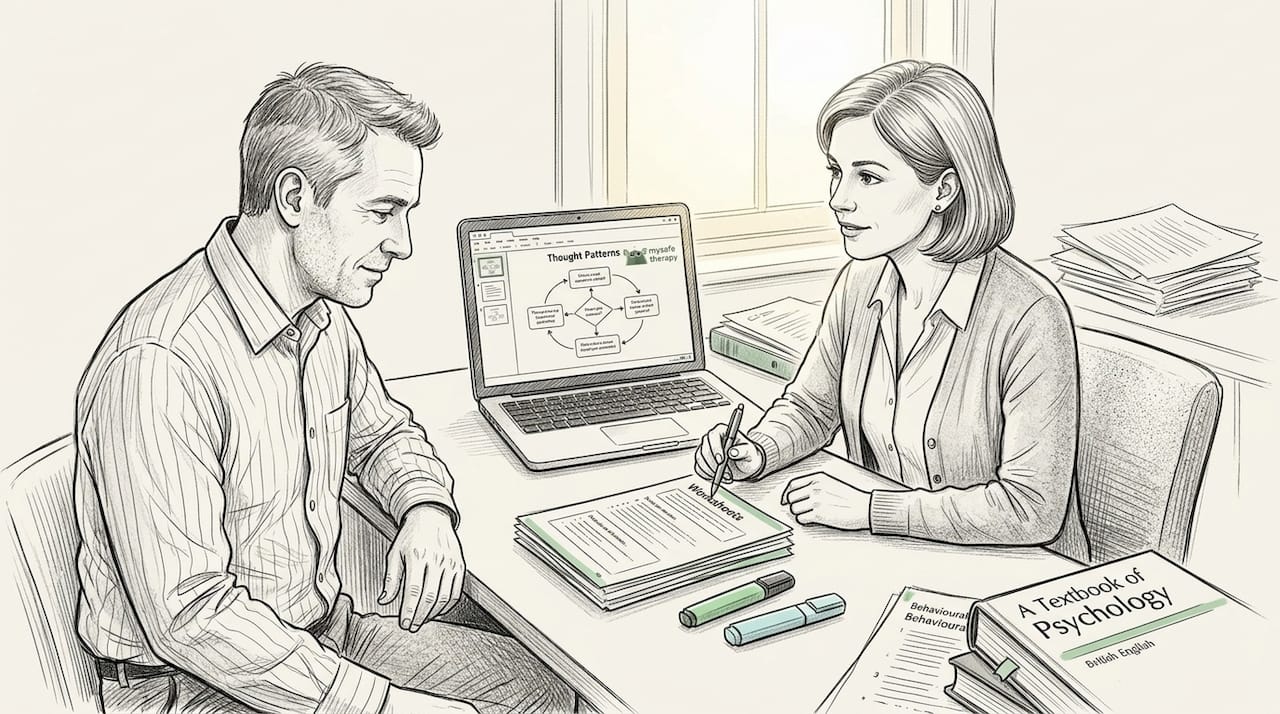
Eye movement desensitisation and reprocessing (EMDR) is a specialised therapy developed for post-traumatic stress disorder (PTSD). It involves recalling distressing memories while following a therapist's bilateral stimulation, typically side-to-side eye movements. The process appears to reduce the emotional intensity attached to traumatic memories. NICE recommends EMDR and individual TF-CBT for adults with PTSD, positioning both as first-line treatments after symptoms persist beyond three months.
Trauma-focused CBT (TF-CBT) applies CBT principles specifically to traumatic experiences. It includes psychoeducation about trauma responses, gradual exposure to traumatic memories in a controlled way, and cognitive restructuring of beliefs that emerged from the trauma. It has strong evidence for PTSD and is particularly well validated for adults who experienced childhood trauma.
Applied relaxation is a structured technique taught by a therapist to train the body's relaxation response. It involves progressive muscle relaxation combined with cue-controlled breathing. The evidence base supports its use primarily in generalised anxiety disorder (GAD) and panic disorder. It is often delivered as an adjunct to CBT rather than as a standalone treatment.
Guided self-help based on CBT is a lower-intensity format where a person works through structured CBT materials with periodic support from a therapist or trained practitioner. NICE recommends it as a step one or step two option in the stepped care model for mild to moderate anxiety and depression. It is accessible, cost-effective, and can be highly effective when used systematically.
Steps for approaching evidence-based therapy:
- Identify your primary concern: anxiety, depression, PTSD, or mixed presentation
- Research which NICE guideline applies to your condition
- Check whether your preferred format (online, face-to-face, self-help) is available for that approach
- Confirm your therapist holds accreditation from a recognised UK body such as BACP, UKCP, or NCPS
- Review progress at agreed intervals using validated outcome measures
Pro Tip: Ask any potential therapist which specific NICE guideline informs their work with your presenting problem. A competent, registered professional will be able to answer this clearly and without hesitation.
Detailed guidance on therapy techniques for mental health can help you understand how these methods are applied in practice sessions. For broader context on managing your mental health day-to-day, mental health tips offer practical, evidence-informed strategies.
Comparing top therapies: what works best for your needs?
Understanding each therapy individually is useful, but comparing them directly gives a clearer basis for decision-making.
| Therapy | Primary conditions | Session format | Evidence strength | Access notes |
|---|---|---|---|---|
| CBT | Anxiety, depression, OCD, phobias | Online, in-person, self-help | Very strong (NICE Grade A) | NHS IAPT, private, online platforms |
| EMDR | PTSD, trauma | In-person, online | Strong (NICE Grade A for PTSD) | Specialist referral often required |
| TF-CBT | PTSD, complex trauma | In-person, online | Strong (NICE Grade A for PTSD) | NHS or specialist private provider |
| Applied relaxation | GAD, panic disorder | In-person, some online | Moderate (often combined with CBT) | Usually delivered by CBT therapist |
| Guided self-help | Mild/moderate anxiety, depression | Self-directed, minimal contact | Moderate to strong | Most accessible; apps and workbooks |
CBT and EMDR are both Grade A recommendations, but they address different presentations. CBT is the broadest option, covering anxiety disorders, depression, obsessive compulsive disorder (OCD), and more. NICE guideline evidence was updated for PTSD treatments; EMDR and individual TF-CBT are now both recommended as the primary options specifically for trauma. For someone with comorbid depression and a trauma history, a combination approach or a sequenced plan may be most appropriate.
"The best therapy is the one that fits your needs, your schedule, and your willingness to engage, not simply the one with the highest ranking in a meta-analysis."
Online formats are now widely accepted as clinically equivalent to in-person delivery for CBT and EMDR. This is a significant development, because it removes one of the most common barriers: geography. If you live in a rural area or have difficulty attending in-person appointments, online delivery is a clinically sound choice, not a lesser alternative.
Pro Tip: When considering self-help formats, look for programmes explicitly based on CBT protocols rather than general wellness content. The structure and session sequence matter for outcomes.
You can explore a detailed breakdown of therapy options for anxiety to identify which of these approaches aligns best with your specific pattern of symptoms.
Making therapy work for you: patient choice and real-world barriers
Understanding the evidence is one thing. Accessing effective therapy within the UK system is another challenge entirely. The concept of patient choice has been incorporated into NICE guidelines, including the 2022 depression guideline, which explicitly encourages clinicians to discuss preferences with patients and offer a range of suitable evidence-based treatments. In principle, this means you have the right to be informed about options and to have your preferences considered.
In practice, the picture is more complicated. Analysis of NHS treatment patterns suggested that inclusion of patient choice in the 2022 NICE adult depression guideline has not yet resulted in patients making wider choices in real-world settings. This gap between what guidelines say and what services deliver is a consistent theme in UK mental health provision.
Common barriers to accessing evidence-based therapy include:
- NHS waiting lists: IAPT (Improving Access to Psychological Therapies) services often have waiting times of weeks to months, depending on region
- Stigma: Many people still delay seeking help due to concerns about judgment at work, within families, or in professional settings
- Limited therapist availability: Demand for EMDR-trained therapists significantly outpaces supply in many areas
- Digital access: Not everyone has reliable broadband, a private space for online sessions, or comfort with video platforms
- Financial barriers: Private therapy costs vary widely, and many people lack information about what is affordable or subsidised
The following table compares access options by key factors:
| Format | Privacy level | Accessibility | NHS availability | Cost range |
|---|---|---|---|---|
| NHS in-person | Moderate | Limited by geography | Yes, with wait | Free |
| Private in-person | High | Good in urban areas | No | £60 to £120 per session |
| Online (private) | High | Nationwide | No | £40 to £90 per session |
| Guided self-help | Very high | Very wide | Yes (some) | Free to low cost |
Digital and online-first options represent a meaningful shift in how evidence-based therapy can be delivered. Confidentiality is often higher online than in a clinic, because there is no physical waiting room, no reception staff, and no chance of being seen by someone you know. Exploring self-help options for depression shows how structured digital tools can supplement or sometimes replace lower-intensity in-person interventions. Understanding UK therapy regulations also helps you verify that any private therapist you approach meets the minimum professional standards expected in the UK.
What most lists miss: closing the gap between guidance and reality
Most articles on evidence-based therapy stop at the list. They describe CBT, mention EMDR, and leave you to figure out the rest. That is a significant omission, because the most important question is not "which therapy has the best evidence?" but rather "how do you actually get access to it?"
The gap between guidelines and practice is real and measurable. Even when guidelines emphasise patient choice, real-world uptake may lag far behind what is formally recommended. This is not a criticism of frontline clinicians. It reflects systemic resource constraints, incomplete training in newer modalities, and a service model that still defaults to what is most available rather than what best fits the individual.
Our view is this: knowing the evidence gives you authority in clinical conversations. If you understand that CBT and EMDR carry Grade A NICE recommendations for your presenting problem, you can ask your GP or referrer to explain why an alternative is being offered. You are not being difficult. You are exercising informed choice.
Digital therapy platforms are not a workaround or a second-best option. They are now a recognised and clinically validated channel for delivering evidence-based treatment, particularly for people for whom access, privacy, or scheduling presents a genuine obstacle. A therapist you connect with on a flexible online platform, who holds BACP or UKCP registration and applies structured CBT or EMDR protocols, delivers equivalent care to an in-person appointment.
Self-advocacy also matters. Bring notes to your GP appointment. Name the therapy you want. Reference the guideline if necessary. Ask what the waiting time is and what alternatives exist. If you are exploring flexible therapy self-help resources, use them as a bridge while waiting for a higher-intensity intervention, not as a permanent substitute when something more structured is clinically indicated.
The most important insight we can offer is that evidence-based care does not only live in NHS clinics. It lives in the approach, the training, the protocol, and the rigour of whoever you work with, regardless of the setting.
Find confidential, evidence-based therapy support online
Taking the first step towards therapy is often the hardest part. Understanding which approaches carry strong clinical evidence is a good start. Connecting with a registered professional who applies them is the next step.
At MySafeTherapy, you can access one-to-one support from UK-registered therapists trained in CBT, EMDR, and other NICE-aligned approaches, via video, chat, or avatar-based sessions that fit around your schedule. Sessions are available evenings and weekends. There are no waiting rooms, no public queues, and full confidentiality throughout. If you are ready to move from understanding your options to acting on them, you can start evidence-based therapy online today, with clear pricing and the flexibility to switch therapists if your needs change.
Frequently asked questions
Which evidence-based therapy works fastest for anxiety?
CBT is first-line for anxiety with a clear structure and defined timelines, often producing measurable improvement within 6 to 12 sessions when attendance is consistent.
Is EMDR only for trauma, or can it help with anxiety too?
NICE recommends EMDR and TF-CBT primarily for PTSD after three months, though emerging evidence suggests potential benefit for certain anxiety conditions; a registered therapist can assess whether it is appropriate for your situation.
Can I choose my preferred therapy on the NHS?
UK guidelines encourage patient choice, but uptake lags in practice; you may need to name your preference directly and ask your referring clinician to explain any departures from NICE guidance.
Are self-help therapies effective for depression?
Self-help and guided self-help options based on NICE recommendations show measurable benefits for mild to moderate depression when followed consistently and based on structured CBT principles rather than general wellness content.