

TL;DR:
- Evidence-based CBT resources are most effective for managing depression.
- Guided self-help tools improve engagement and outcomes compared to unguided options.
- Consistency, personalization, and personal fit are key to successful self-help approaches.
Searching for self-help resources for depression can feel like standing in a library with no index. There are books, apps, websites, community forums, and NHS-backed guides, all claiming to help, and it is genuinely difficult to know which ones are worth your time. The evidence does exist, and it does point clearly in certain directions, but finding it requires cutting through a considerable amount of noise. This guide sets out a straightforward framework for evaluating your options, identifies the most credible and accessible resources available in the UK today, and helps you make a confident, informed choice rather than a guesswork one.
Table of Contents
- How to choose the right self-help resources
- Top evidence-based self-help resources for depression
- Comparing self-help resource effectiveness
- Finding support and making your selection
- Our perspective: Why personal fit and flexibility beat the 'perfect' resource
- Next steps: Start your supported self-help journey
- Frequently asked questions
Key Takeaways
| Point | Details |
|---|---|
| Evidence matters most | Choose self-help resources with proven methods like CBT for best results. |
| Guided support works | Self-help with support or structure is more effective than going it alone. |
| Personal fit is key | The best resource is the one you engage with consistently and find helpful. |
| Start small | Trying one tool at a time and tracking your progress increases the chance of improvement. |
| Help is available | If self-help does not bring relief, professional support is always an option. |
How to choose the right self-help resources
Not all self-help resources are created equal. Some are built on solid clinical research, others on good intentions alone. Before you invest time and energy into any tool, applying a clear set of criteria will help you avoid frustration and maximise your chances of genuine improvement.
Evidence-based methods matter most. Resources that use cognitive behavioural therapy (CBT) principles are consistently among the most thoroughly researched for depression. CBT works by helping you identify and challenge unhelpful thought patterns that contribute to low mood. A recent meta-analysis found that guided self-help CBT yields medium to strong effects on depressive symptoms, with a Hedges' g of 0.74 at post-test and 0.82 at follow-up. That is a meaningful, clinically relevant result. If a resource does not clearly state the approach it uses, treat that as a warning sign.
Cost and access are practical realities. Many people experiencing depression are already managing financial pressure or reduced motivation. Resources that are free, or very low cost, and accessible without a long waiting list, remove barriers that could otherwise prevent you from starting at all. Prioritise tools you can access today, not in three months.
Personalisation improves outcomes. Depression presents differently from person to person. A resource that allows you to move at your own pace, focus on the areas most relevant to your experience, and adjust as you progress will serve you better than a rigid, one-size-fits-all programme.
Confidentiality is not a minor concern. If a resource requires you to share personal data, check its privacy policy. You should feel confident that your information is handled securely, particularly when disclosing sensitive mental health details. This applies to apps, online platforms, and community forums alike.
Guided versus self-directed support. Purely self-directed resources place the full responsibility for engagement on you. Guided resources, those with check-ins, coaching components, or structured feedback, tend to produce better results and lower dropout rates. If you are new to self-help for depression, guided formats are a sensible starting point. You can always explore self-help tools for anxiety and depression to see what formats suit different needs.
Here is a quick summary checklist when evaluating any resource:
- Uses an evidence-based method such as CBT or behavioural activation
- Free or affordable, accessible without long waiting periods
- Offers some level of personalisation or adaptable content
- Has a clear, trustworthy privacy policy
- Provides guided or structured support where possible
- Recommended or approved by the NHS or a recognised mental health body
Pro Tip: Check whether a resource is listed on the NHS website or endorsed by a registered mental health charity such as Mind or the Mental Health Foundation. Endorsement does not guarantee quality, but it does provide a meaningful baseline of credibility.
With your criteria clear, explore top evidence-based resources available to you.
Top evidence-based self-help resources for depression
Several well-established resources stand out when assessed against the criteria above. Each has a distinct format and emphasis, so understanding what each offers helps you choose the right starting point.
NHS Inform depression self-help guide. This is one of the most straightforward and credible starting points available in the UK. The NHS Inform guide provides a free, step-by-step CBT-based programme covering the recognition of symptoms, understanding what maintains depression, activity scheduling, self-care strategies, challenging negative thoughts, and structured problem-solving. It is built on established clinical methodology and is free to access for anyone in the UK.
"The NHS Inform depression self-help guide is free, built on evidence-based CBT principles, and structured to help you work through depression at your own pace. Its credibility within the UK health system makes it an excellent first resource for most people."
Living Life to the Full. This is a free online CBT course developed by psychiatrist Dr Chris Williams, widely used across NHS services. It covers core CBT skills through readable, workbook-style modules. Subjects include managing low mood, building activity levels, improving sleep, and addressing unhelpful thinking. The format is accessible and conversational, making it suitable even if you have no prior experience with therapy or CBT.
Moodgym. Originally developed in Australia but widely used in the UK, Moodgym offers interactive CBT modules delivered through short exercises and quizzes. It focuses on identifying thinking errors, building coping skills, and improving emotional resilience. Some content requires a subscription, though a free tier is available. It functions as a practical complement to other resources rather than a standalone solution.
Togetherall (formerly Big White Wall). Togetherall is a clinically moderated online community where you can share how you are feeling anonymously, access structured self-help courses, and engage with peers. It is available free to many UK adults through their employer, university, or NHS trust. The peer support element is carefully overseen by trained clinicians, which separates it from unmoderated forums and makes it a safer option for those who benefit from community connection.
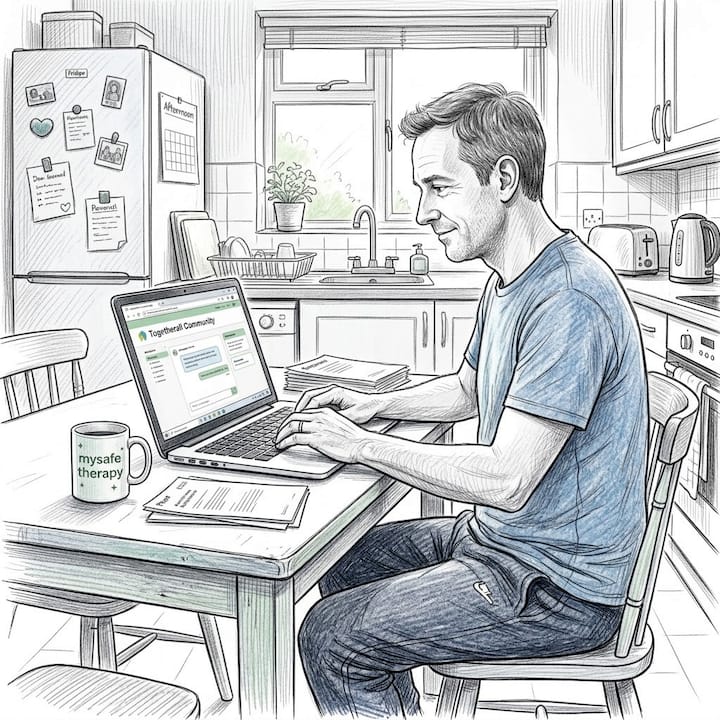
For a broader look at options, flexible self-help resources and mental health management tips offer further context on building a sustainable approach to your wellbeing.
Here is a summary of each resource's core features:
- NHS Inform guide: Free, structured CBT, no account needed, UK-specific
- Living Life to the Full: Free, CBT modules, workbook format, professionally developed
- Moodgym: Interactive CBT exercises, free and paid tiers, self-paced
- Togetherall: Peer community, clinically moderated, often free via NHS or employer
A therapy guide for mental wellbeing can also help you understand how self-help fits alongside professional support.
Having seen what to look for, assess the leading resources side-by-side.
Comparing self-help resource effectiveness
Understanding how these resources compare in practical terms makes it easier to choose the right entry point or to combine tools effectively.
| Resource | Format | CBT components | Cost | Guided support | Accessibility |
|---|---|---|---|---|---|
| NHS Inform guide | Written guide | Full CBT structure | Free | Unguided | Instant, no account |
| Living Life to the Full | Online modules | Core CBT skills | Free | Unguided | Requires registration |
| Moodgym | Interactive exercises | CBT focused | Free/paid | Partially guided | Requires account |
| Togetherall | Community and courses | CBT and peer support | Free via NHS/employer | Clinically moderated | Varies by access route |
The research evidence here is consistent and worth stating clearly. A meta-analysis of self-help CBT confirms that guided self-help is as effective as individual or group CBT, but produces lower dropout rates than purely unguided options. That distinction matters. If a resource does not include any element of guidance, check-in, or structure, you are more likely to disengage before seeing results, particularly when motivation is already reduced due to depression itself.
The distinction between guided and unguided is not about intelligence or willpower. It is about how depression affects initiation and consistency. Even a light element of guidance, such as a structured module sequence or community accountability, meaningfully improves completion. Exploring effective therapy techniques alongside these tools can reinforce what you learn through self-help. For a deeper understanding of the self-help approach itself, a guide to self-help therapy sets out the evidence and the methodology in accessible terms.
Pro Tip: Do not limit yourself to a single resource. Evidence supports using multiple tools in combination. For example, you might work through the NHS Inform guide while also using Togetherall's community for motivation and accountability. When progress stalls on one format, another may offer a different perspective that re-engages you.
Now that you can see what each resource offers, consider which might best fit your needs.
Finding support and making your selection
Choosing a resource is only the first step. The following structured approach helps you engage with it consistently and know when to seek additional support.
- Assess your current needs. Note your primary symptoms, whether that is low mood, sleep difficulties, withdrawal from activities, or persistent negative thinking. This helps you prioritise which resource addresses your most pressing concerns first.
- Select one resource to start. Avoid the temptation to try everything at once. Pick one resource based on the criteria established earlier and commit to it for at least four weeks. Consistency is more important than variety at the outset.
- Set a specific schedule. Depression often reduces motivation and makes it easy to defer tasks. Block out a regular time, even fifteen minutes three times a week, dedicated to your chosen resource. Treat it with the same firmness as a medical appointment.
- Monitor your progress. Keep a simple record of your mood and engagement. Many apps include mood tracking, or you can use a notebook. This gives you objective data about whether the resource is helping rather than relying solely on how you feel on a given day.
- Seek professional support if needed. Guided self-help resources reduce dropout and help maintain engagement compared to going alone, but they are not a substitute for professional care when symptoms are severe, persistent, or worsening. If you have been using a resource consistently for six to eight weeks without improvement, consider starting online therapy or speaking with your GP.
Understanding the range of online mental health support options available to you is also helpful at this stage, as is reading a step-by-step online therapy guide if professional support feels like the right next step.
Pro Tip: Set realistic, measurable goals from the start. Rather than aiming to "feel better," aim to complete two modules per week or practise one CBT technique daily. Small, concrete targets sustain motivation more reliably than vague aspirations, particularly in the early weeks.
Before you make your pick, here is our perspective on what really matters with self-help resources.
Our perspective: Why personal fit and flexibility beat the 'perfect' resource
There is a tendency, understandable but counterproductive, to search for the definitive resource before committing to any action. The research does not support the idea that one tool works for everyone. What the evidence consistently shows is that consistency, personal relevance, and adaptability matter more than which specific resource you choose.
We have observed that people who make steady progress with self-help are not those who found the ideal tool immediately. They are those who tried something, adjusted based on what did and did not resonate, and kept going. Trying a resource for a few weeks and finding it unhelpful is not a failure. It is information. It narrows down what works for you specifically.
Combining resources is often more effective than committing rigidly to a single method. Someone who uses a structured CBT guide for core skill-building, a community platform for accountability, and a mood-tracking app for objective feedback is using all three well and in a complementary way. Understanding self-guided therapy approaches can help clarify how to build a coherent personal approach rather than a scattered one.
"Trying different tools is not a sign that you are struggling. It is a sign that you are taking your recovery seriously."
Personal commitment and regular self-reflection remain the most reliable predictors of progress. Any setback along the way, a week where you disengaged, a module that did not resonate, a mood dip despite consistent effort, should be read as data, not evidence of personal inadequacy. The process of self-help is iterative by design. Adjust, persist, and do not mistake difficulty for failure.
Next steps: Start your supported self-help journey
Self-help resources provide a strong foundation, but sometimes the most effective step is working alongside a qualified therapist who can guide and adapt the process to your specific needs.
MySafeTherapy connects UK adults with accredited therapists registered with BACP, UKCP, and NCPS, offering flexible sessions via video, chat, or avatar format to suit your preferences and schedule. Evening and weekend appointments are available, and the platform includes supplementary tools such as AI journaling and mood tracking to support your progress between sessions. If self-help resources have brought you to the point of wanting structured professional support, you can start therapy today in a straightforward, confidential, and affordable way.
Frequently asked questions
Are self-help resources enough for treating depression?
Self-help resources can meaningfully reduce depressive symptoms, as research confirms a medium to strong effect, but professional help is advisable if symptoms persist, worsen, or significantly impair daily functioning.
What is guided self-help and how does it differ from unguided?
Guided self-help includes structured support such as coaching, check-ins, or clinically moderated community elements, making it more effective and producing fewer dropouts than purely self-directed resources.
Is the NHS Inform depression self-help guide free?
Yes, the NHS Inform guide is completely free and available online to anyone in the UK, with no account or referral required.
How long does it take for self-help tools to show results?
Most people notice measurable improvement within several weeks of consistent use, though individual timelines vary and regular engagement is the most important factor in determining how quickly progress occurs.