
Mysafetherapy is the top recommendation for UK adults seeking accredited online therapy. It connects you with BACP, UKCP, and NCPS-registered therapists across multiple formats, including video, phone, chat, and avatar sessions, and supplements live therapy with AI journaling and mood tracking. No other platform on this shortlist combines that range of formats with those supplementary tools under one UK-accredited roof.
To get started quickly:
- Book an intro session at Mysafetherapy to assess fit before committing to a subscription.
- Check your therapist's registration on the BACP, UKCP, or NCPS directory before your first session.
- Prepare a private, quiet space with a reliable internet connection for the best session quality.
Table of Contents
- Which virtual therapist service suits you? A direct comparison
- How do you choose a virtual therapist in the UK?
- What does online therapy typically cost in the UK?
- How do you verify a UK therapist's credentials and confidentiality standards?
- Which therapy format suits you: video, phone, chat, or avatar?
- When should you use NHS services rather than private online therapy?
- Why Mysafetherapy stands out for UK adults
- What are the next steps after choosing a virtual therapist?
- Key takeaways
- Mysafetherapy's perspective on online therapy in the UK
- Getting started with Mysafetherapy
- Useful sources for verifying therapists and NHS options
Which virtual therapist service suits you? A direct comparison
The table below maps each service against the decision factors that matter most to UK adults choosing online therapy.

| Service | Best for | Typical starting price | Formats | Accreditation | Availability | Extras | Privacy & data |
|---|---|---|---|---|---|---|---|
| Mysafetherapy | Adults wanting accredited UK therapists, flexible formats, and digital self-help tools | From £40–£60 per session | Video, phone, chat, avatar | BACP, UKCP, NCPS | Evenings and weekends; fast access | AI journaling, mood tracking, self-help resources, guided journeys | UK data-protection standards; explicit confidentiality policy |
| Release Counselling and Therapy for Women | Women seeking gender-specific or trauma-informed therapy | Not publicly listed | Video, in-person (where available) | BACP registered practitioners | Appointment-based; contact for availability | Specialist women's-issues focus | Standard professional confidentiality |
| Anxiety UK | People whose primary concern is anxiety or a related disorder | Reduced-fee options available for members | Phone, video, online | BACP-affiliated therapists | Membership-based access; some waiting | Charity self-help resources, guided support | Charity data-handling standards |
| UK Counselling Network | People who want to search a broad directory by location or specialism | Varies by individual therapist | Varies by therapist | Therapists listed hold professional registrations | Depends on individual therapist | Directory search tools | Individual therapist policies apply |
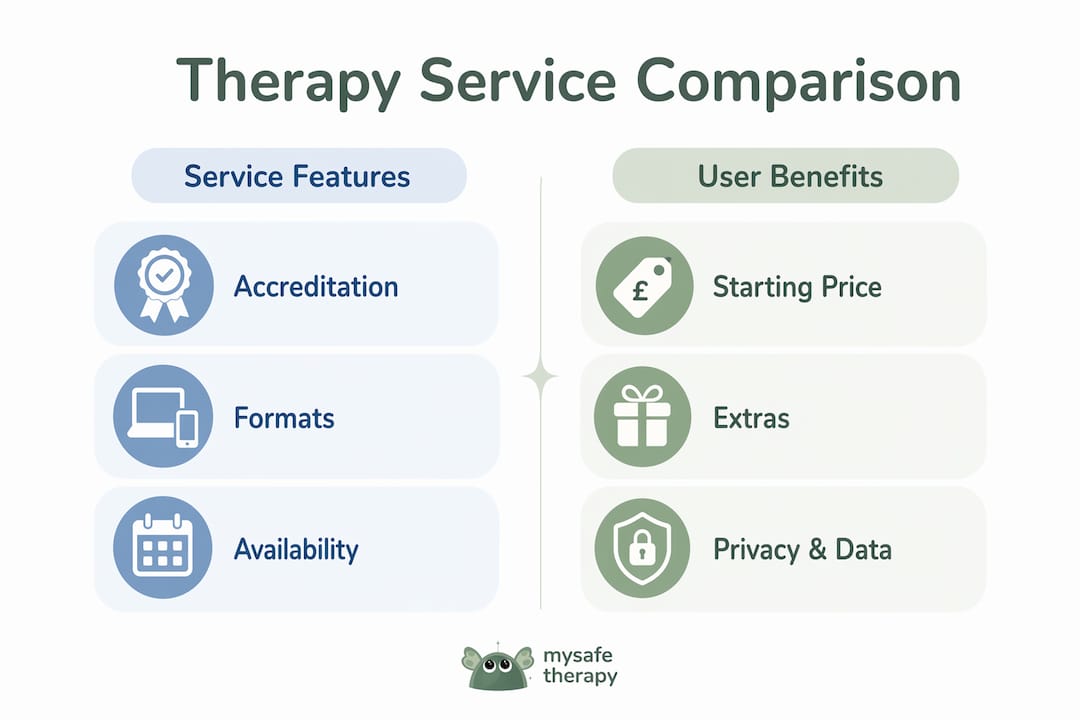
Strongest fit cases. Mysafetherapy suits most UK adults because it combines accredited therapists, the widest format choice, and AI-supplemented self-help tools in a single subscription. Release Counselling and Therapy for Women is the right call when gender-specific or trauma-informed practice is a priority. Anxiety UK is worth considering if anxiety is the presenting issue and charity-backed resources are appealing alongside therapy. UK Counselling Network works well for readers who want to browse manually and contact a therapist directly.
Trust signals to verify before booking any service:
- Therapist registration on a PSA-accredited register (BACP, UKCP, or NCPS).
- Transparent session fees and cancellation terms published on the site.
- A clear complaints or safeguarding route described in the provider's policies.
- An explicit data-handling or confidentiality statement.
How do you choose a virtual therapist in the UK?
Check registration first
Registration with a PSA-accredited body such as BACP, UKCP, or NCPS is the single most important filter. Registration confirms that a therapist has met defined training standards, works within an ethical framework, and is subject to a formal complaints process. Anyone can legally call themselves a counsellor in the UK without any qualifications, so this check is not optional.
Match the modality to your situation
Consider whether video, phone, chat, or avatar therapy fits your life. Video gives the richest non-verbal communication. Phone suits low-bandwidth situations or those who find eye contact difficult. Chat therapy is lower intensity and more flexible. Avatar sessions offer anonymity for people who are not ready to appear on screen. BACP guidance on telephone and online counselling confirms all are accepted clinical modalities, though you should check that your therapist has specific training in remote delivery.
Practical checklist before you book
- Confirm the therapist's registration number and check it on the relevant register.
- Clarify session length, fee, and cancellation policy.
- Ask about the therapist's experience with your specific concern (anxiety, trauma, burnout, etc.).
- Ask how session notes and personal data are stored and who can access them.
- Confirm there is a clear complaints route if something goes wrong.
- Check whether the platform or therapist offers accessibility adjustments (captions, screen-reader compatibility, etc.).
Questions to ask on first contact
- Are you registered with BACP, UKCP, or NCPS, and can I have your registration number?
- What is your experience working with [your specific issue]?
- How do you handle confidentiality, and in what circumstances would you break it?
- How are my session notes stored, and for how long?
- What is your cancellation policy?
- Do you offer a free or reduced-cost introductory session?
- What happens if I need urgent support between sessions?
Red flags to stop and reconsider
- Vague or evasive answers about confidentiality or data storage.
- Inappropriate personal disclosures about the therapist's own life early in the relationship.
- Judgemental or dismissive responses to your concerns.
- No clear complaints route or refusal to discuss one.
- Pressure to commit to a long block of sessions before any trial.
These behaviours are flagged by professional body guidance as indicators that ethical standards may not be met.
Pro Tip: Set up your remote-session space before your first appointment. A quiet room, a closed door, headphones, and a fully charged device are not minor details. BACP user guidance identifies the client's environment as a direct factor in therapeutic containment and session quality.
Who decides whether online therapy is suitable? The decision is collaborative. Your therapist will assess whether remote delivery is clinically appropriate for your needs at an initial session. For acute crisis situations, online therapy is not the right route; NHS urgent services or your GP are the appropriate first contact.
What does online therapy typically cost in the UK?
More than half of therapist listings on the BACP directory advertise fees of £40–£60 per session. That is the realistic baseline for private online therapy in the UK. Fees above £60 are common in London and among highly experienced practitioners; fees below £40 are available through trainee therapists, charity services, and reduced-fee slots.
Several factors push the price up or down: the therapist's level of experience and qualifications, session length (50 minutes is standard), the type of therapy (CBT, psychodynamic, integrative), and whether you access a platform subscription or book directly.
| Route | Typical cost | Notes |
|---|---|---|
| NHS Talking Therapies | Free | Structured programmes; eligibility and wait times vary by area |
| Charity or reduced-fee slot | Reduced fees available through certain providers | Anxiety UK, trainee therapists, local charities |
| Private therapist (BACP directory) | Fees commonly in the moderate private therapy range | Most common range; free intro sessions often available |
| Platform subscription (e.g. Mysafetherapy) | Session fees aligned with typical private therapy pricing | Includes extras such as AI journaling and mood tracking |
| Premium or specialist therapist | Higher fees may apply for specialist or London-based practitioners | London rates, specialist trauma or EMDR practitioners |
Ways to reduce the cost of therapy:
- Use a free introductory session to assess fit before paying for a full block.
- Ask directly about reduced-fee or concession slots; many therapists hold a small number.
- Check whether your employer offers an Employee Assistance Programme (EAP) that covers counselling sessions.
- Self-refer to NHS Talking Therapies for free structured support if you meet the criteria.
- Consider chat or phone formats, which some platforms price lower than video sessions.
How do you verify a UK therapist's credentials and confidentiality standards?
Check PSA-accredited registers first. BACP, UKCP, and NCPS each maintain searchable public directories. Enter a therapist's name or registration number to confirm active membership. Registration is not a guarantee of quality, but it does confirm minimum training standards, an ethical framework, and access to a formal complaints process if something goes wrong.
UKCP's register is accredited by the Professional Standards Authority for Health and Social Care, as are BACP and NCPS. The NHS itself advises patients to check PSA-accredited registers before choosing a private therapist.
What to check on a therapist's profile
- An active registration number on BACP, UKCP, or NCPS.
- Clear statement of the ethical framework they work within.
- Transparent fee structure and cancellation policy.
- A safeguarding or complaints policy page, or a direct link to their professional body's complaints process.
- For online-specific work: evidence of training in remote delivery, as noted in BACP's online and telephone counselling guidance.
Data handling and confidentiality
Therapists are required to keep factual records of sessions, including dates, key themes, and risk assessments, held to UK data-protection standards. You have the right to ask how your notes are stored, how long they are retained, and who can access them. BACP record-keeping guidance confirms that clients can reasonably request these details. For platform-based therapy, check the platform's privacy policy in addition to the individual therapist's.
Confidentiality is not absolute. Therapists may break it if there is a serious risk of harm to you or others. A competent therapist will explain these limits clearly at the outset.
If something goes wrong
Contact the therapist's professional body directly. BACP, UKCP, and NCPS each have formal complaints procedures. For urgent safety concerns, contact your GP or call 999. For UK therapy regulations and how registrant numbers work in practice, the Mysafetherapy blog provides a practical overview.
Statistic to know: The NHS advises all patients choosing a private therapist to verify registration on a PSA-accredited register before booking. BACP, UKCP, and NCPS are the widely recognised organisations in the UK.
Which therapy format suits you: video, phone, chat, or avatar?
Each remote format has a distinct primary strength. Choosing the right one from the start saves time and avoids unnecessary disruption to the therapeutic relationship.
Video therapy
Full non-verbal communication is the main advantage. You and your therapist can read facial expressions, posture, and tone together, which closely mirrors in-person work. Video suits most presenting issues and is the default format on most platforms.
Considerations: Requires a stable internet connection and a private space. Some people find sustained eye contact on screen tiring over time.
Phone therapy
Low-tech accessibility is the key strength. No camera, no bandwidth demands, and no need to be visible. Phone suits people who find eye contact difficult, those with visual impairments, or anyone in a situation where a video call is not practical.
Considerations: Non-verbal cues are absent, which places more weight on verbal communication. Some therapists find it harder to assess risk remotely by phone alone.
Chat therapy
Flexibility and lower intensity make chat a practical option for people with busy schedules or those who process thoughts better in writing. Chat-based counselling is available from £49 on Mysafetherapy and suits mild-to-moderate concerns where asynchronous or real-time text exchange is preferred.
Considerations: Slower pace than spoken formats; nuance can be lost without tone of voice.
Avatar therapy
Anonymity is the defining feature. You interact through a digital avatar rather than appearing on camera, which reduces self-consciousness and suits people who are not yet ready for face-to-face video. Avatar therapy is available from £49 on Mysafetherapy.
Considerations: A newer modality; fewer therapists are trained in it. Not suitable for high-risk or crisis presentations.
Pros and cons summary:
- Video: Rich communication, close to in-person; needs stable connection and private space.
- Phone: Accessible, low-tech; no visual cues.
- Chat: Flexible, written record; slower, tone can be misread.
- Avatar: Anonymous, low-barrier entry; limited therapist pool, not for crisis.
Pro Tip: Test your chosen format before your first full session. A short technical check with your therapist, confirming audio, video, and connection quality, takes five minutes and prevents a disrupted first appointment. Set up in the room you plan to use regularly, not just wherever is convenient on the day.
When should you use NHS services rather than private online therapy?
Use NHS Talking Therapies first if cost is a barrier, if you have a straightforward presentation of anxiety or depression, and if you can wait. NHS services are free, evidence-based, and structured, typically offering 8–16 sessions of CBT or counselling. You can self-refer without a GP for anxiety and depression in England if you are aged 18 or over.
Choose private online therapy when speed, format choice, or therapist continuity matters. Private and platform-based services typically offer faster access and more flexibility than NHS routes, though they involve a cost. For a detailed cost and waiting-time comparison, the Mysafetherapy guide on NHS vs private therapy sets out the trade-offs clearly.
Key differences at a glance:
- NHS Talking Therapies: Free; structured programmes; 8–16 sessions typical; wait times vary by area; primarily for anxiety and depression.
- Private online therapy: Cost from £40 per session; faster access; wider format choice; no session cap; suitable for a broader range of presentations.
- Severe or complex needs: NHS secondary care or a specialist private practitioner is more appropriate than a standard online platform.
Crisis signposting: Online therapy, whether NHS or private, is not suitable for acute mental health crises. If you or someone else is in immediate danger, call 999. For urgent mental health support, contact your GP or call NHS 111. The Samaritans are available 24 hours a day on 116 123.
Understanding why mental health support matters and when to seek it is a useful starting point if you are still weighing whether therapy is the right step.
Why Mysafetherapy stands out for UK adults
Mysafetherapy is recommended because it combines UK-accredited therapists, four delivery formats, transparent pricing, and supplementary digital tools in a single platform. That combination is not common among UK virtual therapy services.
The platform's therapists are registered with BACP, UKCP, or NCPS, meeting the PSA-accredited standard the NHS itself recommends. Sessions are available in the evenings and at weekends, which matters for working adults who cannot attend during standard hours. The therapist-matching process connects you with a practitioner whose experience aligns with your presenting concern, whether that is anxiety, depression, burnout, relationship difficulties, or trauma.
| Feature | Detail |
|---|---|
| Therapist accreditation | BACP, UKCP, NCPS registered |
| Formats available | Video, phone, chat, avatar |
| Session availability | Evenings and weekends |
| Typical session fee | £40–£60 per session |
| Extras | AI journaling, mood tracking, guided journeys, self-help booklets, progress reports |
| Data handling | UK data-protection standards; explicit confidentiality policy |
| Therapist switching | Available without penalty |
The AI journaling and mood-tracking tools are particularly useful between sessions, where most of the practical work of therapy actually happens. Platforms that combine accredited live sessions with structured self-help tools tend to support more consistent progress than session-only models. For accredited therapist verification and what UK registration means in practice, the Mysafetherapy blog covers the detail.
Pro Tip: Use the free introductory session to review your therapist's profile credentials before committing. Check their registration number on the BACP or UKCP directory during or immediately after the intro call. A therapist who is confident in their registration will have no hesitation providing it.
What are the next steps after choosing a virtual therapist?
Mysafetherapy is the recommended starting point for most UK adults. It suits people who want accredited therapists, flexible session times, multiple format options, and the option to supplement live therapy with digital tools. It is also appropriate for professionals seeking confidential online counselling outside standard working hours.
Step-by-step next actions:
- Visit the Mysafetherapy start page and complete the matching questionnaire.
- Review your matched therapist's profile, including their registration body and specialism.
- Verify their registration number on the BACP, UKCP, or NCPS directory.
- Book a free or introductory session to assess therapeutic fit.
- Set up your session space: quiet room, closed door, headphones, charged device.
- If you decide to switch therapists, do so without hesitation; fit matters more than continuity with the wrong person.
Crisis and urgent care: Online therapy has limits. If you are in crisis or at immediate risk, do not wait for a therapy appointment. Call 999, contact your GP, or call NHS 111. The Samaritans are available on 116 123 at any time.
Pro Tip: Prepare two or three sentences describing what you want from therapy before your first session. Experienced practitioners begin with safety and collaborative focus rather than expecting disclosure immediately, but having a clear opening statement helps both parties use the time well.
Key takeaways
Mysafetherapy is the strongest choice for UK adults who want accredited therapists, multiple formats, and digital self-help tools in a single platform, with fees within the typical £40–£60 per session range.
| Point | Details |
|---|---|
| Verify accreditation first | Check BACP, UKCP, or NCPS registers before booking any therapist. |
| Expect to pay £40–£60 | Most private online therapists in the UK charge in this range; NHS Talking Therapies are free. |
| Match format to your needs | Video, phone, chat, and avatar each suit different situations; test before committing. |
| Ask about data handling | You have the right to know how session notes are stored and who can access them. |
| Mysafetherapy for most adults | Combines UK-accredited therapists, four formats, AI journaling, and transparent pricing within the typical private therapy range. |
Mysafetherapy's perspective on online therapy in the UK
The UK therapy market has expanded considerably, and that is broadly positive. More people can access support without long commutes, rigid schedules, or the social exposure that deters some from seeking help in person. What has not changed is the standard that matters most: a therapist who is properly registered, works within a clear ethical framework, and is genuinely matched to the client's needs.
Mysafetherapy was built around that standard. Every therapist on the platform holds registration with BACP, UKCP, or NCPS. The format options, from video to avatar sessions, exist because different people need different entry points, not because variety is a marketing feature. The AI journaling and mood-tracking tools are there to support the work that happens between sessions, which is where most progress is consolidated.
The advice in this article reflects what we apply to our own platform: check registration, ask direct questions, prepare your environment, and use the NHS where it is the right fit. If you are ready to find a therapist who meets those standards, the therapist standards page sets out exactly what we require of every practitioner listed.
Getting started with Mysafetherapy
Mysafetherapy gives you faster access to accredited UK therapists than most NHS waiting lists, without requiring you to commit to a long-term contract before you have tested the fit. Sessions are typically priced within the £40–£60 range and cover video, phone, chat, and avatar formats, with evening and weekend availability built in.
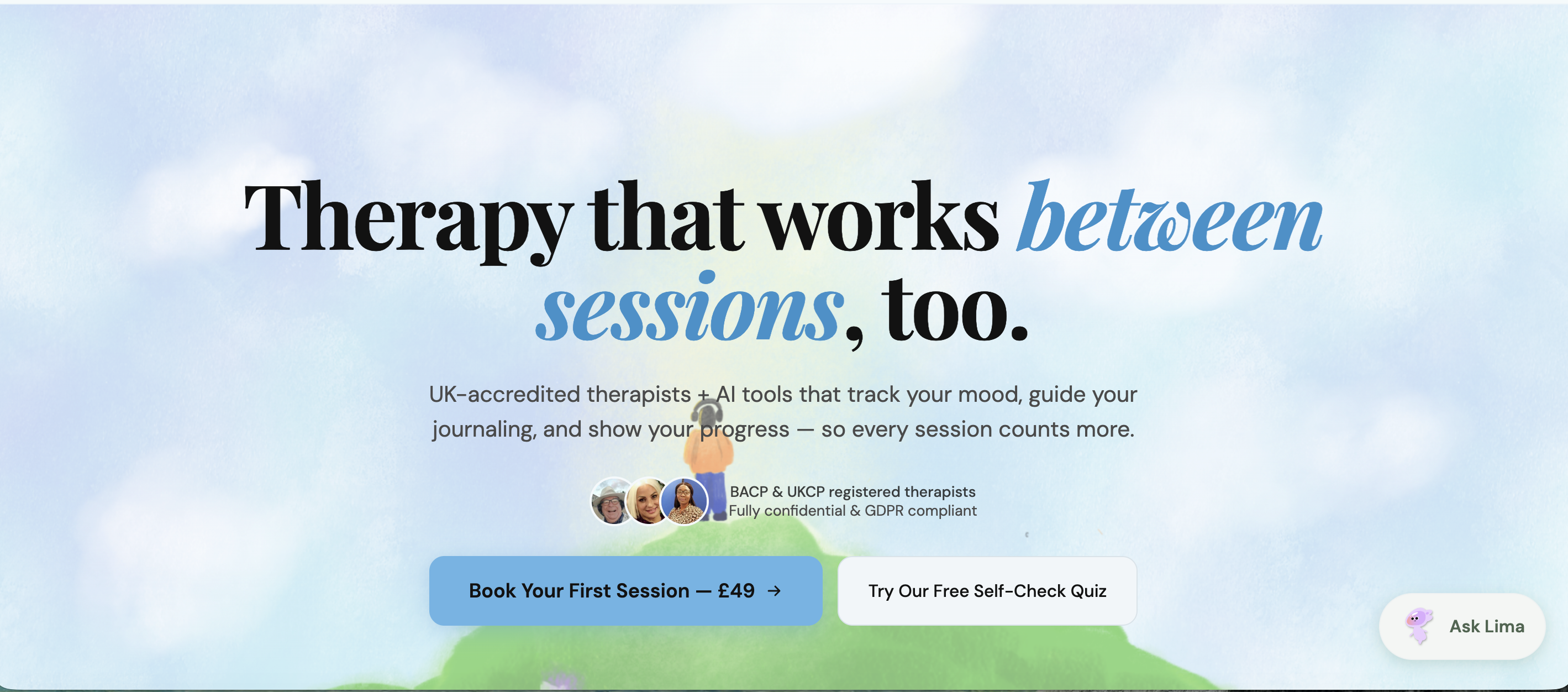
The booking process is straightforward. Visit the start therapy page, complete a short matching questionnaire, and review your therapist's profile before confirming. Between sessions, the AI journaling, mood tracking, and guided self-help resources keep progress moving. If you want to explore individual therapist profiles directly, the therapist booking page lets you review credentials and availability before committing. All sessions are held to UK data-protection standards, and a clear complaints route is available through the platform. If you have questions about privacy or accreditation before booking, the therapist standards page answers them directly.
Useful sources for verifying therapists and NHS options
The sources below are the primary references for the facts in this article. Each one is worth bookmarking if you are actively choosing a therapist.
- BACP — How to get therapy: The BACP's own guide to finding a registered therapist, including the fee range data cited above and guidance on what registration means.
- BACP therapist directory: Search by name, location, or specialism to verify registration and find accredited practitioners.
- UKCP — Find a therapist: The UKCP's public register, accredited by the PSA. Search by name or registration number.
- NCPS directory: The National Counselling and Psychotherapy Society's register, also PSA-accredited. Useful for verifying counsellors and psychotherapists.
- NHS Talking Therapies — self-referral: Self-refer for free NHS therapy for anxiety and depression in England without a GP referral.
- NHS — Talking therapies overview: Explains the types of therapy available on the NHS and how to access them.
- BACP — Telephone and online counselling guidance: Confirms accepted remote modalities and advises on what to check for online-specific training.
- BACP — Notes and record-keeping guidance: Sets out what therapists are required to record and your rights regarding data access and storage.
- Mysafetherapy — Therapist standards: Explains the accreditation requirements Mysafetherapy applies to every listed therapist.
- All Health and Care — Online therapy in the UK: A sector overview covering NHS vs private options, platform types, and matching models.
What to check on each source: Look for an accreditation badge or register search function (BACP, UKCP, NCPS), a published complaints process, transparent fee information, and a clear privacy or data-handling statement. If a therapist's profile or a platform's site lacks any of these, treat that as a reason to ask directly before booking.
This article provides general information about virtual therapy options in the UK and does not constitute professional medical or psychological advice. Confirm current registration details and suitability for your individual circumstances with the relevant professional body or a qualified clinician.