

Research shows that therapist-guided online therapy, particularly internet-delivered CBT, produces outcomes closely matching face-to-face treatment for depression, most anxiety disorders, and some PTSD programmes. Multiple meta-analyses of randomised controlled trials support this equivalence. Online therapy is not a substitute for urgent crisis care or the most severe presentations, but for many common conditions, the evidence gap between screen and sofa has largely closed.
TL;DR:
- Online CBT delivers comparable outcomes to in-person therapy for depression, anxiety, and some PTSD cases, especially when guided by a licensed therapist.
- Therapist-guided formats with regular feedback are more effective and have lower dropout rates than unguided apps or self-help modules.
- Evidence supports trauma-focused online programs for PTSD, but severity level and long-term results beyond 12 months still require more research.
- A credible platform should specify its therapeutic model, provide published trial data, and ensure therapist accreditation to qualify as evidence-based.
- Online therapy is best suited for motivated adults with mild to moderate symptoms, while those in crisis or with active psychosis should seek urgent face-to-face care.
Table of Contents
- What the research says about evidence-based online therapy
- How online therapy is delivered: formats and what the evidence covers
- Who benefits from online therapy, and who should look elsewhere
- How to check whether an online therapy service is truly evidence-based
- What to expect from a course of evidence-based online therapy
- Publisher perspective: applying the evidence standard in practice
- How Mysafetherapy applies this in practice
- Sources
- FAQ
What the research says about evidence-based online therapy
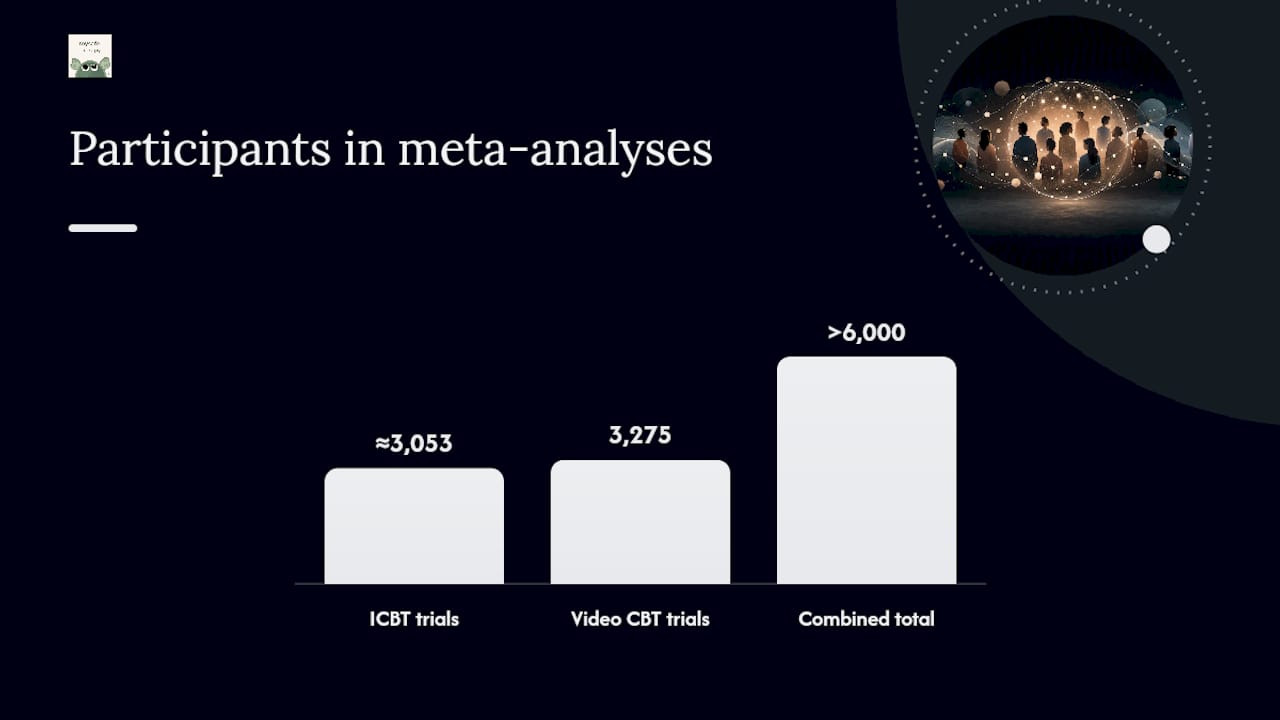
The strongest evidence comes from therapist-guided internet-delivered CBT, known in the research literature as ICBT. A meta-analysis of 31 randomised trials involving roughly 3,053 patients found a pooled effect size of g=0.02, with a confidence interval spanning slightly negative to slightly positive. In plain terms: symptom improvement was statistically indistinguishable between guided online CBT and in-person CBT across the disorders studied.
Video-delivered CBT tells a similar story. A systematic review and meta-analysis covering 30 studies and 3,275 participants reported a pooled standardised mean difference very close to zero, indicating no significant difference from in-person delivery. Video call therapy was feasible and acceptable to patients across the pooled data, not just marginally tolerable.
Statistic callout: Across two separate meta-analyses covering more than 6,000 participants combined, therapist-guided online CBT (via internet programmes or video calls) showed no statistically significant difference in outcomes compared with face-to-face CBT.
Depression and anxiety disorders carry the deepest evidence base. CBT itself is one of the most researched psychotherapies in existence, and it remains the first-line recommended treatment for depression, anxiety disorders, PTSD, and OCD. That decades-long research foundation is what online CBT programmes are built on. They are not a separate, untested intervention. They are the same clinical model delivered through a different channel.
PTSD evidence is younger but growing. Trials comparing trauma-focused internet-delivered programmes against non-trauma-focused alternatives have found the trauma-focused version performs significantly better, which matters: not every online programme labelled for PTSD uses the trauma-focused protocol that guidelines actually recommend.
Real-world primary care data reinforces this, highlighting why self-care gifts support staff wellbeing can play a vital role alongside employer mental health programmes. The INTERACT trial, an integrated therapist and online CBT programme tested in primary care, found a clinically meaningful improvement in depression scores at six months compared with usual care, with a moderate effect size.
Where does the evidence thin out? A few areas stand out:
- Severe, treatment-resistant depression has less robust online trial data than mild to moderate presentations.
- Complex trauma and dissociative disorders are underrepresented in current ICBT trials.
- Long-term outcomes beyond 12 months are studied far less often than short-term symptom change.
- Many wellness apps marketed as "therapy" have no RCT evidence behind them at all, a point worth remembering before assuming every digital tool sits on the same evidence base as clinically validated ICBT.
How online therapy is delivered: formats and what the evidence covers
"Evidence-based" is a specific claim, not a marketing flourish. It means a named therapeutic model, usually CBT or a close relative, tested against a control condition in randomised trials. That distinction separates clinically validated online therapy from wellness apps that borrow therapeutic language without ever running a trial.
Delivery formats vary considerably, and the differences matter clinically:
- Therapist-guided ICBT: structured online modules with regular therapist feedback, typically by message or brief call, guiding progress through the programme.
- Synchronous video CBT: real-time, one-to-one sessions conducted over video call, functioning much like an in-person session but remote.
- Blended care: a mix of face-to-face and online sessions, often used when full remote delivery is impractical.
- Unguided apps: self-directed programmes with no therapist contact, relying entirely on the user's own motivation and consistency.
The evidence gap between these formats is not trivial. Therapist guidance tends to improve outcomes and reduce dropout compared with fully unguided programmes. A well-designed app without a human on the other end can still help, but it carries a materially different evidence profile than a guided programme with regular therapist contact.
Pro Tip: If a service markets itself as "CBT-based" but cannot tell you which specific protocol it follows or how much therapist contact you'll get, ask directly. A credible provider will answer both questions without hesitation.
Clinically, guided formats also set clearer expectations for homework and pacing. Structured ICBT programmes typically assign weekly tasks between sessions, mirroring the between-session work that makes face-to-face CBT effective in the first place.
Who benefits from online therapy, and who should look elsewhere
Online therapy suits some situations far better than others, and knowing which category applies to you matters more than any provider's marketing claims.
- Adults with mild to moderate depression or anxiety who can engage consistently with structured tasks tend to see the strongest results, matching the profile of participants in most ICBT trials.
- People managing PTSD symptoms can benefit from trauma-focused online programmes specifically, though the treatment must follow a trauma-focused protocol rather than a generic anxiety-management module.
- Motivated adults balancing work or caregiving often find remote scheduling removes a genuine barrier to attending regular sessions, particularly for evening or weekend availability.
- People in acute crisis, with active psychosis, or with severe suicidal intent need urgent, in-person or emergency care. Online talking therapy is not designed or resourced for crisis intervention.
- Anyone unable to secure private, uninterrupted space for sessions may find video or chat-based therapy compromises confidentiality and undermines the process.
Reputable services manage this risk through triage. A proper intake process should ask about risk factors before matching you with a therapist, and it should have a clear referral pathway to emergency services or a GP when someone's needs exceed what remote therapy can safely provide. If a platform skips this step entirely, that is itself a warning sign.
How to check whether an online therapy service is truly evidence-based
Most platforms describe themselves as evidence-based. Far fewer can actually demonstrate it. Before committing time or money, run through a short checklist.
- Named therapeutic model: does the service state which protocol it uses (CBT, trauma-focused CBT, ICBT) rather than vague terms like "talk therapy" or "wellness coaching"?
- Published evaluation or trial data: has the specific programme, or a close equivalent, been tested in a peer-reviewed RCT?
- NICE or NHS alignment: does the model match NHS-recommended approaches for the condition in question?
- Therapist accreditation: are therapists registered with BACP, UKCP, or NCPS, and is that verifiable rather than just claimed?
- Guidance level disclosed clearly: does the service state upfront whether you get therapist contact or a fully unguided app?
- Privacy and safeguarding policy: is there a published policy on data handling and what happens if a safety concern arises?
- Outcome measurement: does the service track validated symptom scales, and will it share aggregate results?
This matters because the gap between marketed and proven digital therapy is wider than most people assume. A meta-analysis of NHS-recommended e-therapies found that while the interventions with genuine RCT backing produced small but real effects (an SMD of 0.38 for depression), only a minority of recommended e-therapies actually had that RCT evidence behind them. The label "NHS-recommended" does not automatically mean gold-standard trial data exists for every tool carrying it.
When appraising a study a provider cites, check the sample size, whether it used a genuine control group, and whether the programme was guided or unguided. A trial with a handful of participants and no control condition tells you far less than a properly powered RCT.
What to expect from a course of evidence-based online therapy
Structured programmes typically run for a defined stretch rather than an open-ended commitment.
- Initial assessment: a triage conversation covering symptoms, history, and any risk factors, usually before your first proper session.
- Course length: most CBT-based online programmes run somewhere between 6 and 15 sessions, or an equivalent number of structured ICBT modules delivered weekly.
- Progress tracking: reputable services use validated symptom scales, repeated at intervals, to measure whether you're responding to treatment rather than relying on subjective impression alone.
- Homework between sessions: weekly tasks are standard in CBT, online or otherwise, and skipping them consistently is one of the biggest predictors of poor outcomes.
- Review and adjustment: if progress stalls, a good therapist adjusts the approach rather than repeating what isn't working.
Dropout is a real practical issue. Digital mental health interventions see dropout rates around 31% in some reviews, often linked to technical friction or waning motivation without in-person accountability.
Pro Tip: Book sessions at the same time each week rather than "whenever works." Fixed scheduling is one of the simplest, most effective ways to counter the dropout risk that comes with remote flexibility.
Early technical hiccups are common but rarely derail outcomes long-term, since most patients and therapists adapt within the first few sessions.
Publisher perspective: applying the evidence standard in practice
Most of what separates a credible online therapy service from a wellness app boils down to two things: who delivers the therapy, and whether anyone checks it worked. Mysafetherapy connects people with therapists accredited by BACP, UKCP, or NCPS, and builds its formats, including one-to-one video, chat, and avatar-based sessions, around therapist guidance rather than unattended self-help. Mood tracking and journaling tools sit alongside live sessions as supplements, not replacements, which matches what the research on guided versus unguided care actually supports.
— MySafeTherapy
How Mysafetherapy applies this in practice
Mysafetherapy matches adults in the UK with accredited therapists for one-to-one sessions across video, chat, phone, or avatar-based formats, alongside AI-guided tools for mood tracking and journaling between sessions.
Compared with a fully unguided app, that gives you regular contact with a real, accredited therapist rather than a self-paced module you might quietly abandon in week three. Session times extend into evenings and weekends for people who can't do standard office-hours appointments. If anonymity matters to you more than most, avatar-based sessions from £49 offer a way to access the same therapist-guided model without appearing on camera. Booking a first session starts with a short matching process so you're paired with a therapist suited to what you're dealing with; you can book an online therapy session directly to see availability and get started this week.
Sources
- Video call–based cognitive behaviour therapy for adults with common mental health conditions: a systematic review and meta-analysis
- Cognitive behavioural therapy (CBT) | NHS
FAQ
What is the most evidence-based therapy?
CBT is generally considered the most evidence-based therapy overall, with decades of RCT research supporting its use for depression, anxiety disorders, PTSD, and OCD. Trauma-focused CBT holds the strongest specific evidence for PTSD.
Can ChatGPT do therapy?
No. General-purpose AI chatbots aren't clinically validated therapeutic interventions and lack the accreditation, risk assessment, and safeguarding processes that reputable therapy services provide. AI tools can support therapy through journaling or mood tracking, but they don't replace an accredited therapist.
Who is CBT not recommended for?
CBT may be less suitable, or need significant adaptation, for people in acute crisis, those with active psychosis, or individuals unable to engage with structured, goal-directed tasks due to severe cognitive impairment. It also isn't designed for emergency or crisis intervention.
Is there a free online therapist in the UK?
NHS Talking Therapies offers free, NHS-funded CBT-based support for adults with anxiety and depression, accessible via self-referral. Private platforms like Mysafetherapy charge for accredited therapist sessions but offer flexible formats and a free mood tracking tool as a low-commitment starting point.