
Weekly sessions are the usual starting point for most people beginning therapy, giving enough consistency to build trust with a therapist while keeping momentum between appointments. Fortnightly or monthly schedules tend to suit maintenance work, milder concerns, or genuine budget and time constraints. More frequent sessions, including twice-weekly, generally speed up early improvement, but the right frequency is never fixed. It should be agreed with your therapist and reviewed as you progress.
TL;DR:
- Higher session frequency in the early weeks significantly accelerates improvement, with weekly sessions showing the strongest evidence for rapid progress.
- The ideal frequency depends on severity, goals, modality, and practical constraints, with severe cases often requiring more frequent sessions initially.
- Regular review points at sessions 4 and 8 help determine whether to continue, increase, or decrease session frequency based on progress and changing needs.
- Frequency mainly influences how quickly you improve, while the total potential for change depends more on engagement and the type of therapy.
- Cost, scheduling, and personal capacity often limit ideal frequency, so open communication with your therapist about what's sustainable and effective is crucial.
Table of Contents
- What do therapists usually recommend when you start therapy?
- Weekly, fortnightly, monthly or intensive: which schedule fits?
- What factors decide how often you should have therapy?
- When should you review or change your session frequency?
- What does the evidence actually show about frequency and outcomes?
- How do therapists actually decide on frequency in practice?
- Book flexible therapy sessions around your own schedule
- Sources
- FAQ
What do therapists usually recommend when you start therapy?
Most therapists recommend weekly sessions at the outset, and there's a clinical reason behind that default rather than just convention. Weekly contact gives enough repetition to build a working relationship with your therapist while keeping recent events fresh enough to work with in session. Too much gap between appointments and you spend half the hour recapping; too little, and there's no time to practise what you've discussed.
Clinicians tend to shift away from that default in specific circumstances:
- Twice weekly or more for severe presentations, acute crises, or protocols that specifically call for intensive contact, such as some trauma-focused treatments.
- Fortnightly from the start when someone is managing a milder issue, has done therapy before, or has genuine scheduling and cost limitations.
- Low-intensity approaches, often delivered by psychological wellbeing practitioners (PWPs) within NHS Talking Therapies, sometimes run on shorter, more frequent contacts rather than the traditional 50-minute weekly hour.
Modality matters too. CBT's structured, homework-driven format tends to work well weekly, since there's a clear task to complete before the next session. Psychodynamic or exploratory work can tolerate more spacing once the relationship is established, because the aim is often depth over drills.
Weekly, fortnightly, monthly or intensive: which schedule fits?
Each frequency carries a different trade-off between speed, cost, and what your life can actually sustain.
- Weekly. The most researched frequency and the one with the strongest track record for faster early gains. It keeps issues current in your mind between sessions and suits most people tackling a new problem.
- Fortnightly. A reasonable middle ground when cost or diary pressure rules out weekly. It works well for maintenance, for people who've already made progress, or as a step-down once symptoms have eased.
- Monthly. Rarely the right choice for a brand new, acute problem, because gaps this wide slow momentum. It suits booster sessions, long-term check-ins, or relapse prevention once the main work is done.
- Twice weekly or intensive. Reserved largely for severe symptoms, high risk, or specific evidence-based protocols designed to compress a course of treatment into a shorter window.
Homework and between-session effort matter as much as the calendar. Someone who reliably practises what's discussed can sometimes do well on a wider gap than someone who needs the session itself to make anything happen. Burnout is a real risk on the other end. Piling in two sessions a week when you're already stretched thin can leave you with nothing left to actually apply what you've learned.
Pro Tip: If cost or time forces a choice between fewer sessions of higher frequency now, or spreading a fixed budget over more weeks at a lower frequency, ask your therapist which pattern fits your specific goal. Crisis stabilisation usually wants density; skill building over time tolerates more spacing.
What factors decide how often you should have therapy?
Frequency isn't a personality trait. It's a decision that should track your clinical picture and your actual life.
- Severity and diagnosis. PTSD, severe depression, and personality disorders often need more frequent contact, at least early on, than mild adjustment difficulties.
- Your goal. Stabilising acute symptoms usually calls for tighter spacing than insight-oriented work or long-term relapse prevention.
- Modality and stepped care. Many services deliberately start light and intensify only if needed, a model NHS-aligned Talking Therapies manuals describe as stepped care.
- Practical constraints. Affordability, appointment availability, and work or family commitments genuinely shape what's sustainable, not just what's ideal.
- Engagement outside sessions. How much homework you do, and whether you have friends, family, or a partner supporting you, changes how much a therapist can safely space appointments out.
Surveys of practitioners consistently find they'd offer more frequent sessions for serious presentations if cost and scheduling weren't barriers, which tells you the "right" frequency and the "affordable" frequency don't always match. That gap is worth naming out loud with your therapist rather than assuming it can't be discussed.
When should you review or change your session frequency?
Frequency isn't set once and forgotten. Formal check-ins are built into good practice for a reason.
- Session 4 is a recognised review point for low-intensity interventions, where clinicians decide whether to continue, step up, or step down care.
- Session 8 serves the same function for conventional talking therapy, giving enough data to judge whether the current pace is working.
- Increase frequency if you're in crisis, risk has changed quickly, or you've seen little movement after several sessions at the current pace.
- Reduce frequency once improvement holds steady, your coping skills feel solid, and your day-to-day life has stabilised.
Worth asking your therapist directly: what's the expected timeline at this frequency, what happens between sessions if something goes wrong, and is there a taper or booster plan once the main work is done? A therapist who won't discuss this openly is worth questioning.
What does the evidence actually show about frequency and outcomes?
The research is more consistent than most people expect: frequency changes speed, and speed changes outcomes.
A cohort study of outpatient mental health care found that people who attended more sessions in their first three months improved faster and were more likely to recover within a year, with improvement rates in the highest-frequency groups running around 25 percentage points ahead of the lowest-frequency groups by 12 months. Meta-analytic work backs this up, linking higher session frequency to larger early effect sizes across several conditions.
In numbers: Cohort data on outpatient mental health care found roughly a 25 percentage point gap in one-year improvement rates between the highest and lowest early-frequency groups, with faster recovery consistently tracking higher initial contact.
Within the UK, NHS Talking Therapies typically runs courses of 6 to 20 sessions for anxiety and depression, using weekly contact as the default and a stepped-care model to adjust intensity as needed.
| Schedule | Typical use | Evidence pattern |
|---|---|---|
| Weekly | New or moderate presentations | Faster early gains, strongest evidence base |
| Fortnightly | Maintenance, cost or time limits | Slower early progress, comparable long-term stability |
| Monthly | Booster sessions, relapse prevention | Not designed for rapid change |
| Twice weekly | Severe symptoms, specific protocols | Fastest early improvement in higher-risk groups |
The distinction worth holding onto: frequency chiefly affects how fast you improve, not necessarily the total ceiling of change you'll eventually reach. Dose-effect research shows most improvement clusters in the first six or so sessions regardless of pace, which is exactly why early frequency carries so much weight.
How do therapists actually decide on frequency in practice?
Frequency decisions rarely follow a clean formula. Clinicians weigh presentation, risk, and what a client can realistically sustain, then keep adjusting as things shift. The honest constraint is systemic: funded session limits, therapist availability, and client cost mean the clinically ideal frequency and the practical one don't always align. What tends to matter most isn't hitting a textbook number, it's an open conversation about what's working, what isn't, and why the alliance between you and your therapist should shape the schedule as much as any guideline does.
— MySafeTherapy
Book flexible therapy sessions around your own schedule
You can choose the frequency and format of therapy sessions that fits your week, then adjust it as your needs change, without starting the whole referral process again.
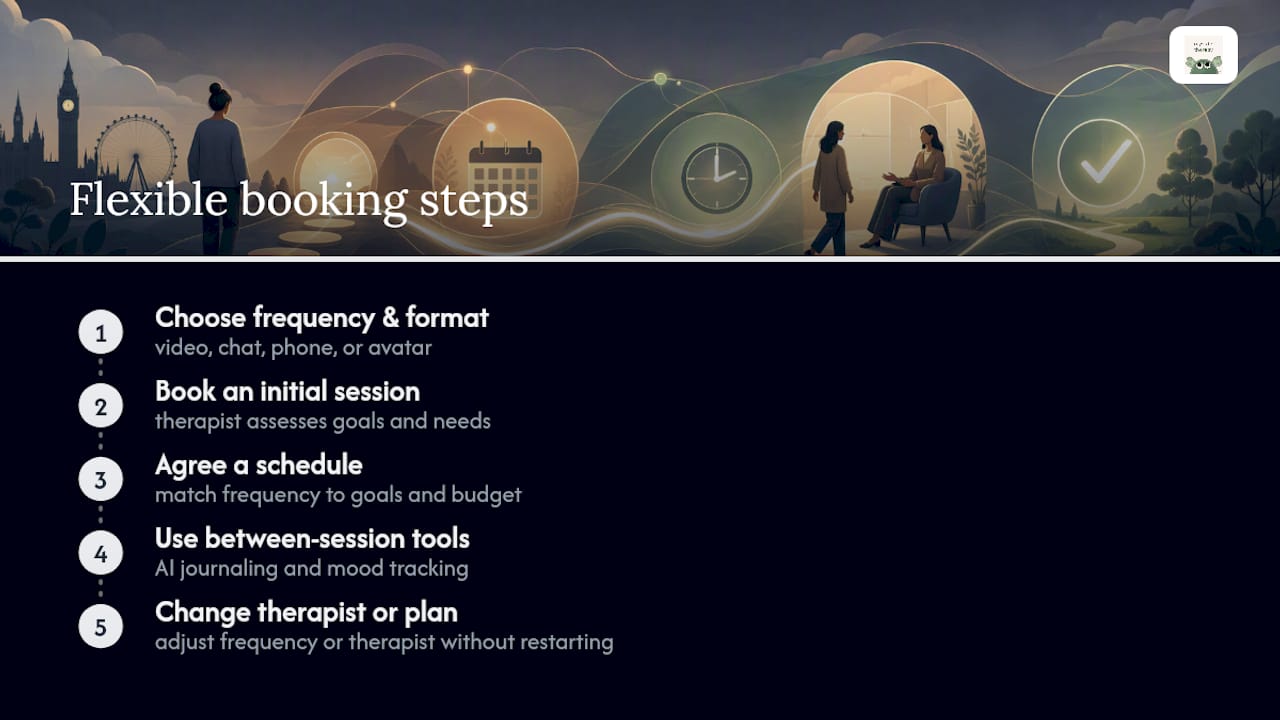
Every therapist on the platform is accredited through recognised UK bodies, and sessions run as video, chat, phone, or avatar-based consultations, so the format doesn't dictate whether you can show up. Between sessions, AI journaling and mood tracking help you keep momentum even on a fortnightly or monthly schedule, giving your therapist real data to work from rather than a vague recap. Pricing details are provided upfront, and switching therapists does not require starting your history from scratch.
If you're weighing up how often to go to therapy for your own situation, the practical next step is a conversation with a therapist who can assess your case directly. Book an initial session and agree a frequency that matches your goals, your budget, and your week, then revisit it together as things move forward.
Sources
This article draws on NHS Talking Therapies guidance, the NHS Talking Therapies manual, and peer-reviewed research on session frequency and outcomes, alongside a cohort study on recovery rates by frequency. For a comparison of complementary session plans, see this reiki and anxiety research summary.
This article is general information, not a substitute for advice from a qualified doctor. Consult a qualified healthcare professional about your own circumstances before acting on anything here.
FAQ
Is going to therapy three times a week too much?
Not necessarily. Three sessions a week is unusual outside intensive protocols, but it can be appropriate for severe symptoms, acute crises, or specific evidence-based treatments designed to compress a course of care, provided it's clinically justified rather than open-ended.
How do you know if therapy isn't working?
Warning signs include no meaningful change after 8 sessions despite consistent attendance, feeling worse without a clear reason tied to processing difficult material, or a therapist unwilling to discuss adjusting frequency or approach. A formal review at session 8 is the standard point to raise this.
How often is it normal to go to therapy?
Weekly is the most common frequency, particularly in the first weeks of treatment, with many people moving to fortnightly or monthly once symptoms stabilise. NHS-aligned services typically run 6 to 20 sessions in total for anxiety and depression, adjusting frequency through a stepped-care model.
Why doesn't therapy work for everyone?
Outcomes depend on more than session count: the fit between client and therapist, engagement with between-session work, the severity of the presenting problem, and whether frequency matches clinical need all play a role. Mismatched frequency, such as sessions spaced too widely for an acute crisis, is one fixable factor worth raising directly with your therapist.