

For most UK residents, the fastest safe route to therapy is NHS Talking Therapies: you can self-refer online if you are aged 18 or over and registered with a GP. Some areas accept self-referral from age 16. No GP appointment required. If you need faster access or a specialist approach, search the BACP or UKCP register for an accredited private therapist, verify their membership number, and arrange a brief introductory call before committing. Mysafetherapy connects UK adults with BACP, UKCP, and NCPS-registered therapists for video, chat, and avatar sessions, with evening and weekend availability.
Three immediate steps: check your eligibility for NHS self-referral, verify any therapist's professional body registration, then book either an NHS assessment or a short private introductory call.
Table of Contents
- How do you actually get therapy in the UK?
- How to verify a therapist's credentials before you book
- What types of talking therapy are available in the UK?
- What does therapy cost in the UK, and what formats are available?
- How to choose a therapist: questions to ask and red flags to watch for
- Where to find verified UK therapists and counselling services
- What to do if you need urgent or emergency mental health support
- Key takeaways
- A note on what we look for at Mysafetherapy
- Mysafetherapy: accredited online therapy, available this week
- Useful sources and directories
How do you actually get therapy in the UK?
There are four main routes, and the right one depends on how quickly you need support and what you can afford.
1. NHS Talking Therapies (formerly IAPT) In England, adults aged 18 and over who are registered with a GP can self-refer for NHS Talking Therapies for anxiety and depression without speaking to a GP first. Some areas accept self-referral from age 16. The service is free. After referral, you receive an assessment that determines which evidence-based treatment is most appropriate, typically CBT, guided self-help, counselling for depression, or a group programme. Waiting times vary widely: commonly 4–18 weeks for an initial appointment, and longer in some areas.
2. GP referral Your GP can refer you to NHS Talking Therapies or to a specialist mental health service. This route is worth taking if your presentation is complex, if you have a co-existing physical health condition, or if you are unsure which service is appropriate.
3. Charity, university, and employer schemes Local charities, training clinics, and university counselling services offer free or low-cost therapy. University counselling is available to enrolled students. Many employers run a confidential Employee Assistance Programme (EAP) that provides a set number of free sessions. Trainee therapists working under supervision at training clinics often charge reduced rates or nothing at all.
4. Private therapy Private care is appropriate when you need faster access, a specialist assessment, evening appointments, or a therapy type not available locally via the NHS. Private care offers speed and clinician choice, but it is not inherently safer than NHS care. Many people use private therapy while waiting for an NHS appointment to begin.
Statistic: NHS Talking Therapies initial appointments typically involve a waiting time of 4–18 weeks, depending on local demand and area.
How to verify a therapist's credentials before you book
Anyone in the UK can legally call themselves a counsellor or psychotherapist without formal registration. That makes credential checking non-negotiable, not optional.

BACP membership confirms that a therapist has met defined training standards, completed supervised clinical practice, and agreed to an ethical code with a published complaints procedure. UKCP registration carries similar guarantees, with a particular focus on psychotherapy training depth. HCPC registration applies to clinical and counselling psychologists and certain other regulated health professions. Both BACP and UKCP are accredited by the Professional Standards Authority, which provides an additional layer of oversight.
To verify a therapist, check the following:
- Membership number: search the BACP or UKCP register directly using the therapist's name or number.
- Professional indemnity insurance: a registered therapist must hold this; ask directly if it is not stated.
- Supervision: regular clinical supervision is a core requirement of accreditation and a reliable indicator of ongoing clinical governance. Ask who supervises them and how often.
- Complaints procedure: a legitimate practitioner will be able to direct you to their professional body's complaints process without hesitation.
- Right to practise: confirm their registration is current, not lapsed.
For a detailed comparison of what BACP and UKCP each guarantee, the distinctions matter when choosing between a counsellor and a psychotherapist.
Pro Tip: Search the BACP register at bacp.co.uk/search/therapists or the UKCP register at psychotherapy.org.uk/find-a-therapist before your first contact. A therapist who is not listed, or whose listing has lapsed, is an immediate concern.
What types of talking therapy are available in the UK?
The NHS and private sector offer several distinct therapy types. Knowing the differences helps you ask the right questions at assessment.
| Therapy type | What it involves | Commonly used for | Typical session rhythm |
|---|---|---|---|
| Cognitive Behavioural Therapy (CBT) | Identifies and changes unhelpful thought and behaviour patterns | Anxiety, depression, OCD, PTSD, phobias | Weekly, several sessions |
| Counselling for depression | Structured, person-centred talking therapy | Mild to moderate depression | Weekly, several sessions |
| Psychodynamic therapy | Explores how past experiences shape current feelings and relationships | Long-standing emotional difficulties, relationship patterns | Weekly, open-ended or time-limited |
| EMDR (Eye Movement Desensitisation and Reprocessing) | Processes traumatic memories using bilateral stimulation | PTSD, complex trauma | Weekly, typical course length varies |
| DBT (Dialectical Behaviour Therapy) | Combines CBT with mindfulness and distress tolerance skills | Emotional dysregulation, borderline personality disorder | Weekly individual + group skills |
| MBCT (Mindfulness-Based Cognitive Therapy) | Integrates mindfulness practice with cognitive techniques | Recurrent depression, anxiety | 8-week group programme |
| Guided self-help | Structured workbooks or digital programmes supported by a practitioner | Mild anxiety and depression | Flexible, 4–8 contacts |
NHS Talking Therapies commonly offer CBT, guided self-help, counselling for depression, group programmes, and digital options. The local IAPT service determines what is available in your area. For evidence-based methods and how they compare in practice, the research base for CBT and EMDR is particularly strong.
What does therapy cost in the UK, and what formats are available?
NHS therapy is free at the point of access. Private therapy fees typically range from £40 to over £100 per session, with cost varying by location, the therapist's experience, and specialism. Many therapists offer reduced rates for students, those on low incomes, or people receiving benefits.
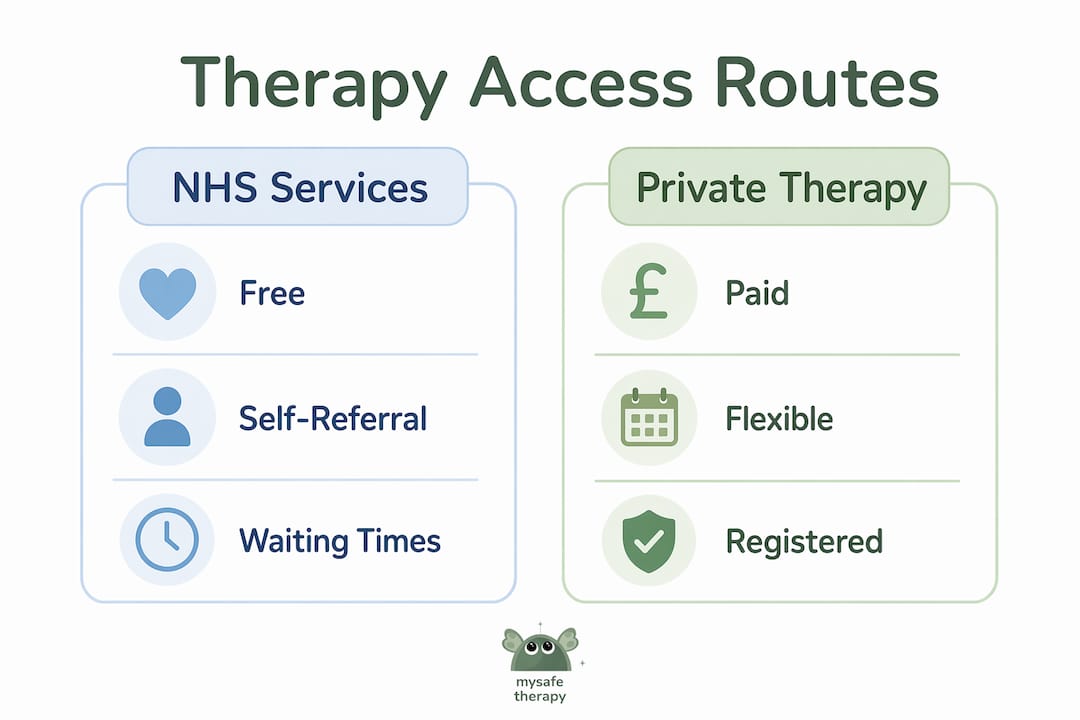
| Access route | Typical cost | Waiting time | Accreditation | Session formats | Best for |
|---|---|---|---|---|---|
| NHS Talking Therapies | Free | 4–18 weeks or longer | NICE-approved, NHS-employed | In-person, video, phone, digital | Anxiety, depression, common mental health conditions |
| Charity / training clinic | Free or low cost | Variable | Varies; check individual provider | In-person, sometimes online | Low income, students, specific communities |
| University counselling | Free (students) | Variable | Varies by institution | In-person, video | Enrolled students |
| Employer EAP | Free (employees) | Often 1–2 weeks | Varies | Phone, video, in-person | Work-related stress, short-term issues |
| Private therapist | £40–£100+ per session | Days to weeks | BACP / UKCP / HCPC recommended | In-person, video, phone, chat | Speed, specialist input, longer-term work |
| Accredited online platform | From £49 per session | Often same week | BACP / UKCP / NCPS | Video, chat, avatar | Flexibility, privacy, evening access |
Format matters beyond cost. In-person sessions suit those who find face-to-face contact important for therapeutic connection. Video and phone sessions remove travel barriers and suit people with irregular schedules. Chat therapy offers written communication for those who find speaking difficult. Avatar-based sessions, available through platforms such as Mysafetherapy, provide an additional layer of anonymity that some people find reduces the barrier to starting.
How to choose a therapist: questions to ask and red flags to watch for
The introductory call is a mutual fit check, not just a clinical assessment. Use it to gather the information you need to make a safe decision.
Questions to ask at first contact:
- What is your professional body registration, and can I verify your membership number?
- Do you hold current professional indemnity insurance?
- Who supervises your clinical work, and how often do you meet with them?
- What therapeutic approach do you use, and why would it suit my presenting issues?
- What are your fees, and do you offer any concessions?
- What is your cancellation policy?
- How do you handle confidentiality, and in what circumstances would you break it?
- What is your complaints procedure if I am dissatisfied?
What good therapeutic fit looks like:
- The therapist explains their approach clearly, without jargon.
- You feel heard and not judged during the initial contact.
- They are transparent about the limits of confidentiality (safeguarding, risk of harm).
- Their availability matches your schedule.
- Cultural background, language, or lived experience matters to you: ask directly whether they have relevant experience.
Red flags:
- No professional body registration, or an unwillingness to provide a membership number.
- No clinical supervisor, or vague answers about supervision.
- Unclear or absent confidentiality policy.
- Pressure to commit to a long block of sessions before any assessment.
- No published complaints procedure.
Pro Tip: Many therapists offer a short free or low-cost introductory call. Treat it as your interview of them, not the other way around. A good therapist will expect and welcome your questions.
For a practical therapist selection checklist covering accreditation, fees, and format, the guidance applies equally to in-person and online bookings.
Where to find verified UK therapists and counselling services
| Source | What it offers | How to use it |
|---|---|---|
| NHS Talking Therapies finder | Local IAPT self-referral services in England | Search nhs.uk for your area |
| BACP Therapist Directory | Registered BACP members advertising services | Filter by location, specialism, online/in-person |
| UKCP Find a Therapist | PSA-accredited register with location and issue filters | Search at psychotherapy.org.uk |
| Mind | Mental health information and local Mind network signposting | mind.org.uk; local branches vary in services |
| Hub of Hope | Aggregated local mental health services by postcode | hubofhope.co.uk |
| Mysafetherapy | BACP/UKCP/NCPS-registered therapists; video, chat, avatar | mysafetherapy.com; evening and weekend slots |
The BACP and UKCP directories are the most reliable starting points for private therapist searches because listing requires current registration. Mind and Hub of Hope are useful for finding local charity and community services, particularly when cost is a barrier. NHS Talking Therapies pages are the correct entry point for free, evidence-based treatment in England.
Community-based support also plays a role in mental wellbeing. For men in particular, social spaces and peer connection can reduce isolation while formal therapy is being arranged or accessed.
What to do if you need urgent or emergency mental health support
Therapy services, including NHS Talking Therapies, are not crisis services. If you or someone you know is at immediate risk of harm, the correct routes are:
- 999 or A&E for a mental health emergency where there is immediate risk to life.
- NHS 111 (select the mental health option) for urgent mental health support that is not immediately life-threatening. Most areas now have a 24-hour mental health crisis line accessible via 111.
- Your GP for same-day urgent appointments if you are in distress but not in immediate danger.
- Samaritans on 116 123 (free, 24 hours) for emotional support at any time.
- Crisis Resolution and Home Treatment Teams (CRHT): your GP or 111 can refer you to your local team if you need intensive community support.
If you are already in therapy and experience a crisis, contact your therapist to discuss a safety plan. Most accredited therapists are required by their professional body to have a clear protocol for managing risk between sessions.
Note: Private therapy and online platforms are not substitutes for emergency services. If there is immediate risk of harm, call 999 first.
Key takeaways
The most reliable route to accredited therapy in the UK starts with NHS self-referral or a verified BACP/UKCP-registered therapist, with private and online options providing faster access when NHS waiting times are a barrier.
| Point | Details |
|---|---|
| Start with NHS self-referral | Adults aged 18+ registered with a GP can self-refer to NHS Talking Therapies for anxiety and depression without a GP appointment. |
| NHS waits vary widely; private or online therapy can provide faster access during waiting periods. | |
| Always verify accreditation | Check BACP or UKCP registration directly; anyone can legally use the title "counsellor" or "psychotherapist" without formal training. |
| Private therapy fees vary considerably with many therapists offering reduced rates for students and low-income clients. | |
| Mysafetherapy for fast online access | Mysafetherapy connects UK adults with BACP/UKCP/NCPS-registered therapists via video, chat, and avatar sessions, with evening and weekend availability. |
A note on what we look for at Mysafetherapy
The absence of title protection in UK counselling and psychotherapy is a genuine risk for anyone searching independently. Every therapist listed on Mysafetherapy holds current registration with BACP, UKCP, or NCPS, carries professional indemnity insurance, and participates in regular clinical supervision. Those are not optional extras on the platform: they are entry requirements.
The practical services cover video, chat, and avatar-based one-to-one sessions, alongside AI-assisted tools including journaling, mood tracking, and guided self-help resources. Clients can switch therapists without penalty if the initial match is not right. Confidentiality policies and the complaints process are published clearly before any session begins.
For professionals seeking confidential support with flexible scheduling, therapy for professionals is available with the same accreditation standards applied across the platform.
The platform's position is straightforward: accreditation is the floor, not a selling point. Readers who use any service, including Mysafetherapy, should verify therapist registration independently using the BACP or UKCP register before booking.
Mysafetherapy: accredited online therapy, available this week
Waiting 4–18 weeks or longer for an NHS appointment is a real constraint for many people. Mysafetherapy offers a faster route to accredited support without sacrificing the standards that matter.
All therapists on the platform are registered with BACP, UKCP, or NCPS. Sessions are available via video, chat therapy, or avatar therapy from £49, with evening and weekend slots to fit around work and family commitments. There are no long-term contracts: you choose your session frequency and can switch therapists at any point. AI journaling and mood tracking tools are included to support progress between sessions.
Before booking, verify your chosen therapist's registration on the BACP or UKCP register. Then start therapy with a brief matching call to confirm the approach and format suit your needs.
Useful sources and directories
- NHS Talking Therapies finder: locate your local IAPT self-referral service in England.
- BACP Therapist Directory: search registered BACP members by location, specialism, and session format; all listings confirm current membership.
- UKCP Find a Therapist: PSA-accredited register with filters for location, online or in-person, and presenting issue.
- Mind (mind.org.uk): mental health information, local Mind network signposting, and guidance on accessing support.
- Hub of Hope (hubofhope.co.uk): postcode-based aggregator of local mental health and community support services.
- NHS CBT information: NHS CBT page explains what to expect from a CBT assessment and how to self-refer.
- Employer and university routes: check your employer's HR policy for EAP details, or your university's student services page for counselling availability.
- Mysafetherapy therapist standards: explains the accreditation and supervision requirements applied to all therapists on the platform.
This article provides general information about accessing therapy services in the UK. It is not a substitute for professional medical or psychological advice. Confirm current eligibility criteria and service availability directly with your chosen provider or a qualified professional.