

TL;DR:
- Verify therapist credentials through UK professional registers like BACP or UKCP to ensure safety.
- Use trusted directories with verification filters and seek initial trial calls to assess therapist fit.
- Prioritize your comfort and instincts during sessions, knowing you can switch therapists if needed.
Searching for a therapist in the UK can feel genuinely confusing. There are hundreds of directories, varying price points, and no shortage of professionals with different letters after their names. If you are dealing with anxiety or depression, the last thing you need is uncertainty about whether someone is properly qualified, how much sessions will cost, or whether your conversations will stay private. This guide walks you through each stage of finding the right therapist: verifying credentials, searching trusted directories, assessing fit during trial calls, and understanding your options on cost and confidentiality.
Table of Contents
- Understanding therapist qualifications and registration
- Finding and shortlisting therapists using trusted directories
- Key questions and trial calls: assessing fit and approach
- Comparing therapy types, costs, and privacy for UK adults
- Our perspective: choosing the right therapist is about more than qualifications
- Get confidential, affordable therapy support
- Frequently asked questions
Key Takeaways
| Point | Details |
|---|---|
| Verify registration | Always check a UK therapist’s registration with recognised bodies for safety and quality assurance. |
| Use trusted directories | Filter therapists by your needs using BACP, Counselling Directory, or Psychology Today UK for reliable options. |
| Try before you commit | Book free introductory calls with multiple therapists to assess fit, approach, and confidentiality. |
| Compare styles and costs | Understand how therapy type, fees, and privacy rules affect your choice—with NHS, charity, and private options available. |
| Fit matters most | Evidence shows a good therapeutic relationship predicts better results, so prioritise your comfort and rapport. |
Understanding therapist qualifications and registration
This is the most important step, and it is one many people skip. In the UK, anyone can use the title "therapist" or "counsellor" without formal training or oversight. Unlike medicine or nursing, the title is not protected by law. That means checking registration is not optional; it is essential for your safety.
The three key professional bodies to know are:
- BACP (British Association for Counselling and Psychotherapy): The largest register in the UK, covering thousands of accredited counsellors and psychotherapists. BACP accreditation requires at minimum a Level 4 Diploma, a minimum number of supervised practice hours, and ongoing professional development.
- UKCP (UK Council for Psychotherapy): Focuses primarily on psychotherapists and requires higher-level training, typically to Masters level or equivalent.
- PSA (Professional Standards Authority): An overarching body that accredits several registers, including BACP and NCPS. Therapists listed on a PSA-accredited register have met consistent standards.
Registration with any of these bodies means the therapist is bound by an ethical code of conduct. It also means there is a formal complaints procedure if something goes wrong, and that mandatory supervision is in place. The NHS advises checking professional registration with bodies like BACP, UKCP, or those accredited by the PSA before beginning therapy.
To verify a therapist's registration, visit the relevant body's website and use their public search tool. Most therapists will also display their registration number and membership status on their own website or directory profile.
Always verify a therapist's registration independently, even if they display a logo on their website. Logos can be copied; registration databases cannot be faked.
For more background on how UK therapy regulations work and why they matter for your protection, it is worth understanding what legal frameworks apply to your therapist. A detailed registration safety guide can also help you understand exactly what to look for when reviewing a therapist's credentials.
Finding and shortlisting therapists using trusted directories
Once you understand what to look for, the next step is locating therapists who meet those standards. Searching broadly on search engines is not the most reliable method. Reputable directories filter by registration status and allow you to narrow by specialism, cost, location, and session format.
The main directories to use are:
| Directory | Verification checks | Affordability filter | Online therapy option |
|---|---|---|---|
| BACP Therapist Directory | BACP-registered only | Yes (fee range) | Yes |
| Counselling Directory | Self-declared, some verified | Yes | Yes |
| Psychology Today UK | Voluntary, limited checks | Yes | Yes |
The BACP Therapist Directory is the most reliable starting point because every listing is a verified BACP member. Counselling Directory and Psychology Today UK allow a broader range of practitioners, so you will need to verify registration manually for those listings.
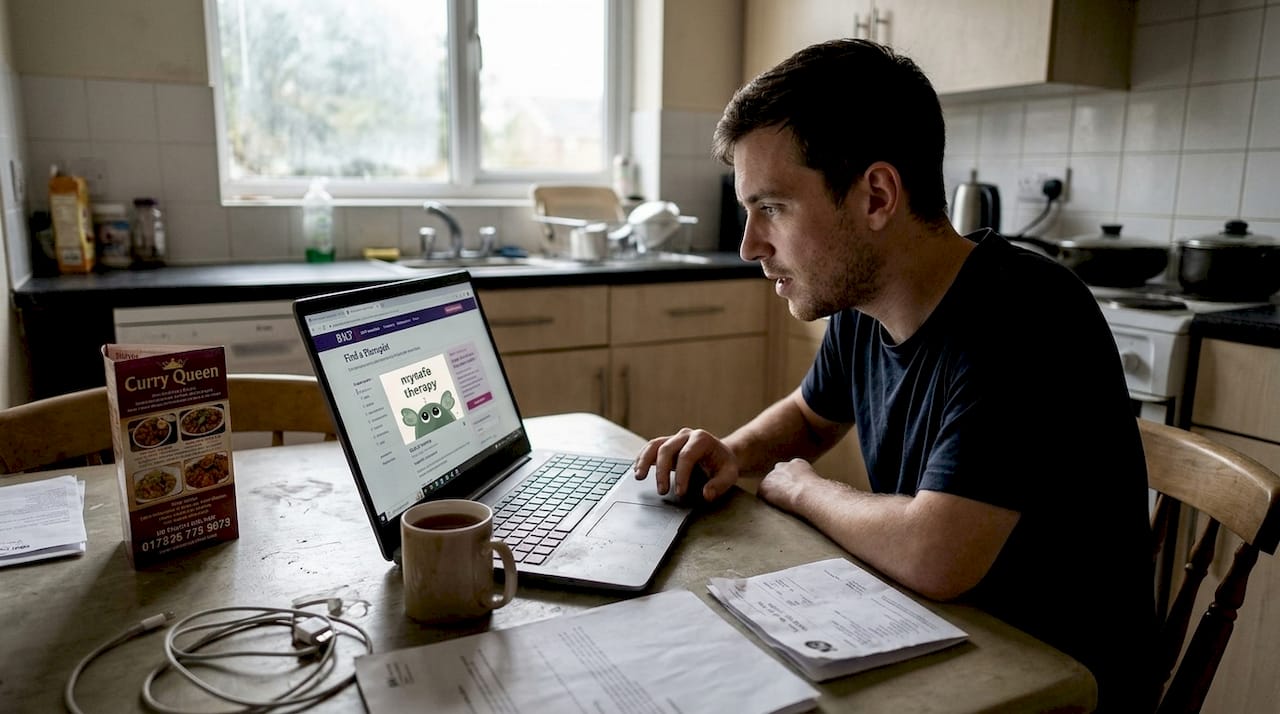
When searching, use filters for: online sessions (so geography is not a barrier), the specific issue you want to address such as anxiety or depression, your preferred therapy style if you have one, your budget, and your available times. Many therapists offer evening and weekend slots, which is important if you work full-time.
Pro Tip: Look for therapists who offer a free or low-cost introductory call, typically 15 to 20 minutes. This is now standard practice and gives you a chance to assess fit before committing financially. If a therapist does not offer this, it is reasonable to ask.
Be cautious of paid adverts at the top of directory search results. These are not ranked by quality or suitability. Genuine reviews from verified clients carry more weight than a well-designed profile. A solid guide to safe online support can help you distinguish between marketing and genuine professional credibility. Always prioritise UK-accredited therapists when making your shortlist.
Key questions and trial calls: assessing fit and approach
A shortlist of three or four therapists is a reasonable starting point. The next step is speaking to each of them before making a decision. Research is clear that the therapeutic relationship is one of the strongest predictors of a good outcome, more so than the specific type of therapy used. Fit matters enormously.
Book introductory calls of 15 to 20 minutes with two or three therapists before deciding. Use each call to ask the following:
- What is your therapeutic approach and how do you typically work with clients?
- Do you have experience working with anxiety, depression, or the specific issue I am facing?
- How do you handle confidentiality, and how does GDPR apply to my data?
- What are your fees, and do you offer a sliding scale for lower incomes?
- What is your cancellation policy if I need to rearrange or stop sessions?
- How do online sessions work technically, and what platform do you use?
- What happens if I want to switch therapist after starting?
Pay attention to how each therapist responds. A good therapist will answer these questions clearly and without defensiveness. They should welcome your questions as a sign that you are taking the process seriously.
Red flags to watch for include: vague answers about their qualifications, reluctance to confirm confidentiality procedures, pressure to commit immediately, or discomfort when asked about their experience with your specific concerns.
Pro Tip: Prepare your deal-breakers before the call. These are the things that genuinely matter to you, whether that is evening availability, fee flexibility, or a specific therapeutic style. Knowing these in advance helps you stay focused during what can feel like an emotionally charged conversation.
Trying more than one therapist before settling is not unusual. It is actively encouraged. Your comfort and sense of safety are the foundation of any effective therapy. For more on how therapist matching works and what to expect from the process, it helps to go in informed.
Comparing therapy types, costs, and privacy for UK adults
Understanding your options on therapy style, cost, and confidentiality helps you make a decision that is both clinically sound and practically manageable.
Therapy styles most relevant to anxiety and depression include:
- CBT (Cognitive Behavioural Therapy): The most evidence-based approach for anxiety and depression, structured over 6 to 20 sessions, and widely available on the NHS.
- Person-centred therapy: Focuses on self-exploration and personal growth rather than structured techniques. Useful for general emotional support.
- Integrative therapy: Combines elements from multiple approaches, tailored to the individual client.
Online CBT is backed by research as effective and acceptable compared to face-to-face delivery, making it a strong option for those who prefer remote access.
| Provider type | Cost | Sessions | Wait time | Privacy |
|---|---|---|---|---|
| NHS Talking Therapies | Free | 6 to 20 | Avg 6 weeks | High (UK law) |
| UK charities | Low or free | Varies | Variable | High |
| Independent UK therapist | £50 to £100 per session | Flexible | 1 to 2 weeks | High (GDPR) |
| Online platforms (e.g. BetterHelp) | £50 to £70 per week | Flexible | Immediate | Variable |
NHS Talking Therapies are free and available to most UK residents via self-referral online, primarily offering CBT for anxiety and depression. The average wait is around six weeks, which may not suit everyone. Charities and affordable therapy services bridge the gap between NHS and private costs.
For therapy for anxiety specifically, reviewing what each modality involves before starting can help you choose effectively.
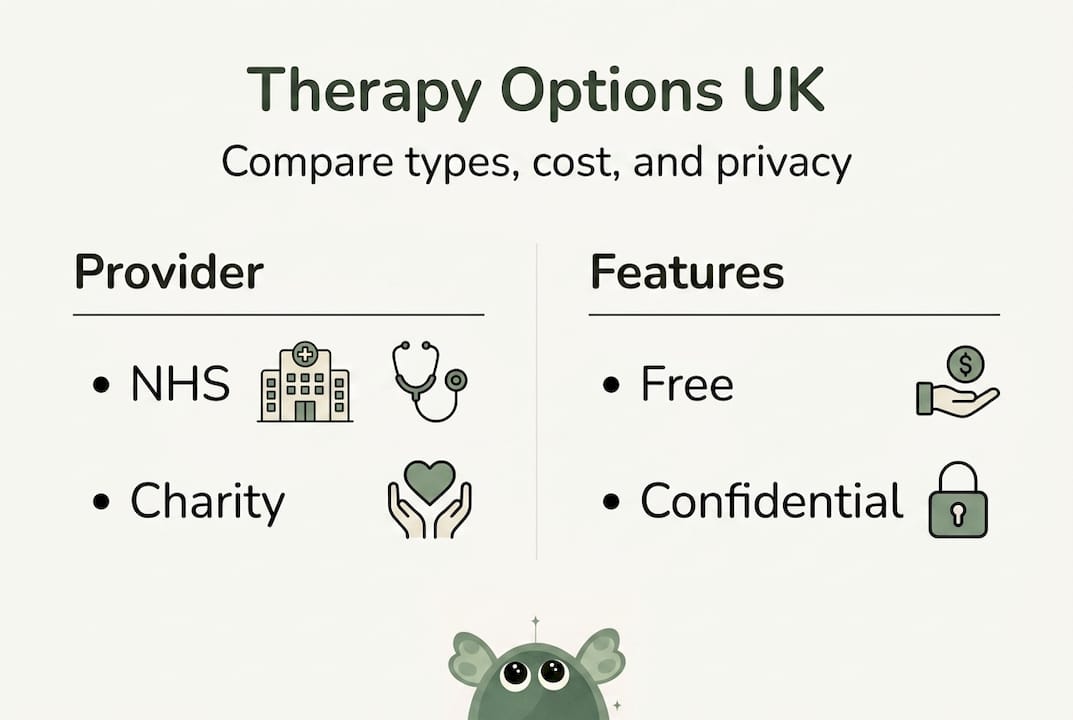
On privacy: UK-registered therapists are bound by GDPR and professional ethical codes. Some larger platforms, particularly US-based ones, operate under different data laws. Always check a platform's privacy policy and prefer BACP or UKCP-registered practitioners for the strongest confidentiality protections.
Privacy checklist for online therapy:
- Therapist is registered with BACP, UKCP, or PSA-accredited body
- Platform or therapist uses end-to-end encrypted video software
- Clear written confidentiality policy is provided before sessions begin
- Data is stored and processed under UK GDPR
- You understand the exceptions to confidentiality (e.g. risk of serious harm)
Confidentiality in therapy is not absolute, but it is robust. A registered therapist must explain its limits clearly at the outset.
Our perspective: choosing the right therapist is about more than qualifications
Most guidance stops at credentials and directories. That is useful, but it misses the most important part: how you feel in the room, even if that room is a video call. Evidence consistently shows that the quality of the therapeutic relationship matters more than the specific modality used. In practical terms, this means you should trust your instincts.
If a first session leaves you feeling unheard or uncomfortable, that information is valid. It does not mean therapy cannot help you. It may simply mean that this particular therapist is not the right fit. Moving on is not impolite. It is good self-advocacy.
Many people tolerate a poor therapeutic match because they feel guilty about "wasting" the therapist's time or because finding someone else feels like more effort. Both of those concerns are understandable but misplaced. You are the one investing time, money, and emotional energy. Your comfort is not a secondary consideration.
The UK system does give you choices, even if those choices require some effort to navigate. Knowing about effective therapy techniques can also help you evaluate whether the work you are doing with a therapist is actually moving in the right direction.
Get confidential, affordable therapy support
Knowing what to look for is the first step. Finding it in one reliable place is the next.
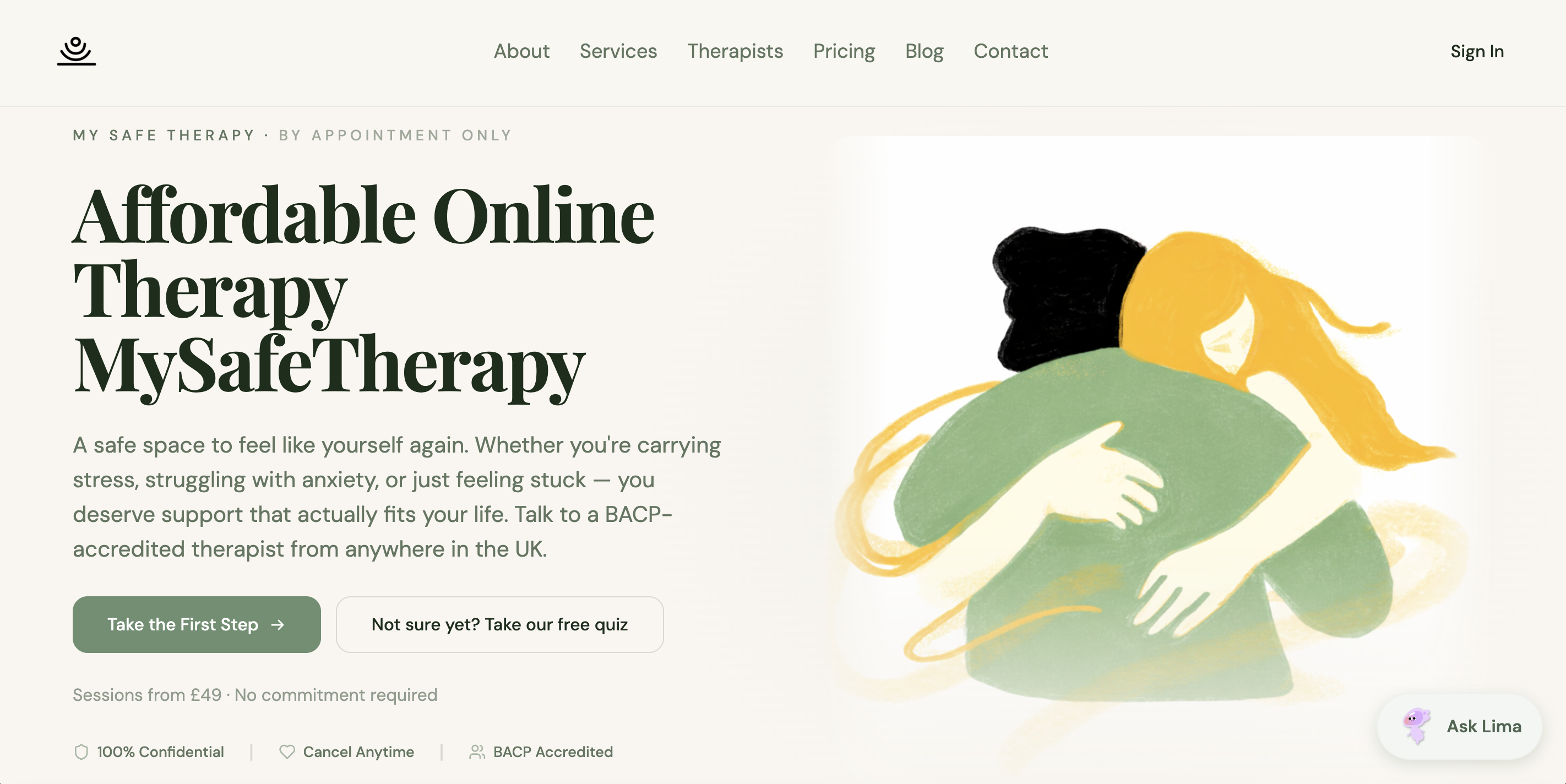
MySafeTherapy connects you with BACP, UKCP, and NCPS-registered therapists across the UK, all verified and practising within professional ethical standards. You can filter by specialism, session format, cost, and availability, including evenings and weekends. The platform also supports formats like video, chat, and avatar-based sessions, so you can find something that suits your comfort level. When you are ready, you can start therapy online with a free assessment call, giving you the chance to apply every step covered in this guide before committing to a therapist.
Frequently asked questions
How do I know if a UK therapist is qualified?
Registered therapists should be listed with BACP, UKCP, or a PSA-accredited register, and will display their membership number on their profile or website. Always verify independently using the body's public search tool.
Is online therapy safe and confidential in the UK?
Yes, provided you choose a therapist registered with BACP or UKCP who complies with UK GDPR. Always review the confidentiality policy before your first session.
Are there affordable or free therapy options in the UK?
NHS Talking Therapies are free for most UK residents, with self-referral available online. Charities and sliding-scale private therapists also offer lower-cost alternatives.
Which therapy style works best for anxiety or depression?
CBT has the strongest evidence base for both anxiety and depression, but person-centred and integrative approaches can be equally effective depending on personal preference and the nature of the issue.
What should I ask a prospective therapist?
Ask about their experience with your specific concerns, their fees and cancellation policy, how they handle confidentiality under GDPR, and what their process is if you decide to switch therapist.
Recommended
- What is affordable therapy? a 2026 guide to cost-effective mental health support
- Why UK-accredited therapists offer safer, evidence-based support
- UK therapy regulations: 31,661 registrants and your safety
- Online therapy safety for UK adults: 2026 guide
- How to Find a Therapist for Accessible Trauma Care - ReviveHealthTherapy
- How to Find the Right Therapist for Your Needs - Interactive Counselling