
TL;DR:
- BACP and UKCP are leading UK therapy organizations with different focuses, training depths, and pathways.
- The 2026 SCoPEd framework standardizes competency levels across both bodies, aiding client comparison.
The British Association for Counselling and Psychotherapy (BACP) and the United Kingdom Council for Psychotherapy (UKCP) are the two leading professional bodies for therapists in the UK, distinguished by their training standards, membership structures, and therapeutic focus. Understanding the differences between BACP and UKCP is the first step to choosing a therapist whose qualifications genuinely match your needs. Both bodies protect the public through ethical codes, complaints processes, and public registers. The 2026 SCoPEd framework now maps their competency levels into a shared structure, making it easier than ever to compare practitioners across both organisations.
What are the core differences between BACP and UKCP?
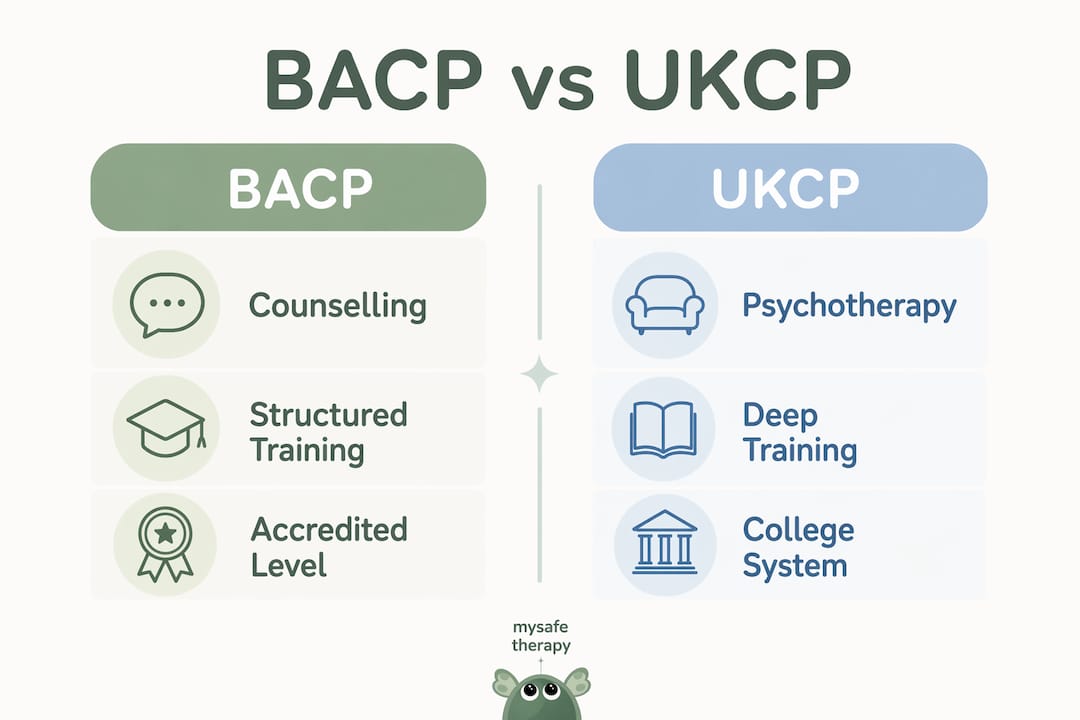
BACP and UKCP differ most clearly in their professional focus and the depth of training they require. BACP centres on counselling and psychotherapy across a broad range of settings, from primary care to private practice. UKCP places greater emphasis on psychotherapy and psychotherapeutic counselling, typically requiring longer and more clinically intensive training pathways.

Both bodies maintain public directories so clients can verify a therapist's registration and professional standing. BACP is commonly associated with shorter-term counselling work, while UKCP is linked to longer-term, psychoanalytic, and depth psychotherapy. This distinction shapes the type of support each body's members typically offer.
The SCoPEd framework, introduced across the profession in 2026, aligns BACP, UKCP, and other bodies into a shared competency structure with three levels: Column A, Column B, and Column C. Column A represents the baseline for registered membership, and Column C reflects advanced, doctoral-level training. This shared language reduces confusion for clients trying to compare practitioners from different organisations.
What does BACP accreditation represent?
BACP accreditation is the recognised standard for counsellors and psychotherapists who have completed structured training and met ongoing professional requirements. BACP membership spans a wide range of practitioners, from students in training to fully accredited members with years of supervised practice behind them.
The training route within BACP progresses through qualification levels, from Level 2 introductory courses through to Level 4 diplomas and beyond. Practitioners seeking full accreditation must complete substantial taught hours alongside supervised placement hours. BACP accreditation routes now include 13 distinct pathways, reflecting the diversity of training backgrounds and career routes within the profession.
BACP members must also meet ongoing requirements to maintain their status:
- Continuing Professional Development (CPD): Members complete regular CPD and keep records of their learning activities.
- Supervision: Ongoing supervision is required throughout a practitioner's career, not just during training.
- Ethical framework: All members adhere to the BACP Ethical Framework for the Counselling Professions.
- Auditing: BACP conducts regular audits to verify compliance with membership standards.
- Public register: The BACP register is publicly searchable, allowing clients to confirm a therapist's standing.
For clients, BACP membership signals that a practitioner has met a defined standard of training and is accountable to a professional body. The BACP register is particularly useful for verifying therapists working in shorter-term or solution-focused settings.
Pro Tip: When searching the BACP register, look for the "Accredited" designation rather than just "Registered Member." Accredited status requires additional supervised hours and a formal assessment, representing a higher threshold of professional development.
To understand more about how BACP shapes therapy practice in the UK, the Mysafetherapy guide on BACP's role in therapy provides a clear breakdown for clients.
How does UKCP accreditation differ in scope and training?
UKCP accreditation is defined by its focus on psychotherapy and psychotherapeutic counselling, with training pathways that are generally longer and more clinically intensive than those required for BACP membership. UKCP membership is organised through a network of colleges and organisational members, each setting their own training standards within UKCP's overarching framework.
This structure means that UKCP training routes vary more widely than BACP's, depending on the modality and the college involved. Psychoanalytic, humanistic, integrative, and systemic approaches are all represented within UKCP's membership. The depth of clinical training reflects UKCP's orientation towards longer-term therapeutic work.
Key features of UKCP membership and accreditation include:
- Organisational membership: Practitioners train through UKCP-affiliated colleges rather than directly through UKCP itself.
- Intensive training pathways: Training typically involves more clinical hours and a greater emphasis on personal therapy for the trainee.
- Code of Ethics and Professional Practice: UKCP's ethical code governs professional conduct and underpins the complaints process.
- CPD and supervision: Ongoing CPD and supervision are required, with standards set by the relevant college or organisational member.
- Public register: UKCP maintains a searchable register, enabling clients to verify a therapist's registration and modality.
UKCP's accountability sits partly with the individual college and partly with UKCP centrally, which creates a layered system of oversight. For clients, this means that a UKCP-registered therapist has met both their college's standards and UKCP's overarching requirements.
Pro Tip: When reviewing a UKCP therapist's profile, check which college they trained through and what modality they practise. This tells you far more about their therapeutic approach than registration alone.
Mysafetherapy's detailed guide on UKCP therapist standards explains what these requirements mean in practice for clients seeking safe support.
How does the SCoPEd framework standardise competency levels?
The SCoPEd framework is a landmark development in UK therapy regulation, introduced in 2026 to map practitioner qualifications and competencies across professional bodies including BACP and UKCP. SCoPEd aligns these bodies into a shared competency structure with three columns, each representing a different level of training and scope of practice.
The three columns work as follows:
| SCoPEd column | Level of practice | Typical training depth |
|---|---|---|
| Column A | Registered counsellor or psychotherapist | Foundation to diploma level |
| Column B | Experienced practitioner with broader scope | Advanced diploma or degree level |
| Column C | Advanced or specialist practitioner | Masters or doctoral level |
The 2026 SCoPEd framework maps BACP and UKCP qualifications to these columns, creating transparency and comparability across the profession. This matters because clients previously had no straightforward way to compare a BACP-accredited counsellor with a UKCP-registered psychotherapist. SCoPEd provides that common language.
For practitioners, SCoPEd affects training routes and membership criteria, as qualifications must now align with specific column requirements. For clients, it means that checking a therapist's SCoPEd column gives a clearer picture of their training depth and scope of practice than membership body alone.
What practical differences should clients consider?
The most practical BACP and UKCP differences for clients relate to therapy length, therapeutic approach, and the types of issues each body's members typically address. BACP is often preferred for shorter-term counselling, such as cognitive behavioural therapy (CBT), person-centred counselling, or solution-focused work. UKCP members are more commonly associated with longer-term psychotherapy, including psychoanalytic, Jungian, or systemic approaches.
Clients dealing with specific, present-focused difficulties, such as work stress, relationship problems, or mild to moderate anxiety, often find BACP-registered counsellors well suited to their needs. Those seeking deeper exploration of long-standing patterns, trauma, or personality-level difficulties may benefit more from a UKCP-registered psychotherapist with specialist training.
Practical considerations when choosing between the two include:
- Therapy length: BACP practitioners more commonly offer short to medium-term work; UKCP practitioners more often work long-term.
- Modality: Check the specific therapeutic approach, not just the membership body.
- Training depth: Use SCoPEd columns to assess the level of training behind a practitioner's qualifications.
- Public register verification: Both bodies maintain searchable registers. Always verify registration before booking.
- Dual membership: Many experienced practitioners hold membership in both BACP and UKCP, reflecting broad training and career development.
The UK therapy register currently lists 31,661 registrants across professional bodies. That figure underlines how important it is to use specific criteria, such as SCoPEd column and modality, rather than membership body alone when selecting a therapist.
Pro Tip: Do not rely on membership body as the sole indicator of quality. A BACP-accredited practitioner with 15 years of experience may be better suited to your needs than a newly registered UKCP member, depending on what you are looking for.
For further guidance on making this decision, Mysafetherapy's resource on choosing a therapist covers safe and affordable options across the UK.
Key takeaways
BACP and UKCP are both credible, accountable professional bodies, but they serve different therapeutic traditions and training depths. Clients who understand these distinctions make better-informed choices about the support they seek.
| Point | Details |
|---|---|
| Different professional focus | BACP covers counselling broadly; UKCP centres on psychotherapy and deeper clinical work. |
| Training depth varies | UKCP pathways are generally longer and more intensive than standard BACP routes. |
| SCoPEd provides a shared standard | The 2026 framework maps both bodies' qualifications into Columns A, B, and C for easy comparison. |
| Public registers are essential | Always verify a therapist's registration on the BACP or UKCP public register before booking. |
| Modality matters most | The specific therapeutic approach a practitioner uses is often more relevant than their membership body. |
Mysafetherapy's view on choosing between BACP and UKCP
The most common mistake clients make is treating BACP and UKCP as a simple quality ranking, with one body considered superior to the other. Neither is inherently better. They represent different traditions within the same profession, and the right choice depends entirely on what a client needs from therapy.
From working with clients across the UK, the clearest pattern is this: people seeking structured, time-limited support tend to do well with BACP-registered counsellors. People who want to understand long-standing patterns or work through complex trauma often benefit from the depth that UKCP-trained psychotherapists bring. The SCoPEd framework is genuinely useful here, because it shifts the conversation away from body membership and towards actual competency level.
One misconception worth addressing directly is that UKCP registration automatically signals greater expertise. A Column B BACP-accredited practitioner with specialist training in trauma may be far better equipped for certain clients than a Column A UKCP registrant who has just completed their training. Accreditation level and modality tell you more than the logo on a therapist's profile.
The practical advice is straightforward. Identify what you need from therapy, check the SCoPEd column, verify registration on the relevant public register, and read the therapist's profile carefully. Membership body is a starting point, not a conclusion.
— Mysafetherapy
Accredited therapists on Mysafetherapy: BACP and UKCP verified
Mysafetherapy connects clients across the UK with therapists registered with BACP, UKCP, and NCPS, all verified before they appear on the platform.
Every therapist listed on Mysafetherapy has been checked against professional body registers, so clients do not need to verify credentials independently. Sessions are available via video, chat, and avatar formats, with evening and weekend appointments to fit around work and family commitments. Pricing starts from £49, with no long-term commitment required. Clients can switch therapists at any point if their needs change. To find a vetted accredited therapist matched to your needs, or to review the platform's therapist standards covering BACP, UKCP, and HCPC, Mysafetherapy makes the process straightforward and transparent.
FAQ
What is the main difference between BACP and UKCP?
BACP focuses on counselling and psychotherapy across a broad range of settings, while UKCP specialises in psychotherapy and psychotherapeutic counselling with generally longer, more intensive training pathways. The key distinction lies in therapeutic depth and training commitment rather than quality.
Is BACP or UKCP better for clients?
Neither body is universally better. BACP-registered practitioners are often well suited to shorter-term, structured work, while UKCP-registered psychotherapists typically support longer-term or deeper therapeutic needs. The right choice depends on the client's presenting issues and preferred therapeutic approach.
What is the SCoPEd framework and why does it matter?
The SCoPEd framework maps practitioner qualifications from BACP, UKCP, and other bodies into three competency columns, A, B, and C, providing a shared standard for comparing therapists across different organisations. It was introduced in 2026 and significantly improves transparency for clients.
Can a therapist be a member of both BACP and UKCP?
Yes. Many experienced practitioners hold membership in both BACP and UKCP, reflecting broad training backgrounds and diverse career paths within the profession.
How do I verify a therapist's registration with BACP or UKCP?
Both bodies maintain publicly searchable registers on their websites. Clients can search by name or location to confirm a therapist's current registration status and, in BACP's case, their accreditation level.