
TL;DR:
- Deciding to switch therapists can be challenging, often due to fear, guilt, or uncertainty about the process. Recognizing red flags like feeling unsafe or stagnating signals it might be time to change, and preparing a clear plan ensures a respectful transition. Communicating directly, requesting a treatment summary, and overlapping with a new therapist help ensure a smooth and effective change that prioritizes your mental health progress.
Deciding to switch therapists is rarely straightforward. Most people know something is not working long before they act on it, held back by guilt, uncertainty, or the fear of starting over. Understanding how to switch therapists safely and confidently can make the difference between months of stalled progress and a therapeutic relationship that genuinely moves you forward. This guide covers everything you need: recognising the signs, preparing for the change, handling the conversation with your current therapist, and building a productive relationship with someone new.
Table of Contents
- Key takeaways
- When to switch therapists
- Preparing to change therapists
- How to switch therapists safely and respectfully
- Starting fresh with a new therapist
- Common mistakes when switching therapists
- My perspective on switching therapists
- Ready to find a better fit with Mysafetherapy?
- FAQ
Key takeaways
| Point | Details |
|---|---|
| Recognise genuine red flags | Feeling unsafe, misunderstood, or stagnant for months are valid reasons to consider a change. |
| Prepare before you search | Reflect on what has not worked and write a list of what you need before seeking a new therapist. |
| End respectfully where possible | A closure session reduces unresolved feelings and builds assertive communication skills for future therapy. |
| Request your treatment summary | Ask your previous therapist for a treatment summary so your new provider has useful context from the start. |
| Give the new relationship time | Building trust typically takes three to five sessions, so resist judging too early. |
When to switch therapists
Knowing when the time is right to change is one of the harder parts of the process. Therapy can be uncomfortable, and discomfort alone is not a reason to leave. Some of the most productive sessions feel the most difficult in the moment. The question is whether that discomfort is the kind that produces growth or the kind that signals a poor fit.
A broken therapeutic alliance marked by feeling judged, misunderstood, or emotionally unsafe is a key indicator that something needs to change. Trust is the foundation of effective therapy. Without it, real progress is difficult regardless of the therapist's qualifications. If you consistently leave sessions feeling worse, dismissed, or unheard, that pattern deserves attention.
Lack of measurable progress is another significant signal. Therapy progress should be noticeable within three to six months. Prolonged stagnation suggests a clinical plateau, meaning the current approach may not suit your needs. This is not a personal failing on anyone's part. It can simply mean a different modality or a different professional perspective would serve you better.
Other clear signs that it may be time to move on include:
- Boundary or ethical concerns: your therapist is sharing inappropriate personal information, blurring professional boundaries, or making you feel obligated to protect their feelings.
- Modality mismatch: you are receiving talk therapy but suspect a more structured approach like cognitive behavioural therapy or EMDR would better address your specific difficulties.
- Persistent discomfort with style: the therapist's communication style, pace, or theoretical approach consistently leaves you feeling unheard, even after you have raised this with them directly.
- Life changes: your original reason for seeking therapy has shifted significantly and the therapist does not have the relevant expertise for your current concerns.
Many clients prematurely leave therapy by mistaking normal tension for a poor fit. If a rupture has occurred, consider whether a direct conversation could repair it before deciding to leave. That said, if you have already raised concerns and nothing has changed, continuing out of loyalty is unlikely to help.
Preparing to change therapists
Before you begin searching for a new therapist, taking time to reflect on the previous experience will prevent you from repeating the same mismatch. Think about what specifically did not work. Was it the therapist's communication style? The approach they used? Practical factors like session times or cost? Being precise about this gives you something concrete to look for in a replacement.
Write a practical wish list that covers the following areas:
- Therapeutic approach: do you want structured, goal-focused therapy such as CBT, or a more exploratory relational approach?
- Practicalities: online or in-person, evening and weekend availability, session frequency, and cost per session.
- Therapist characteristics: experience with your specific concerns, professional registration body (BACP, UKCP, or NCPS), and any personal preferences regarding communication style.
- Format: video, telephone, text-based chat, or in-person. You can read more about therapy format options if you are unsure which suits you best.
Once you have this list, research therapists using it as a filter. Check their professional profiles and registration status. Read their descriptions carefully to see whether their stated approach matches what you are looking for. There is also useful guidance on choosing a therapist with practical steps for screening candidates before committing.
Most private therapists in the UK offer free 15-minute introductory consultations. Use these. They are not a courtesy, they are a screening tool. Come prepared with two or three specific questions, such as how the therapist typically works with your presenting concern or what a typical session structure looks like.
Pro Tip: Book two or three introductory consultations with different therapists before deciding. Comparison gives you a much clearer sense of fit than evaluating one therapist in isolation.

How to switch therapists safely and respectfully
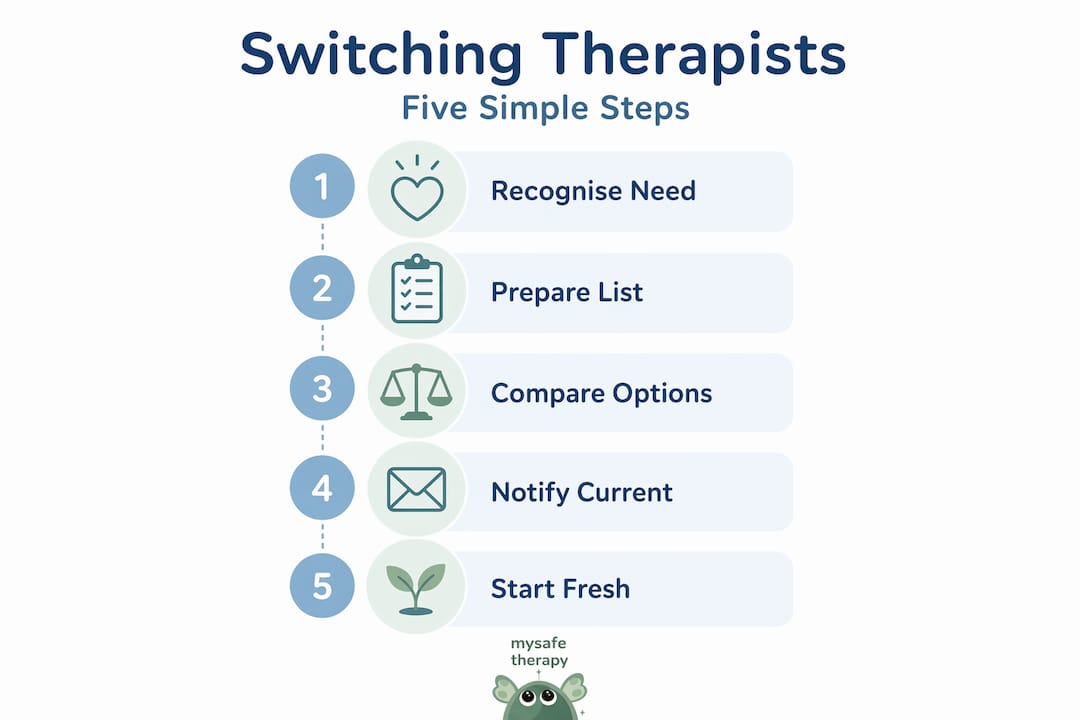
The mechanics of the actual switch are where many people hesitate longest. The prospect of telling your current therapist that you are leaving can provoke real anxiety, particularly if you have a warm relationship with them. Here is a clear sequence to follow.
- Decide with clarity first. Before you say anything, be clear within yourself that the decision is made. You do not need your therapist's approval to leave, and raising it tentatively can lead to a prolonged conversation that leaves you feeling more conflicted.
- Tell your therapist directly. A brief, honest statement is sufficient. Something like: "I've been thinking carefully about this and I've decided to work with a different therapist. I wanted to let you know directly rather than simply not returning." You do not owe a detailed justification.
- Request a closure session. A closure session provides emotional resolution and helps you practise assertive communication, which benefits future therapy relationships. Even one dedicated ending session is more valuable than an abrupt stop.
- Ask for a treatment summary. Requesting a treatment summary allows your new therapist to start with useful context and avoids you needing to repeat your entire history from scratch. This is standard professional practice and your therapist should accommodate it.
- Ask for a referral if appropriate. Therapists may recommend trusted colleagues when a better fit is needed. If your therapist knows your background well, their referral can be a valuable shortcut to finding someone suitable.
- Book your new therapist before ending with the current one. Where practically possible, overlap the transition slightly. Having an appointment already confirmed makes it considerably easier to end the current arrangement without the anxiety of facing a gap in support.
Pro Tip: If you feel unsafe or the reason for leaving involves a professional boundary concern, you are not obligated to have a closure conversation. Simply end contact and, if appropriate, report concerns to the therapist's professional registration body.
Switching therapists is healthy self-advocacy, not a rejection of therapy or a personal failure. Therapists understand this. The fear of hurting your therapist is common but, as one way to frame it, prioritising your own progress is exactly what therapy is supposed to support.
Starting fresh with a new therapist
Your first few sessions with a new therapist function as a mutual assessment. You are evaluating them just as much as they are learning about you. Approaching these early sessions with that mindset removes some of the pressure and makes it easier to engage honestly.
Clients should treat the first session as an interview: state clearly what has not worked previously and what you are hoping for this time. This is not complaint about the previous therapist. It is giving the new therapist the information they need to work effectively with you. Useful things to communicate early include your preferred communication style, topics you find particularly difficult to discuss, and any previous approaches you found unhelpful.
Consider these principles for the early stages of the new relationship:
- Practise honesty from session one. If something does not feel right, say so early. This builds the honest communication pattern that makes therapy work.
- Give it time before judging. Building a strong therapeutic alliance typically takes three to five sessions. Early awkwardness does not indicate a poor match.
- Conduct periodic check-ins with yourself. After sessions five, ten, and twenty, pause to reflect honestly on whether you feel safe, understood, and progressing.
- Welcome feedback. A good therapist will invite you to share what is and is not working. Respond to this openly rather than deflecting.
You can also explore a useful resource on assessing therapist compatibility if you want a more structured framework for evaluating the new relationship.
Common mistakes when switching therapists
Even with good intentions, there are patterns that can undermine a smooth transition. Being aware of them in advance means you are less likely to fall into them.
Therapy-hopping is the most common pitfall. This is the pattern of leaving before therapy has had adequate time to work, moving from therapist to therapist without a clear sense of what you are looking for. Each new start resets the relationship-building phase and can become a way of avoiding the deeper work. If you have switched more than twice in a short period, it is worth pausing to reflect on whether the issue lies with the therapists or with the process itself.
Other common mistakes include:
- Not doing a closure session and simply disappearing without notice. This is often called ghosting, and while it is understandable when anxiety is high, it leaves loose ends that can create guilt or unresolved feelings.
- Skipping the vetting stage and booking the first available therapist out of urgency. Taking even a week to make an informed choice is time well spent.
- Unrealistic expectations of speed. A new therapist is not a reset button. Some ground needs to be covered again, and that is normal.
Switching therapists should be viewed as a proactive step in self-care, not a failure or rejection of therapy itself. Springhealth
If early sessions with a new therapist feel uncomfortable, distinguish carefully between discomfort that comes from doing meaningful work and discomfort that signals the relationship is not safe. The changing therapists process in the UK is well-established, and you have every right to take it at a pace that feels considered.
My perspective on switching therapists
I have worked in the online mental health space long enough to observe one consistent pattern: the clients who get the most from therapy are the ones who treat it as an active collaboration rather than a passive service. Switching therapists, when it is the right call, is one of the most direct expressions of that mindset.
What I have seen hold people back most is not confusion about the process. It is guilt. The belief that leaving amounts to rejection, or worse, that it reflects badly on them as a client. In my experience, that guilt is almost never warranted. Therapists who are ethical and experienced understand that fit matters, and they genuinely want clients to find the right support, even if that support is not them.
The piece of advice I find most underused is the treatment summary request. It is simple, professional, and completely expected, yet most people never ask for one. It means your new therapist walks into the first session with context. You do not start from zero.
If the decision to switch has been sitting with you for a while, that hesitation is information. It usually means you already know the answer.
— MySafeTherapy
Ready to find a better fit with Mysafetherapy?
If you are considering making a change, Mysafetherapy is built to make that process straightforward. The platform connects you with UK-accredited therapists registered with BACP, UKCP, and NCPS, all available via flexible video, chat, or avatar-based sessions, including evenings and weekends. You can book introductory consultations across multiple therapists before committing.
Therapists including Robert Paynter, James Edward Sims, Samantha Cotterill, and Helen Oyokepe Damisa offer a range of specialisms so you can find the right match from the start. Records continuity and a smooth onboarding process are built into the platform. When you are ready to move forward, start therapy with the support and structure that makes a confident transition possible.
FAQ
When should you switch therapists?
Consider switching if you feel consistently unsafe, misunderstood, or have seen no progress over three to six months. A persistent lack of trust or a clear mismatch in therapeutic approach are also valid reasons.
Do you have to tell your therapist you are leaving?
You are not legally obligated to inform your therapist, but a direct conversation or a closure session is recommended where it is safe to do so. It supports emotional resolution and helps your therapist provide a treatment summary for the next provider.
How do you switch therapists without feeling guilty?
Switching is self-advocacy, not rejection. Therapists expect clients to change providers when the fit is not right, and prioritising your own progress is consistent with the goals of therapy.
Can you get your therapy records transferred to a new therapist?
Yes. You can request a treatment summary from your previous therapist and share it with the new one. This provides useful continuity and means you do not need to repeat your full history from scratch.
How many sessions should you give a new therapist before deciding?
Give the relationship at least three to five sessions before drawing conclusions. Building therapeutic rapport takes time, and early discomfort does not necessarily indicate a poor match.