
TL;DR:
- Confidentiality in UK therapy is a legal and ethical obligation that ensures clients can openly disclose sensitive information. It operates under laws like UK GDPR and professional codes, with narrow exceptions such as safeguarding or legal demands, and online platforms require extra data protection measures. Protecting privacy involves informed consent, secure communication, and knowing your rights to access or object to data sharing.
Many adults in the UK hesitate before booking therapy. Not because they doubt it could help, but because they worry about who else might find out. The confidential therapy process exists precisely to address this concern. Privacy is not a secondary benefit of therapy. It is the condition that makes honest disclosure possible in the first place, and trust underpins therapeutic progress in a way that no technique alone can replicate. This guide explains how confidentiality works in UK therapy, what the legal limits are, what your rights include, and how to protect your privacy before and during sessions.
Table of Contents
- Key takeaways
- Understanding confidentiality in UK therapy
- How confidentiality works in practice
- Confidentiality across different therapy formats
- Tips for protecting your privacy in therapy
- What to do if your confidentiality has been compromised
- My perspective on confidentiality in therapy
- Start therapy confidently with Mysafetherapy
- FAQ
Key takeaways
| Point | Details |
|---|---|
| Confidentiality is legally grounded | UK therapy privacy operates under common law, UK GDPR, and professional ethical codes enforced by bodies like BACP and UKCP. |
| Exceptions are narrow but real | Sharing without consent occurs only in specific safeguarding, legal, or serious harm situations, not routinely. |
| Online therapy adds privacy layers | Technology introduces extra data risks; choose platforms with clear encryption and data protection policies. |
| Ask questions at the first session | Clients are entitled to a full explanation of data handling, disclosure criteria, and their rights before therapy begins. |
| Breaches have formal recourse | If confidentiality is compromised, you can raise concerns with the therapist, their professional body, or the ICO. |
Understanding confidentiality in UK therapy
Confidentiality in therapy means your therapist will not disclose what you share without your knowledge or consent, except in defined circumstances. It is not a promise made informally. It is a legal and ethical obligation grounded in UK common law, the UK General Data Protection Regulation (UK GDPR), and the Data Protection Act 2018. Professional bodies including the British Association for Counselling and Psychotherapy (BACP), the UK Council for Psychotherapy (UKCP), and the National Counselling and Psychotherapy Society (NCPS) each publish ethical frameworks that require members to uphold client confidentiality. You can read more about what professional registration means for client protections in UK therapy.
The clinical rationale for confidentiality is direct. Perceived lack of privacy alters therapy effectiveness because clients withhold the information most relevant to their distress. When people know their words are protected, they disclose more honestly, and honest disclosure is what makes therapy work.
That said, confidentiality is not absolute. Therapists carry legal duties that can override privacy protections under specific conditions. These include:
- Safeguarding concerns involving a child or vulnerable adult at risk of harm
- A court order requiring disclosure of session notes or records
- Situations where a client presents a serious, credible risk of harm to themselves or others
- Terrorism-related disclosures under the Terrorism Act 2000
These exceptions are narrow. Confidentiality exceptions focus on preventing serious harm, not on routine information sharing. A therapist will not contact your employer, your family, or your GP simply because they think it might help, unless you have given explicit consent.
Pro Tip: At the start of therapy, ask your therapist to walk you through their confidentiality policy in plain language. A therapist who cannot explain when they would break confidentiality and why is not meeting their professional obligations.
NHS guidance requires transparency at therapy outset, meaning your therapist should explain data handling, who may access your records internally, and under what conditions disclosure to third parties would occur.
How confidentiality works in practice
Understanding the principles is one thing. Knowing what happens to your information day to day is another. Here is what a well-run confidential therapy practice looks like in concrete terms.
What therapists collect and record
Therapists typically record your name and contact details, the presenting issue, session notes, risk assessments if relevant, and any referral correspondence. These records are stored securely, often on encrypted case management software, and accessed only by those with a direct clinical or administrative need.
When information is shared lawfully
There are four common scenarios where sharing occurs, with or without your consent:
- With your consent: You ask your therapist to write to your GP, or you agree to a referral to a specialist service. This is standard and you remain in control.
- Safeguarding a child: UK safeguarding guidance allows sharing without consent when a child is at risk. Your therapist is obligated to act, and they should tell you they are doing so unless that disclosure would put the child at greater risk.
- Court orders: A judge can order that session notes be disclosed in legal proceedings. Your therapist has no discretion to refuse a lawful court order.
- Serious harm risk: If you disclose intent to seriously harm yourself or another person, your therapist may contact emergency services or your GP. They will usually attempt to discuss this with you first.
Your rights as a client
| Right | What it means in practice |
|---|---|
| Right to a privacy notice | Your therapist must explain how your data is used before or at the first session. |
| Right of access | You can request a copy of your records under UK GDPR Subject Access Request rules. |
| Right to object | You may object to certain data processing activities, though exceptions apply. |
| Right to be informed | You must be told if your data is being shared, unless doing so would compromise safety. |
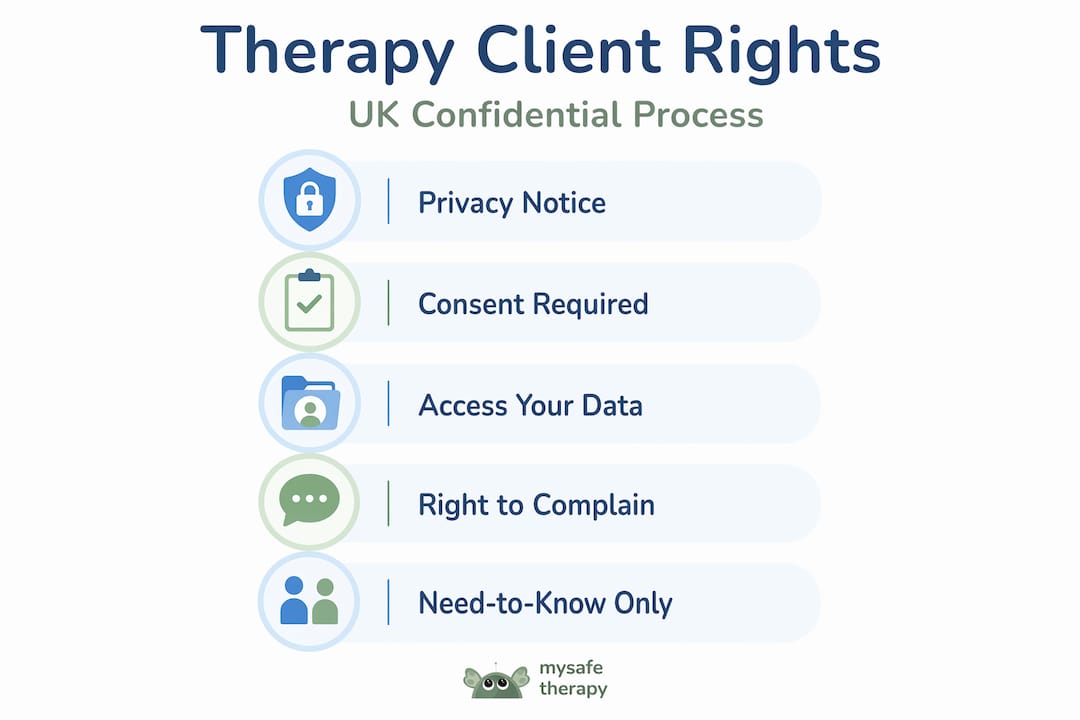
The need-to-know principle applies within therapy practices too. An admin team member may see your contact details and appointment history. They should not have access to your clinical notes unless there is a specific operational reason.
Confidentiality across different therapy formats
The confidential therapy process does not work identically in every setting. Context matters considerably.
Online therapy
Online psychotherapy introduces ethical concerns around data protection that face-to-face therapy does not. Video sessions can be recorded by either party. Data transmitted across the internet carries interception risk if the platform lacks end-to-end encryption. Cloud-stored notes may be subject to the laws of the country where the server is located, which may differ from UK GDPR standards. You should verify that any platform you use stores data within the UK or European Economic Area and uses encrypted connections. You can find a detailed breakdown of online therapy safety for UK adults to understand what to check before starting.
Pro Tip: When using video therapy, join from a private room with the door closed, use headphones, and check that no smart devices with active microphones are within range of the conversation.
One advantage online therapy carries is reduced stigma exposure. Online therapy reduces stigma because clients access support from a private setting without being seen entering a counselling building. This matters for people who fear being recognised. However, this benefit must be weighed against the additional technical privacy considerations described above.
Group therapy
Group therapy presents a distinct confidentiality profile. The therapist is bound by professional ethics, but other group members are not bound by law. Group therapy confidentiality relies on agreements between participants, and no therapist can guarantee that what you share will remain private among the group. Reputable group facilitators address this explicitly at the outset and revisit the agreement regularly. Before joining any group therapy programme, ask the facilitator how confidentiality expectations are set and what happens if a breach occurs.
Younger clients and safeguarding
For clients under 18, confidentiality operates differently. Therapists working with children and adolescents must balance the young person's right to privacy against statutory safeguarding duties. Child protection takes precedence over privacy, and therapists are trained to make disclosures to appropriate agencies when risk is identified. A young person should still be told what is being shared and why, wherever it is safe to do so.
"Confidentiality in therapy is the foundation that allows clients to speak freely. Without it, the therapeutic relationship cannot function. It is not a technicality. It is the entire premise."
Tips for protecting your privacy in therapy
You have more control over the confidential therapy process than you may realise. Taking a few specific steps before and during therapy significantly reduces the risk of unintended disclosure.
- Ask upfront about the confidentiality policy. Before or at the first session, request a written summary of the data handling policy, who can access your records, and the exact conditions under which confidentiality would be broken. Clients are entitled to this information at the start of therapy.
- Check your appointment communications. Consider whether appointment reminders sent to your phone or email could be seen by someone else. Indirect confidentiality risks often arise through appointment letters, texts, and care coordination correspondence rather than through the session itself. Ask whether you can opt for a discreet communication method.
- Prepare your physical or digital environment. For in-person sessions, choose a practice where you are unlikely to encounter people who know you. For online sessions, use a private space and a personal device rather than a work computer, which may be monitored.
- Know your consent rights. You do not have to agree to your information being shared with your GP or other services unless legally required. Ask what is mandatory and what is optional.
- Switch therapists if your concerns are not addressed. If your therapist cannot clearly explain their confidentiality practices, or if you feel your concerns are being dismissed, you have the right to move. Understanding what to know when switching therapists can help you do this with minimal disruption.
Pro Tip: Take brief notes after the first session about what your therapist told you regarding confidentiality. If anything is unclear, raise it at the start of the next session. Clarity at the outset protects both you and the therapeutic relationship.
What to do if your confidentiality has been compromised
Recognising a potential breach and knowing what to do next is part of being an informed therapy client.
Signs that your confidentiality may have been compromised include:
- Your GP or a family member mentions something you only disclosed in therapy, without your consent
- You discover your therapist discussed your case with a colleague without clinical necessity
- Appointment letters are sent to an address or person you did not authorise
- You receive a data breach notification from a therapy platform
Steps to take:
- Raise the concern directly with your therapist or their practice manager first. Many issues arise from misunderstanding rather than deliberate breach, and a direct conversation resolves them faster.
- If your therapist is registered with BACP, UKCP, or NCPS, you can submit a formal complaint to the relevant professional body. Each has a published complaints procedure.
- For data protection breaches specifically, you can report to the Information Commissioner's Office (ICO), which is the UK's independent data protection regulator.
- If the breach has caused you harm, seek legal advice. A solicitor specialising in data protection law can advise on whether you have grounds for a civil claim.
Addressing concerns early also protects your therapy. Unresolved distrust in the therapeutic relationship limits your ability to engage openly, which undermines the process itself.
My perspective on confidentiality in therapy
I have seen how confidentiality shapes whether people engage with therapy at all. In my experience, the clients who feel most hesitant about seeking help are not uncertain about whether therapy works. They are uncertain about whether their privacy will genuinely be respected.
What I find consistently underappreciated is that the risk to privacy rarely comes from the session itself. It comes from the surrounding infrastructure: how appointment reminders are sent, how notes are stored, how referrals are worded. The conversation in the room is usually the safest part. It is everything around it that clients need to scrutinise.
My view is that any therapist who cannot confidently explain the limits of confidentiality, and the specific triggers for disclosure, is not equipped to handle the responsibility of holding sensitive information. Transparency at the start of therapy is not bureaucratic box-ticking. It is how trust gets built before the real work begins.
I also believe that stigma about mental health persists partly because people do not trust that therapy is genuinely private. When that trust is established clearly and early, clients come back consistently, engage more honestly, and make faster progress. Confidentiality is not a background condition. It is an active, functional part of the therapeutic relationship that determines what becomes possible in the room.
— Mysafetherapy
Start therapy confidently with Mysafetherapy
Mysafetherapy is a UK-based online therapy platform that takes the confidential therapy process seriously at every level. All therapists on the platform are registered with professional bodies including BACP, UKCP, and NCPS, and are required to meet strict standards around data handling and client privacy. Sessions are available via secure video, chat, and avatar-based formats, with evening and weekend availability so you can attend from a private setting that suits you.
The platform operates in full compliance with UK GDPR and the Data Protection Act 2018. Pricing is transparent, therapist switching is straightforward, and you receive a clear privacy notice before your first session. If you are ready to begin, you can start therapy today with a therapist matched to your needs, or browse profiles to find someone whose approach fits. Your information stays protected from the moment you arrive.
FAQ
What does the confidential therapy process involve?
The confidential therapy process means your therapist holds your personal disclosures privately and uses your data only for clinical purposes, in line with UK GDPR and professional ethical codes. Exceptions apply only in safeguarding, legal, or serious harm situations.
Why is therapy confidential in the UK?
Therapy is confidential because privacy enables honest disclosure, which is clinically necessary for effective treatment. UK law and professional ethics both require it, grounded in common law duty of confidence and UK GDPR.
Can a therapist break confidentiality without telling me?
In most cases, your therapist must inform you if they intend to share your information. The exception is when telling you would itself create a risk, such as in certain child safeguarding situations where prior notification could endanger the child.
Is online therapy as confidential as in-person therapy?
Online therapy can be equally confidential if the platform uses end-to-end encryption and stores data under UK GDPR. However, technology introduces additional data risks that are not present in face-to-face settings, so checking a platform's data practices before starting is advised.
How do I complain if my therapy confidentiality is breached?
Raise the issue with your therapist or their practice manager first. If unresolved, submit a complaint to the relevant professional body (BACP, UKCP, or NCPS) or report a data protection breach directly to the Information Commissioner's Office (ICO).