
TL;DR:
- Anonymous therapy allows adults in the UK to access mental health support without revealing their identity, reducing stigma and privacy concerns. While it offers immediate, low-commitment assistance, it lacks personalized follow-up and active crisis intervention, making it ideal for initial contact rather than long-term treatment. Understanding the difference between anonymity and confidentiality is crucial for choosing the appropriate support route based on individual needs and safety considerations.
Many people assume that accessing therapy means handing over your name, address, NHS number, and medical history before a single word of support is spoken. That assumption stops a significant number of adults from seeking help at all. Anonymous therapy in the UK usually refers to accessing mental health support without providing identifying details such as your full name or location, typically through text, chat, or phone, specifically designed to reduce privacy concerns and the fear of stigma.
Table of Contents
- What is anonymous therapy?
- How does anonymous therapy work in practice?
- Anonymity vs confidentiality: key differences
- Benefits and limitations of anonymous therapy
- Comparing anonymous therapy with NHS and private support routes
- What most people misunderstand about anonymous therapy
- Getting started: find the right therapy for you
- Frequently asked questions
Key Takeaways
| Point | Details |
|---|---|
| Anonymous therapy basics | You can get mental health support in the UK without disclosing your identity using text or chat services. |
| Anonymity isn’t absolute | Even anonymous platforms may intervene if there are immediate risks, balancing privacy with safety. |
| Compare with NHS options | NHS services offer confidentiality but not true anonymity, requiring personal information for care. |
| Pros and cons | Anonymous therapy is flexible and private but may lack personalised tracking and long-term continuity. |
| Choosing your path | Select a therapy route based on your privacy needs, whether you seek instant support or ongoing care. |
What is anonymous therapy?
Anonymous therapy is not a single service or clinical method. It is a category of access. The core principle is straightforward: you can receive mental health support without disclosing who you are.
In the UK, this typically means using an online or telephone-based platform where you engage via a username or no name at all. You do not register with a GP. You do not join a waiting list tied to your NHS record. You simply connect, and support begins.
It is worth understanding precisely what anonymous mental health support involves in practice. You would not share your full name or postal address. The service does not link to your medical history. Contact is usually limited to text, message, or voice only, without video that could identify you visually.
There is, however, a critical distinction to draw immediately:
Anonymity means the service does not know who you are. Confidentiality means the service knows who you are but is legally and ethically bound to protect that information.
These are not the same thing, and confusing them leads to unrealistic expectations about what any service can or cannot do. A common misconception is that anonymous services are completely off-record. In practice, most platforms retain session logs for safeguarding and operational reasons, even when your identity is unknown. This is important to understand before you engage.
People seek anonymous support for several consistent reasons:
- Fear of stigma from family, employers, or peers
- Concern that a formal mental health record will affect insurance, employment, or custody proceedings
- Anxiety about disclosing personal details to a stranger
- Previous negative experiences with formal services
- Wanting to test whether therapy is right for them before committing
Each of these motivations is legitimate. Anonymous access lowers the barrier to a first conversation, and that first conversation can be the most important one.
How does anonymous therapy work in practice?
The process of using an anonymous therapy or support platform is considerably simpler than accessing NHS talking therapies. Here is what you can generally expect:
- Visit the platform. No referral is required. You go directly to the website or app.
- Create an account or enter as a guest. Many services allow a username only. Some require an email address, though not all verify it.
- Choose your format. Text chat, message boards, or telephone are the most common options for anonymous access.
- Connect with a practitioner or trained supporter. Depending on the service, this may be a counsellor, a trained volunteer, or a peer supporter.
- Engage at your own pace. Sessions may be time-limited or open-ended depending on the platform.
- End contact without obligation. There is no discharge process, no follow-up referral unless you want one.
Research into digital support for mental health consistently highlights that anonymity and user control are key factors in perceived safety and willingness to disclose. In plain terms: people share more honestly when they feel less exposed. That is a meaningful clinical benefit, not just a convenience.
| Feature | Anonymous platform | Standard NHS referral |
|---|---|---|
| Identity required | No | Yes |
| GP referral needed | No | Usually |
| Average wait time | Immediate to days | Weeks to months |
| Session continuity | Limited | Structured |
| Progress tracking | Minimal | Formal |
| Crisis intervention | Basic | Full clinical response |
Understanding the best types of online support available helps you match a format to your actual needs rather than defaulting to whichever option feels least intimidating. If you are unsure how to begin, a clear overview of starting online therapy can make the first step considerably less daunting.
Pro Tip: Because anonymous services often do not retain a record of your sessions in a way you can access later, keep your own private notes after each contact. Record what you discussed, what felt helpful, and any actions you wanted to take. This creates a form of personal continuity that the service itself may not be able to provide.
Anonymity vs confidentiality: key differences
This is arguably the most misunderstood area in mental health access. The distinction matters practically, not just theoretically.
Anonymity means a service does not know who you are. If you contact a text-based support line using only a username, the adviser cannot identify you. This protects your identity entirely, but it also limits what the service can do if you are in serious danger.
Confidentiality means a service knows your identity but is bound by professional and legal obligations not to share it without cause. NHS talking therapies operate on this basis. Your therapist knows your name and your GP may be informed, but that information is protected within a defined legal framework.
The practical difference becomes clear in risk situations. NHS-style care does not offer anonymity as a default. Instead, services operate under clinical confidentiality with defined legal exceptions, including the duty to act when someone's life is at risk.
Anonymous services face a harder problem. If a service does not know who you are, it cannot send emergency services to your address. It cannot alert a GP. It cannot coordinate care. Most anonymous platforms handle this by including clear signposting to crisis lines and by having policies that allow them to act on session content even without a confirmed identity, though their options are necessarily limited.
Key points to understand about each model:
- Anonymous services offer greater privacy but reduced capacity for active crisis response
- Confidential services can take active steps to protect you if risk is identified
- Both models have legal duties that override user preferences in extreme circumstances
- Neither model is completely without oversight or record
Understanding how therapists support mental health within a professional framework clarifies why trained practitioners operate under confidentiality rather than anonymity. When choosing a therapist, it is worth deciding early on whether you prioritise complete privacy or the broader range of support that comes with a registered, ongoing therapeutic relationship. And if a therapeutic relationship does not feel right, it is always possible to consider switching therapists rather than abandoning support altogether.
Benefits and limitations of anonymous therapy
Anonymous therapy is a genuinely useful entry point for many adults in the UK. It is also not the right fit for every situation. A clear-eyed view of both sides helps you make an informed choice.
Benefits:
- Lower barrier to access. There is no referral, no waiting list, and no requirement to explain your situation to a GP first. For someone who has avoided help for months or years due to anxiety or shame, this matters enormously.
- Reduced fear of stigma. Concerns about a mental health record affecting employment or insurance are legitimate for some people. Anonymous access removes that risk entirely.
- Immediate availability. Many platforms offer access within minutes, not weeks. For someone in a moment of distress, speed of access is directly relevant to safety.
- Low commitment. You can engage once and never return. There is no obligation, no file opened, no professional relationship to manage or end.
- Honest disclosure. Research consistently shows that people are more willing to share truthfully when they feel less exposed.
Limitations:
- No personalisation. A practitioner who does not know your history cannot build on previous sessions. Each contact starts from the beginning.
- Limited outcome tracking. Anonymous digital interventions may lower privacy barriers, but they trade off on personalised features and long-term outcome tracking. If you want to measure your progress over time, anonymous services offer little structured support for that.
- Not suitable for complex needs. Trauma, personality disorders, and co-occurring conditions typically require consistent, informed therapeutic relationships. Anonymous support cannot deliver this.
- Crisis limitations. As noted above, without identity information, a service's ability to intervene actively in a crisis is constrained.
- No therapeutic continuity. Rapport, trust, and understanding built over sessions are significant clinical assets. Anonymous access largely removes these.
Pro Tip: Use anonymous support as a first point of contact, not a permanent arrangement. It is a legitimate way to test the waters, clarify what you want to address, and build the confidence to seek personalised therapy options that can offer genuine long-term benefit.
Comparing anonymous therapy with NHS and private support routes
Understanding how the three main pathways differ in practical terms makes it easier to choose a route that suits your specific situation.
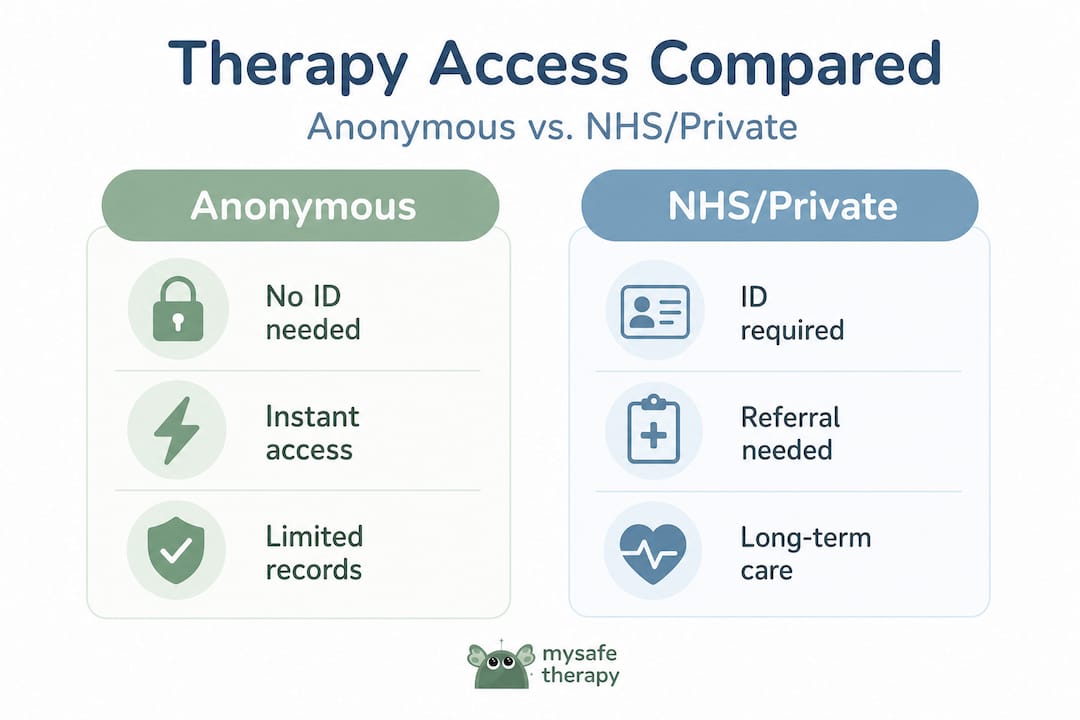
| Factor | Anonymous platform | NHS talking therapies | Private online therapy |
|---|---|---|---|
| Identity required | No | Yes | Yes |
| Cost | Usually free | Free | Paid |
| Access time | Immediate | Weeks to months | Days to a week |
| Session continuity | Low | High | High |
| Personalisation | Minimal | Structured | High |
| Privacy | Maximum | Clinical confidentiality | Clinical confidentiality |
| Crisis response | Limited | Full | Varies |
| Flexibility | High | Lower | High |
NHS talking therapies are available in a range of formats including in-person, telephone, video, and online self-guided courses. You can self-refer in many areas of England without going through your GP. However, eligibility criteria apply, and waiting times vary significantly by region.
Here is how each pathway typically unfolds in practice:
- Anonymous platform. Visit the site, select a format, begin contact immediately or within hours. No record created in your name. Support is time-limited and non-continuous.
- NHS talking therapies. Self-refer or obtain a GP referral. Complete an initial assessment. Be placed on a waiting list. Receive an allocated therapist. Attend a defined course of sessions, typically six to twelve. Be discharged with or without onward referral.
- Private online therapy. Research providers and verify credentials. Book an initial session. Work with a therapist consistently over as many sessions as you choose, at times that suit you including evenings and weekends.
For essential mental health management, the pathway you choose should match both the severity of what you are dealing with and your personal requirements around privacy, flexibility, and continuity. A step-by-step guide to mental health support can help you navigate those decisions methodically rather than reactively.
What most people misunderstand about anonymous therapy
The most persistent misconception is that anonymous therapy provides absolute safety from any form of intervention or record. It does not. Legal safeguarding duties do not disappear simply because a service does not know your name. If a practitioner believes there is an immediate risk to life, they are obligated to act on available information. The mechanics of that response differ from an NHS setting, but the duty exists.
There is a second, less-discussed issue. Many adults use anonymous services as a way of managing a situation they are not ready to fully address. That is not a failure. It is a rational response to real anxiety about disclosure. But anonymity, used indefinitely, can become a way of avoiding the kind of sustained therapeutic work that actually produces change. A crisis-line conversation is not the same as twelve sessions with a therapist who knows your history and has built a framework for understanding your specific patterns.
The more honest framing is this: anonymous support is a gateway, not a destination. The evidence for seeking mental health support is robust. Outcomes improve with engagement, consistency, and therapeutic relationships built over time. Anonymous access can be the thing that gets someone through the door. It is rarely the thing that produces lasting change on its own.
What 'safe' actually means in this context is nuanced. It means safe enough to start. It means protected enough to speak honestly. It does not mean free from all consequence or intervention. Adults who understand this distinction are better positioned to use anonymous services appropriately and to recognise when they are ready for more structured support.
Getting started: find the right therapy for you
If this article has clarified where anonymous therapy fits and where it does not, the logical next step is identifying the right format for your specific situation.
MySafeTherapy connects adults in the UK with BACP, UKCP, and NCPS-registered therapists through confidential, flexible online sessions including video, chat, and avatar-based formats. Sessions are available in the evenings and at weekends, with transparent pricing and no lock-in. You can start therapy securely at a pace that suits you, switch therapists if needed, and supplement sessions with AI journaling and mood tracking tools. Whether you are taking a first cautious step or looking for structured, ongoing support, MySafeTherapy provides a clear and accessible route forward.
Frequently asked questions
Is anonymous therapy truly private in the UK?
Anonymous therapy means you do not share identifying details, but services may still act if they believe someone is at immediate risk. Complete absence of any record or response capacity is not a realistic expectation.
Can I access anonymous therapy through the NHS?
NHS talking therapies require personal information for eligibility and clinical care. They operate under confidentiality, not anonymity, meaning your identity is known but protected within defined legal boundaries.
What are the downsides of using an anonymous therapy service?
The key limitation is that anonymous digital interventions trade off on personalised features and long-term outcome tracking, meaning continuity and tailored support are significantly reduced compared with named, ongoing therapy.
How fast can I access support with anonymous therapy?
Many anonymous platforms emphasise instant access without appointments or referrals, making them considerably faster than NHS routes where waiting times of several weeks are common.
When would anonymous therapy be most suitable?
It is most appropriate for those wanting a low-pressure starting point. Research confirms that anonymity and user control are central to perceived safety and the willingness to disclose, particularly for first-time help-seekers.