
TL;DR:
- UKCP accreditation verifies therapists’ training, supervision, ongoing CPD, insurance, and ethical standards.
- It provides clients with a clear complaints process and assurance of professional accountability.
- Verifying UKCP status involves checking the PSA-overseen register and asking practitioners about their ongoing standards.
Not all therapists in the UK operate under the same standards. Many people assume that any practitioner offering therapy has met rigorous ongoing requirements, but that is not always the case. The UK Council for Psychotherapy (UKCP) sets some of the most demanding and continuously enforced standards in the profession. These requirements cover supervision, training, insurance, and ethical conduct. Understanding what those standards mean in practice helps you make a genuinely informed choice when seeking mental health support. This guide explains what UKCP accreditation involves, what therapists must do to maintain it, and how you can verify it for yourself.
Table of Contents
- What does UKCP accreditation mean?
- Core UKCP therapist standards and requirements
- How UKCP standards protect clients
- How to check your therapist's UKCP status and qualifications
- A fresh perspective on therapist standards: What really matters
- Take the next step with safe, UKCP-accredited support
- Frequently asked questions
Key Takeaways
| Point | Details |
|---|---|
| UKCP accreditation explained | UKCP-accredited therapists are subject to rigorous standards and are regulated by an independent authority for client safety. |
| Ongoing professional requirements | Therapists must undertake supervision, CPD, insurance, and ethical practice to maintain their status. |
| Active client protection | Robust complaints handling and transparency ensure clients can report concerns safely and reliably. |
| Verify UKCP status easily | You can check a therapist’s accreditation and credentials on the UKCP register for peace of mind. |
| Personal fit matters most | Meeting standards is essential, but personal connection and therapist responsiveness are just as important for effective support. |
What does UKCP accreditation mean?
UKCP is one of the UK's leading professional bodies for psychotherapy and psychotherapeutic counselling. It does not simply award a certificate and step back. Membership requires therapists to demonstrate ongoing competence and meet clear accountability standards. Crucially, the UKCP register is PSA-accredited, meaning the Professional Standards Authority independently oversees it and confirms its complaints handling is robust. In 2024, the PSA recorded 57 complaints processed through UKCP's adjudication procedures, which reflects an active and functioning accountability system.
This matters because psychotherapy in the UK is not a legally protected title in the same way that, say, medicine is. In principle, anyone can call themselves a therapist without formal training. UKCP accreditation provides a verifiable marker that a therapist has completed recognised training, is supervised, and is subject to a complaints process if something goes wrong.
How does a UKCP-accredited therapist differ from one who is not accredited? The table below offers a direct comparison.
| Feature | UKCP-accredited therapist | Non-accredited therapist |
|---|---|---|
| Verified training | Yes, assessed by UKCP | Not confirmed |
| Ongoing supervision | Required and monitored | Not required |
| Annual CPD | Mandatory 50 hours | No requirement |
| Complaints mechanism | PSA-overseen process | May not exist |
| Professional insurance | Required | Not confirmed |
The practical difference is significant. When you see a UKCP-accredited therapist, you have a concrete set of rights and assurances. If things go wrong, there is a clear process to follow. This is not guaranteed with an unaccredited practitioner.
Key benefits of choosing a UKCP-accredited therapist include:
- Verified and assessed training recognised by a major professional body
- Access to a formal complaints and adjudication process
- Confirmation that ongoing supervision is in place
- Professional indemnity insurance for your protection
"Choosing an accredited therapist is not just about credentials. It is about knowing that systems exist to protect you if something goes wrong."
For broader context on how UK therapy regulations work across different professional bodies, it is worth familiarising yourself with the wider framework before making a decision.
Core UKCP therapist standards and requirements
Accreditation is not a one-time achievement. UKCP therapists must maintain their standing through ongoing commitments that are assessed and renewed. The specific ongoing requirements include 1.5 hours of monthly supervision after accreditation, 50 hours of annual continuing professional development (CPD), professional indemnity insurance, and strict adherence to the UKCP Code of Ethics.
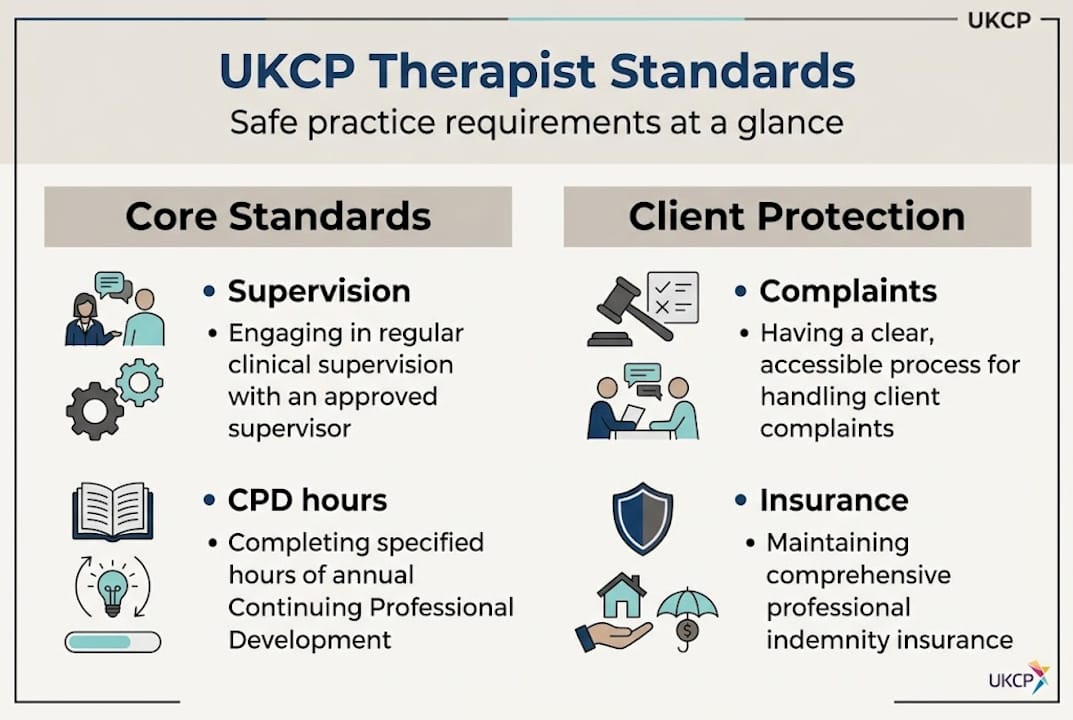
Here is a breakdown of what each requirement involves and why it matters.
| Requirement | Minimum standard | Why it matters |
|---|---|---|
| Monthly supervision | 1.5 hours per month | Ensures practice is reviewed by a senior professional |
| Annual CPD | 50 hours per year | Keeps therapists updated with current methods |
| Professional indemnity insurance | Maintained at all times | Protects clients financially if issues arise |
| Code of Ethics | Full adherence required | Governs confidentiality, respect, and boundaries |
Supervision is particularly important and often underestimated. It means a qualified, more senior practitioner regularly reviews a therapist's casework and approach. This is not the same as a therapist speaking to a colleague. It is a structured, professional process designed to catch problems early and maintain quality.

CPD hours must cover relevant, recognised learning. This might include new therapeutic models, research updates, or specialist training in areas such as trauma or bereavement. Fifty hours per year is substantial and ensures therapists are not relying solely on what they learned at the point of qualification.
How to verify these standards with your therapist:
- Ask directly whether they hold current UKCP membership
- Enquire how many supervision hours they complete each month
- Ask about their most recent CPD activities
- Confirm they hold professional indemnity insurance
- Request to see their registration number so you can check the UKCP register
Pro Tip: If a therapist is hesitant to answer any of these questions clearly, treat that as a signal worth noting. Transparent practitioners welcome these enquiries.
For further guidance on what safe online support looks like in practice, reviewing what accredited therapists consistently provide is a useful next step. Understanding why evidence-based support matters can also help you evaluate a therapist's approach more confidently.
How UKCP standards protect clients
Standards only have real value if they translate into meaningful protection for clients. UKCP's framework does exactly that in several measurable ways.
First, the requirement for ongoing supervision means there is always an additional layer of professional oversight in place. A UKCP therapist is not working in isolation. Their practice is being regularly reviewed, which significantly reduces the risk of harmful or stagnant approaches going unaddressed.
Second, the PSA-accredited complaints process means clients have a genuine route to raise concerns. With 57 complaints processed through adjudication in 2024, the system is actively used and independently scrutinised. That figure is not alarming; it is evidence that accountability mechanisms function and are accessible.
Third, the ongoing training and supervision requirements such as 1.5 hours monthly and 50 annual CPD hours ensure therapists remain current. Mental health research evolves, and a therapist's practice should reflect that. CPD requirements make this obligatory rather than optional.
The key client protections in practice include:
- Formal verification that training and qualifications have been assessed
- A clear route to make a complaint if ethical breaches occur
- Confidence that the therapist is actively supervised and accountable
- Assurance that professional insurance is in place
- Access to PSA oversight if UKCP's own process is insufficient
Pro Tip: If you have concerns about your therapist's conduct, start by reviewing UKCP's complaints guidance on their website. You can also escalate to the PSA if you feel the initial response is inadequate. You do not need to simply accept a situation that feels wrong.
For a detailed look at what the therapist registration safety guide covers across different bodies, and practical advice on online therapy safety in a UK context, both resources offer practical checklists worth reviewing.
How to check your therapist's UKCP status and qualifications
Verifying a therapist's UKCP status is straightforward. The register is publicly accessible, free to search, and updated regularly. Because the register is PSA-accredited, it carries an additional level of credibility beyond self-reported credentials.
Follow these steps to check a therapist's status before or during your first sessions.
- Visit the UKCP website and use the therapist search function
- Enter the therapist's name or registration number
- Confirm their registration status and the date it is valid to
- Note their listed specialisms and membership category
- Cross-reference with the PSA register if you want additional confirmation
Beyond the register check, asking direct questions during an initial consultation gives you important information. Consider asking:
- How many hours of supervision do you complete each month?
- What CPD have you completed in the past 12 months?
- Can you confirm you hold professional indemnity insurance?
- What is your UKCP registration number?
These are not intrusive questions. They are standard due diligence. Any accredited therapist will be comfortable providing this information.
PSA oversight also means you have rights beyond the UKCP complaints process itself. If you raise a concern with UKCP and feel it has not been handled appropriately, the PSA provides an additional avenue. This layered accountability is a meaningful protection that does not exist with unaccredited practitioners.
Pro Tip: Keep a written record of your therapist's registration number and the date you checked it. If you ever need to reference this information, having it documented saves time and provides clarity.
If you are considering a change or want to understand what is involved in moving to a different therapist, guidance on therapist switching tips covers the process in clear, practical terms.
A fresh perspective on therapist standards: What really matters
UKCP standards are rigorous, and they provide a genuinely strong baseline for safe practice. But it would be misleading to suggest that credentials alone guarantee an effective therapy experience.
The uncomfortable truth is that even a therapist who meets every UKCP requirement can still be a poor fit for a particular individual. Therapeutic rapport, communication style, and the quality of the working relationship between client and therapist are significant predictors of outcome. Research consistently supports this. Standards prevent poor practice; they do not automatically create the right match.
The most effective approach is to use UKCP accreditation as a non-negotiable baseline, not a final decision. Once you have confirmed a therapist meets those standards, pay close attention to how sessions actually feel. Does the therapist listen without judgement? Do you feel heard? Is the approach working for you?
Standards create the conditions for safe therapy. You determine whether it is the right therapy for you. If the relationship is not working, switching is a reasonable and valid choice. Information on personalised therapy approaches can help clarify what a well-matched therapeutic relationship might look like in practice.
Take the next step with safe, UKCP-accredited support
Understanding UKCP standards is a practical step towards making a safer, more informed choice about your mental health care. The information in this guide gives you the tools to verify credentials, ask the right questions, and know what protections are in place.
At MySafeTherapy, all therapists on the platform are UK-accredited and registered with recognised professional bodies including UKCP, BACP, and NCPS. If you are ready to move forward, you can start UKCP-accredited therapy with confidence, knowing that the standards covered in this guide are already built into how the platform operates. Your safety and peace of mind are the starting point, not an afterthought.
Frequently asked questions
How can I confirm my therapist is UKCP-accredited?
Search their name or registration number on the UKCP register, PSA-overseen, which confirms their accreditation status and provides an additional layer of credibility. You can also cross-reference with the PSA's own register of accredited bodies.
What ongoing requirements must UKCP therapists meet?
They must complete 1.5 hours monthly supervision, 50 hours of annual CPD, maintain professional indemnity insurance, and adhere fully to the UKCP Code of Ethics. These requirements are ongoing and not simply assessed at the point of initial accreditation.
What should I do if I have concerns about my UKCP therapist?
Use the UKCP complaints process, which is independently overseen by the PSA's robust adjudication system. If you are unsatisfied with UKCP's response, you can escalate the matter directly to the PSA.
Is UKCP the only reputable therapist register in the UK?
UKCP is rigorously overseen, but other bodies such as BACP also maintain strong professional standards. Always check whether the register holds PSA accreditation, as this is the clearest independent indicator of robust oversight and complaints handling.