

The single most important step is training managers in virtual emotional intelligence while making clinical support genuinely easy to reach. Blended interventions, digital tools paired with real therapist contact, outperform digital-only programmes for anxiety, stress and depression. Combine that evidence with clear legal duties under the Equality Act 2010 and structured measurement, and the rest of your remote wellbeing strategy falls into place.
TL;DR:
- Structured social contact and explicit boundary norms immediately reduce feelings of isolation and blurred boundaries for remote employees.
- Manager training focused on emotional intelligence and outcome-based management significantly improves remote staff wellbeing.
- Making clinical support easily accessible and clearly signposted increases employee engagement with mental health resources.
- Regular boosters and human prompts, like managers asking about therapy use, outperform one-time wellness campaigns for sustained impact.
- Combining digital mental health tools with real therapist support enhances effectiveness more than digital-only programs.
Table of Contents
- Why does remote working affect employee wellbeing?
- What practical steps should employers take first?
- How do you make an EAP work for remote staff?
- What manager training actually improves remote wellbeing?
- What legal duties apply to remote employees' mental health?
- How should you measure whether your wellbeing programme works?
- How does a blended therapy platform fit your wellbeing mix?
- What actually works in practice, according to publishers who watch this closely
- How Mysafetherapy supports your remote workforce
- Sources
Why does remote working affect employee wellbeing?
Three mechanisms explain most of the wellbeing decline HR teams report in distributed teams: isolation, blurred boundaries, and digital presenteeism. Isolation strips away the incidental social contact an office provides, corridor chats, shared lunches, and that context accumulates into loneliness over months rather than days. Blurred boundaries happen when the laptop never really closes, so evenings and weekends absorb work that used to stay in the building. Digital presenteeism is subtler still: employees feel pressure to look constantly available on Slack or Teams, mistaking visible activity for genuine productivity.
Each of these has a proportionate fix, which is why blended programmes work better than either pure self-help apps or occasional wellness webinars. A systematic review and meta-analysis published in JMIR found that digital mental health interventions combined with person-to-person support produce meaningfully stronger reductions in stress, anxiety and depression than digital-only tools.
That single finding should shape how you spend your wellbeing budget:
- Isolation responds to structured social contact, not just an open chat channel nobody uses.
- Blurred boundaries respond to explicit norms, not vague encouragement to "switch off".
- Digital presenteeism responds to how managers measure output, not to another wellness poster.
What practical steps should employers take first?
Sequence matters here. Boundaries and manager behaviour cost nothing and pay off immediately; clinical infrastructure takes longer to embed but delivers the deepest impact. Work through this list roughly in order.
- Set communication norms. Cap back-to-back meetings, state explicitly that replies outside contracted hours aren't expected, and let staff choose whether their camera stays on. The SIOP best practice recommendations single out meeting density and camera autonomy as concrete levers against digital fatigue.
- Run wellbeing-focused one-to-ones. Use a short script ("How's your workload really feeling this week?") rather than folding wellbeing into a status update, and confirm confidentiality before the conversation starts.
- Review workload and flexibility together. Trial adjusted hours or reduced meeting loads for a fixed period, then record what changed rather than assuming it worked.
- Build social connection deliberately. Buddy schemes and informal virtual coffee slots fade fast without scheduled "boosters", a monthly nudge that keeps the habit alive.
- Check home working equipment. A dining chair used eight hours a day causes physical strain that compounds mental fatigue.
- Simplify access to clinical support. Make your EAP or therapy provider one click away, not buried in a policy PDF.
- Redesign meetings for cognitive load. Shorter agendas, fewer attendees, more asynchronous updates.
- Signpost mental health resources visibly. Repeat the message often; people forget benefits they only heard about once, at induction.
Pro Tip: Ask new remote starters directly during induction how their home set-up compares to an office, then act on the answer. The CIPD's research on remote working recommends folding psychological risk into onboarding rather than treating it as an afterthought.
How do you make an EAP work for remote staff?
An Employee Assistance Programme only helps the people who know it exists and trust it enough to use it. Many remote employees simply forget the details between the induction session and the moment they actually need support.
Keep the information consistent everywhere it appears, your intranet, your Slack pinned message, your email signature, using plain, reassuring language rather than clinical jargon. Confirm that access genuinely works for remote staff: video, phone and chat options, and out-of-hours availability where your provider supports it. A phone-only helpline nobody can use privately from a shared kitchen table isn't much use.
- Train managers to signpost the EAP naturally in conversation, not just point to a poster.
- Fold EAP awareness into absence management and return-to-work conversations as standard practice.
- Hold wellbeing conversations in private settings, and ask first whether the employee is somewhere they can speak freely, a small step ACAS guidance treats as essential to preserving trust.
- Ask your provider for anonymised uptake data to refine the offer without ever identifying individuals.
What manager training actually improves remote wellbeing?
Supervisor support is the single most consistent predictor of teleworker wellbeing, ahead of pay, workload or even job security, according to a systematic review of leadership competencies published in Frontiers. That puts the burden squarely on how well you train line managers, not on how many wellness initiatives you launch centrally.
Build your manager training around four capabilities:
- Virtual emotional intelligence. Teach managers to notice tone shifts in written messages, longer response times, or someone going unusually quiet in meetings, all early signals that are easy to miss without deliberate attention.
- Structured check-ins. Give managers a simple agenda, a privacy check at the start, and a clear escalation route if something serious comes up.
- Co-created Wellness Action Plans. Adjustments work far better when the employee helps design them rather than receiving them top-down.
- Outcome-based management. Judge work by what gets delivered, not by green dots on a status bar.
Pro Tip: Train managers to ask one specific question when someone seems off: "Has anything changed for you this week, at work or otherwise?" It's open enough to invite honesty without feeling like an interrogation.
What legal duties apply to remote employees' mental health?
Under the Equality Act 2010, a mental health condition qualifies as a disability when it has a substantial, adverse effect on daily life and lasts, or is expected to last, 12 months or more. Once that threshold is met, employers must consider reasonable adjustments, and refusing to do so without good reason is unlawful.
For remote staff specifically, adjustments tend to cluster around a few practical categories:
- Flexible or staggered hours to manage fatigue or medication side effects.
- Alternative communication channels, written follow ups instead of live calls, for employees who find real time video draining.
- Phased returns after sickness absence, with reduced hours building up gradually.
- Adjusted workload or deadlines during a defined trial period.
Document every request, agree a trial period with a fixed review date, and record the outcome, whether the adjustment worked, needs tweaking, or should become permanent. ACAS guidance on reasonable adjustments recommends treating these conversations with the same seriousness given to physical illness, never as a lesser category of request.
How should you measure whether your wellbeing programme works?
Measurement doesn't need to be elaborate to be useful. Track EAP or therapy uptake rates, sickness absence trends, and a short pulse survey of three to five validated items repeated on a consistent schedule rather than a single annual snapshot.
- Watch meeting density and after hours activity as proxy indicators of digital presenteeism.
- Pair quantitative metrics with informal qualitative check-ins to catch what numbers miss.
- Report anonymised trends to leadership quarterly, never individual-level data.
Treat every intervention as provisional. A BMJ umbrella review of workplace mental health interventions found effect sizes across universal, selective and indicated programmes were consistently small to moderate, evidence for continuous refinement rather than a one-off rollout.
How does a blended therapy platform fit your wellbeing mix?

The JMIR meta-analysis is unambiguous on one point: person support materially increases the effectiveness of digital mental health tools for anxiety, depression and stress. That has a direct commissioning implication, a self-help app alone is a weaker investment than a platform pairing self-help tools with real therapist access.
Practical integration looks like this:
- Pilot with a single team or department before a full rollout, so you can iron out access issues early.
- Communicate the offer through the same visible, repeated channels used for your EAP.
- Confirm confidentiality protocols are explicit, especially for staff worried that using the service might reach their manager.
- Ask the provider for anonymised aggregate reporting on uptake, not individual case details.
Mysafetherapy's model, therapist matched video, phone, chat and avatar sessions with UK-accredited clinicians registered with bodies such as BACP, UKCP and NCPS, illustrates what that blended structure looks like in practice for a UK-based workforce.
What actually works in practice, according to publishers who watch this closely
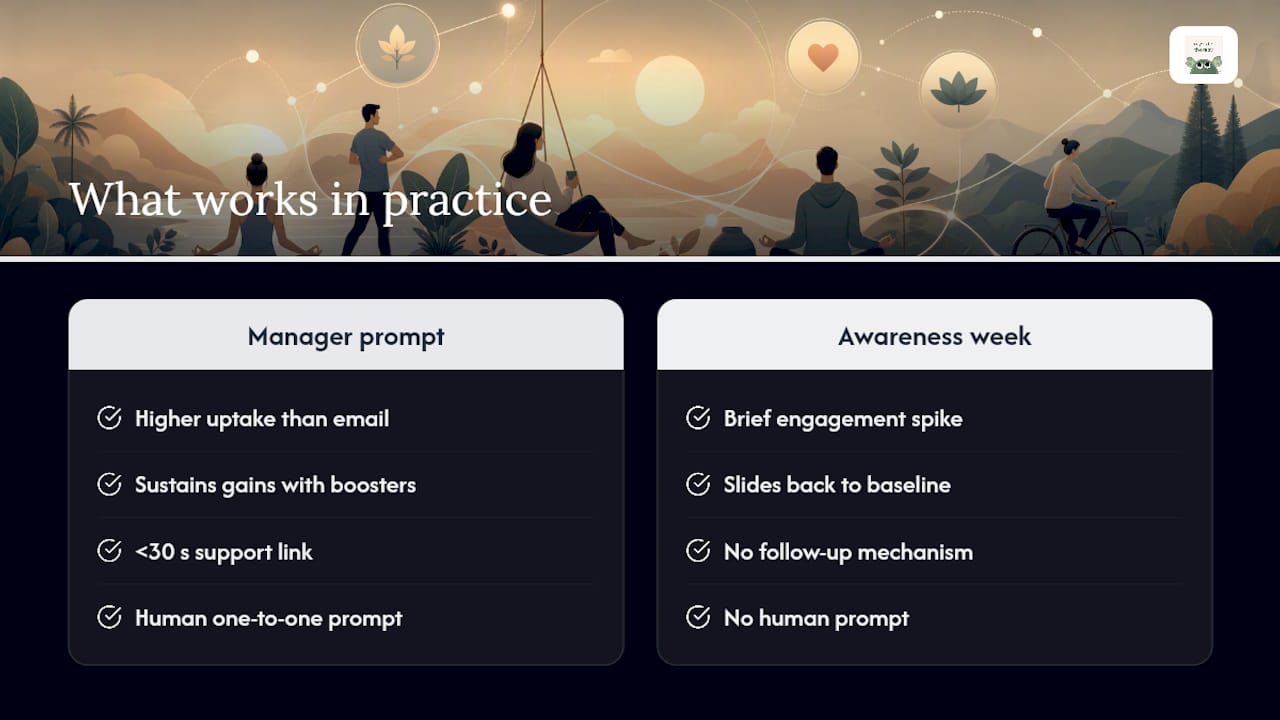
Managers paired with genuinely easy access beats expensive one-off wellbeing campaigns almost every time. We've seen organisations spend heavily on a single "awareness week" that generates a brief spike in engagement, then nothing, because there was no follow-up mechanism to sustain it. Programmes that build in regular boosters and check-ins hold their gains; the ones that don't tend to slide straight back to baseline within a few months, a pattern research on the longevity of workplace wellbeing interventions documents clearly.
One pattern stands out from teams that get this right: a manager simply asking "have you tried the therapy benefit yet?" during a routine one-to-one, combined with a support link that took under thirty seconds to use, lifted uptake far more than any email campaign. Simplicity and a human prompt beat polish every time.
— MySafeTherapy
How Mysafetherapy supports your remote workforce
Mysafetherapy gives employers a working alternative to building an in-house wellbeing team from scratch: a ready-made, blended clinical pathway with UK-accredited therapists, structured commissioning, and no need to vet individual practitioners yourselves.
Corporate clients get therapist-matched one-to-one sessions across video, phone, chat and avatar formats, alongside AI journaling and mood tracking tools staff can use between appointments. Every clinician is registered with a recognised UK body such as BACP, UKCP or NCPS, so your duty of care sits on solid ground from day one. The usual commissioning route starts with a small pilot team, moves to wider rollout once uptake data looks healthy, and continues with anonymised reporting so you can track engagement without ever seeing individual case details. For staff who feel uneasy about being seen using workplace mental health support, avatar therapy from £49 offers a genuinely anonymous route into the same clinical quality. If you're ready to explore a pilot for your team, visit Mysafetherapy's workplace wellbeing services and start the conversation about what a blended programme could look like for your workforce.
This article is general information, not a substitute for advice from a qualified doctor. Consult a qualified healthcare professional about your own circumstances before acting on anything here.
Sources
- Optimizing workplace digital mental health interventions: systematic review and meta-analysis (JMIR, 2025)
- Health, safety and wellbeing — wellbeing when working from home (ACAS)
- Wellbeing in telework: a systematic review of leadership competencies (Frontiers, 2025)
- Remote work post-COVID-19: state of the knowledge and best practice recommendations (SIOP, 2024)