
TL;DR:
- Managing depression online involves a combination of NHS-guided self-help, structured therapies, and practical routines to improve mental health from home. Early escalation to guided support is crucial if symptoms persist after initial self-help efforts, while urgent help must be sought immediately if suicidal thoughts arise. Consistent engagement, reliable routines, and external accountability significantly enhance recovery outcomes in digital depression management.
Managing depression when face-to-face support feels out of reach is a challenge many UK adults recognise. Knowing how to manage depression online, safely and effectively, is not always straightforward. The range of options can feel confusing, and deciding where to start takes effort when motivation is already low. This guide sets out practical steps based on NHS guidance, from initial self-help to accessing talking therapies online, so you can take control of your mental health without leaving your home.
Table of Contents
- Understanding depression and online management options
- Preparing to manage depression online: essential tools and routines
- Step-by-step guide to online depression self-management and therapy
- When and how to get urgent online support for suicidal thoughts
- Common challenges in online depression management and how to overcome them
- Rethinking online depression management: what mainstream advice often misses
- Start your confidential online therapy journey today
- Frequently asked questions
Key Takeaways
| Point | Details |
|---|---|
| Integrated treatment | Managing depression online works best when combining self-help, talking therapies, and medication as recommended. |
| Practical routines | Regular social contact, gentle exercise, and consistent daily routines are critical for improving depression symptoms. |
| Timely help | Seek guided therapy or professional support if depression persists beyond two weeks despite self-help efforts. |
| Urgent support | Always access immediate help via NHS 111 or Samaritans if experiencing suicidal thoughts or crisis. |
| Active participation | Success with online therapy requires active involvement, practising techniques, and integrating changes into daily life. |
Understanding depression and online management options
Depression is not a single experience. It ranges from mild, persistent low mood to severe symptoms that affect every area of daily life. The treatment approach differs depending on severity, which is why understanding your options matters before you start.
Treatment for depression usually involves a combination of self-help, talking therapies, and medicines. This means there is rarely one single solution. For mild to moderate depression, structured self-help and talking therapies are often the first steps recommended. For more severe presentations, medication alongside therapy becomes relevant.
Online management has become a well-established route within this framework. The NHS supports several digital access points:
- Online guided self-help: Structured programmes based on cognitive behavioural therapy (CBT) principles, which you work through independently or with therapist support
- Telephone and video talking therapies: Sessions with an accredited therapist delivered remotely, offering the same clinical value as in-person appointments
- NHS Talking Therapies services: Available across England, many of which accept self-referrals and offer online or phone appointments
- Digital mental health resources: Apps, workbooks, and platforms that support mood tracking and symptom management between sessions
One important distinction: online therapy is not simply reading articles about depression. It involves structured, evidence-based work, often with a qualified therapist guiding the process. Exploring therapy self-help resources can help you understand which formats suit your situation before you commit to a programme.
Preparing to manage depression online: essential tools and routines
With an understanding of depression and treatment options, the next step is practical preparation. Starting without structure rarely leads to consistent progress. The preparations below are straightforward but genuinely make a difference.
NHS self-help guidance recommends practical routines: staying in touch with people, gentle exercise, keeping a sleep and eating routine, and seeking help if symptoms persist beyond a couple of weeks. These are not vague suggestions. They are the behavioural foundations that make online therapy and self-help far more effective when applied consistently.
Before beginning any online depression management programme, consider the following:
- Social connection: Even brief, low-effort contact with a trusted person each day reduces isolation and supports mood regulation
- Gentle movement: A 20-minute walk is enough. It does not need to be structured exercise to deliver benefit
- Consistent sleep and eating patterns: Depression disrupts both. A basic routine, even an imperfect one, creates stability
- A reliable setup for sessions: A quiet space, a charged device, a stable internet connection, and headphones if privacy is a concern
| Preparation area | What to put in place | Why it matters |
|---|---|---|
| Social contact | One check-in per day, message or call | Reduces isolation and supports mood |
| Physical activity | 20-minute walk or light movement | Supports sleep and reduces low mood |
| Daily routine | Fixed wake, meal, and bedtime | Stabilises circadian rhythm and energy |
| Tech setup | Device, internet, headphones, quiet space | Enables uninterrupted therapy sessions |
| Support plan | Know who to contact if symptoms worsen | Prevents crisis escalation |
Reviewing self-help resources for depression before your first session can also help you set realistic expectations. Many people underestimate how much the basics matter and focus entirely on finding the right therapist while neglecting sleep, movement, and contact with others.
Pro tip: Set a recurring phone reminder for your daily walk and one check-in message. When motivation is low, decision fatigue is real. Removing the need to decide makes follow-through far more likely.
You can find further guidance on building practical habits via resources focused on practical routines for wellbeing. For a broader look at building habits that support recovery, mental health management tips covers the practical side in detail.
Step-by-step guide to online depression self-management and therapy
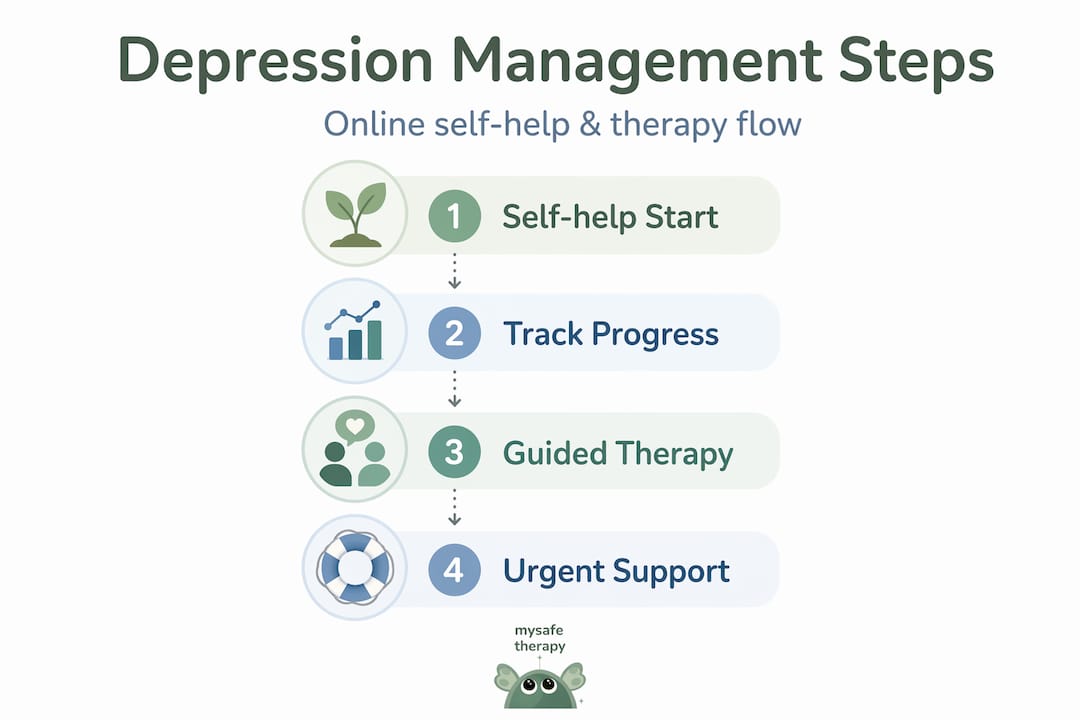
After preparing, the process of managing depression online follows a clear sequence. This is not rigid, but it reflects NHS guidance on how to progress through levels of support appropriately.
-
Begin with NHS-recommended self-help measures. This includes the routines covered above: social contact, movement, sleep hygiene, and avoiding alcohol. Monitor your mood over two weeks. Many people see some improvement at this stage.
-
If symptoms persist, access guided self-help. Guided self-help uses CBT principles and involves 6 to 8 sessions working through a workbook or online course with therapist support by phone or video. Sessions are weekly or fortnightly. This is a clinically effective step and does not require a GP referral in most cases.
-
Engage actively with your chosen format. Whether you are using a digital workbook, attending video sessions, or working through an online CBT course, consistency matters more than intensity. Attending every session and completing work between sessions produces better outcomes than sporadic, high-effort engagement.
-
Track your progress using digital tools. Mood tracking apps, journaling, and symptom questionnaires (such as the PHQ-9) help you and your therapist see whether the approach is working. If you are not improving after 6 to 8 weeks of guided self-help, this data supports the case for moving to direct talking therapies or a GP conversation about medication.
-
Escalate to direct talking therapies or GP involvement if needed. If depression worsens or does not respond to guided self-help, structured talking therapies such as CBT or interpersonal therapy (IPT) delivered by a qualified therapist are the next step. Your GP can also discuss whether antidepressant medication is appropriate alongside therapy.
| Approach | Format | Duration | Best suited to |
|---|---|---|---|
| Self-help routines | Independent, daily habits | Ongoing | Mild symptoms, starting point |
| Guided self-help | Online course or workbook with therapist | 6 to 8 sessions | Mild to moderate depression |
| Talking therapy (CBT, IPT) | Video, phone, or chat with therapist | 6 to 20 sessions | Moderate to severe depression |
| Combined therapy and medication | Therapy plus GP-prescribed medication | Varies | Severe or persistent depression |
Understanding self-help therapy steps can help you identify where you currently sit in this process. If you are unsure which level of support is right for you, reviewing mental health support steps provides a clearer picture. For practical tools that fit each stage, using self-help tools covers the most effective digital options available.
Pro tip: Use the PHQ-9 questionnaire every two weeks to track your score. A consistent score of 10 or above after self-help measures is a clear, objective signal to seek guided support rather than waiting and hoping.
When and how to get urgent online support for suicidal thoughts
Alongside planned management, it is critical to understand how to access urgent support. This section is not optional reading. Depression, at its most severe, can involve thoughts of self-harm or suicide. Knowing the correct steps before reaching a crisis point is essential.
Warning signs that require immediate action include:
- Thoughts that life is not worth living
- Urges to harm yourself or make plans to do so
- Feeling that others would be better off without you
- Sudden calmness after a period of severe depression (this can indicate a decision has been made)
"If you are in immediate danger or feel you may act on suicidal thoughts, call 999 or go to your nearest A&E."
NHS urgent support guidance directs people to contact Samaritans on 116 123 (available 24 hours a day, seven days a week, free and confidential), call 111 out of hours for non-emergency but urgent mental health support, or contact your GP for an emergency appointment. Mental health crisis teams are also available through NHS 111 and can arrange a same-day assessment.
Digital self-management and online therapy are not substitutes for this level of support. If you are in crisis, the immediate priority is human contact. You can also find urgent emotional support resources for additional guidance.
Reviewing online therapy safety will help you understand how reputable platforms handle disclosures and safeguarding obligations, which is important when choosing where to access your care.
Common challenges in online depression management and how to overcome them
Having covered urgent support, it is worth addressing the practical obstacles that frequently slow recovery. Awareness of these challenges is the first step to navigating them.
The most common problem is delayed escalation. NHS guidance advises seeking help if you are still feeling down after a couple of weeks of self-help, yet many people wait far longer. This delay does not mean someone is failing. Depression itself reduces motivation and creates cognitive distortions that make seeking help feel unnecessary or futile. Recognising this pattern as a symptom, not a character trait, matters.
Other frequent challenges include:
- Inconsistent engagement with therapy or self-help tools. Online formats require self-discipline. Without the physical commitment of travelling to an appointment, it is easier to cancel or postpone.
- Difficulty recognising when self-help is insufficient. If your mood is not improving or is worsening, self-help has served its purpose as a starting point. Moving to guided support is not failure; it is appropriate escalation.
- Isolation reinforcing avoidance. Depression reduces the drive to connect and engage. This makes the digital environment both an asset (accessible, low-barrier) and a risk (easy to disengage without accountability).
- Uncertainty about which online resources are reliable. Not all apps and websites meet clinical standards. Prioritise NHS-signposted resources and accredited platforms.
Using a mental health checklist to review your progress at regular intervals helps maintain objectivity. It is also worth exploring the range of mental health support options available, so you are not limiting yourself to one format if it is not working.
Pro tip: Identify one accountability partner, whether a friend, family member, or therapist, and agree a specific check-in schedule. External accountability is one of the most effective tools for maintaining consistency in online depression management.
Rethinking online depression management: what mainstream advice often misses
Most content about managing depression online focuses heavily on cognitive work. Change your thinking patterns, challenge negative beliefs, reframe unhelpful thoughts. These techniques have genuine evidence behind them. But they represent only part of what recovery involves, and the dominance of the cognitive angle leaves a practical gap that many people fall into.
Depression is as much a behavioural condition as a cognitive one. What you do each day, your movement, your sleep, your social contact, your daily structure, shapes your mood as powerfully as any therapy session. In our experience, people who change their daily behaviour alongside engaging in therapy recover faster than those who treat sessions as the entirety of their intervention. The session is an hour. The other 23 hours still count.
There is also a cultural tendency to treat online self-help as a complete treatment rather than a starting point. Apps and workbooks are valuable. They lower the barrier to entry and provide genuine structure. But they are most effective when they lead somewhere. The goal of self-help is not to manage depression indefinitely at a subclinical level. It is to stabilise sufficiently and then engage with guided support.
Early access to guided help, such as CBT-based online therapy with a qualified counsellor, consistently produces better outcomes than prolonged independent self-management. The NHS two-week guideline exists for this reason. It is not arbitrary. The research supports it. Yet many people interpret it as a minimum, not a maximum.
Online therapy also offers something in-person therapy sometimes does not: flexibility that removes the logistical barriers that previously prevented people from seeking help at all. This is a meaningful advantage. But flexibility without structure becomes avoidance. The most effective use of online therapy is when it is embedded into a consistent weekly routine, treated with the same commitment as any other appointment. Exploring effective therapy techniques can help you get more from each session.
Start your confidential online therapy journey today
If you have read this far, you already have a clearer picture of how to manage depression online, what to do, when to escalate, and what obstacles to anticipate. The next step is to act on that knowledge.
MySafeTherapy connects UK adults with accredited therapists registered with BACP, UKCP, and NCPS, offering confidential sessions by video, chat, or avatar format. Sessions are available evenings and weekends, so your schedule is not a barrier. You do not need a GP referral to begin. Therapy can start when you are ready. Additional tools including mood tracking and AI journaling support your progress between sessions. If you are ready to move beyond self-help and into structured, professional support, start therapy online today and take the most important step in your recovery.
Frequently asked questions
How soon should I seek professional help if online self-help does not improve my depression?
NHS advises getting help if you are still feeling low after a couple of weeks of self-help efforts. Do not wait longer, as early guided support consistently improves outcomes.
Can I start talking therapies online without a referral from my GP?
Yes. You can refer yourself directly to an NHS talking therapies service without a GP referral, and many private online platforms, including MySafeTherapy, also accept direct self-referrals.
What should I do if I have suicidal thoughts and need immediate help?
Contact Samaritans on 116 123 or call NHS 111 immediately. If you are in immediate danger, call 999 or go to your nearest A&E.
How does guided self-help online therapy usually work?
Guided self-help involves working through an online course or CBT-based workbook over 6 to 8 sessions, with a therapist providing support via phone or video throughout the process.
What daily habits help support depression management at home?
NHS guidance recommends maintaining social contact, taking gentle daily exercise, keeping consistent sleep and eating routines, and avoiding excessive alcohol as core habits for managing depression at home.