

TL;DR:
- Adaptive therapy in mental health refers to personalised, flexible treatment approaches that adjust methods based on individual needs and responses. Unlike oncology's clinical protocol, it involves therapists integrating evidence-based techniques like CBT or ACT dynamically, fostering better engagement and progress. Access to online formats and ongoing collaboration enhances the effectiveness and responsiveness of mental health support.
If you have searched for information about what is adaptive therapy and landed on pages discussing cancer treatment, you are not alone. The term carries two very different meanings depending on the medical context, and for anyone seeking mental health support, this overlap creates genuine confusion. This article focuses specifically on what adaptive therapy means within mental health, how it applies to conditions like anxiety and depression, and what you should know before choosing a therapist or treatment approach.
Table of Contents
- Key takeaways
- What is adaptive therapy? Clarifying the term
- Adaptive therapy in mental health
- Types of adaptive or flexible therapy
- Benefits and considerations of adaptive therapy
- How to find and access adaptive therapy
- Our perspective on adaptive therapy
- Find flexible therapy with Mysafetherapy
- FAQ
Key takeaways
| Point | Details |
|---|---|
| Two distinct meanings | Adaptive therapy originated in oncology but describes a different concept in mental health contexts. |
| Flexibility is central | In mental health, adaptive therapy refers to tailoring treatment to individual client needs rather than following a fixed protocol. |
| Multiple approaches qualify | CBT, ACT, and integrative therapy all embody adaptive principles when delivered with client-centred flexibility. |
| Therapist skill matters | Effective adaptive care requires a trained therapist who can balance structure with responsive, personalised adjustments. |
| Access has improved | Online and chat-based therapy formats make flexible, adaptive mental health support more accessible than ever. |
What is adaptive therapy? Clarifying the term
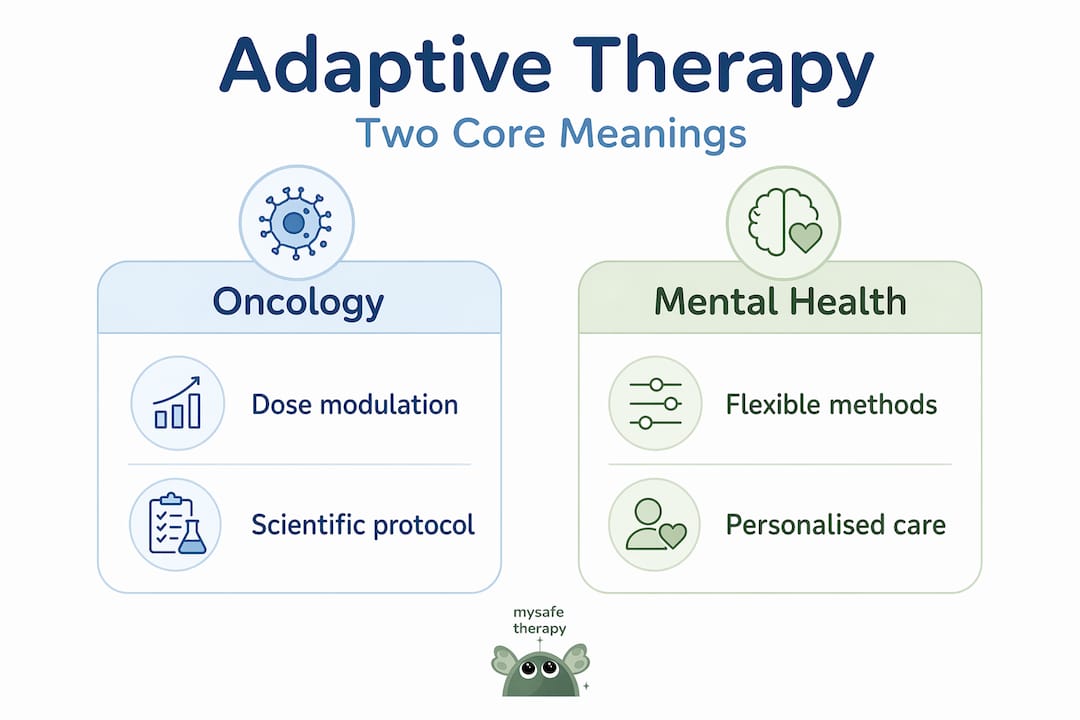
The phrase "adaptive therapy" does not belong to a single discipline. It originated in oncology and has since been used informally within mental health to describe something quite different. Before exploring the mental health meaning, it helps to understand where the term comes from.
In cancer treatment, adaptive therapy is a precisely defined clinical strategy. Rather than applying maximum doses of chemotherapy continuously, oncologists adjust dosing based on tumour response to manage treatment resistance and extend progression-free survival. The underlying logic draws on evolutionary biology: cancer cells sensitive to treatment are kept in competition with resistant cells, preventing the resistant population from taking over entirely. This balance is maintained through real-time monitoring and patient-specific protocols, making it a technically complex and resource-intensive approach.
There are two principal formats in oncology: intermittent and continuous dose modulation. Continuous dose modulation has shown greater robustness in mathematical modelling studies, maximising the time before resistance develops compared to dose-skipping strategies. The point here is not to explain oncology in depth. It is to demonstrate that adaptive therapy in cancer care is a specific, well-documented clinical protocol grounded in tumour biology and pharmacodynamics. This meaning has little relevance to someone managing anxiety or depression.
When you encounter the term in a mental health context, it is being used in a much broader, less formal sense. That distinction is worth holding onto as you read further.
Adaptive therapy in mental health
In mental health, "adaptive therapy" is not a formally defined modality. No single professional body or treatment manual carries that label as a registered approach. Instead, the term describes something practical and meaningful: therapy that adapts to the individual, rather than the individual adapting to the therapy.
This idea sits at the centre of good clinical practice. It means a therapist assesses your specific needs, your history, your presenting symptoms, and your preferences, then draws on whichever evidence-based methods are most appropriate. If your anxiety is rooted in avoidance behaviours, cognitive techniques may take priority. If your depression has roots in unresolved relational patterns, psychodynamic work may be woven in. The therapist is not locked into a single script.

Integrative therapy is the formal term most closely aligned with what people mean when they say adaptive therapy in a mental health context. Integrative therapists are trained to draw from multiple modalities, including cognitive behavioural, humanistic, and psychodynamic approaches, and apply them within a structured but flexible framework.
It is worth distinguishing integrative therapy from eclectic therapy. Eclectic approaches borrow techniques somewhat arbitrarily, applying whatever the therapist finds useful in the moment. Integrative therapy does something more disciplined: it combines modalities according to a coherent theoretical rationale tailored to each client. The difference matters because structure and intentionality protect against inconsistency.
Pro Tip: When speaking with a potential therapist, ask whether they use an integrative or single-modality approach. This one question tells you a great deal about how flexible and personalised your treatment is likely to be.
Types of adaptive or flexible therapy
Understanding which therapy types embody adaptive principles helps you make an informed choice. The table below summarises the main approaches commonly used for anxiety and depression, along with their defining features.
| Therapy type | Core principle | Best suited for |
|---|---|---|
| Cognitive behavioural therapy (CBT) | Identifies and restructures unhelpful thought patterns | Anxiety disorders, depression, phobias |
| Acceptance and commitment therapy (ACT) | Builds psychological flexibility and values-based action | Generalised anxiety, chronic depression |
| Integrative therapy | Combines multiple modalities tailored to client needs | Complex presentations, trauma, relationship issues |
| Psychodynamic therapy | Explores unconscious patterns and relational history | Long-standing depression, emotional dysregulation |
| Online and chat-based therapy | Flexible format adapting to client schedule and preference | Those with access barriers, busy schedules |
CBT is the most widely researched approach for both anxiety and depression. It is highly structured by design, but skilled therapists adapt its delivery considerably. Session pacing, the choice of specific techniques, and the balance between cognitive and behavioural elements all shift according to client response.
ACT is an effective flexible approach that differs from traditional CBT by focusing less on changing thoughts and more on changing your relationship to them. Rather than challenging a negative thought as untrue, ACT encourages acceptance of difficult internal experiences while pursuing actions aligned with your values. This model is particularly adaptive because it does not pathologise distress. It treats psychological flexibility as a skill that can be developed regardless of symptom severity. Research supports its use as a valid alternative to CBT for adolescent and adult depression, particularly when clients have not responded well to more structured approaches.
Flexible session timing and modality choices represent a different but equally important dimension of adaptive care. Online video sessions, text-based chat therapy, and avatar-based formats all allow therapy to meet clients where they are, practically and emotionally. For someone with social anxiety, a face-to-face session may initially feel like too large a step. Starting with chat-based support adapts the format to their current capacity, not to a fixed clinical model.
Benefits and considerations of adaptive therapy
The case for flexible, client-centred therapy is well supported. Here is what the evidence and practice indicate:
- Personalised care improves engagement. Clients whose therapy is adjusted to their specific needs report higher engagement and stronger therapeutic alliances, both of which predict better outcomes.
- Responsiveness supports progress over time. Mental health conditions do not follow linear trajectories. Anxiety may increase during stressful periods; depression may lift and then return. An adaptive therapist adjusts their approach as your needs shift rather than continuing a protocol that no longer fits.
- Accessibility increases with format flexibility. Flexible mental health support directly addresses barriers such as geography, work schedules, and social anxiety, making consistent care achievable for more people.
- Evidence-based methods remain the foundation. Adaptability does not mean improvisation. Effective adaptive therapy integrates client feedback and symptom tracking to guide adjustments while maintaining the integrity of evidence-based interventions.
There are real considerations to weigh alongside these advantages. Adaptive or integrative approaches require more clinical skill than delivering a single standardised protocol. A therapist needs substantial training to draw from multiple modalities confidently without losing coherence. For clients, the absence of a fixed structure can occasionally feel disorienting, particularly in the early stages when a clear treatment plan provides reassurance.
Successful adaptive therapy depends on collaboration and the therapist's ability to tailor interventions dynamically while maintaining a treatment structure. The most productive outcomes occur when clients actively communicate what is and is not working, turning the therapy into an ongoing dialogue rather than a passive experience.
Pro Tip: If you are exploring types of therapy for anxiety, look for a therapist registered with BACP, UKCP, or NCPS who explicitly mentions integrative or flexible approaches in their profile. Professional registration indicates both training standards and accountability.
How to find and access adaptive therapy
Taking the first step towards flexible mental health support is more straightforward than many people expect. Here are the key steps:
- Clarify your goals before your first session. Note whether you are primarily managing anxiety, depression, or a combination. Knowing your priorities helps you assess whether a therapist's approach suits your needs.
- Ask direct questions during an initial consultation. Useful questions include: "Do you adapt your approach based on how I respond?" and "Which therapeutic modalities do you draw from?" A therapist who cannot answer these clearly may not be the right fit.
- Consider online formats as a genuine first option. Not a fallback. Online therapy removes geographical and scheduling barriers and, for many clients, reduces the initial discomfort of seeking support.
- Use self-help tools between sessions. AI journaling, mood tracking, and structured self-help resources allow you to continue therapeutic work outside sessions, giving your therapist richer material to work with and extending the impact of each appointment.
- Do not stay with an approach that is not working. One of the most practical benefits of flexible mental health platforms is the ability to switch therapists or try a different format without starting from zero.
Our perspective on adaptive therapy
I have observed one consistent pattern in how people approach therapy decisions: they search for certainty before they have enough information to find it. The phrase "adaptive therapy" is a good example. People encounter it expecting a named, packaged treatment. What they find instead is a concept, and that can feel frustrating when you are already managing anxiety or depression and simply want to know what will help.
What experience shows, repeatedly, is that the quality of the fit between the person and the approach matters more than the name of the method. I have seen people make significant progress with straightforward CBT delivered by a responsive, attentive therapist. I have seen integrative approaches change the trajectory of long-standing depression precisely because the therapist adjusted the work as the client's needs evolved.
The uncomfortable truth about flexible, adaptive care is that it requires something from the client too. It asks you to communicate, to reflect, and to stay engaged even when progress is slow. That is not a criticism. It is an honest description of how effective therapy works. The therapist adapts. You adapt. Together, that process creates something more durable than any single protocol could.
Do not let terminology become a barrier. The relevant question is not whether your therapist calls their approach "adaptive." It is whether they are genuinely responsive to you.
— MySafeTherapy
Find flexible therapy with Mysafetherapy
Mysafetherapy connects you with UK-accredited therapists registered with BACP, UKCP, and NCPS who offer genuinely flexible, personalised care for anxiety, depression, and a range of other concerns.
Sessions are available via video, chat, and avatar-based formats, including evenings and weekends, so therapy fits around your life rather than the other way around. Every therapist on the platform can adapt their approach to your needs, and switching is straightforward if your first match is not the right one. Supplementary tools including mood tracking and AI journaling support your progress between sessions. If you are ready to begin, you can start your therapy today and find a therapist whose approach genuinely suits you.
FAQ
What is the adaptive therapy definition in mental health?
In mental health, adaptive therapy refers to a flexible, client-centred approach where the therapist adjusts their methods and techniques based on individual needs, responses, and goals. It is not a single formal modality but describes personalised, responsive care.
How does adaptive therapy work for anxiety and depression?
A therapist using adaptive principles draws from multiple evidence-based approaches, such as CBT or ACT, and adjusts the focus, pacing, and techniques based on your progress and feedback. This responsiveness helps treatment remain relevant as your needs change over time.
What are the main types of adaptive therapy?
The main approaches embodying adaptive principles include CBT, acceptance and commitment therapy (ACT), integrative therapy, and psychodynamic therapy. Online and chat-based formats also represent a form of adaptation by making therapy more accessible to more people.
What are the benefits of adaptive therapy over a fixed approach?
Flexible, personalised therapy improves client engagement, supports progress through changing symptoms, and makes care more accessible. It also allows treatment to evolve rather than becoming misaligned with where you are in your recovery.
Is adaptive therapy the same as integrative therapy?
Not exactly. Integrative therapy is a formal therapeutic model that combines multiple modalities within a structured framework. Adaptive therapy in mental health is a broader informal term describing any therapy that adjusts responsively to the client, of which integrative therapy is the most clearly defined example.