

Choose coaching when the problem is practical: missed deadlines, chaotic routines, poor follow-through. Choose therapy when the problem is emotional: low mood, trauma, anxiety, or shame that has built up around years of ADHD symptoms. Many adults get the most benefit from combining both, using therapy to work through the emotional weight and coaching to rebuild daily systems.
TL;DR:
- Therapy is most suitable for emotional issues like trauma, low mood, or shame, especially when ADHD symptoms are compounded by mental health conditions.
- Coaching is ideal when the primary problem involves practical routines, time management, or follow-through, with a focus on concrete results and habit-building.
- Credentialed therapy offers regulated, ethically supervised treatment, whereas coaching varies widely in qualifications, with less oversight and evidence backing its effectiveness.
- Private therapy typically costs between £50 and £150 per session, with NHS options offering fewer sessions and longer wait times, often filled with medication management.
- Combining therapy and coaching in a sequential or parallel approach can provide comprehensive support for adults with ADHD, but coordination and clear goal-setting are essential.
Table of Contents
- ADHD coaching vs therapy: the core differences
- What therapy offers for ADHD
- What ADHD coaching offers
- How to choose: a quick decision tool
- Access, cost and funding in the UK
- Combining coaching and therapy in practice
- Mysafetherapy's perspective on getting the right support
- Sources
ADHD coaching vs therapy: the core differences
The two approaches sit on different axes, and most confusion about which to pick comes from treating them as competitors rather than complements. Therapy is a regulated health intervention aimed at emotional processing and mental health conditions. Coaching is a structured support relationship aimed at behaviour change and skill building. Neither replaces the other's core function.
Here's how they split across the factors that actually matter when you're deciding:
- Primary focus: therapy addresses emotional distress, trauma, mood disorders and diagnosed mental health conditions; coaching addresses executive function gaps such as time management, organisation and follow-through.
- Session format: therapy sessions are typically structured around a therapeutic model (CBT, psychodynamic, integrative) with clinical assessment; coaching sessions are usually goal-setting conversations followed by task planning and accountability check-ins.
- Regulation: therapists working in the UK are commonly registered with bodies such as BACP, UKCP or BABCP, which set ethical codes and complaints processes; ADHD coaching has no statutory register, so credentials vary widely between practitioners.
- Scope of practice: therapists can assess and treat mental health conditions within their training, though only prescribing clinicians (psychiatrists, some specialist nurses) can prescribe ADHD medication; coaches cannot diagnose or treat mental health conditions and should refer out when distress is significant.
- Typical outcomes measured: therapy outcomes often track symptom reduction (anxiety and depression scores, trauma symptoms); coaching outcomes typically track functional markers such as tasks completed, routines maintained, or reduced lateness.
The overlap sits in the middle. Both involve regular sessions, goal-setting, and a working relationship built on trust. But a therapist working with adapted CBT is treating a condition, while a coach builds scaffolding around a brain that already works a certain way. That distinction shapes everything else, including who you should call first.
What therapy offers for ADHD
Cognitive behavioural therapy adapted for ADHD is the most evidence-backed talking therapy for the condition. Standard CBT gets modified to account for executive function difficulties, things like shorter homework tasks, more repetition, and techniques aimed directly at procrastination and emotional regulation rather than just thought patterns. The NIHR evidence summary indicates CBT can benefit adults with ADHD, and it currently has a stronger evidence base than coaching.
Therapy is the right route when ADHD sits alongside anxiety, depression, trauma, or relationship breakdown, which happens often. Years of missed deadlines, criticism, and self-doubt tend to leave emotional scars that no amount of task planning will resolve. A therapist trained in trauma-informed or CBT approaches can work through that history directly, rather than simply managing its symptoms.
Credentials matter here more than they do in coaching, because therapy carries statutory ethical obligations. Look for registration with BACP, UKCP, or BABCP for CBT specifically. These bodies require supervision, ongoing training, and a formal complaints process, which gives you recourse if something goes wrong. A therapist without one of these registrations may still be skilled, but you lose that safety net.
Expect sessions to run 50 to 60 minutes, usually weekly, with a typical course lasting somewhere between 6 and 20 sessions depending on what's being addressed. Straightforward CBT for a specific symptom might wrap up faster; trauma work or complex relationship patterns usually take longer. Progress in therapy tends to look like reduced emotional reactivity, better sleep, less shame around ADHD symptoms, and a stronger sense of self-worth, rather than a tidier inbox.
What ADHD coaching offers
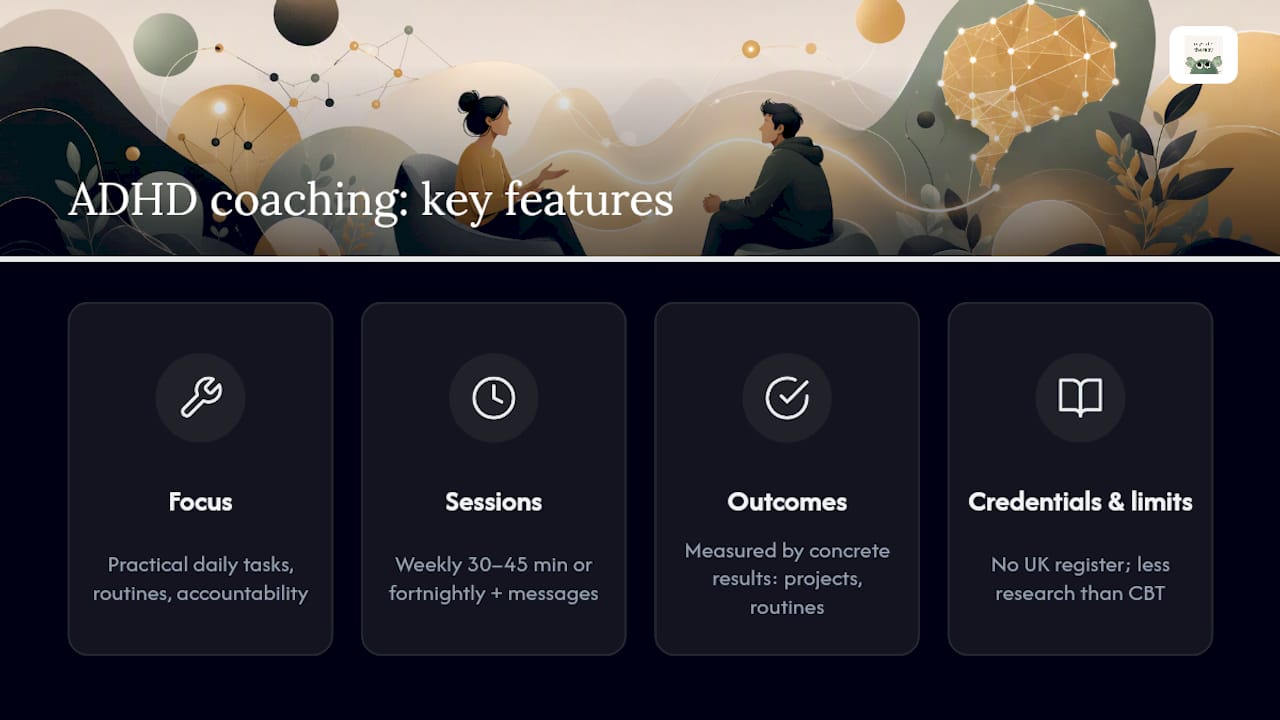
ADHD coaching deals in the practical mechanics of daily life. A typical session breaks down a task that's been stuck for weeks, builds a routine around medication timing or morning starts, or works through why a particular accountability system stopped working. Coaches often use techniques like body doubling, time blocking, and external reminder systems, tools that compensate for working memory and executive function gaps rather than trying to train them away.
Session cadence varies more than therapy. Some coaches meet weekly for 30 to 45 minutes; others prefer fortnightly sessions with check-ins by message in between. Progress is measured in concrete terms: a project finally submitted, a morning routine that held for three weeks straight, fewer late payments. It's a results-oriented relationship, and a good coach will ask you to define what "better" looks like in specific, trackable terms during the first session.
The credential landscape is looser than therapy's, and that's worth knowing before you pick someone. There's no statutory register for ADHD coaches in the UK. Some hold certification through the International Coaching Federation (ICF); others come from ADHD-specific training programmes; some have no formal coaching qualification at all, relying instead on lived experience or informal mentoring. BACP's coaching competences guidance sets out what solid coaching practice should include, but it isn't enforceable the way therapy registration is. Ask directly about training, supervision arrangements, and how long they've worked specifically with ADHD clients.
Coaching's evidence base is thinner than CBT's. Descriptive reviews suggest coaching combined with therapy or medication tends to improve executive functioning and quality of life, but there's less controlled research behind it than behind CBT. Coaching also isn't equipped to handle significant depression, trauma, or suicidal ideation. A BACP analysis of the coaching and therapy distinction notes that coaching suits clients who are already reasonably resilient and ready to work on behaviour change, not those in acute distress.
How to choose: a quick decision tool
Start by naming the loudest problem. If it's "I can't stick to a routine and keep missing deadlines," coaching is the sensible first call. If it's "I feel worthless and can't stop replaying old failures," therapy comes first. If both are loud, book both, ideally with practitioners willing to communicate.
Before committing to either, ask these questions on a discovery call:
- What's your training and, if applicable, your registration body?
- Do you have specific experience working with ADHD clients, and roughly how many?
- What does a typical session look like, and is there homework or between-session work?
- How do you measure progress, and when would we review whether this is working?
- What's your approach if something outside your scope comes up, for example a mental health crisis?
- What's your cancellation policy and typical session cost?
Watch for red flags: vague answers about training, no mention of supervision, promises of guaranteed results, or a reluctance to discuss referring out when something's beyond their scope. Legitimate practitioners, coaches and therapists alike, are usually comfortable naming the limits of what they do.
On budget and time: private therapy and coaching both typically run £50 to £150 per session, so a four to six session trial of either is a realistic way to test fit without a huge commitment.
Pro Tip: If you're unsure which to try first, book a single trial session with whichever practitioner has the shorter waiting list. A single session rarely commits you to a full course, and it gives you real information, how the practitioner works, whether you feel understood, faster than another week of reading comparisons.
Access, cost and funding in the UK
NICE guideline NG87 recommends structured, ADHD-focused psychological interventions such as adapted CBT as minimum non-pharmacological support for adults, but one-to-one coaching generally isn't provided by the NHS. In practice, NHS adult ADHD pathways tend to prioritise diagnostic assessment and medication, with psychological interventions available only episodically, which is why many patients turn to private coaching to fill the ongoing skills-support gap.
Realistic timelines and costs look like this:
- NHS talking therapies typically involve a wait of roughly 4 to 16 weeks and offer 6 to 12 sessions once you're seen, often through self-referral.
- Private therapy is usually bookable within 1 to 4 weeks; costs and comparisons with NHS provision are worth checking before you commit.
- Private ADHD coaching commonly runs between roughly £75 and £150 per hour, varying with the coach's experience and session format.
- Employed people can apply to Access to Work, which can fund one-to-one coaching as workplace support, a route that's underused simply because most applicants don't know it covers this.
- Higher education students may access mentoring through the Disabled Students' Allowance, and some employers now fund therapy or coaching through workplace wellbeing benefits or social prescribing schemes.
Comparing NHS and private therapy routes side by side before deciding usually saves time later.
Combining coaching and therapy in practice
Two models work well together. In the sequential model, therapy comes first to stabilise mood or process trauma, then coaching starts once there's enough emotional steadiness to focus on routines and follow-through. In the parallel model, both run at the same time: therapy handles the emotional undercurrent while coaching tackles this week's deadline, which suits people whose practical and emotional struggles are tangled together rather than sequential.
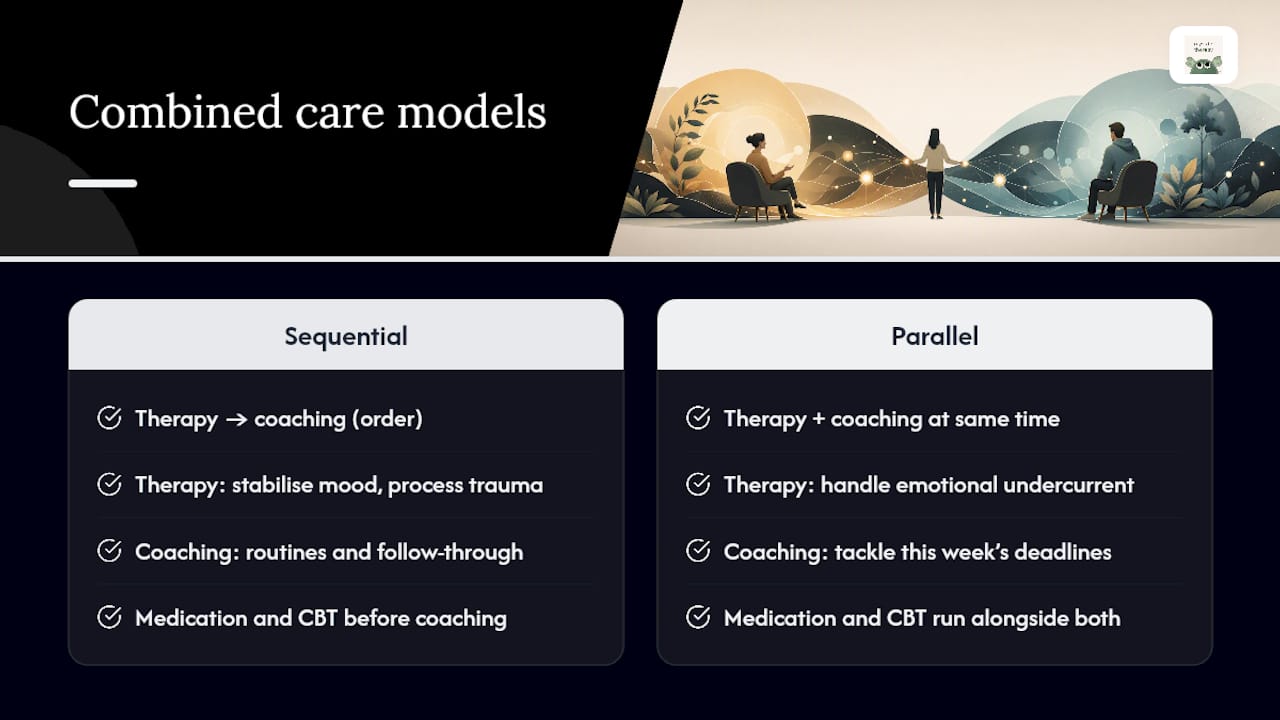
Coordination matters more than people expect. Give written consent for your therapist and coach to share brief progress summaries if you want them working from the same picture, and set goals with each of them separately so their work doesn't overlap or contradict. BACP's guidance on integrated practice recommends clear contracting between practitioners specifically to manage this. A common combined pathway looks like medication for symptom control, CBT for the emotional and cognitive patterns underneath, and coaching for the day-to-day scaffolding that keeps routines standing once therapy winds down, as explained in this guide for special needs families.
Mysafetherapy's perspective on getting the right support
We built Mysafetherapy around a simple observation: most people delay getting help because they're stuck deciding what kind of help they need. If ADHD is tangled with anxiety, low mood, or old shame, that's a job for therapy, not a coaching hack. You can connect with therapists offering video, chat, and avatar-based formats, allowing sessions to fit around work and irregular routines.
A first session is about mapping what's actually going on, not committing to months of work. If therapy sounds like the right starting point, you can book online therapy directly, or explore avatar-based sessions from £49 for a lower-pressure way to begin.
— Mysafetherapy
This article is general information, not a substitute for advice from a qualified doctor. Consult a qualified healthcare professional about your own circumstances before acting on anything here.
Sources
- Pine Medical Centre — ADHD (NICE NG87 summary)
- NHS — Find NHS talking therapies for anxiety and depression
- BACP — Coaching competences user guide (2022)
- NIHR Evidence — Cognitive behavioural therapy could benefit adults with ADHD
- Gov