

Camera-off therapy is a clinically legitimate option when the client and therapist agree on it and appropriate safety steps are in place, not a lesser version of "real" therapy. Video helps with certain assessments and visual-dependent techniques, and higher-risk presentations may need it. The evidence and checklists below explain how to make that judgement safely.
TL;DR:
- Audio-only therapy is a valid option when clients face practical, privacy, or psychological barriers to video sessions, with no impact on clinical outcomes.
- Consent for camera-off therapy must include explanation of its limitations, risk assessment, confidentiality, and emergency planning, reviewed periodically.
- Effective phone sessions rely on verbal cues, explicit behavioral probes, and establishing a focused environment to compensate for the lack of visual information.
- Video becomes essential in specific cases such as initial assessments, exposure therapy, medication management, or deteriorating conditions, where visual cues are critical.
- Flexibility with therapy formats improves access and client comfort, supported by trained protocols and offering hybrid options like secure photo sharing or avatar sessions.
Table of Contents
- What is camera-off therapy and why do clients choose it?
- What does the evidence say about audio-only versus video therapy?
- Consent, risk assessment and emergency planning for audio-only sessions
- How do you run a productive camera-off session?
- When should you encourage a move to video?
- How Mysafetherapy supports flexible and private therapy formats
- Access matters as much as clinical purity
- Ready to start therapy on your own terms?
- Sources
What is camera-off therapy and why do clients choose it?
Camera-off therapy, sometimes called audio-only or phone therapy, means the session happens over sound without a video feed. Clients choose it for reasons that fall into three broad categories, and none of them signal disengagement on their own.
Practical barriers come first. Not everyone has stable broadband, a device that supports video calling, or a private room to sit in. Someone caring for a relative, sharing a house with flatmates, or working a shift job with a ten-minute break has real constraints, not excuses.
Privacy concerns follow closely behind. A client might not want a therapist seeing their kitchen, worry about being recognised on screen, or come from a cultural background where discussing personal issues on camera feels exposing rather than safe.
Psychological reasons are often the most important, and the least discussed. These include:
- Body image concerns that make sustained self-viewing distressing
- Gender dysphoria, where seeing one's own image on screen increases discomfort
- Social anxiety intensified by feeling watched or performing for a camera
- The "mirror effect," where seeing your own face during a difficult conversation pulls focus away from the therapy itself and towards self-scrutiny, a dynamic documented in commentary on video self-viewing
Asking about the reason matters, but the way you ask matters more. A simple, neutral question, "would you rather keep the camera off today, and is there anything I should know about that", invites honesty without implying the answer needs justifying. Judgement shuts the conversation down before it starts.
What does the evidence say about audio-only versus video therapy?
The research picture is more reassuring than most clinicians expect. A systematic review of multiple randomised controlled trials involving participants found no substantial differences in clinical outcomes between telephone and video consultations across a range of ongoing-care contexts. That is a meaningful finding: audio-only is not automatically the inferior option once therapy is underway.
Acceptability data tells a similar story. Qualitative research on patient perceptions of audio-only versus video visits shows people value having both options. Audio-only wins on convenience and access; video tends to win on perceived communication quality because of visual cues like facial expression and body language.
A broader qualitative synthesis of 29 studies published between 2013 and 2023 sets out the trade-off clearly:
- Benefits of audio-only: lower barriers to access, more scheduling flexibility, reduced self-consciousness, and easier fit around caring or work commitments
- Drawbacks of audio-only: loss of nonverbal cues, harder rapport-building for some clients, and reduced ability to read subtle distress signals
Condition-specific evidence adds nuance. A review of 31 RCTs examining audio-based care found phone-delivered interventions can be effective for depression, PTSD, and substance use disorders, though the certainty of evidence varies by condition and audio care sometimes works best as a supplement rather than a replacement.
The gaps matter too. Most trials come from specialist mental health settings rather than primary care, sample sizes are often small, and risk-of-bias concerns are common across the literature. The honest reading of the evidence is not "audio-only is equivalent" or "video is superior." It is that modality should be matched to the clinical task, not applied as a blanket rule in either direction.
Consent, risk assessment and emergency planning for audio-only sessions
Camera-off sessions need their own consent process, not a shortened version of the video one. Before the first audio-only session, cover these points:
- Explain the limitations plainly. Tell the client that you cannot observe body language, physical injuries, or environmental cues, and ask them to flag anything relevant that you would normally see.
- Document the agreement. Note in the record that camera-off was discussed, the reason given (if the client shared one), and that the limitations were explained.
- Clarify recording and confidentiality expectations, including who else might be present in the room on either end.
- Run an immediate risk screen at the start of the relationship: current safety, access to means of harm, and any red flags (active suicidal intent, psychosis, recent self-harm) that warrant insisting on video or face-to-face contact instead.
- Confirm the client's physical location at the start of every session, along with an emergency contact and the address of local emergency services if working across regions.
- Agree a reconnection plan for dropped calls, including a code word or phrase either party can use if something feels wrong.
- Review modality suitability periodically, rather than assuming the initial arrangement should hold indefinitely.
Pro Tip: Rehearse the reconnection plan out loud in the first session, the same way you'd check a fire exit before you need it. Clients rarely think to ask, but knowing there is a plan reduces anxiety about the format itself.
A written safety framework for online sessions gives both parties something concrete to refer back to if a session gets difficult.
How do you run a productive camera-off session?
Losing the visual channel does not have to mean losing depth. It means shifting the tools you rely on.
Verbal technique carries more weight without video. Naming what you notice out loud ("your voice just dropped, tell me what's happening") replaces the visual read you'd otherwise get automatically. Summarising more frequently checks that you and the client are still tracking the same thread, and it signals active listening in a way that would otherwise come through eye contact.
Behavioural probes fill the gap left by body language:
- Ask directly about posture, tension, or restlessness rather than observing it
- Listen for changes in pace, volume, or breathing as a substitute for facial cues
- Check in explicitly when a pause goes on longer than usual, since you can't see whether it's reflection or disengagement
Frame-setting at the start of the session prevents drift into multitasking, which is the real risk with audio-only, not the lack of a face. Agreeing at the outset that the client will be in one place, not driving or doing chores, keeps the session focused.
Pro Tip: If a client wants to share something visual, a photo sent securely beforehand, or a brief camera-on moment just to show an injury or written note, works well as a hybrid without forcing full video throughout. Understanding the difference between video and chat formats helps clients choose the right mix rather than treating it as all-or-nothing.
When should you encourage a move to video?
Certain clinical situations genuinely call for video, and it's worth naming them rather than leaving the decision vague:
- A new assessment, where visual information helps rule things in or out
- Exposure-based work for social anxiety, where camera use is part of the therapeutic task itself
- Medication monitoring, where visible signs matter
- Any indication of deterioration that audio alone makes harder to judge
When one of these triggers appears, a low-pressure trial works better than an ultimatum. Suggest covering the camera with tape for a session so the client controls exposure. Offer a five to ten minute video check-in rather than a full session. If technology is the barrier, offer practical help or a device loan rather than assuming reluctance is purely psychological. If a client still declines after a fair trial, document the discussion and continue with audio, revisiting the question periodically rather than repeatedly pressing the point.
How Mysafetherapy supports flexible and private therapy formats
An online therapy platform offers one-to-one sessions by video, phone, chat, and avatar, alongside evidence-based approaches including DBT, so the format fits the client rather than the other way round. Every therapist is accredited through recognised bodies such as BACP, UKCP, or NCPS, and switching therapists is straightforward if the fit isn't right. Mood tracking and AI journaling sit alongside live sessions to support progress between appointments, with clear, upfront pricing.
Access matters as much as clinical purity
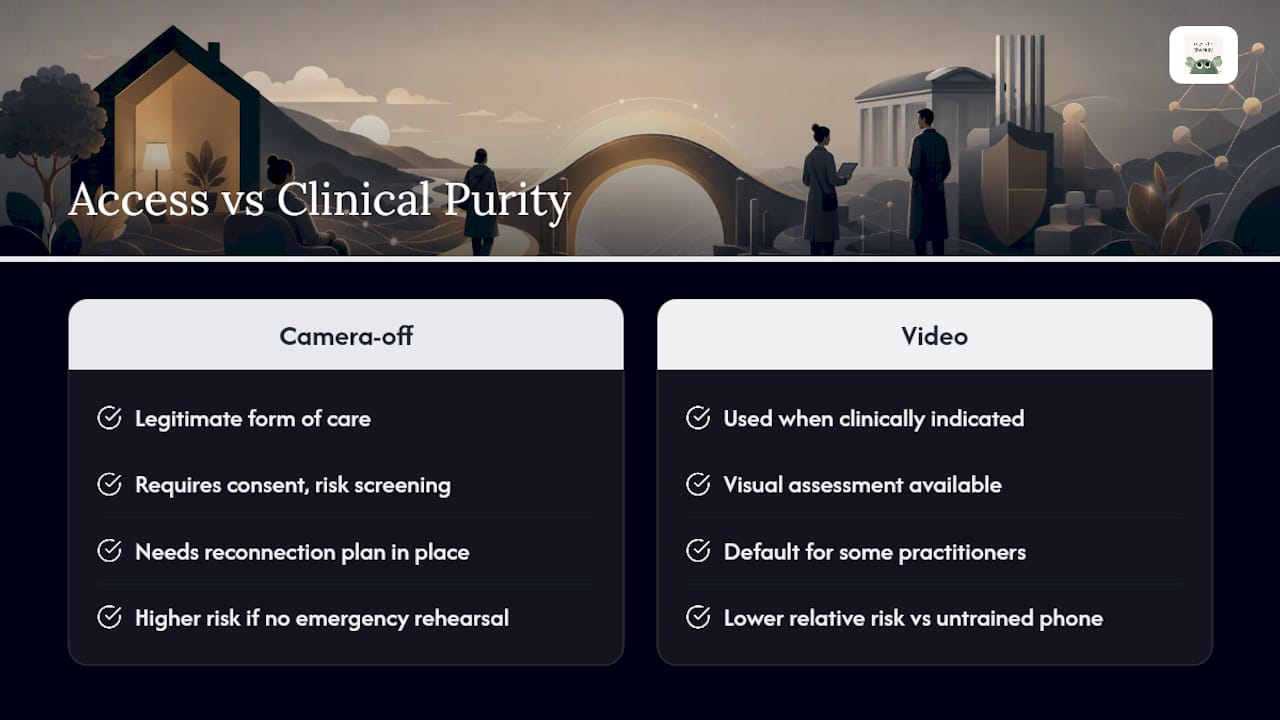
Insisting on video for every client, regardless of circumstance, mistakes uniformity for rigour. The evidence doesn't support that stance, and neither does clinical common sense. Audio-only, done properly, with consent, risk screening, and a reconnection plan in place, is a legitimate form of care rather than a compromise.
That said, flexibility only works when it's paired with training. A therapist who has never rehearsed an emergency protocol for a phone session is taking a bigger risk than one who insists on video by default. The accommodating approach we'd advocate for isn't "anything goes." It's "camera-off when safe, video when clinically indicated, and the client's preference taken seriously either way." If you're weighing this up for yourself, raise it directly with whoever you work with. It's a normal conversation to have, not an awkward one.
— MySafeTherapy
Ready to start therapy on your own terms?
If reading this has made you want a format that actually fits your life, rather than one you're expected to tolerate, starting therapy with Mysafetherapy takes a few minutes and lets you choose video, phone, chat, or avatar from day one, no long sign-up process and no pressure to commit to a format that doesn't suit you.
If camera-off still feels like the right fit but you'd like the reassurance of full anonymity, avatar-based sessions start from £49 and let you engage fully without ever appearing on screen. Clients managing social anxiety often find this bridges the gap between audio-only and video more comfortably than either extreme, and the social anxiety support pages go into more detail on how that works in practice. Between sessions, the free mood tracking tool takes a minute and helps you and your therapist notice patterns that camera-off sessions alone might miss. Whichever format you choose, you decide, and you can change your mind later.
Sources
The systematic review of telephone versus video consultations, the qualitative synthesis on audio-only telemental health, and a legislative report on audio-only telehealth access offer a fuller picture for readers who want the underlying research. For a non-clinical view on managing privacy expectations in personal relationships, CheaterDetectorAI's piece on online privacy boundaries covers adjacent ground worth considering.
This article is general information, not a substitute for advice from a qualified doctor. Consult a qualified healthcare professional about your own circumstances before acting on anything here.
- Comparison of telephone and video telehealth consultations: systematic review (PMC10692872)
- Comparative effectiveness of audio-based care for mental health and substance use disorders (MLR 2025 DOI)