

A crisis plan is a short, written safety plan you and your clinician create while you're well, so everyone knows exactly what to do if your mental health suddenly worsens. It works because it removes guesswork at the exact moment you're least able to think clearly. Common formats include a personal safety plan, a Joint Crisis Plan (JCP), or an advance statement, and the right one depends on your situation.
TL;DR:
- Crisis plans should be concise, focusing on early and escalation signs, trusted contacts, coping actions, medication details, and post-crisis steps, ideally on a single page.
- Joint Crisis Plans facilitated with clinicians in NHS records can reduce compulsory admissions and improve therapeutic relationships but require early involvement and proper documentation.
- Building the plan with professional support helps tailor it to your history, with rehearsals and updates increasing usability during actual crises.
- Use your crisis plan as a stepwise guide, starting with trusted contacts, then calling non-immediate crisis lines, and finally emergency services if needed.
- Regularly review and store your plan with your GP or in trust records, keeping it simple, up-to-date, and actionable in emergencies.
Table of Contents
- What a crisis plan is and who it helps
- Key elements every crisis plan should include
- Types of crisis plans used in therapy and clinical care
- How to build your crisis plan with a therapist, step by step
- When and how to use the plan in an emergency
- Keeping your plan useful over time
- How Mysafetherapy supports crisis plan work
- Start building your plan with professional support
- Sources
What a crisis plan is and who it helps
Terminology in this area is inconsistent, and that trips people up more than the actual content of the plans. A "safety plan" usually means a personal, self‑led document focused on suicidal thoughts or acute distress. A "crisis plan" is broader and can cover any sudden deterioration, including psychosis or severe anxiety. WRAP (Wellness Recovery Action Plan) is a structured recovery framework that includes a crisis section alongside daily wellness tools. A Joint Crisis Plan is facilitated with clinicians and stored in NHS records.
None of these require a diagnosis. Anyone in therapy, or simply managing their own mental health, can write one.
- Safety plan: self‑written, informal, focused on immediate risk
- WRAP: broader recovery tool with built‑in crisis and post‑crisis sections
- Joint Crisis Plan: clinician‑facilitated, held in NHS trust records
- Advance statement/decision: sets out preferences, with limited legal force
Most crisis plans are not legally binding. Only a properly witnessed advance decision to refuse specific treatment carries legal weight, and even then, the Mental Health Act can still override it during detention.
Key elements every crisis plan should include
A good plan reads like a checklist, not an essay. Keep it to one page if you can.
- Front sheet: your name, date of birth, current medications in brief, and where the full plan is kept.
- Yellow signs: early warning signs, such as skipping meals, withdrawing from friends, or sleeping less.
- Red signs: signals that things have escalated, like intrusive thoughts, self‑harm urges, or not leaving the house for days.
- First‑line coping actions: three to seven steps, ordered from easiest to hardest. Grounding techniques improve adherence during acute distress precisely because they stay achievable when concentration is impaired.
- Trusted contacts: names, numbers, and one line on what you want them to actually do (call you, come over, phone your GP).
- Professional contacts: GP, care coordinator, crisis line, with a short phrase you can read aloud when calling ("I have a crisis plan and I'm struggling with X").
- Medication and allergy details: a short standard format works better than a paragraph. Clinicians respond faster to "drug, dose, date started, reaction" than to narrative description.
- Post‑crisis steps: who you tell afterwards, and when to review the plan again.
Pro Tip: Write your red signs from memory of your last actual crisis, not from a generic list. "I stop replying to texts for 48 hours" is more useful to a friend than "feeling low".
Types of crisis plans used in therapy and clinical care
Which format suits you depends on how much structure and clinical involvement you want.
- Personal safety plans and WRAP are person‑led and flexible. You can write one alone, with a therapist, or using Mind's practical guidance, and update it whenever you like.
- Joint Crisis Plans are facilitated jointly with your clinical team and stored in NHS records. A randomised trial found JCPs reduced compulsory admissions significantly and shortened average detention substantially, though later multicentre evaluations found mixed results on admission outcomes while confirming improved therapeutic alliance.
- Advance statements record your preferences (which medication you'd prefer, who to contact) but aren't enforceable. Advance decisions to refuse specific treatment can be legally binding if properly witnessed, though the Mental Health Act can still override them during detention.
Involve your GP or care coordinator early if you want a JCP considered. A solicitor is only usually needed for a formal advance decision.
How to build your crisis plan with a therapist, step by step
Building the plan collaboratively, rather than filling in a template alone, is what makes it usable under pressure.
- Prepare beforehand. Jot down what triggered past episodes, what actually helped, and your current medication list before the session.
- Draft together. Put the easiest actions first. A plan that opens with "ring my sister" works better in a real crisis than one that opens with "practise a 20‑minute breathing exercise".
- Agree and document. Decide who keeps a copy, whether it goes into your GP or trust record, and who else (a partner, a housemate) should have one.
- Rehearse it. Read the plan aloud in session, or walk through what you'd actually do at 2am. This is where a personalised therapy routine helps, since crisis rehearsal fits naturally alongside regular session work.
- Ask about facilitation. If you want a formal JCP, a practical route is to draft a personal plan first, share it with your care coordinator, then request facilitation so it's placed properly in trust records.
- Handle disagreements calmly. If a clinician pushes back on a preference (say, refusing a specific medication), ask them to note your preference in writing even if it can't be formally binding. That written record still carries weight in future conversations.
Pro Tip: Bring your plan to every session for the first few months. Small edits, a phone number that's changed, a coping step that didn't work, matter more than getting it perfect on day one.
When and how to use the plan in an emergency
Think of it as a ladder, not a single button to press.
- Step one: contact a trusted person on your list first, if you're safe enough to do so.
- Step two: call NHS 111 (select the mental health option) or your local crisis line for urgent, non‑immediate risk.
- Step three: call 999 or go to A&E for immediate danger to yourself or others.
When you reach A&E or speak to ambulance staff, lead with the one‑line summary from your front sheet rather than your full history. Samaritans' safety‑plan guidance recommends exactly this: short, direct information first. Keep a wallet card or an encrypted phone note as backup if your GP or trust doesn't yet hold a digital copy. If you're detained under the Mental Health Act, your plan can still influence decisions about medication preferences and who's contacted, even though it can't override clinical judgement.
Keeping your plan useful over time
Review your plan after any hospital admission, any medication change, and at least once a year regardless. Store the master copy with your GP, in your trust's record if you have a JCP, and keep a working copy on your phone and with one trusted person.
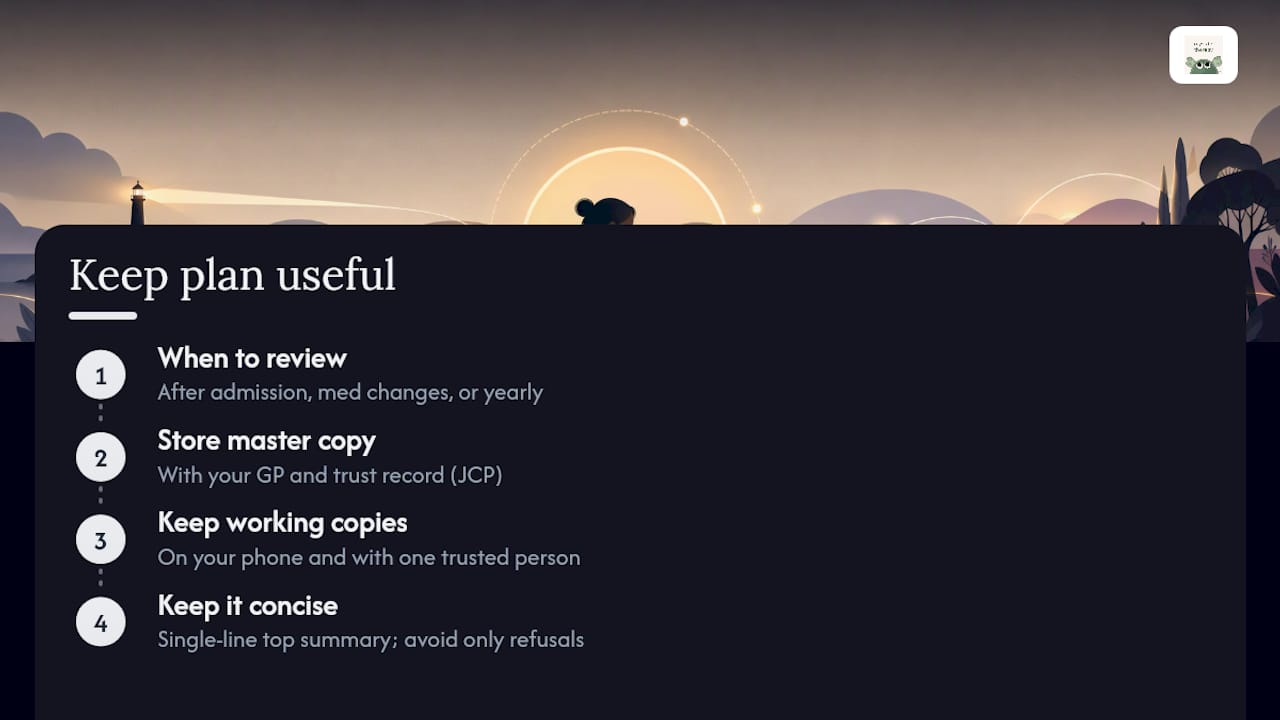
Avoid two common mistakes: making the plan too long, and filling it with things you won't do rather than things you will. A plan of pure refusals ("don't call my mother", "don't suggest hospital") gives clinicians nothing to act on. Put a single‑line summary at the very top, something readable in ten seconds by someone who's never seen the document before.
How Mysafetherapy supports crisis plan work
Drafting a workable crisis plan takes structured time with someone who knows your history, which is what one‑to‑one therapy sessions can provide. Therapists can help you build and rehearse the plan across various online formats, while journaling and mood tracking tools flag the early warning signs your plan should list. If you want a facilitated JCP, raise it with your GP or care coordinator once your personal draft exists.
— MySafeTherapy
Start building your plan with professional support
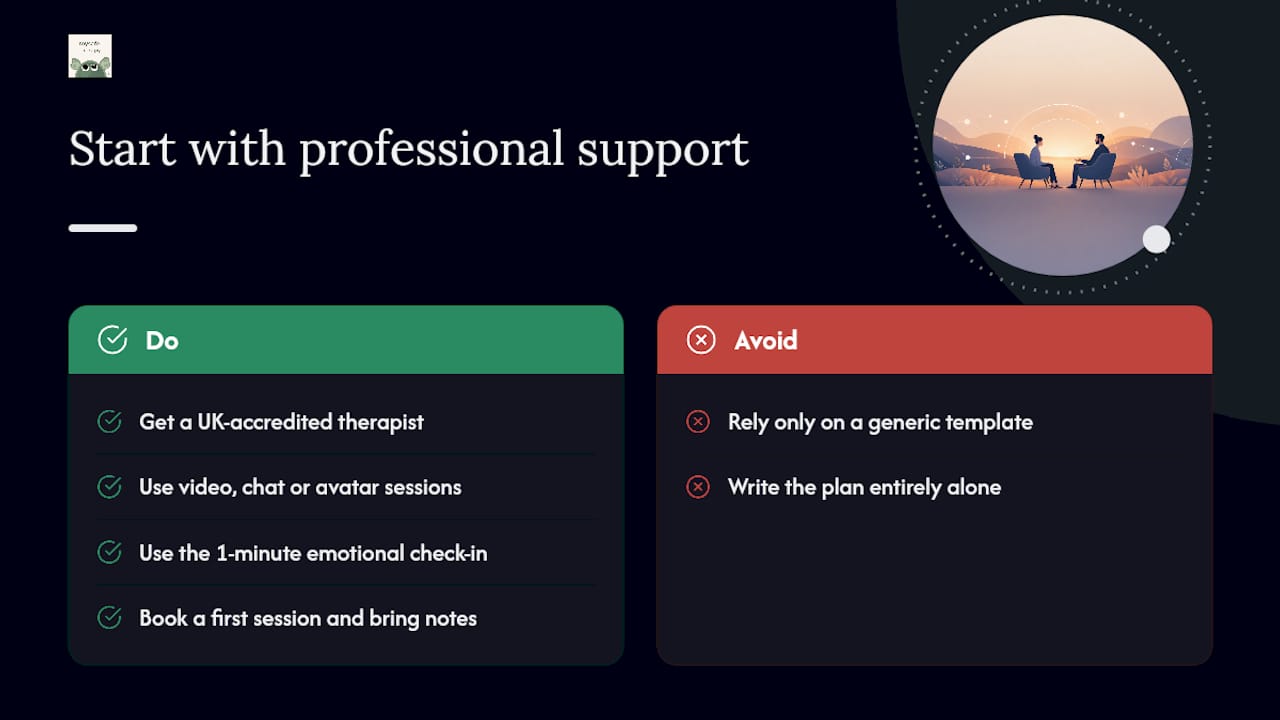
Writing a crisis plan alone is possible, but it's far more robust when a therapist helps you stress‑test it against your actual history rather than a generic template. Mysafetherapy connects you with UK‑accredited therapists across video, chat, and avatar‑based sessions, which suits anyone who wants to talk through red signs and coping steps without feeling exposed on camera. Between sessions, the emotional check‑in tool takes a minute to log mood and early warning signs, giving you and your therapist real material to refine the plan with, rather than guesswork after the fact. If anxiety around specific situations, like assessments or high‑pressure events, feeds into your triggers, it's worth reading how others plan around timing pressure and anxiety too. The most useful next step is simple: book your first session and bring whatever notes you already have.
This article is general information, not a substitute for advice from a qualified doctor. Consult a qualified healthcare professional about your own circumstances before acting on anything here.
Sources
- Effect of joint crisis plans on use of compulsory treatment in psychiatry: single blind randomised controlled trial (BMJ)
- Joint crisis planning in mental health care: the challenge of implementation in randomized trials and in routine care (PMC)
- How to plan for a mental health crisis | Mind
- Help someone create a 'safety plan' | Samaritans