
TL;DR:
- Building a personalized routine helps manage anxiety and depression by providing structure and consistency.
- Understanding available support options and choosing approaches aligned with symptom severity and preferences is essential.
- Progress is slow and subtle, but small, measurable changes over weeks indicate growing mental resilience.
When anxiety or depression takes hold, even simple daily tasks can feel unpredictable and exhausting, leaving many UK adults unsure where to begin with their own mental health. A structured, personalised therapy routine changes that. Rather than waiting for motivation to appear, a clear framework gives you a repeatable path forward, whether you are managing low mood, persistent worry, or the kind of creeping burnout that builds over months. This guide sets out the practical steps to build that framework using evidence-based principles aligned with NHS guidance and modern self-help approaches.
Table of Contents
- What to know before you begin
- Step-by-step: Building your therapy routine
- Common mistakes and how to troubleshoot
- What progress looks like — and when to seek more support
- Why a routine beats motivation — and what most guides miss
- Take the next step with professional support
- Frequently asked questions
Key Takeaways
| Point | Details |
|---|---|
| Start small | Set achievable goals with just one or two daily activities for lasting effect. |
| Use proven methods | CBT-based scheduling, worry time, and grounding can make routines more effective. |
| Review weekly | Regularly check what helps your mood and adjust what isn’t working. |
| Seek help when needed | Speak to a GP or therapist if symptoms worsen or you need more support. |
What to know before you begin
Building an effective routine starts with understanding what support is actually available to you and which approach fits your circumstances. The UK offers a range of publicly funded and private options, each suited to different needs and levels of severity.
NHS talking therapies for adults include cognitive behavioural therapy (CBT), counselling, mindfulness-based cognitive therapy (MBCT), and guided self-help, with access typically through referral or, for conditions such as anxiety and depression, direct self-referral. This means you do not always need to see your GP first. For many adults in England, the Improving Access to Psychological Therapies (IAPT) service allows self-referral online or by phone within minutes. Understanding how therapists support mental health can help you decide which route best fits your situation before you commit to anything.
Before settling on an approach, consider the following personal factors:
- Symptom severity: Mild to moderate anxiety or depression often responds well to guided self-help and structured routines. More severe or persistent symptoms may require a formal therapy programme.
- Time availability: Some approaches, such as CBT, work best with weekly structured sessions. Others, like mindfulness practice, can be built into shorter daily windows.
- Comfort with digital formats: Online and app-based tools make accessing online therapy more flexible than ever, but some people prefer face-to-face contact.
- Previous experience: If you have tried certain approaches before, knowing what helped and what did not is valuable information, not a failure.
| Therapy approach | Delivery format | Best suited to |
|---|---|---|
| CBT | One-to-one, group, online | Anxiety, depression, phobias |
| MBCT | Group, guided programme | Recurrent depression, stress |
| Counselling | One-to-one, in-person or video | Life events, grief, relationship issues |
| Guided self-help | Workbooks, apps, online modules | Mild to moderate anxiety/depression |
Important: NHS guidance makes clear that the right pathway depends on symptom severity, any co-occurring conditions, and overall risk level. If you are uncertain whether self-referral is appropriate, or if you suspect a more complex condition such as bipolar disorder, psychosis, or an eating disorder, speak to your GP before starting any self-directed routine. The right starting point matters.
Step-by-step: Building your therapy routine
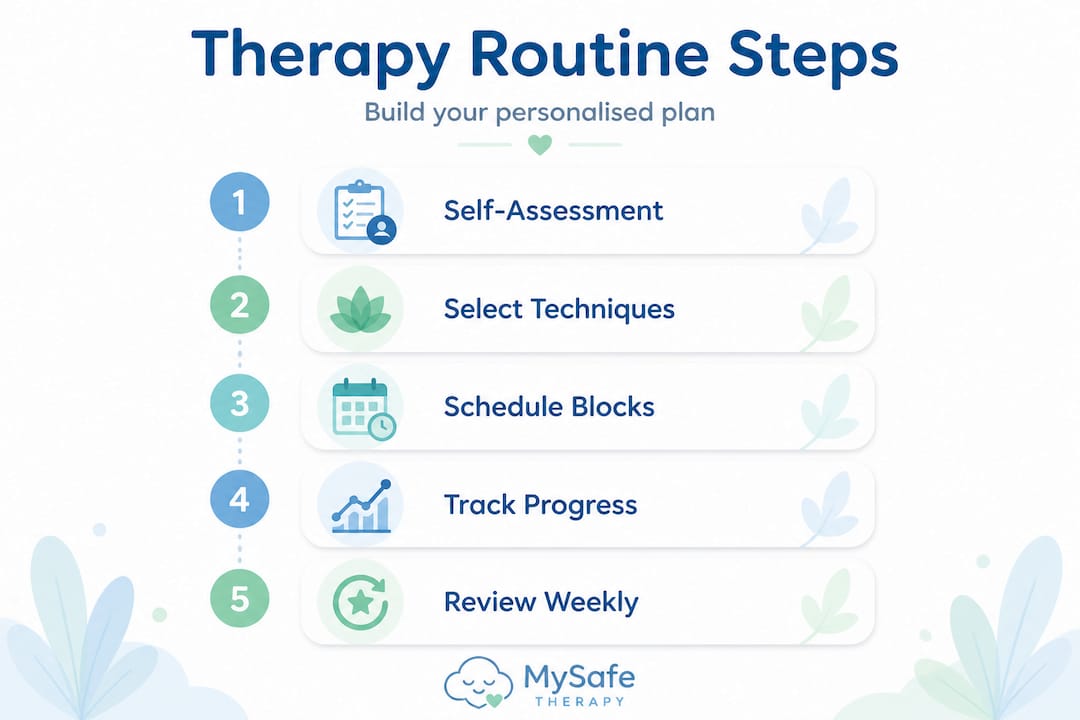
Once you understand your options and have a realistic picture of your needs, you can begin designing a routine that is both practical and sustainable. The goal is not perfection. It is consistency.
1. Conduct a simple self-assessment
Before choosing any technique, spend ten to fifteen minutes noting your current patterns. When do low mood or anxious thoughts tend to peak? What activities seem to help, even briefly? A simple diary or notes app entry each day for one week gives you real data to work from rather than guesswork.
2. Choose one or two focus techniques
Self-help routines for anxiety and depression can be built around structured CBT techniques such as managing worry through scheduled "worry time" and grounding methods when symptoms escalate. Start with one technique and add a second only once the first feels natural.
3. Schedule your sessions and practice blocks
Treat each routine activity as a fixed appointment. A fifteen-minute grounding exercise at 8am and a ten-minute worry time slot at 6pm, for example, creates predictable structure. Use phone reminders, a weekly planner, or a paper calendar. The format is less important than the consistency.
4. Apply activity scheduling principles
A practical method for both depression and anxiety is CBT-style activity scheduling: track what you do across the day and note how each activity affects your mood, then plan a limited set of manageable activities in advance. This is not about filling your diary. It is about identifying which actions lift your mood and building them in deliberately.
5. Monitor progress weekly
At the end of each week, review what you did and how you felt. A simple mood tracker app or a handwritten log both work. Look for patterns rather than dramatic breakthroughs.
The table below compares three techniques commonly included in self-help routines:
| Technique | What it is | Best used when |
|---|---|---|
| Worry time | A fixed daily slot to process anxious thoughts | Anxiety feels constant or intrusive |
| Activity scheduling | Planning mood-lifting activities in advance | Low motivation or low mood dominates |
| Grounding (5-4-3-2-1) | A sensory focus exercise to interrupt spiralling | Anxiety spikes or panic onset |
Pro Tip: Start with one activity per day, not five. A routine built on one small, reliable action is far more likely to survive a difficult week than an ambitious plan that collapses under pressure.
A relevant benchmark: CBT-based courses are commonly scheduled once every week or two, with a full course often spanning 8 to 16 sessions. That timescale applies to formal therapy, but it signals something important for self-help routines too. Measurable change takes weeks, not days.
Common mistakes and how to troubleshoot
Even a well-designed routine will encounter obstacles. Recognising the most common pitfalls in advance makes it easier to recover from them rather than abandoning the plan altogether.
Common mistakes to watch for:
- Trying to change too much too quickly. Adding five new habits in week one almost always leads to burnout by week two. The brain does not adapt at that pace.
- Skipping the weekly review. Without a check-in, small drifts in the routine go unnoticed until the whole structure has quietly collapsed.
- Treating a single missed day as failure. One skipped session is data, not defeat. The response that matters is what you do the following day.
- Setting vague goals. "Feel better this week" is not a goal. "Complete one fifteen-minute walk and one worry time session each day" is.
- Expecting linear progress. Mood and anxiety levels fluctuate. A harder week does not mean the routine is failing.
The NHS advises that starting small and measurable, such as one or two planned activities per day with a weekly review of what helped, is the appropriate benchmark. If symptoms are not improving, the right response is to adjust the plan rather than push harder through an approach that is not working.
Practical timing matters too. NHS Inform's anxiety self-help guidance specifies that "worry time" should be limited to ten to fifteen minutes and kept to a single fixed slot per day. Without those constraints, a structured technique can drift into an unproductive worry cycle that lasts all evening.
"The most useful review is not asking what you failed to do. It is asking what actually helped, however small, and whether you can do more of that next week."
Pro Tip: If your routine stops working, do not double down or abandon it. Instead, reduce it to its smallest viable form and rebuild gradually. Scaling back is a strategy, not a setback.
Refer to mental health management tips for additional strategies on maintaining consistency during particularly difficult periods, including during high-stress work phases or life transitions.
What progress looks like — and when to seek more support
One of the most disorienting aspects of managing anxiety or depression is not knowing whether anything is actually working. Progress is rarely dramatic. It tends to be quiet and incremental.
Signs your routine is having a positive effect:
- You notice slightly more energy on most days, even if energy is still lower than you would like.
- Sleep quality or duration shows some improvement, even modest.
- You are able to engage in one or two previously avoided activities each week.
- Low mood or anxious episodes feel slightly shorter or less intense.
- You have a greater sense of agency, even on difficult days.
- You find it easier to return to the routine after a difficult period.
These changes are not always visible week to week. A monthly comparison is often more informative than a daily one.
| Approach | Typical timeframe for initial improvement | Notes |
|---|---|---|
| Guided self-help | 4 to 6 weeks | Requires daily consistency |
| Structured CBT routine | 8 to 16 sessions | Works best with therapeutic input |
| Formal talking therapy | 6 to 12 weeks | Outcome depends on fit and engagement |
| Medication (if prescribed) | 4 to 6 weeks for antidepressants | Prescribed and monitored by GP |
For depression specifically, NHS treatment commonly combines self-help, talking therapies, and in some cases medication, with the choice of approach depending on symptom severity. That combination matters. A self-help routine is one part of the picture, not the whole of it.
Knowing when to escalate is equally important. Consult your GP or consider starting online therapy if you notice any of the following:
- Symptoms persist or worsen after several weeks of consistent effort.
- You experience persistent low mood lasting more than two weeks with no improvement.
- You feel unsafe or have thoughts of harming yourself. In that case, contact your GP urgently or call 999.
- Daily functioning is significantly impaired at work, in relationships, or with basic self-care.
A self-help routine is not a substitute for clinical care. It is most effective as a complement to it.
Why a routine beats motivation — and what most guides miss
Most mainstream mental health content leads with motivation. It promises that once you find the right reason, the right mindset, or the right moment, consistent self-care will follow naturally. This is not how behavioural change actually works.
Motivation is a feeling. Feelings are temporary and heavily influenced by the very symptoms you are trying to manage. When depression suppresses energy and initiative, or when anxiety makes planning feel threatening, waiting for motivation is the least reliable strategy available.
A routine, by contrast, is a structure. It does not require you to feel ready. It only requires you to do the next small action. That distinction is significant.
From both clinical observation and the accounts of UK adults who have managed their own mental health over time, one pattern emerges consistently. Those who maintain progress over months and years do not do so by having particularly strong willpower. They do so by keeping their routines small enough to survive bad days. Five minutes of structured breathing. One entry in a mood log. A single planned activity after work. These are not dramatic interventions. They are reliable ones.
Explore self-help resources for flexible support to find tools that fit around work, family, and the unpredictable pace of real life.
The second thing most guides miss is the role of visible wins. When a routine is in place, even a partial completion of the day's plan provides a concrete reference point. "I did the worry time slot. I went for a short walk." That record matters. It counters the cognitive distortion, common in both depression and anxiety, that nothing is working and nothing has changed.
Building a personalised routine is not about engineering a perfect system. It is about creating a structure that is strong enough to hold you on difficult days and flexible enough to adapt as your needs change.
Take the next step with professional support
A structured self-help routine is a meaningful starting point, and for many people it produces real, measurable improvements in mood and daily functioning.
However, self-help works best alongside professional input, particularly when symptoms are persistent or complex. MySafeTherapy connects you with UK-accredited therapists registered with BACP, UKCP, and NCPS, available via video, chat, or avatar-based sessions, including evenings and weekends. Whether you want guidance on building your routine or need a more tailored therapeutic programme, start therapy today through the MySafeTherapy platform with clear pricing, flexible scheduling, and full confidentiality. Professional support does not replace what you are already doing. It builds on it.
Frequently asked questions
Do I need a referral to start therapy in the UK?
For many NHS talking therapies, including CBT and guided self-help for anxiety and depression, you can self-refer without seeing a GP first. Private platforms such as MySafeTherapy also allow direct access without a referral.
What types of therapy are most effective for anxiety and depression?
CBT is the most widely recommended approach for both conditions, with NHS talking therapies also including counselling, MBCT, and guided self-help as evidence-based options. The most effective type depends on the individual and the nature of their symptoms.
How quickly should I expect results from a therapy routine?
Initial improvements from a consistent self-help routine may appear within four to six weeks, though CBT courses are typically scheduled over 8 to 16 sessions for more complete results. Progress tends to be gradual rather than sudden.
What should I do if my symptoms get worse?
If symptoms worsen or you feel unsafe, contact your GP promptly or seek urgent care. NHS guidance is clear that severity and risk level determine the appropriate next pathway, and self-help alone is not suitable for all presentations.