
Online EMDR produces clinically meaningful reductions in PTSD, anxiety and depression, and the evidence so far shows no reliable difference in outcomes compared with face-to-face delivery. That verdict comes from a mix of randomised trials, a multilevel meta-analysis and UK service evaluations, though study sizes remain modest and results vary enough that a clinician still needs to confirm suitability for your specific situation.
TL;DR:
- Online EMDR demonstrates similar effectiveness to face-to-face therapy, with a meta-analysis showing no significant overall difference in outcomes.
- The eight-phase protocol remains unchanged online, with bilateral stimulation delivered via screen tracking, eye movements, tapping, or self-administered techniques.
- Most adults with simple trauma or anxiety are suitable candidates for remote EMDR, but complex trauma, recent crises, or dissociation require thorough pre-treatment assessments.
- Evidence for online EMDR is growing despite modest study sizes, with high completion rates and positive client feedback on convenience and engagement.
- Therapist accreditation, supervision, and delivery quality are more crucial than the treatment medium itself for achieving positive results.
Table of Contents
- What the research shows on EMDR online effectiveness
- How online EMDR is delivered: the eight phases explained
- Is online EMDR safe for everyone?
- How many sessions does online EMDR typically take?
- Where the evidence still falls short
- Does online EMDR work for children and veterans?
- What training do therapists need to deliver EMDR online?
- MySafeTherapy's approach to online EMDR
- How to start online EMDR with MySafeTherapy
- Why the "it's not real therapy if it's on a screen" myth persists
- Sources
- FAQ
What the research shows on EMDR online effectiveness
The strongest single piece of evidence is a systematic review and multilevel meta-analysis comparing synchronous video-based psychotherapy against face-to-face treatment across multiple randomised trials and multiple mental health diagnoses. It found no significant average difference between the two formats, with an overall effect size of Hedges g = −0.09. That number sits close enough to zero that video and in-person therapy behave, on average, the same.
In numbers: the meta-analysis's confidence interval ran from −0.52 to 0.33, and the prediction interval flagged substantial heterogeneity between studies. Translation: the average result is reassuring, but individual trials still swing widely depending on population, protocol and technical quality.
Trial-level data on EMDR specifically tells a similar story, with some added texture. A randomised trial conducted after the 2023 Kahramanmaraş earthquakes delivered both EMDR and CBT remotely to survivors and found both treatments produced large PTSD reductions against a control group, with large effect sizes. EMDR showed a tendency toward steeper symptom decline than CBT, though the confidence intervals overlapped enough that neither treatment can claim a decisive edge.
Closer to home, a mixed-methods service evaluation from a primary care network in England reported high completion rates and large pre to post reductions across standard trauma and mood measures for clients receiving EMDR entirely online. Acceptability ran high too. Clients described valuing:
- Not having to travel to an unfamiliar clinic while processing distressing material
- Feeling more control over their environment during difficult sessions
- Higher attendance and lower drop-off than they expected going in
Separate reviews of online EMDR effectiveness points to a similar pattern, with some brief protocols reporting notable symptom reductions. That's a genuinely useful evidence base for a modality that barely existed in clinical practice before 2020.
How online EMDR is delivered: the eight phases explained
The protocol itself doesn't change for remote delivery. Francine Shapiro's original eight-phase EMDR structure stays intact whether you're sitting across from a therapist or logging in from your kitchen table.
- History taking — the therapist reviews your background and identifies target memories.
- Preparation — you learn grounding and self-soothing techniques before any reprocessing begins.
- Assessment — a specific memory is selected, along with its image, belief and emotional charge.
- Desensitisation — bilateral stimulation is applied while you focus briefly on the memory.
- Installation — a more adaptive belief is strengthened in place of the old one.
- Body scan — residual physical tension linked to the memory is checked and addressed.
- Closure — every session ends with stabilisation, whether or not processing is complete.
- Reevaluation — the next session begins by checking how the previous work has settled.
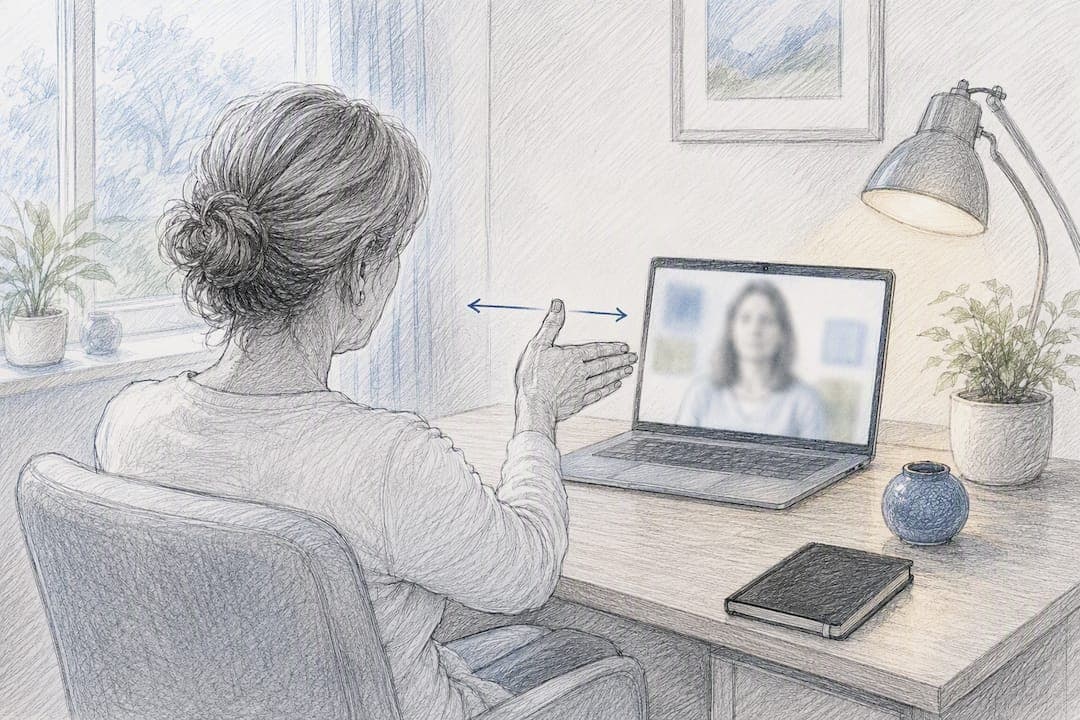
What changes online is how bilateral stimulation gets delivered. Therapists commonly use on-screen tracking dots, guided eye movements via video, self-administered tapping, or the butterfly hug technique, where you cross your arms and tap your own shoulders in rhythm. None of these substitute the clinical judgement behind each phase; they simply replace the therapist's moving hand.
Pro Tip: Test your internet connection and audio setup a day before your first EMDR session, not five minutes beforehand. Bilateral stimulation depends on a steady, uninterrupted rhythm, and a lagging video feed can break your concentration at exactly the wrong moment.
Is online EMDR safe for everyone?
Most adults with single-incident trauma, anxiety or mild to moderate PTSD are reasonable candidates for remote EMDR. Suitability gets more complicated when other factors are in play, and a proper assessment should happen before you commit to a course of sessions.
Therapists typically watch for:
- Active suicidal intent or a recent crisis requiring urgent in-person support
- Severe dissociation that could make remote grounding difficult to manage safely
- Unstable housing or a lack of private, uninterrupted space for sessions
- Complex, layered trauma histories that may need specialist or face-to-face assessment first
A properly run online assessment includes a risk conversation and an agreed crisis plan, covering what happens if you become distressed between sessions or if the connection drops mid session. Video does lose some non-verbal information, a shift in breathing, a barely visible flinch, that a therapist in the room might catch instantly. Experienced remote practitioners compensate by checking in more verbally and building in a deliberate "safe container" ritual at the start and end of each session, since clients lack the natural transition of physically leaving a therapy room after a session.
How many sessions does online EMDR typically take?
UK service evaluations report typically several sessions for standard trauma-focused online EMDR, though intensive formats compressed into four to twelve sessions over a shorter window are increasingly common for single-incident trauma.
Progress gets tracked with standard, validated tools rather than guesswork:
- PCL-5 for PTSD symptom severity
- GAD-7 for generalised anxiety
- PHQ-9 for depressive symptoms
The primary care evaluation mentioned earlier reported large pre to post reductions across all three measures, alongside high completion rates, a detail that matters because dropout undermines outcomes in any modality. Accessibility appears to be doing real work here: removing the commute and the waiting room seems to keep more people showing up to finish the course they started, which is arguably as important as the technique itself.
Where the evidence still falls short
None of this evidence is closed and settled, and it's worth being honest about where the gaps sit.
- Most trials and evaluations involve modest sample sizes, which limits how confidently findings generalise to the wider population.
- Study designs vary considerably in protocol length, population and outcome measures, producing the heterogeneity flagged in the meta-analysis.
- Few trials are explicitly designed as non-inferiority studies, the gold standard for proving one format is genuinely equivalent to another rather than simply "not statistically different" in a smaller sample.
- Long-term follow-up beyond a few months is thin, so durability of gains from online delivery specifically is less well mapped than for in-person EMDR.
The practical consequence: online EMDR is a promising, reasonably well-supported option, not a guaranteed outcome. Diagnosis, technical quality and individual circumstances all shape results, which is exactly why a clinical conversation before starting still matters.
Does online EMDR work for children and veterans?
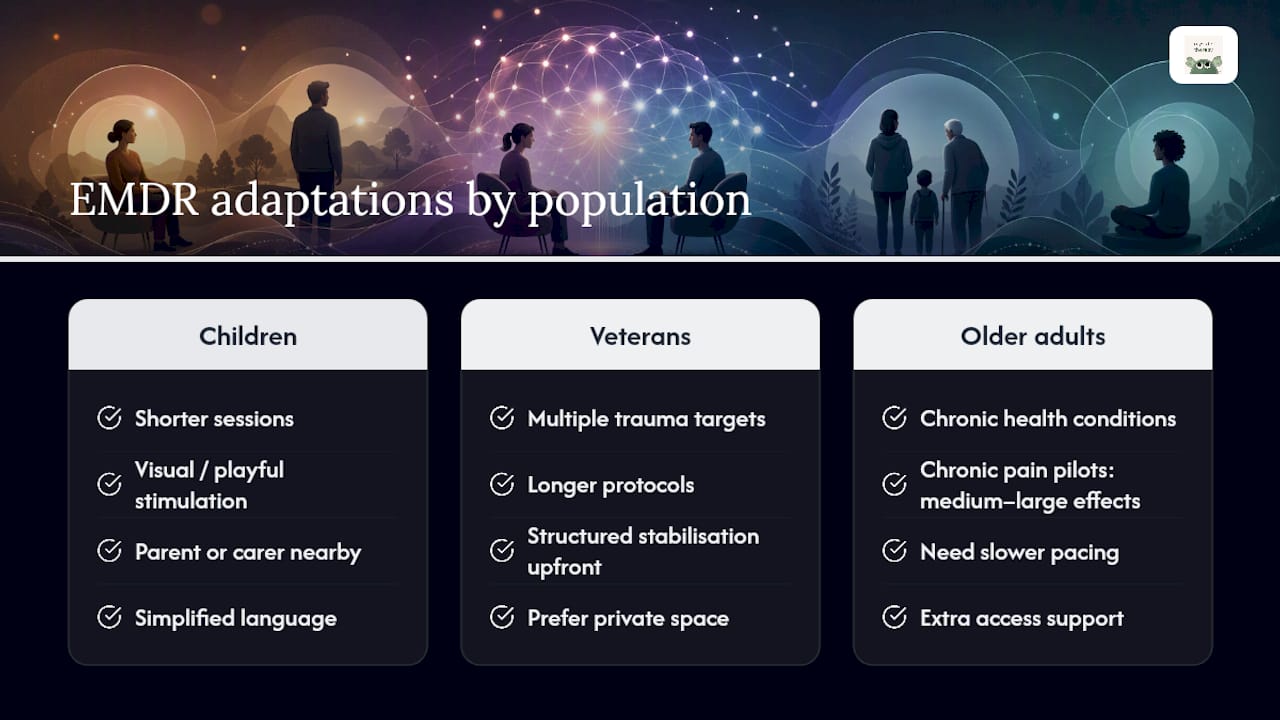
Population matters more than platform when it comes to adapting EMDR for remote delivery. Children generally need shorter sessions, more visual and playful bilateral stimulation options, and a parent or carer nearby, though not necessarily in view of the screen, to manage the practical and emotional side of remote work. Therapists working with younger clients often lean on simplified language for the eight phases and build in extra time for the preparation phase, since emotional regulation skills can't be assumed the way they might with an adult.
Veterans and emergency responders present a different set of adaptations. Combat-related and operational trauma frequently involves multiple targets rather than a single incident, so online protocols for this group often run longer and incorporate more structured stabilisation work upfront. Privacy also carries different weight: some veterans specifically prefer online sessions because a private, self-chosen space feels safer than a clinic waiting room shared with strangers.
Older adults and people with chronic health conditions represent a third adaptation category. Pilot work on online EMDR for chronic pain reported medium to large effect sizes on pain-related outcomes, though the authors were clear that sample sizes were small and larger trials are needed before firm conclusions can be drawn. Across every population, the constant is that the therapist adjusts pacing and support, not the underlying eight-phase structure.
What training do therapists need to deliver EMDR online?
EMDR is a specialist modality on top of a core therapy qualification, not a standalone entry-level training. Therapists typically hold accreditation through a recognised professional body, such as BACP, UKCP or NCPS, before completing separate, structured EMDR training accredited by an EMDR professional association, covering all eight phases in supervised practice.
Delivering EMDR remotely well adds a further layer most generalist training doesn't cover in depth: managing bilateral stimulation through a screen, reading distress cues over video, and running a safe closure ritual when the client is sitting in their own home rather than a clinical space. A commentary on tele-EMDR adaptations noted that refining these techniques during the pandemic significantly improved feasibility, but it also underlined that ongoing supervision and case discussion matter more, not less, when delivery moves online. Ask any prospective therapist directly about their EMDR-specific accreditation and how much remote EMDR experience they have logged, not just their general therapy credentials.
MySafeTherapy's approach to online EMDR
We connect clients with UK-accredited therapists registered with BACP, UKCP or NCPS, offering EMDR-suitable sessions across video, chat and avatar formats, and provide guidance on privacy-focused AI tools clinicians can use to support therapy through our privacy-first guide for UK practices. Every therapist's accreditation is checked before they join the platform, and privacy safeguards, flexible scheduling and adjunct tools like AI journaling and mood tracking support the work between sessions. Suitability for EMDR specifically is always confirmed by your therapist, not assumed from a form.
How to start online EMDR with MySafeTherapy
If the evidence above has you considering online EMDR, the practical next step is a proper suitability conversation, not a leap straight into treatment. Mysafetherapy exists precisely for that gap between "I think I need trauma support" and "I know exactly which therapy fits my situation." Every therapist on the platform holds verified accreditation with BACP, UKCP or NCPS, and you can check that registration before booking anything.

Sessions run one to one, chat-based, or through avatar-based formats if talking on camera feels like too much at first, and switching therapists later is available after discussing fit. Individual therapy sessions on Mysafetherapy start from £50 per session, with full details on the pricing page so you know the cost before you commit to anything. For trauma-specific concerns, the trauma and PTSD therapy service outlines what to expect from an initial assessment. Book that first conversation through Start Therapy and let a qualified therapist confirm whether EMDR, online or otherwise, is the right fit for you.
Why the "it's not real therapy if it's on a screen" myth persists
People still assume therapy delivered through a laptop must be a diluted version of the real thing, and that assumption gets repeated so often it starts to sound like established fact. It isn't. The meta-analytic evidence points the other way: format explains remarkably little of the variation in outcomes, while therapist skill, protocol fidelity and client engagement explain a great deal more.
What genuinely deserves more scrutiny than it gets is quality control on the therapist side, not the medium itself. Anyone can buy a webcam and call themselves an online trauma therapist; far fewer have logged supervised EMDR hours and hold current accreditation with a body like BACP or UKCP. The Kahramanmaraş trial and the primary care evaluation both worked because trained clinicians ran structured, supervised protocols remotely, not because a screen has some inherent therapeutic property. Readers weighing up EMDR online effectiveness should spend less time asking "does video work?" and more time asking "who exactly is running my sessions, and can I verify that?" That's a question that actually predicts outcomes.
— MySafeTherapy
This article is general information, not a substitute for advice from a qualified doctor. Consult a qualified healthcare professional about your own circumstances before acting on anything here.
FAQ
Is online EMDR as effective as in-person EMDR?
Current evidence suggests online EMDR performs comparably to face-to-face delivery, with a large meta-analysis finding no significant average difference between video and in-person psychotherapy formats. Individual results still vary, so a clinical assessment remains the best way to judge fit for your situation.
Why do some therapists have reservations about EMDR?
Some clinicians remain cautious because EMDR's exact mechanism isn't fully understood, and because heterogeneous trial results make it harder to promise consistent outcomes across every client. Others simply trained in different trauma modalities and haven't sought EMDR-specific accreditation themselves.
Why did Sandra Bullock reportedly try EMDR?
Public reports have linked several public figures to EMDR as a trauma treatment, reflecting its growing mainstream visibility rather than any unique celebrity endorsement of effectiveness. The clinical evidence behind EMDR stands independently of any individual's experience with it.
Does EMDR actually work for complex PTSD (CPTSD)?
EMDR is used for CPTSD, though treatment for complex, multi-layered trauma typically runs longer than the roughly eight sessions reported in standard UK service evaluations. A therapist experienced in complex trauma should assess pacing and stabilisation needs before starting reprocessing work.
How much does online EMDR cost through MySafeTherapy?
Individual therapy sessions on Mysafetherapy start from £50 per session, with tiered options detailed on the pricing page. Your therapist will discuss whether EMDR fits your goals during an initial assessment before any course of sessions begins.