
Online therapy delivers many of the same clinical benefits as face-to-face care for people with common mental health problems, and it improves access for those who cannot easily reach a clinic. Randomised trials and routine NHS Talking Therapies data both support this for mild to moderate anxiety and depression. It is not the right fit for everyone, particularly during a crisis or with severe, complex presentations, where in-person care remains preferable.
TL;DR:
- Online therapy significantly increases access for rural residents, shift workers, and those with logistical or mobility barriers, making support more feasible.
- Evidence from trials like INTERACT shows that therapist-led online CBT reduces depression symptoms for up to a year, with no increase in adverse events.
- Digital tools and NHS data indicate that remote therapy maintains or improves recovery rates compared to in-person care, especially when supported by trained clinicians.
- Online therapy suits mild to moderate anxiety or depression, but severe cases involving active suicidal thoughts, psychosis, or addiction require in-person or specialized intervention.
- Safety, privacy, and credential checks are critical, as providers should have clear crisis protocols, transparent costs, accredited therapists, and secure data handling before starting treatment.
Table of Contents
- What are the core benefits of online therapy?
- Is online therapy actually effective?
- Who should try online therapy, and who should not?
- Video, phone, chat or guided programme: which format fits?
- What should you check before booking online therapy?
- How do you choose a provider and prepare for your first session?
- Does MySafeTherapy meet these standards?
- Where does online therapy fit in the future of mental health care?
- Ready to start? Here's how to book with confidence
- Sources
- FAQ
What are the core benefits of online therapy?
The single biggest advantage is reach. Someone in a rural area with one therapist within 30 miles, a parent who cannot arrange childcare for a Tuesday afternoon appointment, or a shift worker whose hours never align with a clinic's opening times, all gain access to a therapist they otherwise would not see. Mobility-restricted patients avoid a physically difficult journey altogether. This is not a marginal convenience. It is the difference between getting support and not getting it.
Convenience compounds over time in ways that matter more than they first appear. A session that starts the moment you open a laptop, rather than after a 40-minute drive and a search for parking, is a session far less likely to be cancelled. Cancellations and no-shows are the quiet killer of therapeutic progress, since sporadic attendance blunts even the best-designed treatment plan. Remote delivery lowers that friction, and IAPT service data shows this shows up in practice: attendance and treatment fidelity improved once services moved to telephone and video delivery, a plausible mechanism behind the outcome gains seen in that data.
Privacy plays a role too, often an underestimated one. Attending therapy from your own home, rather than sitting in a waiting room where a neighbour or colleague might see you, removes a barrier that keeps some people from ever booking a first appointment. For anyone worried about stigma, particularly in smaller towns or close-knit workplaces, that difference alone can decide whether they seek help at all.
The financial and time savings are concrete rather than abstract:
- No petrol, train fare, or parking charges for a weekly appointment
- No half-day taken from annual leave to attend a lunchtime slot
- No lost hour commuting each way, which over a 12-week course of therapy adds up to a working week's worth of time
- Fewer missed sessions, meaning less money spent on appointments that deliver no clinical value
- Flexible evening and weekend slots that fit around shift patterns and caring responsibilities
None of this replaces clinical skill, and a poorly matched therapist is a poor fit whether you meet them online or in a room. But when accessibility, convenience, and reduced stigma combine, more people start therapy, more people finish a full course, and more people return for a top-up session when they need one. That pattern, sustained engagement rather than a single good appointment, is what tends to drive better outcomes over months rather than weeks.
Is online therapy actually effective?
Yes, for the conditions and delivery models that have been studied, and the evidence base is more substantial than many assume. Three separate strands of research point the same direction: NICE's early value assessment, a large UK randomised trial, and routine NHS service data.
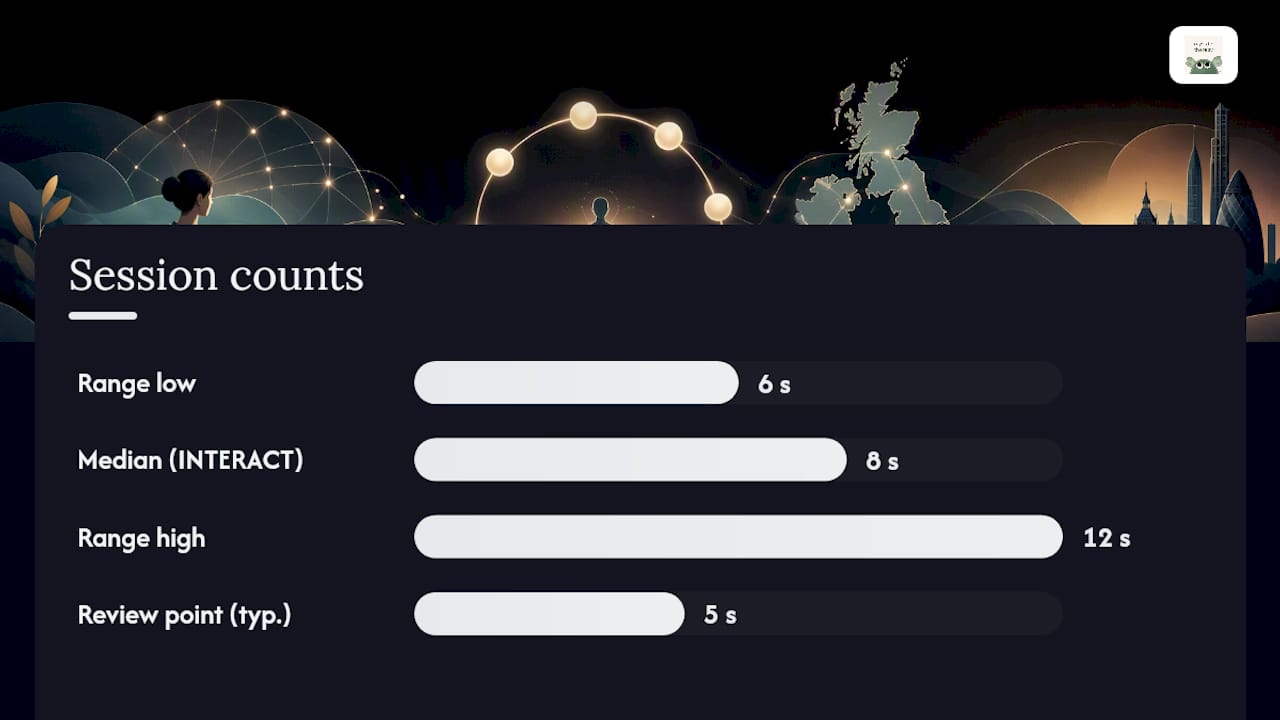
The INTERACT trial found that integrated therapist-delivered online CBT reduced depressive symptoms at six months compared with usual care, with an adjusted difference of −4.4 on the BDI-II and an effect size of 0.43, a moderate effect by clinical trial standards.
Participants in that trial received a median of eight therapist-led online sessions, and the benefit held at 12 months, not just at the six-month mark, which matters because plenty of interventions show a short-term bump that fades. The trial also monitored adverse events, including instances of self-harm and clinical referrals, and found none definitively attributable to the online format itself. That distinction, tracking harm without assuming causation, is exactly the kind of rigour a treatment needs before it can be trusted at scale.
NICE reached a similar conclusion from a different angle. Its HTG675 early value assessment names three digitally enabled therapies, Beating the Blues, Deprexis, and Space from Depression, as technologies with genuine potential for adults with depression, provided they are delivered with practitioner support rather than left as standalone self-help. NICE also flagged a practical system benefit beyond individual outcomes: these therapies can free up clinician time and shorten waiting lists within NHS Talking Therapies services, which matters given how stretched those services are.
Real-world data from London backs this up outside the controlled conditions of a trial. Across two IAPT services covering 5,360 clients, telephone and video therapy produced recovery rates comparable to, or better than, pre-pandemic in-person care for clients able to access it. PHQ-9 and GAD-7 scores, the standard measures for depression and anxiety severity, improved in one service and held steady rather than worsening in the other.
None of this means every digital tool works, or that evidence is uniform across the board:
- Meta-analyses of NHS-recommended e-therapies show small-to-moderate effect sizes, roughly 0.2 to 0.5 on standard depression measures, alongside real dropout and acceptability problems
- Study quality varies considerably across the many apps marketed for mental health, and most have far less rigorous testing behind them than a trial the scale of INTERACT
- Where remote therapy improves attendance and adherence, that process gain, rather than something inherent to the medium, may explain part of the improved outcome
- Therapist skill in adapting technique for remote delivery, and maintaining a working relationship without being in the same room, appears to be a genuine differentiator between services that work well and those that do not
The honest summary: online therapy for mental health has solid trial and service-level evidence behind it for common conditions when delivered with proper clinical oversight, and considerably thinner evidence behind many unsupervised apps sold on convenience alone.
Who should try online therapy, and who should not?
Online delivery suits a specific but broad group of people well, and it is worth being honest about where it does not.
People it tends to suit:
- Adults with mild to moderate anxiety or depression, the population where most of the trial evidence, including INTERACT, was gathered
- People with social anxiety, for whom a screen can lower the initial barrier to speaking openly
- Anyone facing logistical barriers, rural location, disability, caring responsibilities, or work hours that rule out daytime clinic visits
- People who have had therapy before and know roughly what to expect, making the format change lower-risk
- Those who feel comfortable with basic video-calling technology and have a private space to talk
People who need in-person or higher-intensity care instead:
Severe or complex presentations sit outside what online formats are designed for. This includes active suicidal ideation with a plan, psychosis or acute mania, complex trauma requiring specialist stabilisation work, and substance dependence needing supervised detox. Active suicidal ideation, in particular, is a red flag that calls for immediate in-person or crisis service contact, not a scheduled online appointment days away.
Environment matters as much as diagnosis. If you share a small flat and cannot get 50 minutes of genuine privacy, or if unreliable broadband keeps disconnecting sessions, online therapy becomes a source of stress rather than relief. In those cases, a telephone-only format or in-person referral usually works better than pushing through video calls that keep dropping.
If any of the exclusion criteria above apply to you, the right first step is contacting your GP, NHS 111, or a crisis line, not searching for a therapist online.
Video, phone, chat or guided programme: which format fits?
Format choice shapes outcomes more than most people expect before they start.
Video comes closest to a face-to-face session. You see facial expressions and body language, which supports rapport-building and matches the format used in most of the RCT evidence, including INTERACT. It needs a stable connection and a private, well-lit space, which is not always available.
Telephone strips away the visual layer but removes almost every barrier to entry. No camera anxiety, no worry about how your background looks, and it works on a basic mobile signal. The London IAPT data found telephone delivery held up well against video and in-person care in routine services, which makes it a genuinely underrated option rather than a fallback.
Chat and messaging therapy trades real-time depth for flexibility. It suits people who process thoughts better in writing, or who need brief, asynchronous check-ins between structured sessions rather than a full replacement for them.
Guided digital programmes, like the technologies named in NICE's assessment, work best as a supported adjunct rather than a standalone product. NICE's own guidance is clear that clinician oversight and monitoring for deterioration substantially improve outcomes compared with an app used entirely alone. Services often build in fortnightly check-ins or automated outcome tracking specifically to catch early signs of decline.
- Choose video for full-alliance work and complex issues
- Choose telephone when privacy, bandwidth, or camera anxiety are barriers
- Choose chat for flexible, low-intensity support alongside other treatment
- Choose a guided programme only when a trained practitioner is monitoring progress, not as an unsupervised substitute for it
Many services now blend formats, video for the core session and messaging for between-session support, which the evidence suggests captures more of the benefit than committing to a single channel.
Pro Tip: If you are unsure which format suits you, ask a prospective therapist whether they offer a mixed approach. A short video introduction followed by phone sessions is often the easiest way to build comfort with the process before committing to a full course.
What should you check before booking online therapy?
Safety in online therapy has less to do with the video call itself and more to do with what happens around it: who has your data, what occurs if a session drops, and what plan exists if things go wrong between appointments.
Start with the basics. A legitimate provider should have a clearly written privacy policy explaining how session notes and personal data are stored, and, where relevant, reference recognised frameworks such as the Digital Technology Assessment Criteria that NICE applies to digitally enabled therapies. NICE guidance is explicit that practitioner oversight and local risk-management protocols are not optional extras, they are core to safe delivery.
Ask directly about crisis handling before your first session, not after a problem arises. What happens if you disclose a risk to yourself between appointments? Is there a named escalation path to a GP or crisis team, or does the service simply refer you to a generic helpline number?
Technical resilience matters more than people expect. Testing the video platform in advance, using a wired connection where possible, and agreeing a backup contact method with your therapist (a phone number for when video fails) prevents a dropped call from derailing a session that took real courage to start.
Credentials remain non-negotiable regardless of delivery format:
- Confirm your therapist is registered with a recognised UK accrediting body: BACP, UKCP, or NCPS
- Ask how session records are stored and for how long
- Check what happens technically if your session disconnects mid-appointment
- Confirm whether supervision arrangements exist for the therapist you are matched with
| What to check | Why it matters |
|---|---|
| Accreditation (BACP, UKCP, NCPS) | Confirms recognised training and an ethical complaints process |
| Written crisis escalation plan | Ensures a clear path to help outside scheduled sessions |
| Data storage and privacy policy | Protects confidentiality of sensitive personal disclosures |
| Backup contact for tech failure | Prevents a dropped call from ending support mid-crisis |
| Transparent, upfront pricing | Avoids unexpected charges that erode trust in the service |
Treat opacity as the clearest warning sign. A provider who will not name their therapists' accrediting bodies, will not explain what happens in a crisis, or buries pricing behind a sales call rather than a published rate, is not one worth trusting with a first session.
How do you choose a provider and prepare for your first session?
Selecting a service is easier when you treat it like any other important purchase decision: check credentials first, then compare practicalities.
- Confirm the provider only works with accredited therapists (BACP, UKCP, or NCPS registration, at minimum)
- Check which formats are offered, video, phone, chat, and whether you can switch between them
- Get clear, published pricing rather than a figure only revealed after a sales call
- Ask about the cancellation policy and whether a trial or introductory session is available
- Ask the therapist directly about their experience with your specific presenting issue, not just their general qualifications
Before you commit to a provider, ask two or three direct questions: What is your approach if I tell you I'm struggling between sessions? Have you worked with clients presenting with [your specific concern] before? What is your policy if the technology fails mid-session?
For the first session itself, keep expectations realistic. Most therapists spend the opening appointment on assessment, understanding your history and what you want from therapy, rather than diving straight into technique. Early progress often looks like feeling slightly more understood and having a clearer sense of what the next few sessions will cover, not a dramatic shift in mood.
A typical course runs somewhere between six and twelve sessions for common presentations like mild to moderate anxiety or depression, broadly consistent with the eight-session median seen in the INTERACT trial. Most services build in a review point, often around session four to six, to check whether the approach and the format are working, and to adjust if they are not.
Pro Tip: Write down what you want to get from therapy before your first session. A one-line note, "I want to sleep better" or "I want to stop avoiding social situations", gives your therapist a concrete anchor and makes the assessment session far more productive.
Does MySafeTherapy meet these standards?
Every check outlined above, accreditation, format flexibility, crisis planning, and transparent pricing, maps directly onto how MySafeTherapy is structured.
Therapists on some online platforms are UK-accredited and registered with BACP, UKCP, or NCPS, the same bodies this article recommends verifying before booking anywhere. Rather than locking you into one delivery format, MySafeTherapy offers one-to-one video, chat, and avatar-based sessions, giving you the flexibility to choose whichever channel matches your comfort level, including the anonymous, low-pressure entry point that avatar-based therapy provides for people who find video calls a barrier in themselves.
The platform also builds in the supported digital tools that NICE's guidance favours over unsupervised apps. Its AI journaling and mood-tracking features sit alongside live therapy rather than replacing it, giving you a way to track patterns between sessions and share them with your therapist, which fits the clinician-oversight model that produces better outcomes than a standalone app used alone.
Some therapy services offer flexible session frequency, evening and weekend slots, and straightforward therapist switching if the initial match is not right. Pricing is published upfront rather than hidden behind sales conversations, addressing transparency concerns recommended before committing to any provider.
Where does online therapy fit in the future of mental health care?
Online therapy is not a replacement for the full range of mental health services. It is a genuinely effective addition to it, and the strongest evidence, INTERACT's trial data and the London IAPT figures, backs formats delivered with proper clinical oversight rather than left unsupervised.
The gaps deserve honest acknowledgement rather than glossing over. Many digital tools still lack trial evidence at INTERACT's scale, dropout rates in some studies remain a real concern, and therapist skill in adapting to remote delivery varies. Continued monitoring of outcomes, not just enthusiasm for the format, is what will keep standards rising.
If you are unsure whether online therapy suits your situation, a conversation with your GP or a qualified mental health professional remains the sensible starting point, particularly where symptoms feel severe or you are worried about your safety.
— MySafeTherapy
Ready to start? Here's how to book with confidence
Choosing between video, phone, chat, and guided digital tools does not need to be a solo decision. Some services match clients with accredited UK therapists based on presenting issues and preferred formats, helping users choose options that suit them best.
Sessions can be available across evenings and weekends, with pricing published upfront, and some services allow switching therapists simply if the first match is not quite right. If reading through the evidence and checklists above has left you ready to take the next step, you can book a session with an accredited therapist and set up your first appointment in a few minutes.
Sources
- Digitally enabled therapies for adults with depression: early value assessment — NICE
- Integrated therapist and online cognitive behavioural therapy in addition to usual care versus usual care for depression in primary care in England (INTERACT) — University of Bristol
- The effectiveness of remote therapy in two London IAPT services — The Cognitive Behaviour Therapist
- Meta‑analysis of NHS‑recommended e‑therapies — Simmonds‑Buckley et al.
This article is general information, not a substitute for advice from a qualified doctor. Consult a qualified healthcare professional about your own circumstances before acting on anything here.
FAQ
What are the downsides of online therapy?
The main limitations are unsuitability for severe or crisis presentations, dependence on stable technology and private space, and a possible adjustment period for building rapport without in-person cues. Evidence quality also varies widely across different apps and platforms.
What counts as a red flag in online therapy?
Red flags include a therapist who will not confirm accreditation with BACP, UKCP, or NCPS, a provider with no clear crisis escalation plan, opaque or hidden pricing, and any pressure to continue sessions that are not helping. Active suicidal ideation during therapy is a red flag requiring immediate crisis support, not a scheduled follow-up.
Can ChatGPT or AI chatbots replace therapy?
No. General AI chatbots are not clinically supervised, lack crisis escalation protocols, and are not what NICE's guidance on digitally enabled therapies refers to. NICE-assessed tools like Beating the Blues and Deprexis are designed for use alongside practitioner support, which is a fundamentally different model from an unsupervised chatbot conversation.
What are the main advantages and disadvantages of online therapy?
The advantages are improved access, lower cost and time burden, higher session attendance, and reduced stigma from attending sessions at home. The disadvantages are unsuitability for severe or crisis cases, reliance on a stable internet connection and private space, and variable evidence quality across different digital tools and apps.
Is online therapy as effective as in-person therapy?
For mild to moderate anxiety and depression, routine NHS data and trial evidence such as INTERACT show broadly comparable outcomes to in-person care when delivered with proper clinical oversight. Severe, complex, or crisis presentations still generally require in-person or specialist care rather than remote delivery alone.