

UK employers have a legal duty to assess the risk of work-related stress under health and safety law, and using the HSE Management Standards is the accepted way to meet that "suitable and sufficient" test. Organisations with five or more staff must record the assessment in writing. The immediate next step is data gathering, ideally starting with the HSE Management Standards Indicator Tool.
TL;DR:
- Conduct a proportional, documented stress risk assessment using the HSE Management Standards Indicator Tool, focusing on six key work design areas.
- Cross-reference survey scores with absence data and staff feedback to identify systemic issues rather than relying on assumptions.
- Review and update the assessment annually or after significant triggers, maintaining detailed records of findings and actions taken.
- Support individual employees with stress through private, empathetic conversations and tailored Wellness Action Plans, separate from performance reviews.
- Incorporate confidential therapy options like Mysafetherapy to address employee struggles beyond organizational changes.
Table of Contents
- Legal requirements and the HSE Management Standards
- How to conduct a stress risk assessment step by step
- Templates and worked examples you can adapt
- Supporting individual employees who are struggling
- Proving your assessment is suitable and sufficient
- How Mysafetherapy fits alongside your employer controls
- Why most stress risk assessments fail before they start
- Getting practical support in place for your team
- Where to find the official guidance and templates
- Sources
Legal requirements and the HSE Management Standards
Stress falls squarely within existing health and safety law. The Health and Safety at Work etc. Act 1974 places a general duty on employers to protect the health, safety, and welfare of employees, and the Management of Health and Safety at Work Regulations 1999 requires a "suitable and sufficient" assessment of risks to health, which includes psychological harm from work-related stress.
"Suitable and sufficient" does not mean exhaustive. It means proportionate to the size and risk profile of your organisation, based on real evidence rather than assumption, and reviewed when circumstances change. Employers with five or more staff must record the significant findings in writing. Smaller businesses can skip the paperwork legally, but doing it anyway protects you if a dispute ever reaches a tribunal.
The HSE's Management Standards give you a structured way to satisfy that duty. They cover six areas of work design known to drive stress when badly managed:
- Demands: workload, work patterns, and the working environment
- Control: how much say staff have over how they do their work
- Support: encouragement and resources from managers and colleagues
- Relationships: promoting positive working to avoid conflict
- Role: whether people understand their role and it doesn't conflict with others
- Change: how organisational change is managed and communicated
HSE estimates that over 15.4 million working days were lost to stress, anxiety, or depression in a single year, at an estimated cost of £5.2 billion. Following the Management Standards framework demonstrates that you've addressed the recognised causes rather than guessing at solutions, which matters if the HSE ever asks to see your reasoning.
How to conduct a stress risk assessment step by step
Running a stress risk assessment follows the same five-step logic HSE applies to any hazard, adapted for something you can't see on a factory floor.
- Prepare and gather data. Pull absence records, grievance logs, exit interview themes, and staff survey results. The HSE Management Standards Indicator Tool is a 35-question survey built around the six stressor categories and gives you a structured baseline rather than anecdotal impressions.
- Identify the stressors and who might be harmed. Work at team or department level rather than trying to assess the whole organisation at once. Remember agency workers and remote staff. Acas guidance is explicit that agencies must communicate known risks before placing staff with you.
- Evaluate and prioritise. Cross-reference survey scores against absence patterns and direct staff feedback. A team with poor Indicator Tool scores but low absence might be masking presenteeism rather than coping well.
- Record findings and build an action plan. Note each hazard, who owns the fix, the timescale, and how you'll measure success. Vague commitments like "improve communication" don't survive scrutiny; "monthly one-to-ones reinstated by March, tracked via calendar audit" does.
- Implement, monitor, and review. Set a review date and name specific triggers for an earlier look: a spike in absence, a stress-related grievance, or a major restructure.
Pro Tip: Don't run the Indicator Tool as a one-off. Repeat it annually against the same teams so you can see whether an action plan actually shifted the scores, not just whether staff feel better in the moment.
Templates and worked examples you can adapt
You don't need to build a stress risk assessment from scratch. HSE publishes a full workbook covering how to run the Indicator Tool, analyse results, and turn them into action plans, alongside a worked example risk assessment for a fictional business, Alpha Financial Services.
That example shows the level of detail regulators expect: named hazards, existing controls, and further actions with owners attached. A generic, copy-paste version won't satisfy the law, but the Alpha Financial Services document works well as an editable template for small and mid-sized businesses.
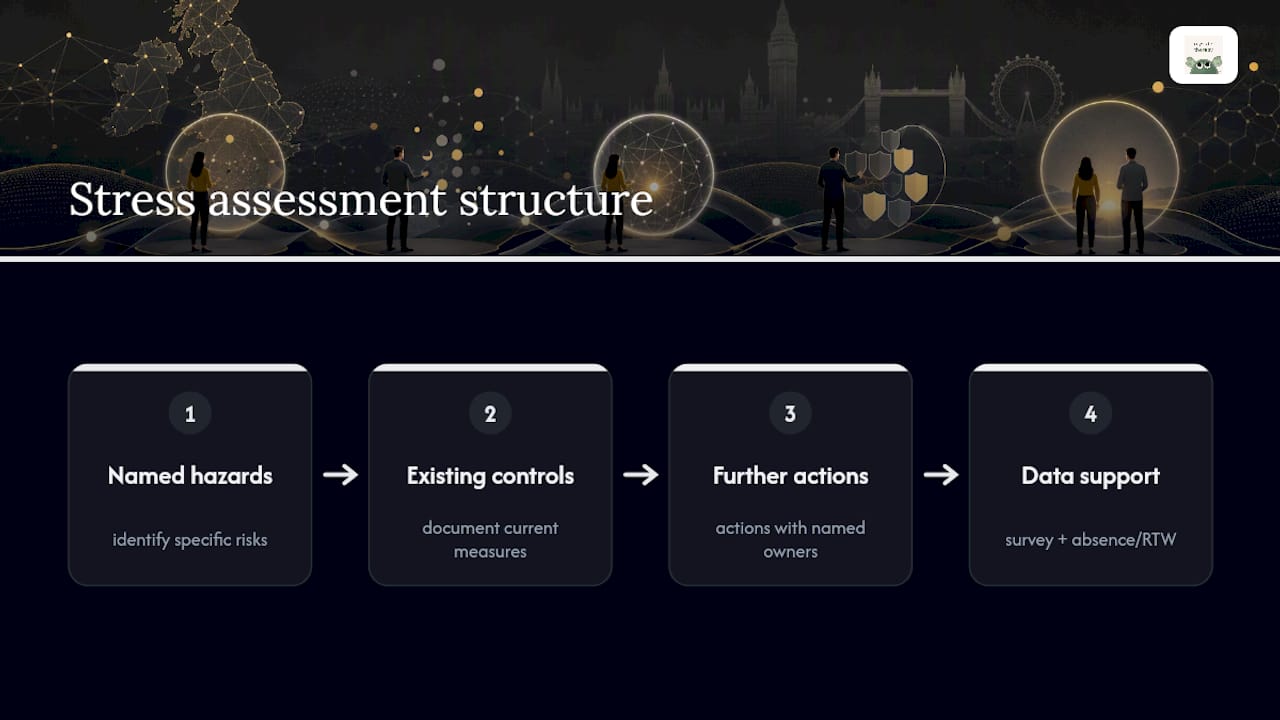
To make your findings defensible, combine at least two data sources, typically survey results plus absence or return-to-work data, rather than relying on one alone. If you employ fewer than five people, the legal writing requirement doesn't apply to you, but recording your assessment anyway is genuinely good practice and costs you almost nothing.
Supporting individual employees who are struggling
An organisational assessment looks at systemic risk. An individual assessment kicks in the moment a specific employee discloses they're struggling, and the two shouldn't be confused. One informs policy; the other addresses a person in front of you.
Acas recommends that managers respond with a private, empathetic conversation, then work with the employee to agree a simple Wellness Action Plan covering practical adjustments.
- Temporary changes to hours, deadlines, or duties
- Adjusted communication style, such as written follow-ups after verbal briefings
- Reduced meeting load or protected focus time
- Referral to occupational health, an employee assistance programme, or counselling
Pro Tip: Keep the Wellness Action Plan conversation separate from performance reviews. Mixing the two makes staff far less likely to disclose stress early, when it's easiest to address. Guidance on structuring these support conversations, such as Alvarado Therapy's framework for manager-led wellbeing check-ins, can help managers who feel unsure where to start.
Proving your assessment is suitable and sufficient
Regulators and tribunals judge your assessment on whether it's a living document, not a filed-and-forgotten form. Review it annually as standard, and immediately after any trigger event.
- Trigger events: a stress-related ill-health case, a restructure, a spike in grievances, or sustained absence increases
- Measures to track: absence rates, Indicator Tool scores by team, and incident or grievance volumes
- Records to keep: findings, decisions made, named owners, dates, and outcomes, retained for as long as your organisation's standard H&S records policy specifies
- Evidence for stakeholders: a before-and-after comparison of your tracked measures, showing action taken and its effect
With over 15.4 million working days lost annually to stress-related ill health across the UK, a paper trail showing genuine follow-through is what separates a defensible assessment from a box-ticking exercise.
How Mysafetherapy fits alongside your employer controls
Mysafetherapy connects staff with UK-accredited therapists registered with BACP, UKCP, or NCPS, through one-to-one video, phone, chat, or avatar-based sessions. That range matters because a control measure from your risk assessment, say, reduced workload, doesn't help an employee who's already struggling with anxiety or burnout; therapy addresses the person, not just the system around them.
Confidential therapy sits comfortably alongside the action plan from your assessment rather than replacing it. Employers can commission access through a pilot, a broader employer contract, or by simply pointing staff towards individual sign-up. Details on corporate wellbeing options cover how contracts and employee access typically work.
Why most stress risk assessments fail before they start
The gap between what most employers do and what the HSE framework actually requires isn't complicated. It's that too many organisations treat the stress risk assessment as a compliance document rather than a diagnostic tool, filling in a template once and filing it away.
The Management Standards framework works precisely because it forces you to look at systemic causes, workload, role clarity, management support, rather than individual resilience. Too much workplace wellbeing advice still frames stress as something employees need to manage better themselves. That's backwards. If your Indicator Tool scores are consistently poor on Demands or Control across a whole team, no amount of individual coping strategy fixes a structural problem.
What should you prioritise first? Get real data before you write a single word of your assessment. A form filled in from assumption, however well-intentioned, won't survive scrutiny and won't fix anything. Start with the Indicator Tool, cross-reference it against absence data, and only then start drafting.
— MySafeTherapy
Getting practical support in place for your team
A risk assessment identifies where the pressure is coming from. It doesn't fix an employee who's already burnt out, and that's where most employer wellbeing strategies fall short: they stop at documentation. Mysafetherapy is built to close that specific gap, offering confidential one-to-one therapy alongside self-help tools like mood tracking and guided journaling, so staff have somewhere to go once your action plan identifies who needs support.
Sessions run via video, phone, chat, or avatar format, with evening and weekend availability that fits around shift patterns and school-run schedules rather than forcing staff to take time off to get help. Pricing is transparent and therapists can be switched easily if the first match isn't right, which matters when you're rolling this out across a whole team rather than one person.
For employers ready to move from assessment to action, the employer wellbeing services page covers pilot options and contract structures. Individual staff who'd rather self-refer can start therapy directly and book a session with a therapist like Robert Paynter without waiting on a company-wide rollout.
Where to find the official guidance and templates
Go straight to the primary sources rather than third-party summaries. HSE's stress risk assessment guidance and Management Standards pages cover the legal framework, while Acas's guidance on supporting employees addresses individual cases. Download the worked example assessment to see the level of detail expected in practice.
This article is general information, not a substitute for advice from a qualified doctor. Consult a qualified healthcare professional about your own circumstances before acting on anything here.