

TL;DR:
- Support networks are essential for mental health, providing emotional, practical, and informational support that enhances resilience. Building and maintaining these connections through deliberate effort and regular contact improves well-being, especially when complemented by professional therapy. Structural barriers and life stage pressures can limit access, but online support offers an accessible alternative.
A support network is defined as the group of people and resources that provide emotional, practical, and informational assistance to an individual during times of need or growth. The role of support network in mental health is substantial. Social capital accounts for 43% of variance in UK mental health outcomes. That figure means who you have around you predicts your psychological health almost as reliably as clinical risk factors. Understanding why mental health matters starts with recognising that no one recovers, grows, or thrives in isolation. Social prescribing, the NHS-backed practice of connecting people to community support, yields £9 of well-being benefits for every £1 invested. The evidence is clear: your connections are not a luxury. They are a health resource.
What are the main types of support networks?
Support networks fall into four broad categories, each serving a distinct function in a person's life. Knowing which type you are drawing on helps you identify gaps and fill them deliberately.
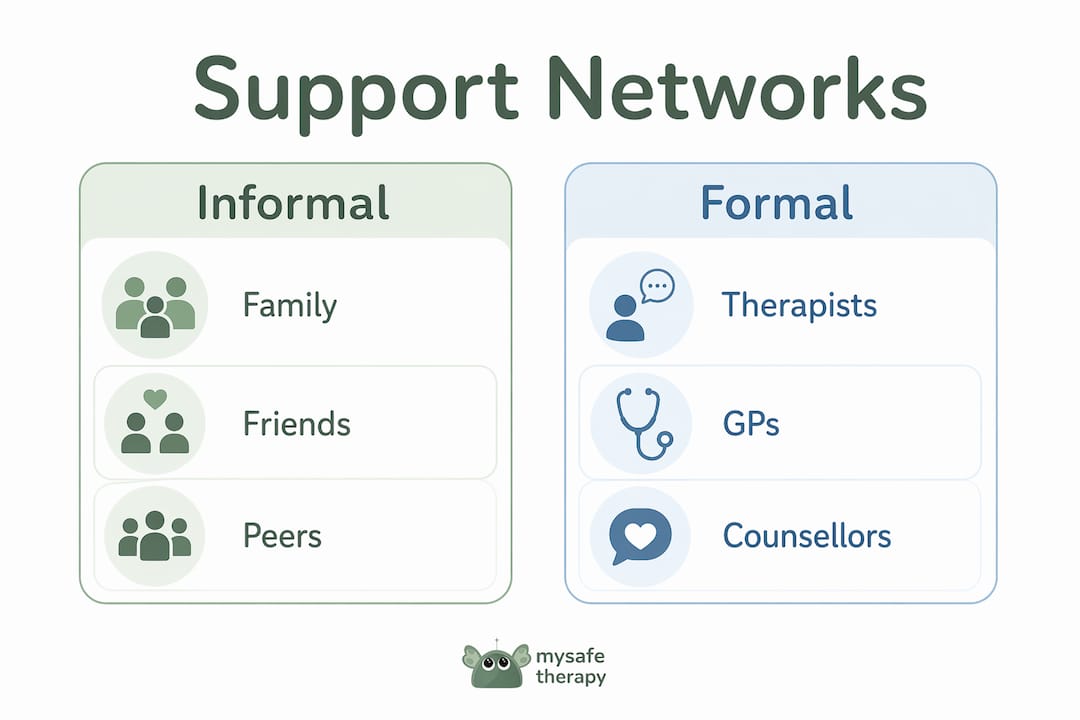
Informal networks are the most familiar. Family members, close friends, and peers form the backbone of most people's support. They offer emotional comfort, practical help such as childcare or transport, and a sense of belonging. The quality of these relationships matters more than the quantity.
Formal networks include professionals such as GPs, therapists, counsellors, and social workers. These relationships are structured, confidential, and governed by professional standards. In the UK, therapists registered with bodies such as BACP, UKCP, and NCPS operate within clear ethical frameworks. Formal support is particularly valuable when informal networks are unavailable or when the issue requires specialist knowledge.
Community and group networks cover faith groups, sports clubs, volunteering organisations, and peer support groups. These connections build what researchers call social capital: the shared trust and reciprocity that strengthens communities. Organisations such as Mind and local community hubs across the UK facilitate these connections.
Online and hybrid networks have grown significantly. Forums, mental health apps, and video-based therapy sessions extend access to people in rural areas or those with mobility limitations. Online support does not replace face-to-face connection but it meaningfully supplements it.
| Type | Examples | Primary benefit |
|---|---|---|
| Informal | Family, friends, peers | Emotional comfort, belonging |
| Formal | Therapists, GPs, counsellors | Specialist guidance, confidentiality |
| Community | Clubs, faith groups, volunteers | Social capital, shared purpose |
| Online/hybrid | Forums, video therapy, apps | Accessibility, flexibility |
How do support networks affect mental health and resilience?
The benefits of social support on mental health operate through several well-documented mechanisms. Understanding them helps you appreciate why connection is not simply pleasant but physiologically necessary.

Stress buffering is the most studied mechanism. When you face a difficult situation, the presence of a trusted person reduces the cortisol spike your body produces. Social connectedness strongly reduces stress and improves physiological health, with effects sometimes rivalling those of quitting smoking. That comparison is not rhetorical. Social isolation carries a measurable mortality risk.
Behavioural influence is subtler but equally powerful. People in strong networks are more likely to attend medical appointments, maintain exercise habits, and seek help early. Your social circle shapes your health behaviours whether you notice it or not.
Reciprocity adds a layer most people overlook. Helping others through social support provides psychological and physical health benefits for the giver, not just the receiver. Engaging in helping behaviours buffers your own stress response. This means that building a support network is not a one-way transaction. It is a system that rewards everyone who participates.
"Sharing with understanding others reduces the distressing power of difficult experiences. Humans are social by design, and connection is one of the most reliable tools we have for managing psychological pain."
Doubling the number of close friends significantly improves life satisfaction, with an effect comparable to half the impact of major life events such as marriage or having a child. That is a striking finding. It suggests that investing in friendships produces returns comparable to the most significant transitions in adult life.
Pro Tip: When you are struggling, resist the instinct to withdraw. Reaching out, even briefly, activates the same stress-buffering mechanisms as sustained social contact. A short message to a trusted person counts.
What challenges exist in building and accessing support networks?
Access to strong support networks is not equally distributed. Structural and personal factors create real barriers for many UK adults.
Structural inequality limits social capital for people in lower-income communities. Reduced access to transport, community spaces, and leisure time means fewer opportunities to build connections. Public infrastructure, including libraries, community centres, and funded peer support groups, plays a direct role in whether informal networks can form at all.
Life stage pressures create specific difficulties. For middle-aged adults, social support must be coupled with a sense of control to significantly improve mental well-being. Social support alone is insufficient without agency over one's environment and responsibilities. This matters because midlife often brings competing demands: caring for children and ageing parents simultaneously, career pressures, and shrinking discretionary time. Without addressing the sense of control, adding social connections may not produce the expected benefit.
Cultural and ethnic minority experiences add further complexity. Informal support networks among racially and ethnically minoritised UK groups provide crucial safety and mental well-being support. These networks are a form of community resourcefulness, not a substitute for well-funded public mental health services. Relying on informal networks alone places an unfair burden on communities that already face systemic disadvantage.
Common barriers to building support networks include:
- Geographic isolation, particularly in rural areas of England, Wales, and Scotland
- Stigma around mental health, which discourages people from seeking or accepting help
- Past experiences of rejection or betrayal that make trust difficult
- Disability or chronic illness that limits participation in social activities
- Work schedules that leave little time for relationship maintenance
Pro Tip: If structural barriers limit your access to in-person networks, online mental health support offers a legitimate and evidence-backed alternative. It is not a lesser option. For many people, it is the most accessible one.
How can you build and maintain an effective support network?
Building a support network requires deliberate effort, particularly for adults whose social circles have contracted through life changes such as relocation, divorce, or retirement. The process is gradual, and that is normal.
-
Start with existing connections. Audit who is already in your life. Family members, former colleagues, and neighbours are often underutilised sources of support. A direct conversation about staying in closer contact is usually welcomed.
-
Join structured activities. Sports clubs, book groups, volunteering organisations, and faith communities provide repeated contact with the same people over time. Repeated exposure builds familiarity, and familiarity builds trust. The activity itself matters less than the regularity of contact.
-
Expect initial awkwardness and proceed anyway. Initial awkwardness in joining support groups is common. Most people turning up alone feel equally self-conscious. Recognising that shared discomfort can itself become a point of connection reduces the barrier to showing up.
-
Practise reciprocity actively. Offer help before you need it. Check in on others. Share information or resources. Networks built on mutual exchange are more durable than those built on one-sided need. The psychological benefits of helping others are well established and accumulate over time.
-
Use professional support as a foundation. Therapy is not a replacement for social connection, but it builds the self-awareness and communication skills that make other relationships work better. A therapist registered with BACP or UKCP can help you identify patterns that have previously undermined your connections.
-
Maintain connections consistently. Networks decay without maintenance. Schedule regular contact rather than relying on spontaneous interaction. A monthly walk, a weekly call, or a shared activity creates the rhythm that keeps relationships alive.
Pro Tip: Learning how to talk about mental health with the people around you is one of the most practical skills you can develop. It lowers the threshold for honest conversation and makes your network more useful when you actually need it.
The importance of support system maintenance is often underestimated. People invest effort in building connections and then assume the work is done. Relationships require ongoing attention, particularly during periods when life is going well and the urgency to connect feels lower. Consistent contact during stable periods is what makes a network available during difficult ones.
Social connection also supports stress reduction and relaxation in ways that solitary self-care cannot replicate. The physiological calming effect of being with a trusted person is distinct from the effect of rest alone.
Key takeaways
A support network is one of the most evidence-backed predictors of mental health and life satisfaction available to UK adults, and building one is a skill that can be learnt and practised at any life stage.
| Point | Details |
|---|---|
| Social capital predicts mental health | Social capital accounts for 43% of variance in UK mental health outcomes, making it a primary health factor. |
| Reciprocity benefits both parties | Helping others buffers your own stress response, making giving support as valuable as receiving it. |
| Midlife requires agency alongside support | Social support alone does not improve well-being for middle-aged adults without a concurrent sense of control. |
| Structural barriers are real | Inequality, stigma, and life stage pressures limit access; public infrastructure and online options help close the gap. |
| Consistency sustains networks | Regular contact during stable periods is what makes a network available and functional during difficult ones. |
What Mysafetherapy has observed about support networks
The most common misconception about support networks is that they form naturally if you are a likeable person. They do not. They form through deliberate, repeated effort, and they require maintenance. Many adults who present with anxiety or low mood are not lacking in social skills. They are lacking in structured opportunities to use those skills.
A second pattern worth naming: people often wait until they are in crisis before reaching out. By that point, the network they need has not been built. The time to invest in connection is when life feels manageable, not when it has become unmanageable.
The UK has a particular cultural tendency to understate need and overstate self-sufficiency. That tendency is not a character flaw. It is a product of social norms that associate asking for help with weakness. The evidence does not support that association. Asking for help is a behaviour that predicts better outcomes, not worse ones.
Professional therapy is not a substitute for a support network, and a support network is not a substitute for professional therapy. They serve different functions and work best in combination. The adults who fare best are those who have both: a circle of trusted people and access to professional support when the situation requires it.
— Mysafetherapy
Professional support to complement your network
Informal connections are the foundation of any support network. Professional therapy adds a layer that friends and family cannot always provide: structured, confidential, evidence-based support from a qualified practitioner.
Mysafetherapy connects UK adults with therapists registered with BACP, UKCP, and NCPS. Sessions are available via video, chat, or avatar format, including evenings and weekends. Pricing is transparent, therapist switching is straightforward, and confidentiality is built into every session. Whether you are managing anxiety, navigating a relationship difficulty, or working through burnout, professional support complements rather than replaces the connections you already have. Start therapy with a qualified UK therapist and take a concrete step towards building the mental health foundation you need.
FAQ
What is the role of a support network in mental health?
A support network provides emotional, practical, and informational resources that buffer stress, improve resilience, and reduce the risk of poor mental health outcomes. Social capital accounts for 43% of variance in UK mental health outcomes, making social connection one of the strongest predictors of psychological well-being.
What are the main types of support networks?
Support networks fall into four types: informal (family and friends), formal (therapists and GPs), community-based (clubs and faith groups), and online or hybrid networks. Each type serves a distinct function, and most people benefit from drawing on more than one.
How does helping others improve your own mental health?
Helping others activates stress-buffering mechanisms in the giver as well as the receiver. Engaging in helping behaviours reduces your own cortisol response and produces psychological and physical health benefits, making reciprocity a core feature of effective support networks.
Why do middle-aged adults find support networks harder to maintain?
Middle-aged adults face competing demands from work, caring responsibilities, and reduced discretionary time. Research shows that social support alone does not significantly improve well-being in midlife without a concurrent sense of control and agency over one's circumstances.
How can I start building a support network as an adult?
Join structured, recurring activities such as sports clubs, volunteering, or community groups, and expect initial awkwardness as a normal part of the process. Practise reciprocity by offering help before you need it, and consider professional therapy to develop the communication skills that make other relationships more effective.