

TL;DR:
- Emotional wellbeing involves the ability to manage and express emotions effectively and is a learnable skill.
- Building emotional skills through practices like the Five Ways to Wellbeing enhances resilience and supports long-term mental health.
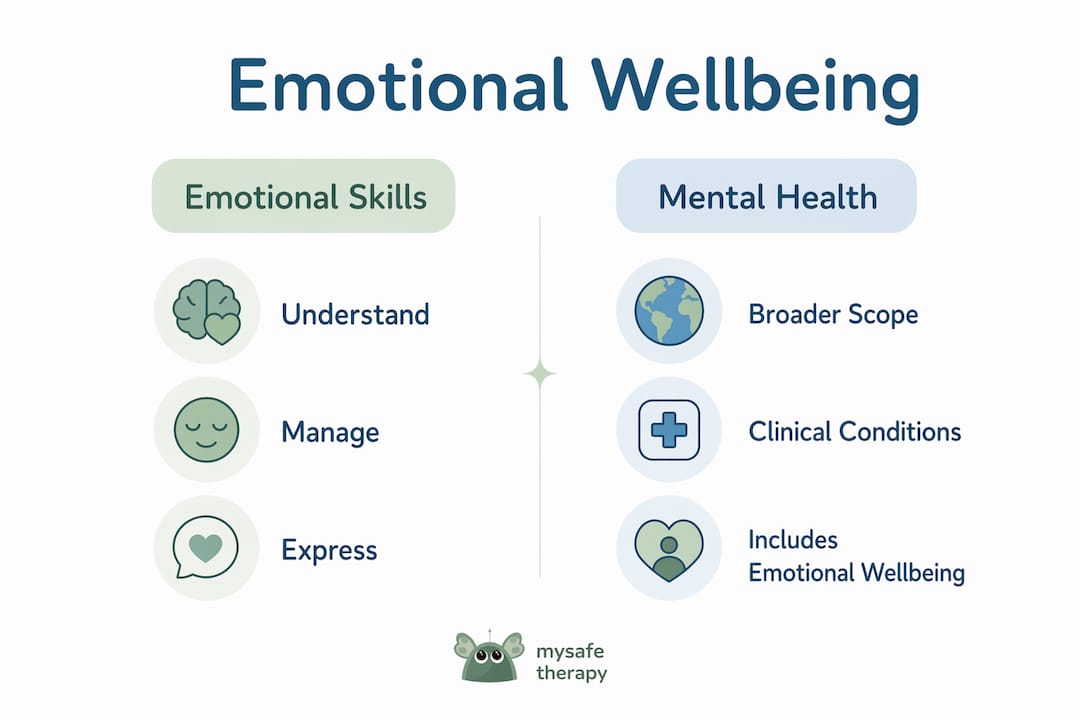
Emotional wellbeing is defined by the NHS as the ability to understand, manage, and express emotions effectively. It sits at the core of overall mental health, alongside psychological and social wellbeing. Emotional wellbeing is not the same as the absence of mental illness. It describes a set of skills that shape how you respond to stress, relationships, and daily challenges. Adults across the UK are increasingly recognising that building these skills matters as much as any other aspect of health.
What is emotional wellbeing and how does it differ from mental health?
Emotional wellbeing and mental health are related but distinct concepts. Mental health is the broader category. It includes clinical conditions such as depression, anxiety disorders, and bipolar disorder, all of which require professional diagnosis and treatment. Emotional wellbeing, by contrast, refers to the skills and capacity you use to handle emotions and stress on a daily basis.
The NHS recognises emotional wellbeing as a core component of mental health, encompassing how you think, feel, and relate to others. That distinction matters practically. You can have strong emotional wellbeing skills and still experience a mental health condition. Equally, you can have no diagnosed condition and still struggle with poor emotional regulation.
Understanding emotional health as a skill set rather than a fixed state changes how you approach it. Skills can be practised and strengthened. A person who learns to recognise their emotional triggers, for example, is better placed to respond calmly under pressure than someone who has never reflected on their patterns.
The key differences between emotional wellbeing and broader mental health are worth spelling out clearly:
- Emotional wellbeing refers to skills: self-awareness, emotion regulation, and the ability to express feelings constructively.
- Mental health conditions are clinical diagnoses requiring therapeutic or medical intervention.
- Emotional wellbeing can coexist with a mental health condition. Good emotional health skills act as a protective factor, providing resilience even during periods of illness.
- Low emotional wellbeing is not a diagnosis. It signals a need to develop skills, not necessarily to seek clinical treatment.
- Both matter. Neglecting emotional wellbeing increases the risk of developing more serious difficulties over time.
This distinction also reduces stigma. Framing emotional wellbeing as a skill set removes the implication that struggling emotionally means something is clinically wrong with you.
What are the five ways to wellbeing and why do they work?
The Five Ways to Wellbeing is an evidence-based framework developed to support emotional resilience and reduce stress. It is widely recommended by UK health services, including NHS trusts and Public Health England. The five actions are: Connect, Be Active, Take Notice, Keep Learning, and Give.
Each action targets a different mechanism that supports emotional regulation and mood. Engaging in these activities measurably boosts mood-regulating brain chemicals and prevents the escalation of emotional difficulties. That is not a vague claim. The framework is grounded in research from the New Economics Foundation, commissioned by the UK government's Foresight Mental Capital and Wellbeing Project.
- Connect. Maintaining relationships with family, friends, colleagues, and neighbours builds a sense of belonging. Social connection and a sense of personal agency substantially improve emotional wellbeing. Feeling supported and in control boosts positive mental health and resilience.
- Be Active. Physical activity does not need to be intense. A walk in a local park, cycling, or yoga all contribute. Regular movement reduces cortisol levels and supports emotional regulation.
- Take Notice. Paying attention to the present moment, noticing your surroundings, your thoughts, and your feelings, builds self-awareness. Mindfulness-based practices rooted in this principle are used in NHS-approved therapies such as Mindfulness-Based Cognitive Therapy (MBCT).
- Keep Learning. Acquiring new skills, whether that is cooking a new recipe, joining a local class, or reading about a new subject, builds confidence and a sense of purpose.
- Give. Acts of kindness, volunteering, or simply helping a colleague create a sense of connection and meaning. Giving shifts attention outward and reduces rumination.
The Five Ways work best as a balanced, personalised lifestyle approach rather than a rigid daily checklist. Integrating them sustainably creates a chain reaction that supports overall wellbeing over time.
Pro Tip: Pick one of the Five Ways that feels most natural to your current routine and commit to it for two weeks before adding another. Sustainable change builds faster than attempting all five at once.
How to improve emotional wellbeing in everyday life
Improving emotional wellbeing starts with self-awareness. You cannot regulate what you cannot recognise. Keeping a brief daily journal, noting what you felt and what triggered it, builds the habit of emotional observation. Mysafetherapy's platform includes an AI journaling tool specifically designed to support this process between therapy sessions.

Emotion regulation techniques used in evidence-based therapies include grounding exercises, controlled breathing, and cognitive reframing. Grounding involves focusing on physical sensations in the present moment to interrupt a stress response. Controlled breathing, such as the 4-7-8 method, activates the parasympathetic nervous system and reduces physiological arousal. Cognitive reframing, a core technique in Cognitive Behavioural Therapy (CBT), involves identifying unhelpful thought patterns and replacing them with more balanced ones.
Co-regulation is another foundational mechanism. Being with someone who listens and responds sensitively builds resilience and a sense of safety. This applies to adults as much as to children. Seeking out relationships where you feel genuinely heard is not a luxury. It is a practical strategy for building emotional strength.
- Practise self-awareness daily. Use journaling, mood tracking, or a simple end-of-day check-in to notice emotional patterns.
- Build social connections intentionally. Schedule time with people who support you, not just those who demand from you.
- Engage in physical activity regularly. Even 20 minutes of walking has a measurable effect on mood.
- Limit emotional suppression. Suppressing emotions is counterproductive for wellbeing. Acknowledging difficult feelings reduces their intensity over time.
- Seek professional support when needed. About 15% of individuals with low-level emotional problems risk progression without proactive management. Early intervention prevents escalation.
Lifestyle factors also matter. Sleep quality, alcohol consumption, and diet all influence emotional regulation capacity. The mental health benefits of stopping smoking, for example, include reduced anxiety and improved mood stability, effects that appear within weeks of quitting.
Pro Tip: Set a weekly "connection appointment" with someone you trust. Treat it with the same priority as a work meeting. Consistent social contact is one of the most reliable ways to maintain emotional resilience.
Common misconceptions about emotional wellbeing
The most persistent misconception is that emotional wellbeing means feeling happy most of the time. This is incorrect. Good emotional wellbeing involves experiencing the full range of emotions, including grief, frustration, and fear, with awareness and appropriate regulation rather than avoidance. The goal is not to eliminate negative emotions. It is to respond to them in ways that are helpful rather than harmful.
A second misconception is that emotional health is a fixed trait you either have or lack. The Centre for Emotional Health is clear on this point:
"Emotional health is not a fixed state but a set of skills shaped by experiences and relationships that can be strengthened over time. The goal is not to eliminate negative emotions but to respond to them in appropriate and helpful ways."
This reframing is significant. It means that wherever you are starting from, you can build stronger emotional skills. Therapy, self-reflection, and supportive relationships all contribute to that development.
A third misconception is that emotional difficulties and mental health conditions are the same thing. They are not. A person living with a diagnosed condition such as PTSD or OCD can simultaneously develop strong emotional wellbeing skills. Those skills act as a protective resilience factor, reducing the impact of symptoms on daily functioning. Emotional health does not cure a clinical condition, but it meaningfully improves quality of life alongside clinical treatment.
Key takeaways
Emotional wellbeing is a learnable skill set, not a fixed state, and building it through evidence-based practices like the Five Ways to Wellbeing reduces stress and supports long-term mental health.
| Point | Details |
|---|---|
| Emotional wellbeing defined | It is the ability to understand, manage, and express emotions effectively, distinct from clinical mental health diagnoses. |
| Separate from mental illness | Strong emotional wellbeing skills can coexist with a diagnosed condition, acting as a protective factor. |
| Five Ways to Wellbeing | Connect, Be Active, Take Notice, Keep Learning, and Give are evidence-based actions that measurably boost emotional resilience. |
| Skills can be developed | Emotional health is not fixed. Self-awareness, regulation techniques, and social connection all build it over time. |
| Early action matters | Around 15% of people with low-level emotional difficulties risk progression without proactive management. |
Mysafetherapy's perspective on emotional wellbeing
Emotional wellbeing rarely gets the same attention as physical health, yet the two are inseparable. At Mysafetherapy, we see this clearly in the people who come to us. Many arrive having managed difficult emotions alone for months or years, not because they lacked insight, but because they did not recognise that what they were experiencing was addressable.
The evidence is consistent: emotional regulation is a skill, and skills improve with practice and the right support. What surprises many people is how quickly that improvement becomes noticeable. A few weeks of consistent self-reflection, combined with professional guidance, often produces a measurable shift in how a person responds to stress.
The most effective approach we observe is not dramatic change but small, sustained adjustments. Journalling for ten minutes, attending a weekly therapy session, or simply naming an emotion out loud before reacting to it. These are not trivial acts. They are the building blocks of genuine emotional resilience. Treating your emotional health with the same discipline you apply to physical fitness is not an indulgence. It is a practical necessity.
— Mysafetherapy
Support for your emotional wellbeing from Mysafetherapy
Mysafetherapy connects adults across the UK with accredited therapists registered with professional bodies including BACP, UKCP, and NCPS. Sessions are available via video, chat, and avatar formats, with evening and weekend appointments to fit around your schedule.
For those who prefer complete anonymity, avatar therapy offers confidential counselling from £49, without the need to appear on camera. If you are ready to begin, you can start therapy today and be matched with a therapist suited to your needs. The platform also includes AI journaling and mood tracking tools to support your emotional health between sessions. Pricing is transparent, therapist switching is straightforward, and your confidentiality is protected throughout.
FAQ
What is the emotional wellness definition?
Emotional wellness is the ability to understand, manage, and express your emotions constructively. It is a set of learnable skills, not a fixed personality trait.
How does emotional wellbeing differ from mental health?
Mental health is the broader category that includes clinical conditions requiring diagnosis and treatment. Emotional wellbeing refers specifically to the skills used to handle emotions and stress day to day.
What are practical ways to enhance emotional wellbeing?
The Five Ways to Wellbeing, Connect, Be Active, Take Notice, Keep Learning, and Give, are evidence-based practices recommended by UK health services. Combining these with self-awareness techniques and professional support produces the strongest results.
Can you have good emotional wellbeing with a mental health condition?
Yes. Good emotional health skills can coexist with a diagnosed condition and act as a protective factor, improving resilience and quality of life alongside clinical treatment.
When should you seek professional support for emotional health?
Seek support when low-level emotional difficulties persist or begin to affect daily functioning. Early intervention significantly reduces the risk of progression to more serious mental health problems.