

Cognitive behavioural therapy is an evidence-based treatment for depression that reduces symptoms in the short term and helps prevent relapse for many adults. NICE lists it as a core option within its stepped-care model, and a comprehensive meta-analysis of 409 trials found moderate-to-large effect sizes against control conditions, with benefits holding up to 12 months later.
In brief: CBT works for many people with mild to moderate depression, particularly when they engage with between-session practice. It is not the right first step for everyone.
- If you are experiencing suicidal thoughts, a rapid decline in functioning, or thoughts of harming yourself, contact your GP, NHS 111, or a crisis line immediately. CBT is not a crisis intervention.
- If your symptoms are mild to moderate and you can commit to weekly homework tasks, CBT for depression is worth discussing with a GP or booking directly through an NHS talking-therapy service.
Key Takeaways
CBT reduces depressive symptoms with moderate-to-large effect sizes and sustains benefit for up to twelve months, particularly when matched to severity and comorbidity.
| Point | Details |
|---|---|
| Evidence is strong but scoped | CBT works well for mild to moderate depression; complex protocols suit comorbid presentations better. |
| Homework is the mechanism | Between-session practice, not session time, drives most measurable improvement. |
| Stepped care shapes access | NICE recommends guided self-help or group CBT before individual therapy for less severe cases. |
| Urgent signs need urgent action | Suicidal thoughts or psychosis mean contacting a GP, NHS 111, or A&E before starting CBT. |
| Mysafetherapy offers a direct route | Accredited CBT therapists, flexible formats, and transparent pricing without NHS waiting times. |
This article is general information, not a substitute for advice from a qualified doctor. Consult a qualified healthcare professional about your own circumstances before acting on anything here.
Table of Contents
- What the evidence says about CBT for depression
- Individual, group, self-help or online: which CBT format fits?
- Inside a CBT session: structure, techniques and homework
- How long does CBT take, and does it work better with medication?
- Getting CBT in the UK: NHS, GP referral and private routes
- Who benefits most from CBT, and when to seek urgent help instead
- Practical CBT exercises you can start this week
- Where Mysafetherapy fits if you're considering CBT
- Considering CBT for depression: an editorial view
- Start CBT for depression with a UK-accredited therapist
- Sources
What the evidence says about CBT for depression
The strength of the evidence for cognitive behavioural therapy for depression is unusually well established for a psychological treatment, but it is not unconditional. A 409-trial meta-analysis found CBT outperforms control conditions with moderate-to-large effect sizes, and those gains were largely maintained at the 12-month mark rather than fading once sessions stopped. That durability matters more than the initial effect size, because plenty of interventions produce a short-term lift that evaporates within weeks.
A 2022 network meta-analysis published in the British Journal of Psychiatry dug into a more specific question: does the complexity of the CBT protocol change the outcome? It found that core, complex, and ultra-complex CBT all reduced depression at the end of treatment, but complex and ultra-complex protocols sustained those effects for longer, particularly for people with additional comorbidities. This is a genuinely useful finding, because it undercuts the assumption that a standard 12-session course suits everyone equally.
NICE's NG222 guideline frames all of this within a stepped-care model: start with the least intrusive, effective intervention, and step up only when it is not enough.
- Less severe depression: guided self-help or group CBT is usually recommended first.
- More severe or persistent depression: individual CBT, or CBT combined with medication, becomes the appropriate step.
- Comorbid presentations: complex or ultra-complex CBT protocols may sustain benefit for longer.
"Stepped care means using the least intrusive effective option first," as the rationale behind NICE's guidance puts it, which reduces wait times and spreads limited therapy resources without compromising outcomes for people whose depression is less severe.
Publication bias is a genuine limitation across psychotherapy research generally, and CBT's advantage over other structured talking therapies tends to be small rather than dramatic. The honest summary: CBT for depression has strong support, but "strong support" means "one of the best-evidenced options," not "guaranteed to work for you."
Individual, group, self-help or online: which CBT format fits?
Cognitive behavioural therapy for depression is not a single format. It comes as one-to-one sessions, group work, guided self-help, and fully digital or app-based delivery, and each suits a different situation.
- Individual CBT: the most intensive and flexible option, tailored session by session; best evidence base for moderate to severe depression.
- Group CBT: cost-effective, adds peer support, works well for less severe presentations; less personalised than one-to-one work.
- Guided self-help: structured workbooks or programmes with brief therapist check-ins; often the first rung on the NHS stepped-care ladder.
- Digital/online CBT and bibliotherapy: highly accessible and can fit around work or caring responsibilities, though outcomes tend to improve with some element of therapist support built in.
Cost-effectiveness data referenced in NICE's guidance backs group CBT and behavioural activation as sound first-line choices for less severe depression, which is part of why NHS services often offer these before individual therapy.
Pro Tip: If you are offered guided self-help before individual CBT, don't read it as a lesser option. It's the deliberate first step in a stepped-care system, and many people improve enough at this stage that they never need to move further up.
Inside a CBT session: structure, techniques and homework
A typical CBT session for depression follows a predictable shape, and that predictability is deliberate. Practitioner guides describe a consistent flow: a brief mood check-in, collaborative agenda-setting, review of the previous week's homework, focused work on one or two techniques, and a closing summary with a new task to practise before the next session.
- Check-in and agenda-setting. You and your therapist agree what the session will focus on, based on what has come up during the week.
- Homework review. Whatever you practised last time gets discussed honestly, including what didn't work.
- Technique work. The therapist introduces or refines a specific skill, often with modelling before you try it yourself.
- Summary and new task. The session closes with a clear, specific practice task for the coming week.
The core techniques driving cognitive behavioural therapy for depression include:
- Behavioural activation: scheduling small, achievable activities to counter the withdrawal that depression drives, such as a 15-minute walk booked into the diary rather than left to motivation.
- Cognitive restructuring: identifying and testing automatic negative thoughts, for example examining the evidence for and against "I always mess things up."
- Activity scheduling: mapping out the week in advance to balance obligation, connection, and pleasure rather than letting depression dictate the shape of each day.
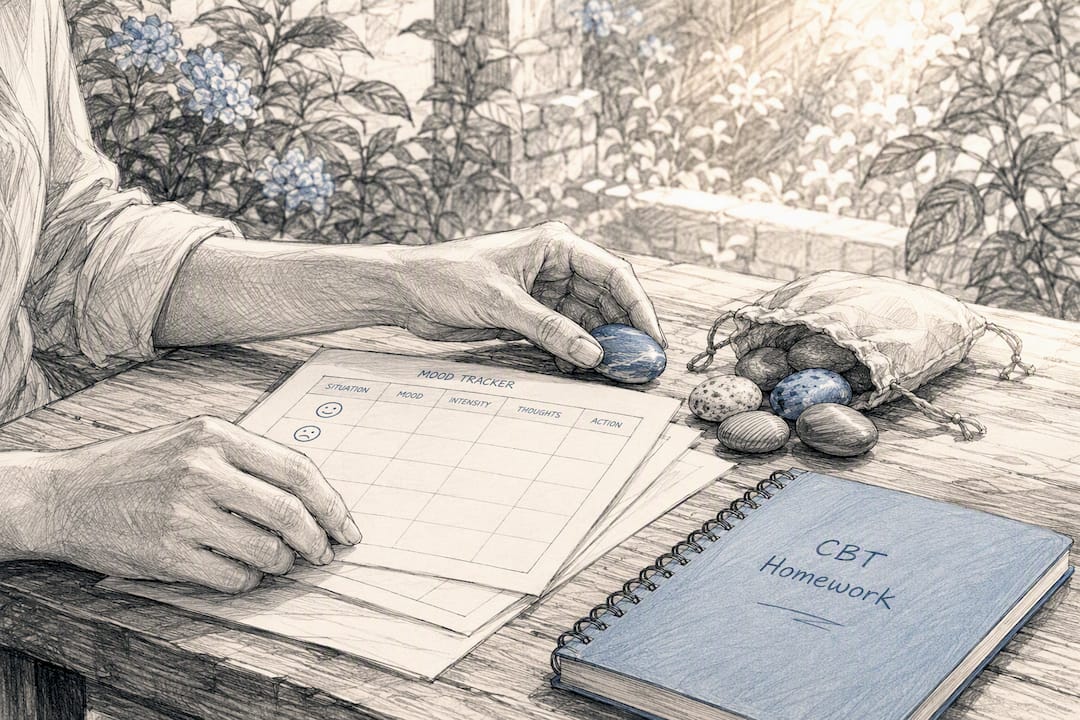
- Thought records: a written log linking a situation, the automatic thought, the emotion it produced, and a more balanced alternative.
Between-session practice is where most of the real change happens, not the fifty minutes in the room. A therapist can model a skill perfectly, but if it never gets tested against real life during the week, it stays theoretical. Relapse-prevention planning, usually built in towards the end of a course, turns these same techniques into a toolkit you keep using long after formal sessions end. You can read more about how therapists support ongoing mental health between sessions.
Pro Tip: Treat homework as the actual treatment, not an optional add-on. The techniques you practise between sessions are doing more of the work than the conversation itself.
How long does CBT take, and does it work better with medication?
Course length for CBT varies by format and severity, and it's worth knowing the typical ranges before you start so you're not judging progress against the wrong timeline.
- Guided self-help programmes: often six to eight short sessions, sometimes with only brief therapist contact between modules.
- Standard CBT packages: commonly 12 to 20 sessions for moderate depression, usually weekly.
- Complex or ultra-complex protocols: longer courses for people with comorbid conditions, where sustained benefit past the end of treatment is the priority.
Most people notice some shift, often in mood stability or reduced avoidance, within the first four to six sessions, though the deeper changes in thought patterns tend to build more gradually across the full course. "Success" in CBT rarely means the sudden disappearance of low mood. It more often looks like fewer bad days in a row, faster recovery from setbacks, and a toolkit for catching negative thought spirals before they take hold.
On combining CBT with antidepressants, clinical reviews indicate that CBT can be used alone or alongside medication depending on severity and personal preference, with combined treatment generally considered for more severe or recurrent presentations. The relapse-prevention argument for CBT is one of its strongest selling points: because it teaches skills rather than only adjusting brain chemistry, the effects tend to persist after treatment ends in a way that pure medication maintenance does not automatically replicate. This is one of the clearer answers to the CBT versus medication for depression question: it's rarely either/or, and the choice depends on severity, history, and what you can realistically stick with.
Getting CBT in the UK: NHS, GP referral and private routes
Accessing cognitive behavioural therapy for depression in the UK doesn't require a long wait for a GP appointment as a first step, though many people still go that route.
- Self-refer to an NHS talking-therapy service. Most areas allow direct self-referral to NHS talking therapies (formerly IAPT) without seeing a GP first.
- Ask your GP for a referral. Useful if your depression is more complex, you're already on medication, or you'd prefer a clinician to help route you to the right service.
- Consider private or online therapy. Faster access, more choice of format and therapist, at your own cost.
If you go private or online, a short checklist protects you from poor-quality providers:
- Confirm the therapist is accredited with a recognised body such as BACP, UKCP, or NCPS.
- Check what specific CBT training and experience they have with depression, not just general counselling.
- Ask about session format (video, phone, in-person) and whether pricing is transparent upfront.
Waiting times for NHS talking therapies vary considerably by area, and guided self-help is often offered as a genuinely useful first step rather than a stopgap while you wait for something better. For a fuller picture of how NHS and private routes compare on cost and speed, see this comparison of NHS and private therapy.
Who benefits most from CBT, and when to seek urgent help instead
CBT tends to suit people who can commit to structured, between-session work. If you can tolerate homework tasks, tracking thoughts, and testing new behaviours even when motivation is low, you're a strong candidate. Mild to moderate depression responds particularly well; people with comorbid anxiety, trauma, or long-standing patterns of low mood may need the complex or ultra-complex protocols mentioned earlier rather than a standard short course.
CBT is less suited, at least as a starting point, to some presentations. Comorbid conditions such as psychosis, severe personality disorder features, or active substance dependency usually need a tailored, often multidisciplinary approach before or alongside standard CBT.
Certain signs mean CBT for depression is not the immediate priority:
- Active suicidal thoughts or a specific plan to self-harm.
- Symptoms of psychosis, such as hallucinations or delusional beliefs.
- Severe self-neglect, including not eating, drinking, or maintaining basic safety.
Any of these warrants contacting a GP urgently, calling NHS 111, or going to A&E. Therapy can follow once you're safe.
Practical CBT exercises you can start this week
You don't need a therapist in the room to try the basics of CBT for depression, though ongoing support helps you refine them. Mind's guidance on self-help elements confirms behavioural activation and simple thought records can be started safely by most adults, provided any risk has been assessed.
- Behavioural activation task: pick one small activity you've been avoiding, such as a ten-minute walk, and schedule it for a specific time tomorrow rather than "whenever you feel up to it."
- Thought record: write down a difficult moment, the automatic thought that followed, the emotion it triggered, and one piece of evidence against that thought.
- Activity schedule: map your week across three categories, obligation, connection, and enjoyment, and check whether one category is missing entirely.
- Review your week every Sunday and adjust one task rather than overhauling the whole plan.
- If a task feels too big, halve it rather than skip it entirely.
Pro Tip: Log your mood on a simple 1 to 10 scale before and after each activity. Patterns emerge faster than memory alone will tell you, and they make good discussion material if you do start formal CBT.
You'll find more structured tools in this guide to self-help resources for depression and anxiety.
Where Mysafetherapy fits if you're considering CBT
Mysafetherapy connects people with UK-accredited therapists registered with BACP, UKCP, or NCPS, offering CBT and other evidence-based approaches through video, chat, or avatar-based sessions depending on what feels comfortable. Sessions run into evenings and weekends, which matters if NHS waiting times don't fit your schedule.
- AI-guided journaling and mood tracking sit alongside live sessions to support the between-session practice CBT depends on.
- Pricing is stated upfront, and switching therapists is straightforward if the first match isn't right.
- The platform works within the same stepped-care logic NICE describes: a practical option once you've decided formal support, rather than self-help alone, is the next step.
| Point | Details |
|---|---|
| Format matters | CBT delivery ranges from guided self-help to individual sessions, matched to depression severity. |
| Homework drives results | Between-session practice, not session time alone, produces most of the measurable change. |
| Complexity should match need | Comorbid conditions often respond better to complex or ultra-complex CBT protocols than a standard course. |
| Access routes vary | NHS self-referral, GP referral, and private or online therapists, including Mysafetherapy's accredited network, all lead to CBT. |
Considering CBT for depression: an editorial view
CBT is often sold as a fixed twelve-week fix, and that framing does readers a disservice. The evidence points somewhere more nuanced: core CBT protocols work well for straightforward presentations, but the 2022 network meta-analysis makes a case that's rarely emphasised in mainstream coverage, that people with comorbid conditions often need the longer, more complex protocols to sustain benefit rather than just reach it.
The bigger gap, in our view, sits between guideline and lived reality. NICE's stepped-care model is sound in principle, but a reader stuck on an NHS waiting list doesn't experience "stepped care" as a system, they experience it as delay. That's precisely where guided self-help, digital options, and accredited private or online therapists earn their place, not as inferior substitutes but as genuinely valid entry points supported by the same evidence base.
What we'd prioritise first: start the practical exercises now, whatever route to formal therapy you're on. The homework is the treatment.
— MySafeTherapy
Start CBT for depression with a UK-accredited therapist
Waiting lists shouldn't decide when you get support. Mysafetherapy gives you a direct route to a UK-accredited CBT therapist without the months-long queue that NHS talking-therapy services often carry, with evening and weekend slots built around your working week rather than office hours. Every therapist profile shows clear pricing and credentials upfront, so you know exactly what you're booking before you commit.
If individual CBT feels like the right next step after reading this, you can browse therapist profiles and book a session directly, with the option to switch therapists if the first match isn't quite right. For ongoing support between sessions, the platform's AI journaling and mood-tracking tools help you keep up the behavioural activation and thought-record work covered earlier. Explore individual therapy options and book a first session whenever you're ready.
Sources
- Depression in adults: treatment and management — NICE (NG222)
- Cognitive behavioural therapy (CBT) — NHS
- Cognitive Behavioral Therapy for Depression — PMC (review)
- Effectiveness of cognitive–behavioural therapies of varying complexity in reducing depression in adults — BJP 2022