

Yes. Decision fatigue responds well to targeted psychotherapy, particularly approaches that tackle its underlying drivers rather than just the symptom. If you recognise the signs below, the next step is straightforward: look for a therapist accredited by BACP or UKCP, or start with a safe online option such as Mysafetherapy, rather than trying to white-knuckle through it alone.
TL;DR:
- Therapy targets the underlying factors like perfectionism and anxiety that cause decision fatigue, rather than just teaching faster decision-making techniques.
- Common signs of serious decision fatigue include persistent procrastination, impulsive choices, avoidance behaviors, and mental fog that worsen over time or with stress.
- Evidence-based treatments such as CBT, behavioral activation, and mindfulness help rebuild decision capacity by reducing avoidance, restructuring thought patterns, and promoting small, manageable choices.
- Reducing decision load with routines, batching choices, and deliberate recovery strategies can improve decision quality immediately, but professional support becomes necessary if exhaustion persists.
- Finding accredited therapists via platforms like Mysafetherapy ensures safe access to therapy that addresses the root causes, especially for neurodivergent individuals or when fatigue overlaps with burnout and mental health issues.
Table of Contents
- What decision fatigue therapy actually addresses
- How decision fatigue develops
- Signs and impacts: when does it become serious?
- Evidence-based therapy for decision fatigue
- Practical strategies to cut your decision load today
- When to seek professional support, and how to find it safely
- Mysafetherapy's approach to decision fatigue
- Real-world patterns in how therapy resolves decision fatigue
- Why most decision fatigue advice misses the point
- Start therapy for decision fatigue with Mysafetherapy
- Sources
What decision fatigue therapy actually addresses
Decision fatigue is the measurable decline in decision quality that follows sustained mental effort. Choices that would normally take seconds start feeling impossible, and the ones you do make tend to skew towards the easiest option rather than the best one. It is not laziness and it is not a character flaw.
It also isn't a diagnosis. You won't find it in the DSM-5-TR, and no clinician will write it on a referral letter. Instead, it's a well-documented psychological phenomenon that sits alongside conditions like anxiety and burnout, sometimes overlapping with them, sometimes standing alone.
The scale of the problem is easy to underestimate. Some commentators cite an illustrative estimate suggesting adults face many decisions each day, a number worth treating as a rough approximation rather than a clinical measurement. What matters more than the exact count is the pattern:
- Most decisions are trivial but still draw on the same finite mental resource.
- Quality drops as the day goes on, regardless of how important the decision is.
- The effect is reversible with rest, structure and, for many people, therapy.
How decision fatigue develops
The classic explanation is ego depletion: the idea that self-control and decision-making draw from a shared, limited resource that runs low with use. The theory has taken some knocks in recent years, and researchers now treat it as one contributing factor among several rather than the whole story.
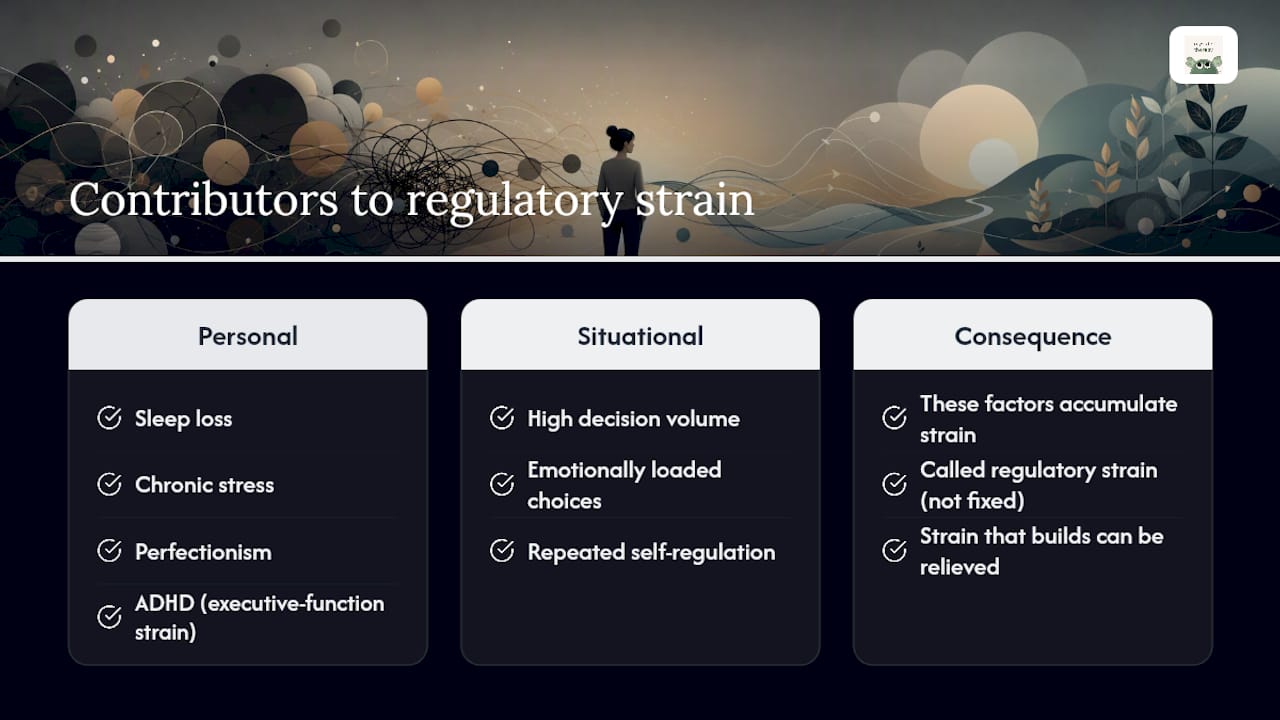
Sleep loss accelerates the decline sharply. So does chronic stress, which keeps your nervous system in a heightened state that makes every choice feel higher stakes than it is. Perfectionism compounds the problem because it turns simple decisions into extended risk assessments. People with ADHD often experience decision fatigue faster and more intensely, since executive function differences already strain the same cognitive systems that decision-making relies on.
Situational factors matter as much as personal ones. High decision volume, emotionally loaded choices, and repeated bouts of self-regulation (holding your tongue in meetings, resisting snacks, managing other people's moods) all draw on the same well. Recent clinical literature frames this as regulatory strain rather than a fixed trait, which is good news: strain that builds can also be relieved.
Signs and impacts: when does it become serious?
Decision fatigue tends to show up in predictable ways. You'll recognise some of these immediately:
- Procrastination on choices that used to feel easy
- Impulsive decisions made just to end the discomfort of deciding
- Avoidance, including ignoring emails or postponing appointments
- Brain fog and a sense of mental static by mid-afternoon
At work, this might look like defaulting to whatever your last email suggested rather than weighing options properly. In shopping, it's the trolley full of familiar brands because comparing alternatives felt unbearable. In relationships, it's snapping "I don't care, you choose" at a partner over something genuinely trivial, then feeling guilty about the tone.
Where it gets serious: when the exhaustion doesn't lift after rest, or when it's tangled up with persistent low mood, anxiety, or the emotional flatness of burnout. Cleveland Clinic notes that decision-making problems overlapping with functional impairment, such as struggling to hold down basic daily responsibilities, are a signal to seek professional assessment rather than push through alone.
Evidence-based therapy for decision fatigue
Therapy doesn't just teach you to "decide faster." It targets the mechanisms that made deciding so exhausting in the first place. A few approaches consistently show up in clinical practice:
- CBT identifies the catastrophic thinking and perfectionism that turn ordinary choices into high-stakes gambles, then restructures those thought patterns.
- Behavioural activation breaks the avoidance cycle by scheduling small, verifiable actions rather than waiting to feel motivated first.
- Values clarification shrinks the decision space itself by helping you filter choices against what actually matters to you, so fewer options need full deliberation.
- Mindfulness and stress-reduction techniques, taught alongside these approaches, lower the background anxiety that makes every decision feel urgent.
NHS Education for Scotland describes behavioural activation as particularly effective for breaking cycles of avoidance, since each completed action becomes evidence that things are manageable. Clinicians often track progress through small, measurable wins, such as decisions kept "closed" rather than reopened, which rebuilds decision-making stamina gradually rather than all at once.
Pro Tip: Ask your therapist to help you build one personal "decision rule" this week, such as "I never accept new commitments same day I'm asked." One rule removes dozens of micro-decisions permanently.
Expect therapy for this to run in short, focused blocks, often six to twelve sessions, with goals framed around reduced avoidance and faster "closing" of decisions rather than vague notions of feeling less stressed.
Practical strategies to cut your decision load today
You don't need a therapist to start reducing decision load, though the two work well together. Try this sequence:
- Automate the trivial. Fix a weekly meal rotation, a standard work outfit, or a default order at your usual coffee shop. Every automated choice is bandwidth saved for something that matters.
- Batch similar decisions. Set one time each week to answer all non-urgent emails, plan the week's meals, or approve expenses, rather than deciding piecemeal all week.
- Front-load the hard calls. Schedule your most consequential decisions for your highest-energy hours, usually mid-morning for most people, and push low-stakes ones later.
- Run a decision audit. List every recurring choice you made last week. For each one, ask: automate, delegate, or eliminate?
- Engineer recovery deliberately. Short breaks, consistent sleep, and regular meals aren't indulgences here. Research on decision-making capacity consistently links rest and reduced choice volume to restored decision quality.
Pro Tip: Keep a "closed decisions" list on your phone. Every time you revisit a decision you've already made, add it to the list and physically close it again. It trains your brain to stop reopening settled questions.
Reducing decision load isn't only a personal project. Some workplaces now build decision audits and automation into how teams operate, recognising that individual willpower can't outpace badly designed systems.
When to seek professional support, and how to find it safely
Self-help strategies solve a lot of everyday decision fatigue. Therapy becomes the right call when the exhaustion persists despite rest, when it's affecting your job or relationships, or when it overlaps with anxiety, depression, or burnout that won't shift.
Finding safe, competent support in the UK means checking credentials before you check availability:
- Confirm the therapist is registered with BACP or UKCP, the two main accrediting bodies for talking therapies in the UK.
- Accreditation with either body means the therapist meets set training standards and follows an ethical code, which matters as much online as in person.
- On first contact, ask about confidentiality practices, session format flexibility, and whether you can switch therapists if the fit isn't right.
- For safe online therapy, verify the platform itself vets therapists against these standards rather than just listing them.
Understanding what BACP registration actually guarantees helps you ask sharper questions before committing to anyone.
Mysafetherapy's approach to decision fatigue
Mysafetherapy matches clients with UK-accredited therapists registered with BACP, UKCP, or NCPS, all trained in evidence-based approaches including CBT and behavioural activation. Sessions run as video, chat, phone, or avatar-based formats, fitting around work and family life rather than the other way round. Between sessions, AI-guided journaling and mood tracking help clients notice patterns in their own decision fatigue, giving therapists concrete material to work with rather than vague recollections of "a bad week."
Real-world patterns in how therapy resolves decision fatigue
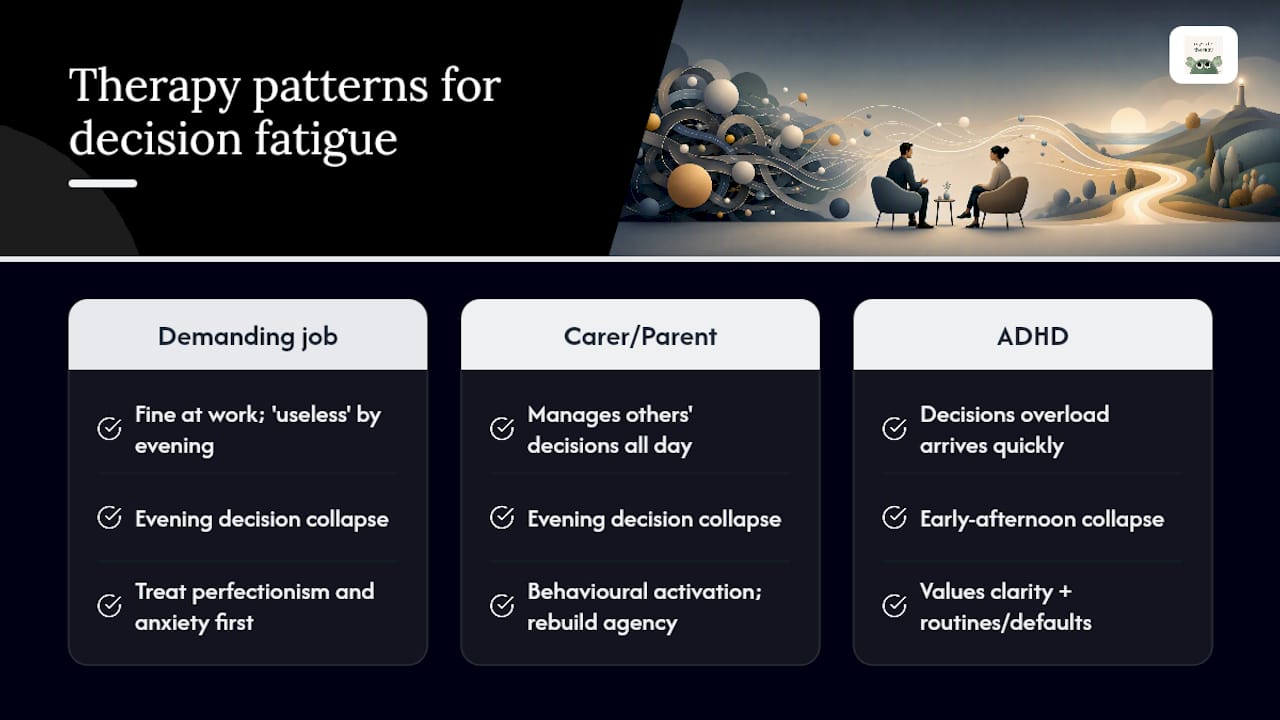
Decision fatigue rarely arrives as a single, isolated problem, and therapy outcomes tend to reflect that. A common pattern involves someone in a demanding job who describes feeling fine at work but "useless" by evening, unable to decide what to eat or whether to reply to a text. Therapy in these cases often starts not with decision-making techniques directly, but with the perfectionism or anxiety underneath them, since the fatigue is usually a downstream symptom.
Another recognisable pattern is the parent or carer managing decisions for other people all day, then losing all capacity for their own choices by evening. Behavioural activation tends to help here, because it rebuilds a sense of personal agency through small, self-directed actions rather than more decisions about others.
A third pattern shows up among people with ADHD, where decision fatigue arrives faster and more severely than it does for neurotypical clients, often by early afternoon rather than evening. Therapy for this group frequently combines values clarification, to cut down the sheer number of options being weighed, with practical structural changes such as fixed routines and automated defaults.
None of these patterns resolve overnight. What they share is a shift from treating decision fatigue as a productivity problem to treating it as a regulatory one, addressing the underlying strain rather than just adding more coping tricks on top of an already overloaded system.
Why most decision fatigue advice misses the point
Most articles on this subject hand you a productivity checklist and call it a day: wear the same clothes, eat the same lunch, automate your calendar. None of that is wrong, but it treats decision fatigue as a logistics problem when it's frequently a regulatory one.
The conventional advice underestimates how often perfectionism, anxiety, or undiagnosed neurodivergence sit underneath the exhaustion. Automating your breakfast choice does nothing for someone who reopens every decision they've already made because uncertainty feels unbearable. That's a therapeutic problem, not an organisational one.
If we had to prioritise one thing for readers here, it wouldn't be a new routine. It would be an honest look at whether the fatigue is situational (too many decisions, easily fixed with structure) or driven by something that structure alone won't touch. The first responds to load reduction. The second needs a therapist who can work with the actual cause, not just the symptom.
Get that diagnosis right first. Everything else, including which routines to build, follows from it.
— MySafeTherapy
Start therapy for decision fatigue with Mysafetherapy
Mysafetherapy gives you a faster, lower-friction route to accredited support than searching directories one therapist at a time. Every therapist on the platform is registered with BACP, UKCP, or NCPS, and you can choose video, chat, phone, or avatar-based sessions depending on what feels manageable on a given day.
Pricing is transparent from the outset, sessions can flex around evenings and weekends, and switching therapists if the fit isn't right takes a few clicks rather than an awkward conversation. AI journaling and mood tracking tools sit alongside your sessions, helping you and your therapist spot patterns between appointments.
If avoiding face-to-face contact feels easier right now, avatar-based sessions from £49 offer the same clinical grounding with more anonymity. Ready to talk to someone? Start therapy today and get matched with an accredited therapist this week.
This article is general information, not a substitute for advice from a qualified doctor. Consult a qualified healthcare professional about your own circumstances before acting on anything here.
Sources
- Decision fatigue conceptual discussion (UQ repository)
- NHS Education for Scotland — behavioural activation and therapeutic approaches
- Frontiers: clinical decision fatigue (2026)
- PubMed literature on decision-making and fatigue