

UK employers have a legal duty to protect employee mental health under the Health and Safety at Work etc. Act 1974, not just a moral one. Start this week with three actions: run a stress risk assessment against the HSE Management Standards, train line managers to spot warning signs and hold early conversations, and build a clear referral pathway to occupational health, an EAP, or accredited therapy. Employers who act on all three typically see fewer long-term absence days and catch problems before they become crises.
TL;DR:
- Employers should prioritize early intervention through manager training, work redesign, and building clear referral pathways to reduce long-term employee absences.
- Conducting stress risk assessments based on the HSE Management Standards helps identify specific workplace pressures, enabling targeted improvements.
- Measuring quarterly absence days related to mental health, therapy uptake, and staff turnover provides better insight into strategy effectiveness than annual surveys alone.
- Confidential access to accredited online therapy offers a flexible, stigma-free support route outside traditional clinical channels, with pricing starting from £50.
- Effective mental health support depends more on skilled managers and good work design than on individual perks or benefits.
Table of Contents
- Why employee mental health uk statistics demand employer action
- Employers' legal duties in the UK and HSE expectations
- How line managers spot problems and know when to escalate
- Practical interventions employers can implement now
- Running a stress risk assessment with HSE Management Standards
- Measuring the impact of your mental health strategy
- Clinical and accredited support routes for UK employees
- Why manager capability matters more than any single perk
- Give employees a confidential route to accredited therapy
- Sources
- FAQ
Why employee mental health uk statistics demand employer action
Mental ill health is now the leading cause of long-term absence in UK workplaces, according to CIPD and Simplyhealth's 2025 wellbeing report. Absence linked to stress, anxiety and burnout has climbed steadily, and Mental Health UK's Burnout Report found that a minority of employees feel their mental health is genuinely prioritised at work.
That gap between employer intention and lived experience is where the real cost sits. Untreated stress rarely stays contained; it spreads into presenteeism, disengagement, and eventually resignation. Many organisations still respond reactively, offering support only once someone has already gone off sick, rather than building prevention into how work is designed.
The pattern is consistent: absence rises where manager training is absent, and falls where it exists. Employers who invest early typically spend less later, both in sick pay and in recruitment costs from avoidable turnover.
Employers' legal duties in the UK and HSE expectations
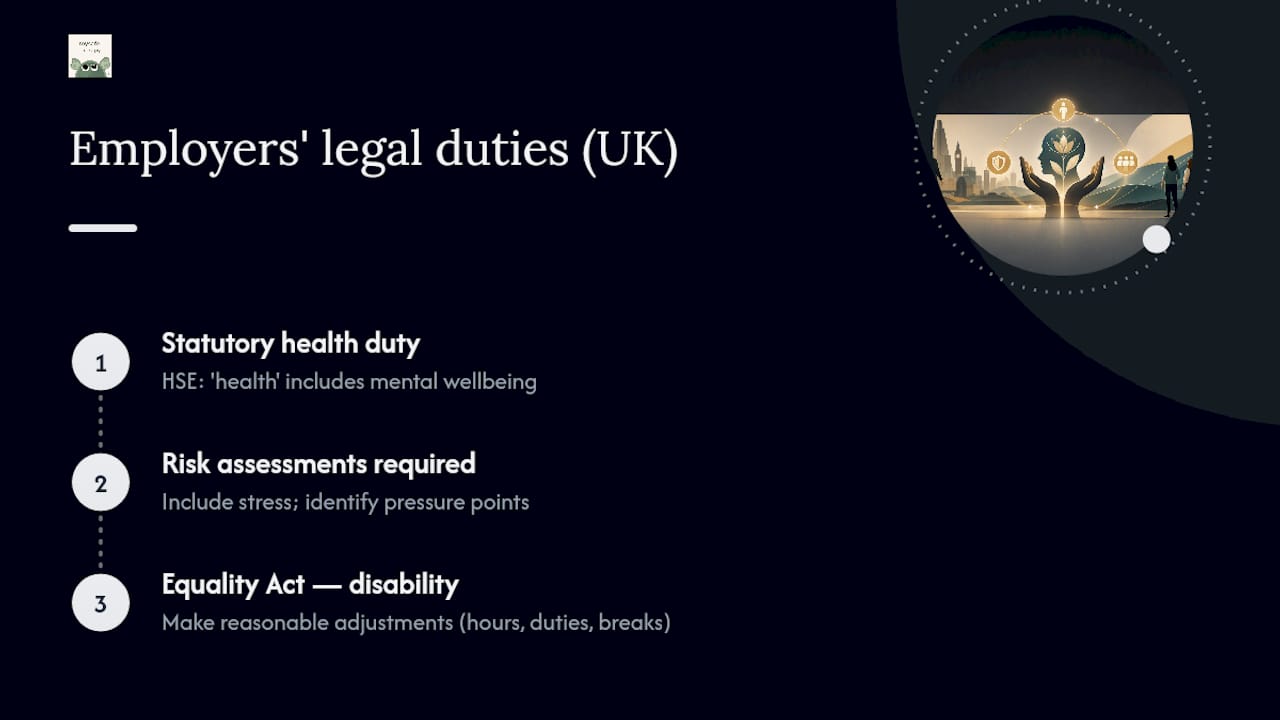
Section 2 of the Health and Safety at Work etc. Act 1974 requires employers to protect the health, safety and welfare of employees, so far as is reasonably practicable, and the HSE explicitly reads "health" to include psychological wellbeing, not just physical safety. This isn't discretionary guidance; it's the same statutory duty that covers machinery guarding or fire exits.
The Management of Health and Safety at Work Regulations go further, requiring "suitable and sufficient" risk assessments, and stress falls squarely within that requirement. A generic policy document doesn't satisfy this; you need an assessment that actually identifies where pressure builds and what you're doing about it.
Where a mental health condition has a substantial, long-term effect on someone's ability to do normal daily activities, it may meet the definition of disability under the Equality Act 2010. That triggers a duty to make reasonable adjustments, whether phased hours, altered duties, or extra breaks. Acas guidance on supporting mental health at work recommends treating a mental health condition with exactly the same seriousness as a physical one.
How line managers spot problems and know when to escalate
Line managers are usually the first to notice something has changed, long before HR gets involved. Watch for shifts in behaviour rather than a single bad day: withdrawal from colleagues, uncharacteristic irritability, dropping performance, increased short-notice absence, or someone who suddenly stops taking breaks or holiday.
A supportive conversation doesn't need a script, but it does need structure:
- Open privately and informally: "I've noticed you've seemed under pressure lately, how are you doing?"
- Ask open questions and then stop talking; let silence do some work.
- Avoid diagnosing, minimising ("everyone's stressed") or promising outcomes you can't control.
- Ask what would help practically, whether that's a workload change or time off.
- Agree a next step together, even a small one, and a date to check back in.
Escalate to HR or occupational health when someone discloses a diagnosed condition, mentions self-harm or crisis, or when workplace adjustments are needed that sit above a manager's authority. Document the conversation factually and keep a simple record of agreed follow-ups, both for continuity of care and to demonstrate the organisation acted.
Pro Tip: Managers often freeze because they fear "saying the wrong thing." A five-minute rule helps: ask one open question, then listen for the rest of the conversation before offering any solution.
Practical interventions employers can implement now
Not every fix needs a budget. The Mental Health Foundation argues that work design itself, workload, autonomy, job security, functions as a genuine health intervention, and should be treated with the same weight as any clinical service.
- Redesign work at the organisational level. Review workload distribution, clarify role boundaries, and enforce anti-bullying policies with teeth, not just wording.
- Build manager and team routines. Regular one-to-one check-ins, flexible working where roles allow it, and structured phased returns after absence.
- Add clinical and confidential support. EAPs, occupational health referrals, and accredited online therapy give employees a route outside the direct management line, which matters when trust is the barrier.
- Sequence by cost and impact. If budget is tight, start with manager training and flexible working before adding paid clinical services; 69% of UK organisations already provide occupational health, but uptake among smaller employers lags well behind.
Running a stress risk assessment with HSE Management Standards
The HSE Management Standards organise workplace stress into six areas: demands, control, support, relationships, role, and change. Each one has a simple, measurable question behind it, for example, whether people have a say in how they do their work, or whether change is communicated clearly before it happens.
- Survey staff using the HSE indicator tool or an equivalent short questionnaire against the six areas.
- Run focus groups to unpack low-scoring areas in more depth than a survey alone can capture.
- Form a working group with manager and employee representation to own the findings.
- Prioritise two or three issues rather than attempting everything at once.
- Implement targeted actions, such as revised handover processes or clearer change communication.
- Review after a set period and repeat the survey to track movement.
HSE guidance is explicit that a survey without a working group and documented action plan doesn't meet expectations. If an inspector or auditor asks what changed as a result of your last assessment, you need a paper trail, not a memory.
Measuring the impact of your mental health strategy
A handful of consistent metrics tells you more than a single annual survey ever will:
- Absence days linked to stress, anxiety or depression, tracked quarterly against a baseline.
- Return-to-work success rate: how many phased returns complete without relapse into further absence.
- EAP or therapy uptake as a percentage of eligible staff.
- Pulse survey scores on the six Management Standards areas.
- Staff turnover and formal grievances relating to workload or conduct.
Set your baseline in month one, then report quarterly rather than annually, so trends are visible while they're still actionable. When presenting to senior leadership, frame the numbers as cost avoidance: fewer absence days and lower turnover translate directly into recruitment and cover savings, which tends to land better with a board than wellbeing language alone.
Clinical and accredited support routes for UK employees
Occupational health and EAPs remain the backbone of most employer mental health provision, but they don't always solve the trust problem. Employees are often more comfortable disclosing to someone entirely outside their reporting line, which is where accredited online therapy fits alongside existing support.
Employees can access accredited therapists through online platforms offering video, chat, phone and avatar-based formats, allowing staff to choose whatever feels least exposing. Sessions may run flexibly, including evenings and weekends, which matters for shift workers and carers who can't attend daytime appointments.
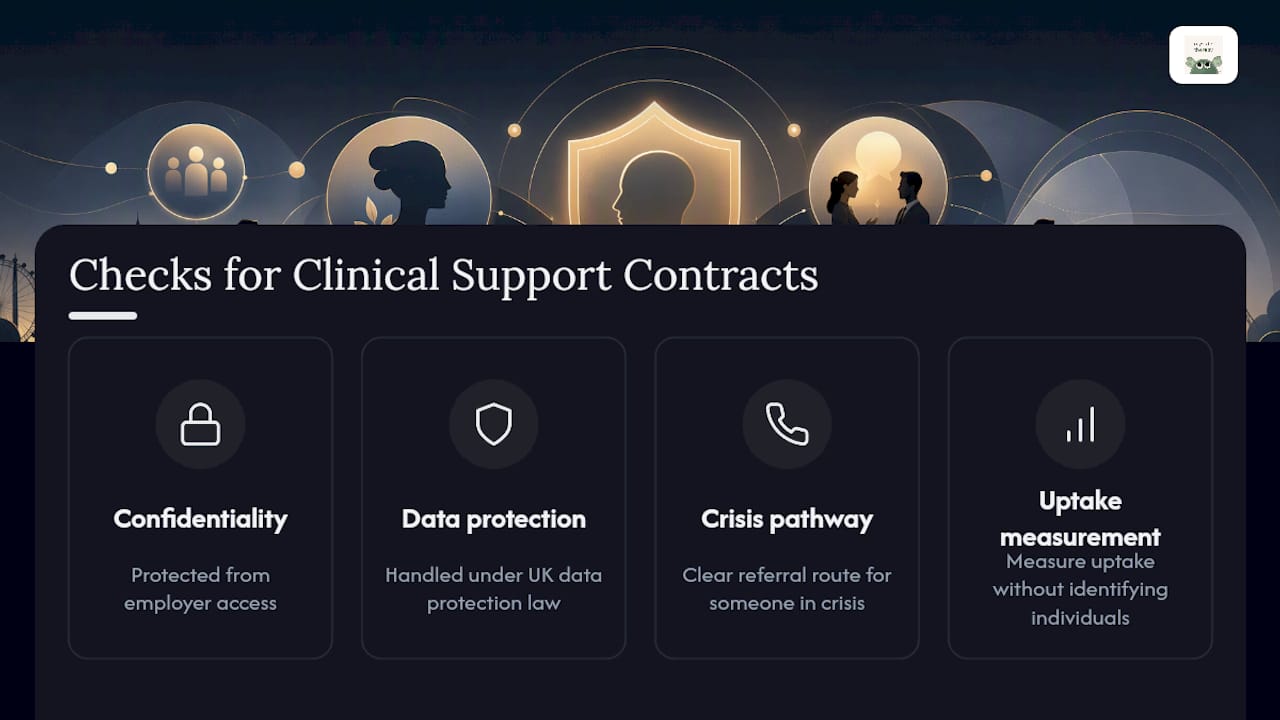
If you're contracting clinical support, check four things: how confidentiality is protected from the employer, how data is handled under UK data protection law, what the referral pathway looks like for someone in crisis, and how you'll measure uptake without identifying individuals. Get those right and therapy as an employee benefit becomes a genuine addition rather than a box-ticking add-on.
Why manager capability matters more than any single perk
The conventional wisdom treats mental health support as a menu of benefits: an app here, a wellbeing day there. That misses the point. A team with a well-trained manager and sensible workloads needs far less clinical intervention than one without, because most distress is preventable, not just treatable. Therapy matters, but it works best as the safety net beneath good work design and confident, well-supported managers, not as a substitute for either.
— MySafeTherapy
Give employees a confidential route to accredited therapy
Employers can offer confidential, accredited therapy services without building an in-house clinical service or committing to a rigid annual contract. Employees can choose their own format, such as video, chat, phone or avatar-based sessions, and have the option to switch therapists freely if the first match isn't right, all without their manager ever knowing who accessed support or why.
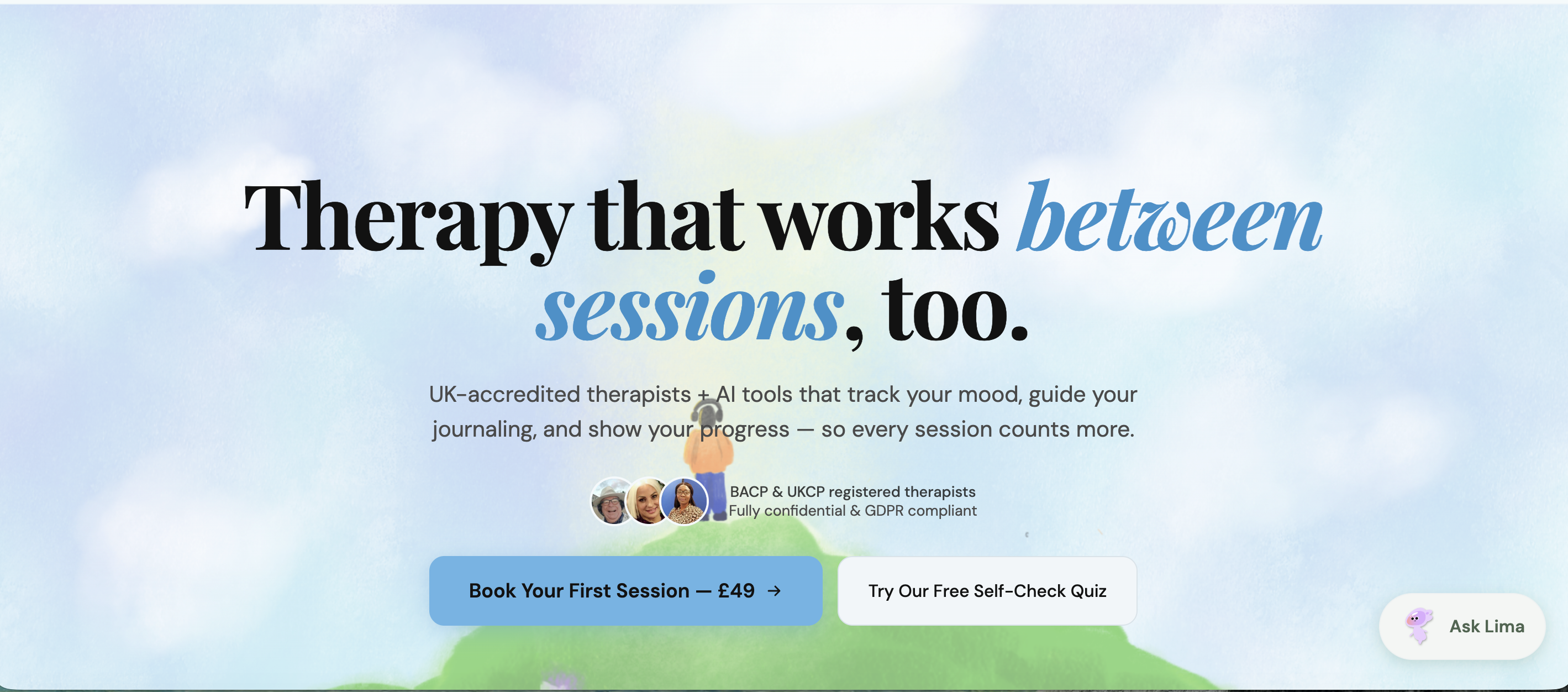
Introducing the benefit is straightforward: most employers position it alongside existing EAP or occupational health provision, framed as an additional confidential option rather than a replacement. Individual sessions start from £50 through the Essential, Standard, Premium and Elite tiers, with transparent one-off pricing rather than opaque bundled fees. If you're ready to explore a workplace arrangement, review current pricing or have your team start with individual therapy sessions directly.
Sources
- HSE stress risk assessment workbook
- Health and Safety at Work etc. Act 1974 — section 2
- Mental health and the law – Supporting mental health at work (Acas)
- The Foundation Reports: Tackling mental health inequalities in the UK (Mental Health Foundation)
- Health and wellbeing at work 2025 (CIPD / Simplyhealth)
This article is general information, not a substitute for advice from a qualified doctor. Consult a qualified healthcare professional about your own circumstances before acting on anything here.
FAQ
How do I deal with an employee who has mental health issues?
Start with a private, supportive conversation focused on listening rather than diagnosing, then agree practical next steps together. Escalate to HR or occupational health if the person discloses a diagnosed condition or needs adjustments beyond your authority, and document what's agreed.
Can I dismiss an employee with mental health issues in the UK?
Dismissing someone purely because of a mental health condition risks breaching the Equality Act 2010 if that condition qualifies as a disability, since employers must first consider reasonable adjustments. Any dismissal process should follow a fair, documented procedure and take occupational health advice before any final decision.
Do I have to disclose mental health to my employer?
There's no general legal requirement for employees to disclose a mental health condition unless it directly affects safety-critical work. Disclosure can, however, unlock support and reasonable adjustments, which is why building trust around confidentiality makes people more willing to come forward.
When should someone take time off work for mental health?
Time off is appropriate when someone's symptoms are affecting their ability to function safely or effectively at work, similar to any other health condition. A GP or occupational health professional can advise on duration, and a phased return plan, rather than an abrupt full-time restart, tends to reduce the risk of relapse.
Does Mysafetherapy offer workplace mental health support?
Mysafetherapy provides UK-accredited therapists across video, chat, phone and avatar-based formats, which employers can offer employees as a confidential support option. Session pricing starts from £50 and full details are available on the pricing page.