

TL;DR:
- Avatar-based therapy uses digital avatars to provide private, remote mental health support without face-to-face contact. It is effective primarily for psychosis and distressing voices, with structured, therapist-led sessions and high anonymity. Ongoing research confirms its benefits, and future developments may expand its application to other mental health conditions.
Therapy does not always require sitting opposite someone in a room, nor does it demand a live video call where every expression is visible. For many UK adults, that visibility is precisely what makes seeking help feel impossible. Avatar-based therapy removes that barrier entirely, offering a structured, clinically developed approach where digital representations stand in for real faces and voices. This guide explains what avatar-based therapy is, how sessions are structured, who it suits, what the research shows, and where the field is headed next.
Table of Contents
- What is avatar-based therapy?
- How does avatar-based therapy work?
- What makes avatar-based therapy unique?
- Evidence and limitations: What does the research show?
- Beyond psychosis: Where might avatar-based therapy go next?
- Why avatar-based therapy changes the rules for mental health access
- Explore secure, flexible therapy options
- Frequently asked questions
Key Takeaways
| Point | Details |
|---|---|
| Digital anonymity | Avatar-based therapy allows private sessions without using your real image or voice for comfort and openness. |
| Effective for voices | Strong evidence shows it helps reduce distressing auditory hallucinations, especially for psychosis. |
| Structured, flexible sessions | Therapy follows a clear programme with options for brief or extended support, designed to fit different needs. |
| Real-world challenges | Some may face technical issues or temporary symptom changes, but NHS support is growing. |
| Future potential | The approach is expanding, with AI avatars promising wider access and uses beyond psychosis. |
What is avatar-based therapy?
Avatar-based therapy uses digital avatars within a mental health treatment setting to help people engage with distressing psychological experiences in a controlled, safe environment. The most established form is AVATAR therapy, a digital intervention specifically designed for distressing auditory verbal hallucinations, commonly described as hearing voices, particularly in psychosis and medication-resistant cases.
The approach was developed and tested in the UK, with significant contributions from King's College London, University College London, and several NHS Trusts. Because the patient interacts through a digital avatar environment, there is no requirement for real-face exposure, making it one of the few therapy formats that genuinely separates identity from participation. This anonymity has practical consequences: people who would otherwise avoid traditional or video-based therapy can access structured support on their own terms.
You can read more about the broader landscape of types of online therapy to see where avatar-based therapy sits alongside other formats.
Core features: Avatar-based therapy vs standard therapy
| Feature | Avatar-based therapy | Standard therapy |
|---|---|---|
| Patient camera required | No | Usually yes |
| Anonymity level | High | Low to moderate |
| Therapist involvement | Mediated via avatar | Direct, face-to-face or video |
| Primary clinical target | Psychosis, auditory hallucinations | Broad range of conditions |
| Format | Digital, structured sessions | In-person, video, or phone |
| Flexibility | Remote, schedule-adaptable | Often fixed clinic times |
Who may consider avatar-based therapy:
- UK adults living with psychosis or distressing voices, particularly where medication has not fully resolved symptoms
- Those who find traditional therapy settings uncomfortable or inaccessible due to anxiety, stigma, or identity concerns
- People seeking remote, digitally structured support without the need to appear on camera
- Individuals whose care teams are exploring medication-resistant or complementary treatment options
- Adults interested in innovative, evidence-based digital mental health formats
How does avatar-based therapy work?
The session structure of AVATAR therapy is precise and methodical. It is not an informal chat through a digital interface. Each element of the programme serves a defined therapeutic purpose, and the process follows a staged clinical pathway.
Here is how a typical programme unfolds:
- Assessment session. The therapist conducts an initial assessment to understand the nature of the voices, including their content, perceived identity, and the distress they cause. This informs everything that follows.
- Avatar creation. The patient and therapist co-create a digital avatar that resembles the voice as the patient perceives it, adjusting appearance and voice modulation to match their experience as closely as possible.
- Trialogue sessions. The therapist voices the avatar in real time, creating a three-way interaction between therapist, patient, and avatar. This structure is called a trialogue. The patient is encouraged to confront and challenge the voice directly.
- CBT-based techniques. Cognitive restructuring, emotion regulation, and graduated exposure are applied throughout. The patient practises responding differently to the voice, shifting from a position of fear to one of greater control.
- Phased progression. Phase 1 focuses on exposure, anxiety reduction, and building empowerment. Phase 2 is more personalised, addressing factors such as trauma history, identity, and relational themes connected to the voice.
- Closing and review. Sessions end with structured reflection, and progress is reviewed across the programme to assess change in voice severity and distress.
Knowing how these sessions are structured can help you feel more confident about starting online therapy in a digital format for the first time.
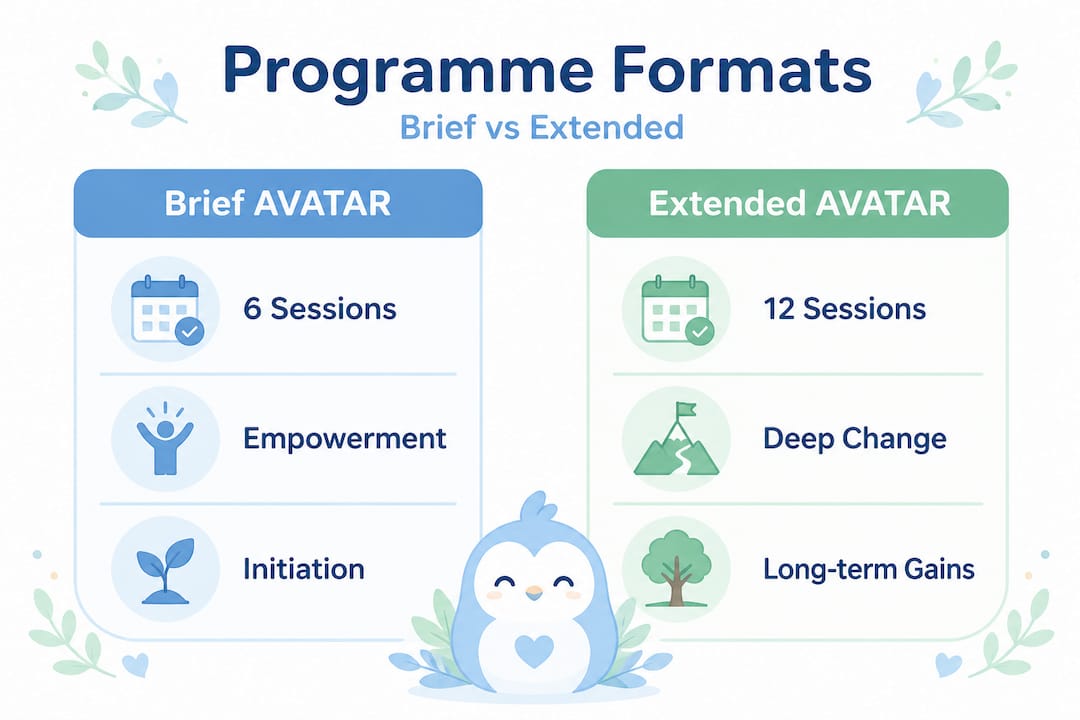
Brief vs extended programme formats
| Format | Number of sessions | Primary focus |
|---|---|---|
| Brief AVATAR | 6 sessions | Exposure, empowerment, initial anxiety reduction |
| Extended AVATAR | Up to 12 sessions | Personalised work, trauma, identity, sustained effects |
Pro Tip: If you are exploring avatar-based therapy, ask your care team or therapist which programme length suits your specific situation. The brief format can produce meaningful results, but extended sessions allow for more personalised, sustained work particularly where trauma or complex identity themes are involved.
What makes avatar-based therapy unique?
Several features separate avatar-based therapy from most other formats currently available in the UK.
Key benefits of avatar-based therapy:
- No camera required for the patient. You interact through the avatar environment, which removes the self-consciousness or fear of being watched that stops many people seeking help.
- Privacy as a structural feature. Anonymity is not a bolt-on option. It is built into the format from the outset, ensuring your real face and voice remain private throughout.
- Remote access. Sessions are delivered digitally, meaning geography, transport limitations, and clinic availability are not barriers to participation.
- Structured and therapist-led. Unlike self-guided apps, AVATAR therapy involves a trained clinician directing the process. That combination of digital delivery and professional oversight distinguishes it from lower-intensity digital tools.
- Potential for AI-powered scaling. Emerging research is exploring AI avatars, which could extend access to a wider UK population without proportionally increasing cost or therapist time.
Avatar-based therapy is ideal for adults seeking innovative mental health support without direct exposure, combining the structure of evidence-based therapy with the protection of a digital, anonymised format.
Pro Tip: The anonymity that avatar-based therapy provides is not just about comfort. It can actively change what you are willing to say. Many people find they disclose more when they feel less exposed. Use that privacy to speak more directly about your experiences than you might in a standard session.
Understanding how privacy works in digital therapy settings is important, and you can find detailed guidance on online therapy safety to know exactly what protections are in place. Those who want to understand how personalised therapy options can be tailored to their specific circumstances will find that digital formats like AVATAR therapy are increasingly accommodating diverse clinical needs.
Evidence and limitations: What does the research show?
The clinical evidence for AVATAR therapy is substantial and continuing to grow. The AVATAR2 randomised controlled trial, conducted across eight UK NHS sites with 345 participants, found both brief and extended formats superior to treatment as usual. One key measure, the PSYRATS-AH scale, which assesses auditory hallucination severity, showed a significant difference of minus 2.97 points in favour of AVATAR therapy. Extended treatment produced sustained effects over follow-up periods. A supporting meta-analysis confirms the therapy's efficacy specifically for auditory hallucination severity. NICE's EVA review has recommended its rollout within NHS settings, subject to ongoing real-world evidence collection.
The AVATAR2 trial represents one of the most robust evaluations of a digital therapy for psychosis in UK clinical history.
However, the evidence also reveals important limitations and nuances that should inform realistic expectations.
Known limitations of avatar-based therapy:
- Temporary symptom worsening. Some patients experience an early increase in distress before improvement. This is a recognised feature of exposure-based approaches but requires careful clinical monitoring.
- Technical failures. Avatar rendering and voice modulation issues occur in a significant proportion of sessions, affecting the therapeutic experience if not managed promptly.
- Therapist skill demands. The real-time voicing of the avatar requires a specific and demanding skill set. Not all therapists are trained or comfortable performing this role, which limits availability.
- Not uniformly superior. Comparisons between screen-based and virtual reality delivery show mixed results in some subgroups, meaning VR versions do not automatically outperform simpler formats.
- Potential trigger risk. For individuals with specific trauma histories or self-harm risks, the confrontational nature of the trialogue requires careful clinical assessment before commencement.
- Protocol variation. Different research groups use slightly differing versions of the therapy, making direct comparisons across studies complex.
Those interested in how digital technology is changing mental health practice more broadly can explore AI in online therapy as a complementary reading.
Beyond psychosis: Where might avatar-based therapy go next?
AVATAR therapy is currently most established for psychosis and distressing voices. But the principles underlying it, using digital avatars to create safe confrontational or reflective therapeutic encounters, are being explored in other clinical areas.
Research into avatar approaches for depression shows promising effects, with one study reporting a large effect size of d=minus 1.19 for challenging dysfunctional beliefs. That is a substantial figure, though the evidence base for depression-specific avatar therapy remains far less developed than for psychosis. More research, replication, and clinical protocol standardisation are needed before it could be considered ready for wide NHS adoption in those contexts.
Areas where avatar-based therapy may have future applications:
- Depression. Using avatars to challenge negative self-beliefs and dysfunctional thought patterns in a low-exposure format.
- Social anxiety. Practising social interactions through avatar environments before attempting them in real-world settings.
- Trauma processing. Using avatars to represent aspects of traumatic memories in a controlled, graduated manner.
- Adolescent mental health. Adapting digital avatar formats for younger populations who are already comfortable with digital environments.
- Accessibility for marginalised groups. Reaching populations who face barriers to standard therapy, including those with mobility limitations, social isolation, or significant stigma concerns.
The barriers to wider adoption are real and substantive. Budget constraints within NHS mental health services, therapist scepticism about voicing distressing content, and the risk of technology becoming outdated before it is properly embedded all pose challenges. Reliable delivery platforms, ongoing therapist training, and clear commissioning pathways are prerequisites for scale.
AI-powered avatars represent one potential solution. If an AI system can deliver parts of the trialogue structure without requiring a trained clinician to voice the avatar in real time, the cost and logistical barriers reduce considerably. Early work in this area is underway, though clinical governance and safety frameworks will need to be robust before AI avatars move into mainstream NHS settings.
Flexible mental health support that responds to the varied needs of UK adults is central to where digital therapy is heading. Avatar-based therapy, in its current and emerging forms, sits firmly within that direction of travel.
Why avatar-based therapy changes the rules for mental health access
Most coverage of avatar-based therapy centres on symptom reduction data. PSYRATS scores, effect sizes, randomised controlled trial results. That data matters. But it does not fully capture what this therapy actually represents for people who have been excluded from conventional mental health support.
Consider who traditional therapy has historically not reached well: adults with severe social anxiety who cannot sustain eye contact in video calls; people whose cultural backgrounds carry significant mental health stigma; individuals who have experienced prior therapeutic relationships that felt exposing or unsafe; those whose voices or experiences are so distressing they cannot articulate them in a standard session without shutting down. For these groups, the barrier was never willingness. It was format.
Avatar-based therapy does not merely offer a digital version of existing therapy. It structurally removes the conditions that make therapy inaccessible for a meaningful proportion of the UK population. That is a different proposition entirely. When you do not have to show your face, when your identity is mediated through a digital representation, when the confrontation happens at a controlled distance, something shifts. People say things. They engage. They progress.
The real social value of this approach lies in that shift. The potential for AI-powered scaling makes this even more significant. Private digital mental health care that is both clinically rigorous and practically accessible is not a contradiction. Avatar-based therapy is demonstrating that the two can coexist. The question now is whether UK commissioning bodies, NHS trusts, and digital health providers will move quickly enough to meet that potential. The technology is ready. The evidence is accumulating. The people who need it are waiting.
Explore secure, flexible therapy options
Avatar-based therapy represents a genuine step forward for digital mental health care in the UK, particularly for those who need privacy, flexibility, and a structured clinical approach. If the idea of anonymised, evidence-based digital therapy resonates with you, or if you are simply looking for a secure way to access support without the pressure of traditional formats, exploring your options now makes sense.
MySafeTherapy connects UK adults with accredited therapists registered with BACP, UKCP, and NCPS, offering a range of session formats including video, chat, and digital options that prioritise your comfort and confidentiality. Whether you want to explore avatar-based approaches or other forms of flexible therapy, you can start therapy at a time and pace that suits you, including evenings and weekends.
Frequently asked questions
Who is avatar-based therapy suitable for?
It is primarily designed for UK adults experiencing distressing voices in psychosis, especially those seeking privacy, or where medication alone has not fully resolved symptoms.
Does avatar-based therapy work for depression or anxiety?
It shows large effects for depression in emerging research, but AVATAR therapy is most clinically established for psychosis, and more evidence is needed for other conditions.
Are avatar-based sessions anonymous?
Yes. Patients interact through digital avatars, and the format means no camera is required for the patient, preserving privacy throughout each session.
What are the risks or side effects?
Possible risks include temporary early worsening of symptoms, technical difficulties during sessions, and the requirement for specifically trained therapists to deliver the therapy safely.
Is avatar-based therapy available through the NHS?
NICE has recommended NHS rollout with ongoing real-world evidence collection, and it is currently available in some UK NHS mental health services.