

Yes, journaling for anxiety works when it's brief and repeated: aim for one 5 to 15 minute session, two or three times a week, using a single prompt rather than a blank page. Pick one calming prompt from the list below, set a timer, and write without stopping. For guided prompts or professional backup, Structured tools alongside accredited therapists are available for guided prompts or professional backup.
TL;DR:
- Short, frequent journaling sessions of 5 to 15 minutes, two to three times a week, can lead to a modest but significant reduction in anxiety symptoms.
- Privacy and timing are critical; use personal, secure methods and space sessions every one or two days to prevent rumination and maximize benefit.
- Structured prompts like positive-affect journaling or grounding techniques are safer for acute anxiety and often more effective than free-form expressive writing.
- If journaling increases anxiety or triggers self-harm thoughts, it should be paused immediately and replaced with structured exercises or professional support.
- Combining journaling with therapist guidance or AI tools enhances pattern recognition and helps tailor methods to specific anxiety types, such as generalized or social anxiety.
Table of Contents
- What does the evidence say about journaling to reduce anxiety?
- How do you start journaling for anxiety without overthinking it?
- Which journaling method actually fits your anxiety?
- Fifteen anxiety journal prompts you can use today
- When journaling makes anxiety worse, and what to do about it
- How does journaling fit into wider anxiety treatment?
- Does journaling need to change for generalised anxiety versus social anxiety?
- Our take: keep it small and keep experimenting
- Getting guided support for your journaling practice
- Sources
What does the evidence say about journaling to reduce anxiety?
A 2022 systematic review and meta-analysis of journaling interventions found a statistically significant reduction in anxiety symptom scores, with roughly a 9% drop in anxiety subgroups compared with control groups. That's a modest effect, not a cure, but it's consistent enough across studies to take seriously.
Key finding: Journaling produced a measurable reduction in anxiety symptoms across multiple trials, with the strongest results linked to short, frequent sessions rather than long, occasional ones.
NHS-backed guidance from the London Waiting Room recommends brief sessions, around 15 minutes a couple of times a week, to lower stress and build resilience over time. That timing isn't arbitrary. A preliminary randomised controlled trial of online positive-affect journaling tested 15 minute sessions three times weekly in medical patients with elevated anxiety symptoms, and found reduced psychological distress and improved well-being compared with baseline.
What does that translate to today? Readers who stick with short sessions tend to report:
- Falling asleep faster because racing thoughts have somewhere to land before bed
- Noticing anxious patterns sooner, rather than being blindsided by them
- Feeling less immediate physical tension after a session, even when the underlying worry hasn't fully resolved
- Building a clearer sense of what actually triggers a spike in anxiety, versus what just feels that way
None of this replaces professional care for moderate to severe anxiety. It's a tool that works best alongside other support, not instead of it.
How do you start journaling for anxiety without overthinking it?
You need almost nothing to begin: paper and a pen, or a private notes app on your phone. If you're using a digital tool, check it isn't backing up to a shared cloud account or syncing to a device other people can access. Privacy matters more than people expect, especially when you're writing about people close to you.
Timing beats intensity. A meta-analytic review of expressive writing found better outcomes when sessions were spaced one to three days apart rather than bunched together or left too infrequent. Set a timer for 5 to 15 minutes. Writing without a time limit tends to spiral into rumination, which works against you.
Here's a simple first-session plan:
- Choose one prompt (see the calming group below if you're anxious right now)
- Rate your anxiety out of 10 before you start
- Set a timer for 8 minutes
- Write without editing, crossing out, or worrying about grammar
- Stop when the timer ends, even mid-sentence
- Write one line summarising what you noticed
- Rate your anxiety out of 10 again
Practitioner guidance from Mersey Care's Write Stuff programme makes a point worth holding onto: the goal is organising your thoughts, not producing something worth reading back. Simple scaffolds and short timers do more work than a blank page and good intentions.
Pro Tip: Keep your journal, pen, and a printed prompt list in the same spot, a bedside drawer, a bag pocket, so starting never depends on remembering where anything is.
Which journaling method actually fits your anxiety?
Not all journaling is the same, and picking the wrong method for your state of mind can backfire.
- Expressive writing means unstructured emotional disclosure, writing freely about whatever is troubling you. It's useful for processing difficult events, but it can raise distress temporarily in acute crises or collective trauma, so it's not the right starting point if you're already overwhelmed.
- Gratitude journaling narrows your focus to a few specific positives each session. It suits low mood and habitual negative thinking better than acute panic.
- Positive-affect journaling (PAJ) uses structured, short sessions, typically 15 minutes, three times a week, and has shown reduced distress in randomised trials of medical patients with elevated anxiety. It's the most evidence-backed structured option for regular use.
- The 3-3-3 method asks you to name three things you see, three sounds you hear, and three body parts you can move. It's a grounding technique rather than a writing exercise, best used when anxiety is spiking and full journaling feels impossible.
Positive, structured writing also helps people who find open disclosure uncomfortable. Research on positive emotional writing found it particularly useful for people with high social inhibition, letting them process feelings without the pressure of talking it through with someone else. If free writing tends to spiral into worst-case scenarios for you, structured prompts are the safer default.
Fifteen anxiety journal prompts you can use today
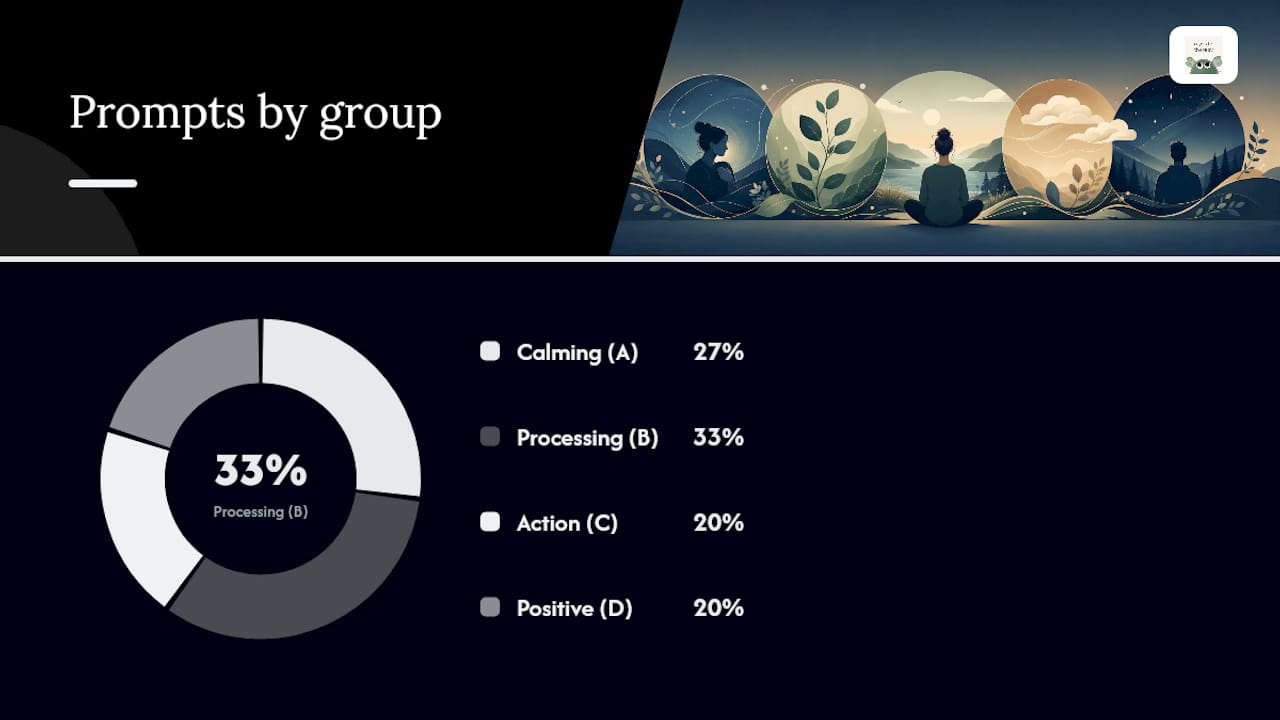
Prompts remove the hardest part of journaling: deciding what to write. Work through one prompt per session rather than trying to answer several at once.
Group A: Calming prompts (for anxiety right now)
- What can I see, hear, and physically feel in this exact moment?
- What is one thing within my control right now, and one thing that isn't?
- If I described this feeling as weather, what would it look like, and is it passing?
- What has helped me get through anxious moments before?
Group B: Processing prompts (for examining triggers safely)
- What happened just before I noticed my anxiety rise today?
- Sussex Mindfulness Centre suggests rewording anxious thoughts in the third person, try "she feels like everything will go wrong" instead of "I am sure everything will go wrong." What shifts when you read it back?
- What's a pattern I've noticed in what sets off my anxiety this month?
- What would I tell a friend who described this exact worry to me?
- Is this thought a fact, or a fear dressed up as one?
Group C: Action-planning prompts (for moving from worry to small steps)
- What is the smallest possible step I could take on this today?
- What has actually happened, versus what I'm afraid might happen?
- Who or what could support me with this, and have I asked yet?
Group D: Positive-affect prompts (for building resilience)
- What went better than expected this week, even slightly?
- What's something my body did well today, regardless of how my mind felt?
- What's one thing I'm looking forward to, however small?
Give each prompt its own timed session rather than rushing through several. If a calming prompt isn't settling you within a few minutes, switch to grounding (Group A, prompt 1) before attempting anything reflective. Rotate through the groups across the week instead of always reaching for the same one; variety keeps the habit from feeling stale, and different groups genuinely serve different moods. For a longer bank of NHS-aligned prompts, Mysafetherapy's guide to journal prompts backed by NHS guidance is worth bookmarking.
When journaling makes anxiety worse, and what to do about it
Expressive writing isn't universally safe. Practitioners caution that unstructured emotional writing can temporarily raise stress in people dealing with acute or collective trauma, and recommend professional oversight for anyone with severe symptoms.
If a session leaves you more agitated than when you started, more than once, that's information, not a failure. It means the format needs to change, not that journaling has failed you.
Watch for these signs that it's time to pause or adjust:
- Anxiety feels worse after several sessions in a row, not just occasionally
- You notice rumination taking over, replaying the same worry without resolution
- Writing brings up thoughts of self-harm or suicidal ideation
If any of that happens, stop free writing immediately and switch to structured, brief prompts, or grounding exercises like the 3-3-3 method. If thoughts of self-harm appear, contact the Samaritans on 116 123 or call 999 in an emergency, and consider booking a therapy session rather than continuing to journal alone.
How does journaling fit into wider anxiety treatment?
Therapists often use journaling as structured homework between sessions, trigger logs, mood ratings, or thought records tied to cognitive behavioural techniques. It's not a replacement for therapy; it's the raw material that makes therapy sessions more productive.
Before a session, skim back through your entries and note:
- Dates and rough times when anxiety spiked
- What was happening just before, not just how you felt
- Any prompt or entry that surprised you, positive or negative
- Whether the same trigger keeps reappearing across the week
A symptom diary template can help structure this if you're preparing for a GP or therapy appointment and want to advocate clearly for what you've noticed.
AI journaling and mood tracking tools that log patterns automatically and can be shared with a matched therapist are available, which suits people who find solo journaling hard to sustain or who want a second layer of accountability beyond their own notebook.
Does journaling need to change for generalised anxiety versus social anxiety?
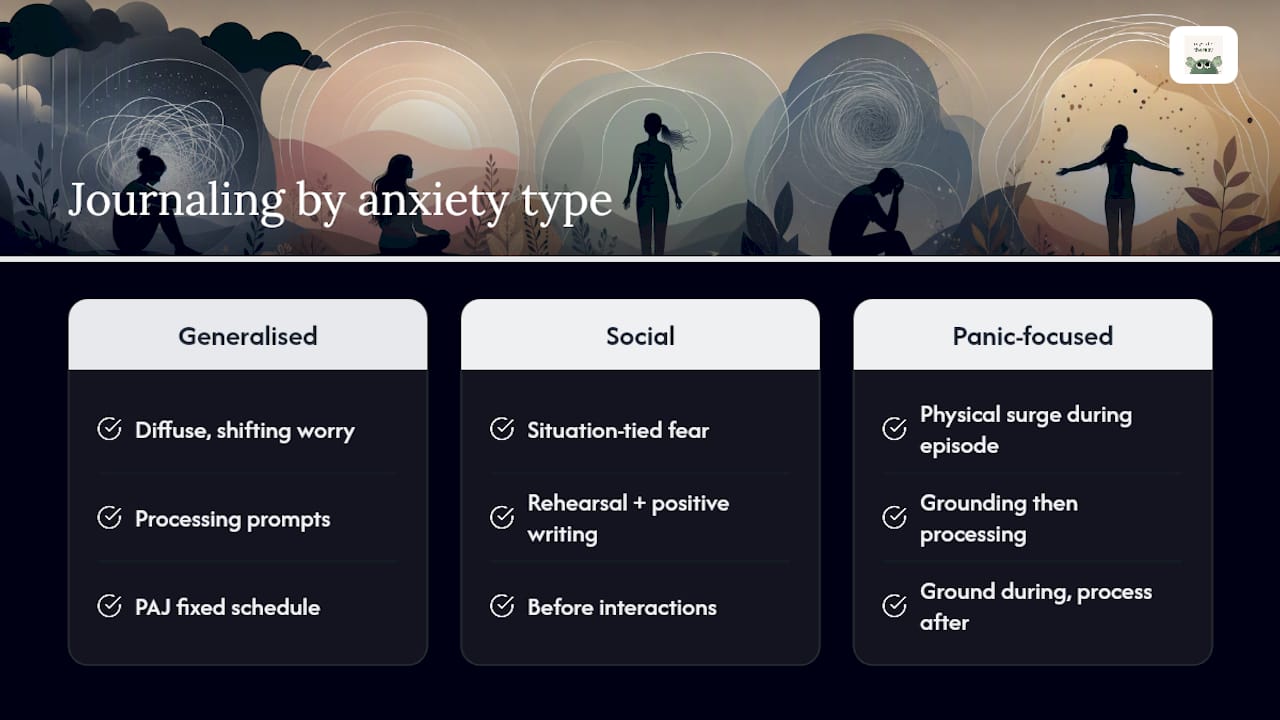
Generalised anxiety disorder tends to produce diffuse, shifting worry, so processing prompts that ask "what happened just before this started" work well, they help separate the anxiety from whatever it's currently attached to. Structured formats like PAJ suit generalised anxiety particularly well, because the fixed schedule counteracts the tendency to worry about everything, indefinitely.
Social anxiety behaves differently. The distress is usually tied to specific situations, being watched, judged, or evaluated, so prompts that rehearse upcoming social situations in writing can reduce anticipatory dread. Try: "What's the worst realistic outcome of this interaction, and what's the most likely one?" Positive emotional writing is particularly useful here, since it lets people process social fears without the pressure of saying them aloud to someone else.
Panic-focused anxiety benefits most from grounding prompts (Group A above) during an episode, then processing prompts afterwards, once the physical surge has passed. Trying to journal analytically mid-panic rarely works; the nervous system needs to settle first. Whatever the diagnosis, the underlying principle holds: match the prompt to the state you're actually in, not the state you wish you were in.
Our take: keep it small and keep experimenting
The biggest mistake people make with journaling for anxiety is treating it like a discipline to master rather than a tool to test. A messy, half-finished entry written in six minutes on a Tuesday does more for you than a beautifully composed page you never get around to writing. Consistency at low intensity beats intensity you can't sustain.
Privacy concerns shouldn't stop you either. A locked notes app, a hidden notebook, or private digital tools all work; what matters is that you feel safe writing honestly. If one prompt or method doesn't suit you, drop it and try another from the groups above. For further evidence-based prompts, Mysafetherapy's guide to journaling for mental health is a solid next stop.
— MySafeTherapy
Getting guided support for your journaling practice
Journaling gives you a private space to process anxiety, but pattern-spotting is easier with a second pair of eyes, and an AI journaling and mood tracking platform is built to add that without forcing you into a rigid weekly commitment. It picks up trends in your entries automatically, so you're not relying on memory to notice what's actually triggering your anxiety.
If you'd rather start there, Mysafetherapy's AI mental health platform pairs journaling with mood tracking that a UK-accredited therapist can review with you. For more direct support, you can book an online therapy session with a BACP, UKCP, or NCPS-registered therapist, choosing video, chat, or avatar-based formats depending on what feels comfortable. Sessions run evenings and weekends, pricing is transparent, and switching therapists is straightforward if the first match isn't right. Start by trying the AI journaling tool this week, then decide whether a therapist-matched session is the right next step for you.
This article is general information, not a substitute for advice from a qualified doctor. Consult a qualified healthcare professional about your own circumstances before acting on anything here.