

If an employee needs to talk, ask them privately, "How are you doing at the moment?" and then listen without interrupting. Only 29% of UK organisations train managers for these conversations, yet trained managers report far higher confidence. Agree next steps together, and know that occupational health, an EAP, or a service like Mysafetherapy can support what happens next.
TL;DR:
- Training managers significantly boosts their confidence (73%) in supporting staff with mental health issues, which in turn reduces informal dissipation and enhances retention.
- Preparing for conversations involves booking a private space, clarifying confidentiality limits, and knowing available support resources like occupational health or EAP.
- Using open, specific questions and active listening helps managers accurately identify staff needs without overstepping or offering clinical diagnoses.
- Follow-up notes should be sent promptly, focusing on practical adjustments and review dates to ensure ongoing support and timely action.
- Instant access to professional therapy via Mysafetherapy helps overcome waitlist delays, with flexible formats designed for discreet, quick support especially effective in high-pressure roles.
Table of Contents
- Why manager mental health conversations matter
- How should you prepare for the conversation?
- What should you actually say in the conversation?
- Which templates make follow-up easier?
- What happens after the meeting?
- How do you avoid overstepping?
- How do you build enough trust for someone to open up?
- Why does stigma still shape these conversations?
- How do you keep mental health support visible year-round?
- Mysafetherapy perspective: how a UK therapy partner complements manager support
- Getting staff faster access to support
- Sources
- FAQ
Why manager mental health conversations matter
Trained managers report 73% confidence in supporting staff with mental ill health, against 57% for those with no training at all, according to CIPD's research. Only a minority of employers actually provide that training, which leaves most managers guessing at exactly the moment an employee needs certainty.
The gap matters because early conversations change outcomes. A manager who notices withdrawal, missed deadlines, or a shift in mood and acts on it can often prevent a short dip becoming long-term absence. CIPD's wider analysis links manager capability directly to retention, engagement, and productivity, treating it as a business investment rather than a soft skill.
Cite these to stakeholders when you need to justify time spent on this:
- Trained managers are notably more confident having sensitive conversations than untrained ones.
- Early, informal conversations reduce the likelihood of formal sickness absence.
- Consistent manager support correlates with better staff retention.
How should you prepare for the conversation?
Preparation decides whether the conversation feels safe or feels like an ambush. Get the practical details right before you say a word.
- Book a private room or a quiet video call with no interruptions, and offer the employee a choice of time rather than summoning them.
- State your confidentiality limits at the outset. You cannot promise total secrecy where there's a risk to health and safety, and HSE's guidance is clear that being upfront about this builds trust rather than breaking it.
- Check what support already exists. Occupational health, an Employee Assistance Programme, and the reasonable-adjustments process should all be on your radar before the meeting, not after.
- Decide whether HR needs to be present or simply informed, and agree how you'll record what's discussed.
Pro Tip: Write your confidentiality line down beforehand. Something like, "This stays between us unless I'm worried about your safety or someone else's, in which case I'd need to tell [named person]" removes the guesswork under pressure.
HSE's talking toolkit exists precisely because most managers have never been shown how to open this kind of meeting. Read it once and the structure sticks.
What should you actually say in the conversation?
Open gently and specifically. "I've noticed you've seemed quieter than usual lately, and I wanted to check how you're doing" works better than "Is everything alright?" because it names what you've observed rather than forcing the employee to guess why you've called them in. For additional mental health resources, managers can access external materials on mental health techniques and self-help to support these conversations.
From there, Acas recommends open, non-judgemental questions and active listening as the two pillars of a supportive conversation. In practice that looks like:
- "How are you finding things at work right now?"
- "Is there anything happening, in or outside work, that's affecting how you're feeling?"
- "What would make things easier for you day to day?"
- "Is there anything you'd like me to do differently as your manager?"
Listen more than you talk. Nod, pause, resist the urge to fill silence, and reflect back what you've heard ("So the deadline pressure and the lack of sleep are feeding each other, is that right?"). Watch for red flags: mentions of hopelessness, statements about not coping, or a marked change in someone usually reliable. These warrant a direct, calm follow-up question rather than avoidance: "When you say you can't see a way through, can you tell me more?"
Focus on work factors you can actually change, not diagnosis. Ask what's making the job harder, not what condition someone might have. If the employee says, "Can this stay just between us?", repeat your confidentiality line from the preparation stage rather than improvising a new promise on the spot.
Trained managers report meaningfully higher confidence handling exactly this kind of exchange than untrained ones, and the difference tends to show in how naturally these questions come out rather than in any single perfect script.
Which templates make follow-up easier?
Copy these directly rather than composing from scratch under time pressure.
- Conversation checklist: private setting booked, confidentiality limits stated, opening question asked, active listening throughout, at least one practical adjustment discussed, next steps agreed aloud.
- Follow-up email structure: thank them for talking, summarise what was discussed in neutral terms, list agreed actions with named owners, set a review date, and confirm who else (if anyone) needs to know and why.
- Wellbeing action plan prompts: What's the specific work trigger? What adjustment addresses it (reduced hours, deadline flexibility, quieter workspace)? Who checks in, and when? What does "better" look like at the review point?
A short written record, as CIPD's manager guide notes, reduces misunderstandings later and protects both sides if questions arise about what was promised.
What happens after the meeting?
Send your follow-up note within a day or two, while details are fresh, and share it only with people who genuinely need it, such as HR or occupational health if adjustments require sign-off.
- Implement adjustments around tasks and working patterns, not around a guessed diagnosis.
- Loop in occupational health or HR where the adjustment needs formal approval or a fit note.
- Set a review date, typically two to four weeks out, and check whether the adjustment is actually helping.
- Escalate immediately, bypassing the usual review cycle, if you hear anything suggesting risk to safety.
Employers carry a duty of care to consider reasonable adjustments even without a formal diagnosis on file, so don't wait for paperwork before acting on what you've already agreed.
Pro Tip: Put the review date in your own calendar, not just the employee's. Follow-up conversations get skipped far more often than opening ones, precisely because the crisis feels resolved once the first meeting is done.
How do you avoid overstepping?
Your job is to support performance and wellbeing at work, not to become a therapist. That line matters more than it sounds.
Ask about work factors: workload, deadlines, team dynamics, working patterns. Don't ask someone to explain a diagnosis, relive a trauma, or justify why they feel the way they feel. If an employee volunteers detail you didn't ask for, thank them for trusting you and gently steer back to what you can practically change. You're not equipped to diagnose, and trying to often does more harm than staying in your lane.
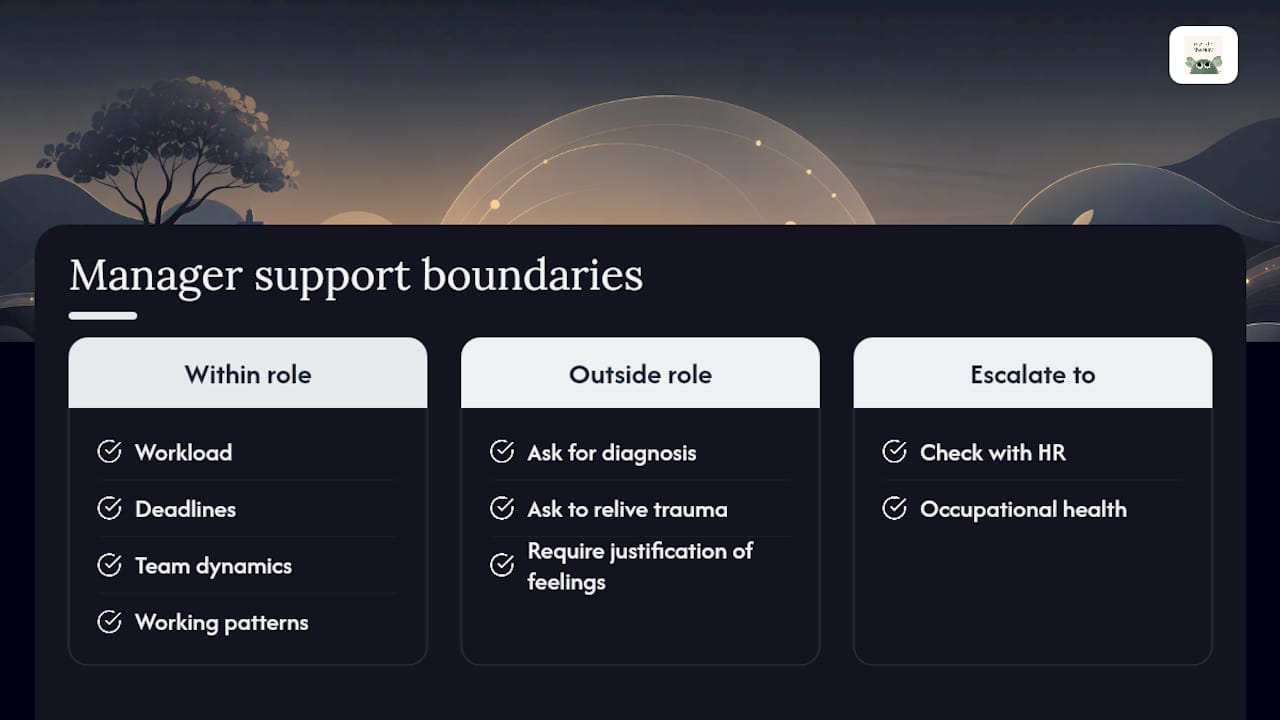
Boundaries run both ways. Be clear about what you can and can't promise, particularly around confidentiality, and be equally clear about what you expect from yourself. If a conversation leaves you unsure how to respond, it's entirely reasonable to say, "I want to make sure I support you properly. Can I check with HR or occupational health and come back to you?" That's not a failure to help; it's the correct next step.
Watch for the opposite mistake too: managers who become so cautious about overstepping that they avoid the conversation entirely. Silence isn't neutral. An employee who's struggling and gets no acknowledgement at all often reads that as indifference. The goal is a conversation that stays within your role while still being genuinely warm, which is a narrower target than most managers assume but entirely achievable with the scripts above.
How do you build enough trust for someone to open up?
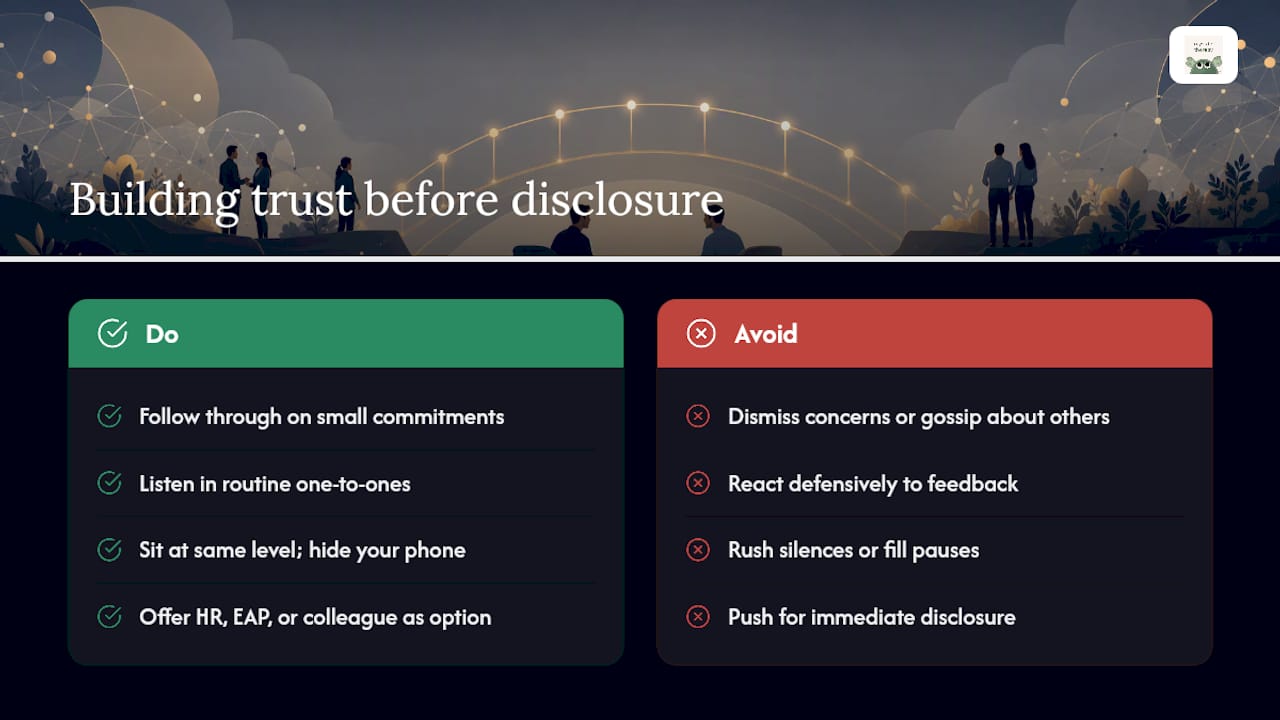
Trust is built long before the difficult conversation happens, through everyday consistency: following through on small commitments, listening properly in routine one-to-ones, and reacting calmly to mistakes.
Employees decide whether to disclose something personal based on how you've behaved in the past, not on how well-intentioned your opening line is on the day. If you've previously dismissed concerns, reacted defensively to feedback, or gossiped about someone else's situation, no amount of careful phrasing will make this conversation feel safe.
Body language and pacing do heavy lifting too. Sit at the same level rather than across a desk, put your phone away entirely, and resist checking the time. Silence after a question isn't a problem to fix; it's often the moment someone is deciding whether to trust you with something real. Rushing to fill it signals impatience, even unintentionally.
If someone is reluctant to talk at all, don't force it. Offering a neutral location, permission to bring a colleague or union representative, or an alternative contact such as HR or the EAP often opens the door further down the line, even when the first attempt goes nowhere. Pushing for disclosure the moment they hesitate tends to close it permanently.
Consistency over time beats a single well-executed meeting. A manager who checks in briefly and genuinely every few weeks, win or lose, builds far more trust than one who only appears when there's a formal reason to.
Why does stigma still shape these conversations?
Stigma doesn't disappear because a company publishes a wellbeing policy. It shows up in the small hesitations: someone using vague language ("just a bit tired") instead of naming what's actually going on, or waiting until performance visibly slips before saying anything.
Cultural background, seniority, and gender all shape how comfortable someone feels disclosing. In some teams and communities, mental health struggles carry a different weight, sometimes framed as personal weakness or something to manage privately rather than raise at work. A manager who assumes everyone will disclose the same way, or expects the same emotional register from every employee, risks misreading silence as fine when it isn't.
The practical response isn't to interrogate someone's background. It's to make the invitation to talk consistently available, low pressure, and repeated, rather than a one-off event. Language matters here too: "How are you finding things?" travels across cultural lines far more safely than a question that assumes a Western therapeutic framing of emotions.
Senior staff disclosing their own experiences, even briefly, tends to shift a team's comfort level faster than any policy document. If a manager has navigated a difficult period and mentions it in passing, without turning it into a big announcement, it quietly signals that this workplace doesn't treat struggle as disqualifying.
How do you keep mental health support visible year-round?
A single good conversation doesn't fix a culture where mental health only gets mentioned during Awareness Week. Ongoing visibility is what actually changes behaviour.
Build small, regular touchpoints into existing routines rather than creating a separate wellbeing programme nobody remembers exists. A line in every one-to-one asking how someone's doing, not just what they've delivered, normalises the topic far more effectively than an annual survey. Make sure every employee actually knows how to reach the EAP, occupational health, or their GP, because awareness of the pathway matters as much as the pathway itself.
Share what's been learned, anonymised and general, when adjustments have genuinely helped someone. It signals that raising a concern leads somewhere useful rather than disappearing into a file. And keep training current: since CIPD found that only 29% of organisations train managers on this at all, simply refreshing that training annually puts a company ahead of most competitors without much additional cost.
For teams working remotely, visibility needs a deliberate substitute for the informal corridor check-in. A structured approach to remote wellbeing helps close that gap, since isolation often hides symptoms that would otherwise be obvious in person.
Mysafetherapy perspective: how a UK therapy partner complements manager support
Managers can open the conversation and agree adjustments, but they aren't clinicians, and pretending otherwise helps nobody. Mysafetherapy connects employees to UK-accredited therapists registered with bodies like BACP and UKCP, with flexible formats including video, chat, and avatar-based sessions for people who find a first disclosure easier without a camera on.
The real value sits in the handoff. A manager identifies the concern and removes the immediate work pressure; a therapist addresses what's underneath it. Neither replaces the other. Therapy doesn't fix a broken adjustment process, and an adjustment doesn't resolve a clinical need for structured support. Get both moving, and they reinforce each other far better than either does alone.
— MySafeTherapy
Getting staff faster access to support
Waitlists are usually the biggest barrier between a manager's good intentions and an employee actually getting help. Mysafetherapy removes that delay by matching staff to a UK-accredited therapist quickly, with sessions available in the evenings and at weekends when a typical nine-to-five EAP referral can't stretch.
For HR teams weighing up whether to pilot this, the pricing page lays out session costs plainly, from Essential through to Elite, with no long waitlist and no obligation to commit to a fixed block of sessions upfront. Staff can switch therapists if the first match isn't right, which can be important when someone has just found the courage to open up once already. For employees in high-pressure or client-facing roles, the therapy for professionals service offers a format built around discretion and flexible scheduling.
If you're a manager who's just had the conversation this article describes, the next step is simple: point the employee toward Mysafetherapy's services page so they can see the formats on offer and book a first session on their own terms, at their own pace.
Sources
For policy detail beyond this guide, consult Acas's guidance on supporting mental health at work, CIPD's health and wellbeing report, the HSE talking toolkit for downloadable templates, and the NHS mental health services directory for clinical entry points to signpost staff toward.
FAQ
How can I talk to my manager about my mental health?
Ask for a private, informal chat and be as specific as you can about what's affecting your work, such as workload or sleep. You don't need a diagnosis to raise it, and a reasonable manager should focus on practical adjustments rather than asking you to explain a clinical label.
What are good topics to raise with my manager about wellbeing?
Workload, deadlines, working pattern, and any specific task that's become harder than usual are all fair ground. You can also raise what kind of check-ins or flexibility would genuinely help, since that gives your manager something concrete to act on.
What are practical tips for maintaining mental health at work?
Regular breaks, realistic workload conversations with your manager, and a consistent sleep routine all make a measurable difference over time. Using a support tool alongside any formal therapy, such as mood tracking or guided journaling through a platform like Mysafetherapy's self-help tools, can help spot patterns between what's happening at work and how you're feeling.
What should a manager do if an employee discloses a mental health problem?
Listen without trying to diagnose, ask what practical adjustment would help most, and agree next steps together before the meeting ends. Follow up in writing within a day or two, and involve occupational health or HR only where the adjustment needs formal sign-off.
How much does therapy through Mysafetherapy cost?
Session prices range from £50 to £75 for Essential, £80 to £110 for Standard, £120 to £180 for Premium, and from £200 for Elite, all listed on the pricing page. A Self-Help subscription with journaling and mood-tracking tools is also available for £14.99 a month.